×
Request Free Sample ×

Kindly complete the form below to receive a free sample of this Report

* Please use a valid business email

Leading companies partner with us for data-driven Insights

clients tt-cursor
Hero Background

South Korea Smart Toys Market

ID: MRFR/ICT/60970-HCR
200 Pages
Aarti Dhapte
February 2026

South Korea Smart Toys Market Research Report By Type (Robots, Interactive Games, Educational Robots), By Technology (Wi-Fi, Bluetooth, RFID or NFC), By Distribution Channel (Online/Ecommerce Stores, Specialty Stores, Toy Shops) and By End-user (Toddlers, Pre-schoolers, School-going, Stripling)-Forecast to 2035

Share:
Download PDF ×

We do not share your information with anyone. However, we may send you emails based on your report interest from time to time. You may contact us at any time to opt-out.

South Korea Smart Toys Market Infographic
Purchase Options

South Korea Smart Toys Market Summary

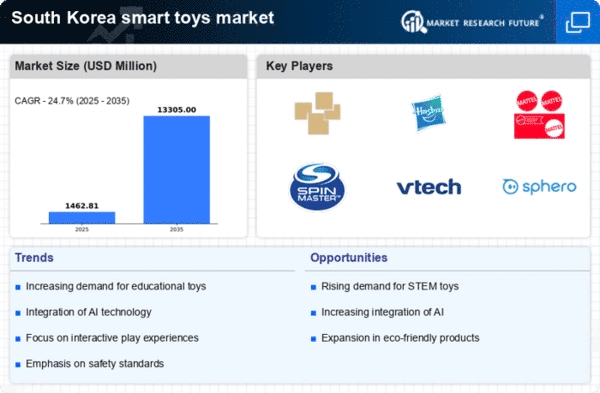
As per Market Research Future analysis, the South Korea smart toys market size was estimated at 1173.06 USD Million in 2024. The South Korea smart toys market is projected to grow from 1462.81 USD Million in 2025 to 13305.0 USD Million by 2035, exhibiting a compound annual growth rate (CAGR) of 24% during the forecast period 2025 - 2035

Key Market Trends & Highlights

The South Korea smart toys market is experiencing robust growth driven by technological advancements and changing consumer preferences.

  • The largest segment in the South Korea smart toys market is interactive learning toys, which are gaining traction among parents.
  • The fastest-growing segment is connected toys, reflecting the increasing integration of technology in play.
  • Online shopping is expanding rapidly, with consumers preferring the convenience of purchasing smart toys digitally.
  • Key market drivers include rising demand for interactive learning and increased parental investment in child development.

Market Size & Forecast

2024 Market Size 1173.06 (USD Million)
2035 Market Size 13305.0 (USD Million)
CAGR (2025 - 2035) 24.7%

Major Players

LEGO Group (DK), Hasbro Inc (US), Mattel Inc (US), Spin Master Corp (CA), VTech Holdings Ltd (HK), Sphero Inc (US), Fisher-Price (US), Nerf (US)

Our Impact
Enabled $4.3B Revenue Impact for Fortune 500 and Leading Multinationals
Partnering with 2000+ Global Organizations Each Year
30K+ Citations by Top-Tier Firms in the Industry

South Korea Smart Toys Market Trends

the smart toys market in South Korea is evolving dynamically, driven by technological advancements and changing consumer preferences. The integration of artificial intelligence and interactive features into toys has captured the attention of both children and parents. This trend reflects a growing demand for educational and engaging products that not only entertain but also promote learning and development. As a result, manufacturers are increasingly focusing on creating innovative solutions that cater to the needs of modern families. Furthermore, the rise of digital platforms and online shopping has transformed the way consumers access and purchase smart toys, leading to a more competitive landscape. In addition, sustainability has emerged as a key consideration within the smart toys market. Consumers are becoming more conscious of the environmental impact of their purchases, prompting companies to adopt eco-friendly materials and production processes. This shift towards sustainability is likely to influence product design and marketing strategies in the coming years. Overall, the smart toys market in South Korea is poised for continued growth., with a focus on innovation, sustainability, and enhanced consumer engagement.

Technological Integration

The incorporation of advanced technologies such as AI and IoT into toys is reshaping the smart toys market. These innovations enhance interactivity and learning experiences, appealing to tech-savvy parents and children alike.

Sustainability Focus

There is a noticeable shift towards eco-friendly practices within the smart toys market. Companies are increasingly prioritizing sustainable materials and production methods, responding to consumer demand for environmentally responsible products.

Online Shopping Growth

The rise of e-commerce platforms is significantly impacting the smart toys market. Consumers are increasingly turning to online channels for purchasing, leading to a more diverse range of products and competitive pricing.

South Korea Smart Toys Market Drivers

Focus on Safety and Quality Standards

Safety and quality standards are paramount in the smart toys market in South Korea. With heightened awareness regarding child safety, parents are increasingly scrutinizing the materials and manufacturing processes of toys. Regulatory bodies are enforcing stricter guidelines to ensure that smart toys meet safety requirements. This focus on safety is influencing purchasing decisions, as parents prefer brands that prioritize high-quality materials and rigorous testing. Consequently, manufacturers are investing in research and development to enhance product safety features. This emphasis on safety not only builds consumer trust but also contributes to the overall growth and sustainability of the smart toys market.

Rising Demand for Interactive Learning

the smart toys market in South Korea is experiencing a notable increase in demand for interactive learning tools.. Parents are increasingly seeking educational toys that promote cognitive development and engagement. This trend is driven by a growing awareness of the importance of early childhood education. According to recent data, the market for educational toys is projected to grow at a CAGR of 10% over the next five years. Smart toys that incorporate augmented reality and artificial intelligence are particularly appealing, as they offer personalized learning experiences. This shift towards interactive learning solutions is reshaping the smart toys market, as manufacturers innovate to meet the evolving needs of parents and children alike.

Growing Popularity of Connected Devices

The proliferation of connected devices in South Korea is influencing the smart toys market. As households become increasingly equipped with smart home technology, toys that can connect to these devices are gaining traction. This trend is characterized by toys that can be controlled via smartphones or integrated with home assistants. The convenience and interactivity offered by connected toys are appealing to tech-savvy parents. Market analysis suggests that the segment of connected toys is expected to grow by 15% annually, reflecting a shift towards more integrated play experiences. This growing popularity is likely to drive innovation and competition within the smart toys market.

Technological Advancements in Toy Design

Technological advancements play a crucial role in shaping the smart toys market in South Korea. Innovations such as artificial intelligence, machine learning, and IoT integration are transforming traditional toys into interactive experiences. For instance, toys that can adapt to a child's learning pace or provide real-time feedback are gaining popularity. The market is witnessing a surge in products that utilize voice recognition and responsive features, enhancing user engagement. As a result, the smart toys market is expected to expand significantly, with projections indicating a potential market size of $1 billion by 2027. This technological evolution is likely to attract both consumers and investors, further driving growth.

Increased Parental Investment in Child Development

In South Korea, there is a marked increase in parental investment in child development, which significantly impacts the smart toys market. Parents are prioritizing products that not only entertain but also contribute to their children's growth and learning. This trend is reflected in the rising sales of smart toys that offer educational content and developmental benefits. Recent statistics indicate that 65% of parents are willing to spend more on toys that promote STEM learning. This shift in consumer behavior is prompting manufacturers to focus on creating innovative products that align with educational goals, thereby enhancing the overall appeal of the smart toys market.


Market Segment Insights

By Type: Robots (Largest) vs. Interactive Games (Fastest-Growing)

In the South Korea smart toys market, the distribution of market share among segment values indicates that Robots hold the largest portion, appealing to consumers with their sophisticated technology and interactive features. Educational Robots are also gaining traction but are overshadowed by the popularity of Robotics. Interactive Games, while currently a smaller segment, are rapidly increasing in popularity due to their engaging nature and the integration of advanced technology. The growth trends in this segment are driven by innovations in technology, increasing consumer demand for interactive and educational experiences, and a strong push from manufacturers to enhance product features. As parents seek toys that not only entertain but also educate, the market for Educational Robots grows. Similarly, the rise of gamified learning fuels the expansion of Interactive Games, making them the fastest-growing segment in this market.

Robots: Dominant vs. Interactive Games: Emerging

Robots have established themselves as the dominant force in the South Korea smart toys market, characterized by their advanced capabilities and appeal to both children and parents alike. These toys often incorporate AI and machine learning, allowing for interactive play experiences that enhance learning and creativity. In contrast, Interactive Games represent an emerging segment focused on gamified learning methodologies, capturing the attention of tech-savvy youngsters. They encourage active participation and critical thinking through engaging formats. While Robots dominate market shares, Interactive Games are on a swift upward trajectory, driven by technological innovations and changing consumer preferences towards educational entertainment.

By Technology: Wi-Fi (Largest) vs. Bluetooth (Fastest-Growing)

In the South Korea smart toys market, Wi-Fi technology has established itself as the largest segment, widely adopted for its ability to provide robust connectivity features. This segment benefits from the increasing trend of interactive and cloud-connected toys, enabling real-time updates and remote access. Conversely, Bluetooth technology is rapidly gaining traction, recognized as the fastest-growing segment due to its ease of use and energy efficiency, making it a preferred choice for various smart toys. The growth trends in the technology segment are driven by the rising demand for connected play experiences among younger audiences. As parents seek toys that offer educational content and interactive capabilities, both Wi-Fi and Bluetooth technologies are essential. The advancements in battery technology and mobile connectivity solutions also support this growth, making smart toys more appealing and versatile in the market.

Technology: Wi-Fi (Dominant) vs. Bluetooth (Emerging)

Wi-Fi technology stands out as the dominant force in the South Korea smart toys market, facilitating seamless connectivity and enabling functionalities like cloud data synchronization and remote control. This segment caters to consumers desiring advanced toy interactions, making it popular among tech-savvy parents. On the other hand, Bluetooth technology is marked as emerging, characterized by its simplicity and energy-efficient connectivity. It appeals to a demographic looking for convenience and affordability, often seen in everyday playthings. The rising popularity of mobile apps for smart toys bolsters Bluetooth's position, allowing for easy pairing and extended functionalities, which complements its growth as a crucial player in the smart toy ecosystem.

By Distribution Channel: Online/E-commerce Stores (Largest) vs. Specialty Stores (Fastest-Growing)

The South Korea smart toys market exhibits a diverse distribution channel landscape, with Online/E-commerce Stores capturing the largest market share due to their convenience and growing consumer preference for internet shopping. Specialty Stores also hold a significant position, known for their curated selections and expert staff that cater to specific customer needs. Toy Shops, while traditional, continue to play a role in the market, especially in localized areas. Growth trends in the distribution channels are heavily influenced by evolving consumer behavior and technological advancements. Online/E-commerce Stores are rapidly expanding as more consumers seek the ease of online shopping, spurred by increased internet penetration and the popularity of mobile shopping. Meanwhile, Specialty Stores are becoming increasingly relevant, focusing on unique offerings and experiences that differentiate them from larger retailers, thus experiencing notable growth in recent years.

Online/E-commerce Stores (Dominant) vs. Toy Shops (Emerging)

Online/E-commerce Stores have established themselves as the dominant distribution channel in the South Korea smart toys market, offering vast selections and the convenience of home delivery. These platforms leverage advanced digital marketing and user-friendly interfaces that appeal to tech-savvy parents. In contrast, Toy Shops are positioned as an emerging channel, attracting customers with their tangible shopping experience and personalized service. Though their market presence is smaller compared to online stores, Toy Shops are innovating by enhancing in-store experiences, focusing on community engagement and specialized products that cater to niche audiences seeking unique toys.

By End-user: School-going (Largest) vs. Preschoolers (Fastest-Growing)

In the South Korea smart toys market, the distribution of market share among different end-user segments reveals that school-going children form the largest group due to their increasing engagement with educational toys that promote learning and development. Meanwhile, preschoolers represent a significant portion of the market, thanks to their early introduction to smart toys that enhance playtime through interactive features and educational content. Growth trends indicate a sharp increase in demand for smart toys among preschoolers, as parents are more inclined to invest in toys that stimulate cognitive development. The rising awareness about the benefits of tech-enabled educational toys is driving this segment's expansion. Additionally, innovative toy designs and features tailored to preschoolers are contributing to their status as the fastest-growing segment in the market.

Toddlers (Dominant) vs. Stripling (Emerging)

In the South Korea smart toys market, toddlers represent a dominant segment, characterized by their high level of interaction with toys that combine entertainment and learning. These toys often include features that promote sensory exploration and basic cognitive skills, making them appealing to parents. Conversely, stripling is emerging as a segment driven by the demand for advanced technological toys that cater to older children's interests, incorporating elements like coding and robotics. The innovation in smart toy designs for stripling is responding to their preference for engaging and educational experiences, which are becoming essential in nurturing their developmental needs.

Get more detailed insights about South Korea Smart Toys Market

Key Players and Competitive Insights

the smart toys market in South Korea has a dynamic competitive landscape, driven by rapid technological advancements and evolving consumer preferences.. Key players such as LEGO Group (DK), Hasbro Inc (US), and Spin Master Corp (CA) are at the forefront, each adopting distinct strategies to enhance their market presence. LEGO Group (DK) emphasizes innovation through its integration of augmented reality (AR) into its product lines, aiming to create immersive play experiences. Meanwhile, Hasbro Inc (US) focuses on expanding its digital offerings, leveraging partnerships with tech firms to enhance its smart toy portfolio. Spin Master Corp (CA) appears to be concentrating on sustainability, introducing eco-friendly materials in its manufacturing processes, which resonates well with environmentally conscious consumers. Collectively, these strategies contribute to a competitive environment that is increasingly centered around technological integration and consumer engagement.In terms of business tactics, companies are localizing manufacturing to reduce costs and improve supply chain efficiency. This approach is particularly relevant in a moderately fragmented market where smaller players also vie for consumer attention. The competitive structure is influenced by the collective actions of these key players, who are not only innovating but also optimizing their operations to maintain a competitive edge.

In October LEGO Group (DK) launched a new line of smart toys that incorporate AR technology, allowing children to interact with their physical toys in a digital environment. This strategic move is significant as it positions LEGO at the intersection of physical and digital play, potentially attracting a broader audience and enhancing user engagement. The introduction of AR features may also set a new standard in the industry, compelling competitors to innovate similarly.

In September Hasbro Inc (US) announced a partnership with a leading AI firm to develop interactive smart toys that adapt to children's learning styles. This collaboration is crucial as it not only enhances Hasbro's product offerings but also aligns with the growing trend of personalized learning experiences. By integrating AI, Hasbro is likely to improve customer satisfaction and loyalty, thereby strengthening its market position.

In August Spin Master Corp (CA) unveiled its commitment to sustainability by pledging to use 100% recyclable materials in its packaging by 2026. This initiative reflects a broader industry trend towards environmental responsibility and may appeal to a growing demographic of eco-conscious consumers. Spin Master's proactive approach could enhance its brand image and differentiate it from competitors who may not prioritize sustainability.

As of November the competitive trends in the smart toys market are increasingly defined by digitalization, sustainability, and the integration of AI technologies. Strategic alliances are becoming more prevalent, as companies recognize the value of collaboration in enhancing innovation and market reach. Looking ahead, competitive differentiation is likely to evolve from traditional price-based strategies to a focus on technological innovation, product quality, and supply chain reliability. This shift suggests that companies must continuously adapt to maintain relevance in a rapidly changing market.

Key Companies in the South Korea Smart Toys Market include

Industry Developments

The South Korea Smart Toys Market has seen significant developments recently, particularly with key players such as Samsung Electronics and LG Electronics enhancing their product offerings in the sector. This shift aligns with the increasing demand for interactive learning tools among parents, as more households transition to smart home environments.

In terms of mergers and acquisitions, in July 2023, VTech Holdings announced its acquisition of Goldi Technology, aiming to leverage their innovative toy designs for AI-powered educational solutions. Such movements reflect a broader trend in the Smart Toys Market, where companies strive for a competitive edge through technological integration.

Additionally, the market has experienced a steady growth valuation with estimates suggesting an increase from 1.2 USD Billion in 2021 to 1.7 USD Billion in 2023, propelled by increased consumer interest in digital learning and interactive play. This growth is shaping the development and marketing strategies of major companies who are actively investing in R&D for smart toys.

Future Outlook

South Korea Smart Toys Market Future Outlook

The Smart Toys Market is projected to grow at a 24.7% CAGR from 2025 to 2035, driven by technological advancements, increased consumer demand, and educational benefits.

New opportunities lie in:

  • Development of AI-driven interactive learning platforms for children.
  • Expansion of subscription-based models for smart toy content updates.
  • Partnerships with educational institutions for curriculum-integrated smart toys.

By 2035, the smart toys market is expected to achieve substantial growth and innovation.

Market Segmentation

South Korea Smart Toys Market Type Outlook

  • Robots
  • Interactive Games
  • Educational Robots

South Korea Smart Toys Market End-user Outlook

  • Toddlers
  • Preschoolers
  • School-going
  • Stripling

South Korea Smart Toys Market Technology Outlook

  • Wi-Fi
  • Bluetooth
  • RFID or NFC

South Korea Smart Toys Market Distribution Channel Outlook

  • Online/E-commerce Stores
  • Specialty Stores
  • Toy Shops

Report Scope

MARKET SIZE 2024 1173.06(USD Million)
MARKET SIZE 2025 1462.81(USD Million)
MARKET SIZE 2035 13305.0(USD Million)
COMPOUND ANNUAL GROWTH RATE (CAGR) 24.7% (2025 - 2035)
REPORT COVERAGE Revenue Forecast, Competitive Landscape, Growth Factors, and Trends
BASE YEAR 2024
Market Forecast Period 2025 - 2035
Historical Data 2019 - 2024
Market Forecast Units USD Million
Key Companies Profiled LEGO Group (DK), Hasbro Inc (US), Mattel Inc (US), Spin Master Corp (CA), VTech Holdings Ltd (HK), Sphero Inc (US), Fisher-Price (US), Nerf (US)
Segments Covered Type, Technology, Distribution Channel, End-user
Key Market Opportunities Integration of artificial intelligence and interactive features enhances engagement in the smart toys market.
Key Market Dynamics Rising consumer demand for interactive features drives innovation in the smart toys market.

Countries Covered South Korea
Leave a Comment

FAQs

What is the expected market size of the South Korea Smart Toys Market in 2024?

The South Korea Smart Toys Market is expected to be valued at 1.3 billion USD in 2024.

What is the projected market size for the South Korea Smart Toys Market by 2035?

By 2035, the South Korea Smart Toys Market is projected to reach a value of 7.0 billion USD.

What is the expected CAGR for the South Korea Smart Toys Market from 2025 to 2035?

The expected CAGR for the South Korea Smart Toys Market from 2025 to 2035 is 16.538%.

Which segment accounts for the largest share in the South Korea Smart Toys Market?

The Robots segment is expected to grow significantly, valued at 0.5 billion USD in 2024 and projected to reach 2.5 billion USD by 2035.

What market value is projected for Interactive Games in the South Korea Smart Toys Market by 2035?

The Interactive Games segment is projected to grow from 0.4 billion USD in 2024 to 2.2 billion USD by 2035.

What is the expected market size for Educational Robots in 2035?

The Educational Robots segment is expected to reach a market size of 2.3 billion USD by 2035.

Who are the major players in the South Korea Smart Toys Market?

Key players include Samsung Electronics, SK Telecom, VTech Holdings, and LG Electronics among others.

What opportunities exist in the South Korea Smart Toys Market?

The market is witnessing trends such as increasing demand for interactive and educational toys, creating numerous growth opportunities.

What challenges might affect the growth of the South Korea Smart Toys Market?

Challenges may include competition from traditional toys and the need for continuous technological advancement.

How does the South Korea Smart Toys Market compare to global market trends?

The South Korea Smart Toys Market is experiencing rapid growth, consistent with global trends towards smart and interactive play-based learning.

Download Free Sample

Kindly complete the form below to receive a free sample of this Report

Compare Licence

×
Features License Type
Single User Multiuser License Enterprise User
Price $4,950 $5,950 $7,250
Maximum User Access Limit 1 User Upto 10 Users Unrestricted Access Throughout the Organization
Free Customization
Direct Access to Analyst
Deliverable Format
Platform Access
Discount on Next Purchase 10% 15% 15%
Printable Versions