×
Request Free Sample ×

Kindly complete the form below to receive a free sample of this Report

* Please use a valid business email

Leading companies partner with us for data-driven Insights

clients tt-cursor
Hero Background

UK Self Checkout In Retail Market

ID: MRFR/ICT/56439-HCR
200 Pages
Aarti Dhapte
February 2026

UK Self-Checkout in Retail Market Size, Share and Trends Analysis Report By Application (Grocery Stores, Convenience Stores, Pharmacies, Department Stores), By Type (Standalone Machines, Integrated Solutions), By Payment Method (Cash, Credit Card, Debit Card, Mobile Payment) and By End Use (Retail, Hospitality, Entertainment)- Forecast to 2035

Share:
Download PDF ×

We do not share your information with anyone. However, we may send you emails based on your report interest from time to time. You may contact us at any time to opt-out.

UK Self Checkout In Retail Market Infographic
Purchase Options

UK Self Checkout In Retail Market Summary

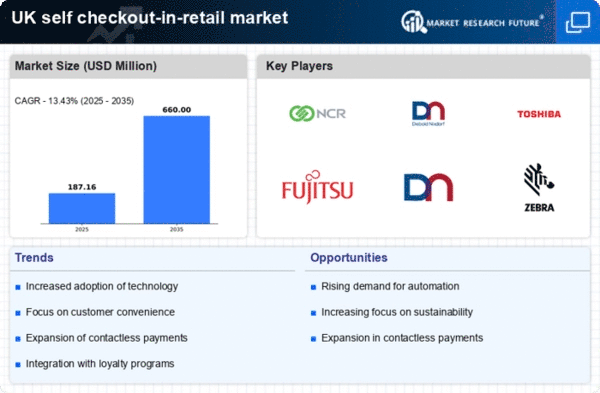
As per Market Research Future analysis, the UK Self Checkout In Retail Market size was estimated at 165.0 USD Million in 2024. The Self Checkout-in-retail market is projected to grow from 187.16 USD Million in 2025 to 660.0 USD Million by 2035, exhibiting a compound annual growth rate (CAGR) of 13.4% during the forecast period 2025 - 2035

Key Market Trends & Highlights

The UK self checkout-in-retail market is experiencing a robust shift towards technological integration and consumer autonomy.

  • Technological integration is reshaping the self checkout landscape, enhancing user experience and operational efficiency.
  • Consumer preference for autonomy is driving the adoption of self checkout systems, particularly among younger demographics.
  • The rise of contactless payments is facilitating quicker transactions, appealing to consumers seeking convenience.
  • Increased operational efficiency and consumer demand for convenience are major drivers propelling market growth in the UK self checkout sector.

Market Size & Forecast

2024 Market Size 165.0 (USD Million)
2035 Market Size 660.0 (USD Million)
CAGR (2025 - 2035) 13.43%

Major Players

NCR Corporation (US), Diebold Nixdorf (US), Toshiba Global Commerce Solutions (US), Fujitsu (JP), Wincor Nixdorf (DE), Zebra Technologies (US), Sato Holdings Corporation (JP), Aldelo (US)

Our Impact
Enabled $4.3B Revenue Impact for Fortune 500 and Leading Multinationals
Partnering with 2000+ Global Organizations Each Year
30K+ Citations by Top-Tier Firms in the Industry

UK Self Checkout In Retail Market Trends

The UK Self Checkout In Retail Market is experiencing notable evolution, driven by technological advancements and changing consumer preferences. Retailers are increasingly adopting self-service solutions to enhance operational efficiency and reduce labor costs. This shift appears to be influenced by a growing demand for convenience, as consumers seek quicker and more autonomous shopping experiences. The integration of advanced technologies, such as artificial intelligence and mobile payment systems, is likely to further streamline the checkout process, making it more user-friendly and efficient. Moreover, the self checkout-in-retail market is witnessing a rise in the adoption of contactless payment methods, which aligns with consumer preferences for speed and safety. Retailers are investing in modernizing their checkout systems to accommodate these trends, potentially leading to increased customer satisfaction and loyalty. As the market continues to evolve, it seems that the focus will remain on enhancing the shopping experience through innovative solutions, ultimately reshaping the retail landscape in the UK.

Technological Integration

The self checkout-in-retail market is increasingly characterized by the integration of advanced technologies. Retailers are adopting systems that utilize artificial intelligence and machine learning to improve the efficiency of checkout processes. This technological shift not only enhances operational capabilities but also provides a more personalized shopping experience for consumers.

Consumer Preference for Autonomy

There is a noticeable trend towards consumer preference for autonomy in shopping experiences. Shoppers are gravitating towards self-service options that allow them to control their purchasing process. This shift indicates a desire for convenience and speed, prompting retailers to expand their self checkout offerings.

Rise of Contactless Payments

The self checkout-in-retail market is witnessing a significant rise in the adoption of contactless payment methods. This trend aligns with consumer expectations for quick and secure transactions. Retailers are increasingly implementing these payment solutions to meet the demand for efficiency and enhance the overall shopping experience.

UK Self Checkout In Retail Market Drivers

Cost Reduction Strategies

Cost management remains a pivotal driver in the self checkout-in-retail market. Retailers are increasingly recognizing the potential for significant cost savings through the implementation of self checkout systems. By reducing the number of staff required at checkout points, businesses can lower labor costs, which can account for a substantial portion of operational expenses. Reports indicate that retailers can save up to £100,000 annually by transitioning to self checkout solutions. This financial incentive is compelling, particularly for smaller retailers looking to remain competitive. Consequently, the self checkout-in-retail market is poised for growth as more retailers adopt these cost-effective solutions.

Consumer Demand for Convenience

The self checkout-in-retail market is significantly influenced by the growing consumer demand for convenience. Shoppers increasingly prefer quick and efficient shopping experiences, which self checkout systems provide. Data suggests that approximately 60% of consumers in the UK express a preference for self checkout options, valuing the ability to complete transactions at their own pace. This trend is particularly evident among younger demographics, who are more inclined to embrace technology in their shopping habits. As retailers respond to this demand by expanding their self checkout offerings, the market is likely to witness sustained growth, driven by the desire for convenience and efficiency.

Increased Operational Efficiency

The self checkout-in-retail market is experiencing a notable shift towards enhanced operational efficiency. Retailers are increasingly adopting self checkout systems to streamline their checkout processes, thereby reducing wait times and improving customer satisfaction. According to recent data, retailers that implemented self checkout solutions reported a reduction in checkout times by up to 30%. This efficiency not only benefits customers but also allows staff to focus on other critical areas of the store, such as inventory management and customer service. As a result, the self checkout-in-retail market is likely to see continued growth as businesses seek to optimize their operations and enhance the overall shopping experience.

Integration of Advanced Technologies

The self checkout-in-retail market is being propelled by the integration of advanced technologies such as artificial intelligence (AI) and machine learning. These technologies enhance the functionality of self checkout systems, enabling features like automated age verification and personalized shopping experiences. Retailers are increasingly investing in these innovations to improve security and customer engagement. For instance, AI-driven systems can analyze shopping patterns and suggest products, thereby enhancing the shopping experience. As these technologies become more prevalent, the self checkout-in-retail market is expected to evolve, offering more sophisticated solutions that cater to the needs of modern consumers.

Regulatory Compliance and Safety Standards

The self checkout-in-retail market is also shaped by the need for compliance with regulatory standards and safety protocols. Retailers must ensure that their self checkout systems adhere to various regulations, including data protection and consumer safety laws. This compliance is crucial for maintaining customer trust and avoiding potential legal issues. As regulations evolve, retailers are likely to invest in self checkout technologies that not only meet these standards but also enhance security features, such as secure payment processing and data encryption. This focus on compliance is expected to drive innovation within the self checkout-in-retail market, as businesses seek to align with regulatory requirements while providing a seamless shopping experience.


Market Segment Insights

By Application: Grocery Stores (Largest) vs. Convenience Stores (Fastest-Growing)

In the UK self checkout-in-retail market, grocery stores capture the largest market share, driven by their high transaction volumes and consumer preference for convenience. Convenience stores, while smaller in share, have been gaining traction as they cater to the on-the-go shoppers looking for quick purchase options. Pharmacies and department stores hold lesser shares but still contribute to the diverse landscape of self-checkout applications. Growth trends in this segment indicate increasing adoption of self-checkout systems as retailers aim to enhance customer experience and reduce operational costs. Grocery stores are continually investing in technology to streamline the checkout process, while convenience stores are rapidly expanding their self-service options. This trend reflects a broader consumer shift towards maximizing convenience in shopping experiences, particularly in urban areas.

Grocery Stores: Dominant vs. Convenience Stores: Emerging

Grocery stores serve as the dominant force within the self checkout-in-retail market due to their extensive product offerings and established customer base, facilitating a seamless shopping experience. The large volume of transactions at grocery stores allows them to capitalize on the efficiency of self-checkout systems effectively. In contrast, convenience stores are emerging players, appealing to busy urban consumers who prioritize speed and convenience over extensive product ranges. These stores are progressively incorporating advanced self-checkout technologies, enhancing their appeal, and addressing the growing demand for quick shopping solutions. The ability of both segments to adapt to consumer preferences will dictate their future trajectories in the marketplace.
By Type: Standalone Machines (Largest) vs. Integrated Solutions (Fastest-Growing)

In the UK self checkout-in-retail market, Standalone Machines hold the largest market share, significantly dominating over Integrated Solutions. This segment appeals to a wide range of retailers due to their ease of installation and operational independence. Meanwhile, Integrated Solutions, which combine self-checkout functionalities with existing retail systems, have been steadily gaining traction, attracting retailers seeking seamless operations and enhanced customer experiences. The growth trends for these segments are driven by the increasing consumer preference for self-service options and the need for retailers to optimize their operations. Standalone machines continue to be favored for their straightforward usage, while Integrated Solutions are becoming popular due to their ability to enhance efficiency and reduce wait times. This dual trend indicates a vibrant market catering to diverse retail needs and operating models.

Standalone Machines (Dominant) vs. Integrated Solutions (Emerging)

Standalone Machines are characterized by their simplified user interface and operational independence, making them the preferred choice for many retailers aiming to minimize queues and enhance customer experience. Their dominance is evident in various retail environments, providing a cost-effective and efficient solution for checkout. On the other hand, Integrated Solutions represent an emerging trend in the market, where technology merges with traditional retail systems. These solutions not only offer the convenience of self-checkout but also drive operational efficiencies by integrating inventory management and customer data analytics, allowing retailers to deliver a more personalized shopping experience.

By Payment Method: Credit Card (Largest) vs. Mobile Payment (Fastest-Growing)

In the UK self checkout-in-retail market, the payment method landscape is evolving, with cash, credit card, debit card, and mobile payment taking various shares. Credit cards currently hold the largest market share, benefiting from consumer convenience and wide acceptance across retailers. Meanwhile, cash continues to decline in popularity, as more customers prefer electronic payments for their speed and efficiency. Debit cards also maintain a steady presence, appealing to customers seeking immediate fund access without credit. Growth trends in this segment indicate a strong shift towards mobile payment solutions, which are rapidly gaining traction among consumers, especially younger demographics. The proliferation of smartphones and contactless payment technology drives this trend, creating an increasingly competitive environment. Retailers are investing in mobile payment systems to align with consumer preferences, further fueling the growth of this segment and establishing it as a cornerstone of the self checkout-in-retail landscape.

Credit Card (Dominant) vs. Mobile Payment (Emerging)

Credit card payments dominate the UK self checkout-in-retail market due to their widespread acceptance and user familiarity. They are favored for larger transaction amounts, providing customers with added security and rewards programs, often resulting in customer loyalty. Conversely, mobile payments represent an emerging segment that is capturing the attention of tech-savvy consumers. These solutions offer speed, convenience, and added security features, such as biometric verification, appealing particularly to younger shoppers. Retailers are increasingly embracing mobile payment technologies to stay competitive and cater to changing consumer behaviors, positioning this method as a vital part of the evolving payment landscape.

By End Use: Retail (Largest) vs. Hospitality (Fastest-Growing)

The self checkout-in-retail market showcases a diverse distribution among its primary end use segments, with Retail holding the largest share. This segment capitalizes on the growing trend towards convenience and efficiency, allowing consumers to complete transactions quickly and independently. In contrast, the Hospitality segment is emerging rapidly, driven by a shift in consumer expectations for seamless transaction experiences in restaurants, hotels, and entertainment venues, enhancing service speed and improving customer satisfaction. Growth in the self checkout-in-retail market is fostered by technological advancements and evolving consumer behaviors. The Retail segment remains dominant, benefiting from the increasing adoption of self-service technologies by grocery and convenience stores. Meanwhile, the Hospitality segment is experiencing the fastest growth as businesses prioritize innovations that enhance customer interaction and streamline service delivery. As establishments in leisure and dining adopt these solutions, the demand for efficient checkouts continues to rise, promoting further market expansion.

Retail (Dominant) vs. Hospitality (Emerging)

Retail in the self checkout-in-retail market is characterized by its widespread adoption and established infrastructure. This segment leverages automated systems to improve throughput and enhance customer convenience, resulting in high customer satisfaction and repeat visits. With many retail chains implementing self checkout systems, this segment is well-positioned to capitalize on ongoing trends towards automation and digital payment solutions. On the other hand, the Hospitality segment is emerging as a vital player, integrating self checkout technology within service environments like restaurants and hotels. This segment focuses on delivering a unique customer experience, efficiently handling diverse transactions while reducing wait times. As consumers increasingly favor quick service, Hospitality is adapting to meet these expectations, making it one of the most dynamic segments in the market.

Get more detailed insights about UK Self Checkout In Retail Market

Key Players and Competitive Insights

The self checkout-in-retail market is currently characterized by a dynamic competitive landscape, driven by technological advancements and evolving consumer preferences. Key players such as NCR Corporation (US), Diebold Nixdorf (US), and Toshiba Global Commerce Solutions (US) are at the forefront, each adopting distinct strategies to enhance their market positioning. NCR Corporation (US) focuses on innovation through the development of advanced self-service solutions, while Diebold Nixdorf (US) emphasizes partnerships with retailers to optimize their checkout processes. Toshiba Global Commerce Solutions (US) is leveraging digital transformation to integrate AI and machine learning into their systems, thereby enhancing customer experience and operational efficiency. Collectively, these strategies contribute to a competitive environment that is increasingly reliant on technology and customer-centric solutions.
In terms of business tactics, companies are localizing manufacturing and optimizing supply chains to respond swiftly to market demands. The competitive structure of the market appears moderately fragmented, with several players vying for market share. However, the influence of major companies is substantial, as they set benchmarks for innovation and service quality, thereby shaping the overall market dynamics.
In October 2025, NCR Corporation (US) announced a strategic partnership with a leading UK supermarket chain to deploy its latest self-checkout technology, which integrates AI-driven analytics to enhance customer engagement. This move is significant as it not only expands NCR's footprint in the UK but also positions the company as a leader in providing tailored solutions that meet the specific needs of retailers. The integration of AI is likely to improve operational efficiencies and customer satisfaction, thereby reinforcing NCR's competitive edge.
In September 2025, Diebold Nixdorf (US) launched a new self-service kiosk designed specifically for convenience stores, featuring a streamlined interface and enhanced security features. This initiative reflects Diebold Nixdorf's commitment to addressing the unique challenges faced by smaller retail formats. By focusing on convenience and security, the company aims to capture a larger share of the convenience store segment, which is experiencing growth in self-service adoption.
In August 2025, Toshiba Global Commerce Solutions (US) unveiled a new software platform that allows retailers to customize their self-checkout systems more effectively. This platform is designed to facilitate seamless integration with existing retail systems, thereby enhancing operational flexibility. The strategic importance of this development lies in its potential to attract a broader range of retailers looking for adaptable solutions that can evolve with changing market conditions.
As of November 2025, the self checkout-in-retail market is witnessing trends such as increased digitalization, a focus on sustainability, and the integration of AI technologies. Strategic alliances among key players are shaping the competitive landscape, fostering innovation and collaboration. Looking ahead, it is anticipated that competitive differentiation will increasingly hinge on technological advancements and supply chain reliability, rather than solely on price. This shift underscores the importance of innovation and adaptability in maintaining a competitive advantage in a rapidly evolving market.

Key Companies in the UK Self Checkout In Retail Market include

Industry Developments

The UK Self-Checkout in Retail Market has seen significant developments recently, particularly with the increasing penetration of self-service technologies. Companies like NCR, Toshiba Global Commerce Solutions, and Diebold Nixdorf are launching innovative self-checkout systems that enhance customer experience through improved user interfaces and faster transaction speeds. In recent months, notable partnerships and acquisitions have occurred, such as Toshiba Tec's acquisition of the self-service technology solutions provider, enhancing its product offerings. The market is experiencing significant growth, with estimates suggesting an increase in valuation due to the heightened demand for contactless transactions driven by the pandemic. 

Throughout 2021 and into 2022, retailers expanded their self-service lanes in response to changing shopping behaviors. Market players like VMC and Datalogic are also focusing on integrating artificial intelligence to streamline operations and improve inventory management. Additionally, Zebra Technologies is investing in solutions that augment retail capabilities, aiding in inventory tracking and customer service efficiency. Overall, the UK Self-Checkout in Retail Market is dynamically evolving, reflecting broader trends in retail automation and consumer preferences for speed and convenience.


Future Outlook

UK Self Checkout In Retail Market Future Outlook

The self checkout-in-retail market is projected to grow at a 13.43% CAGR from 2025 to 2035, driven by technological advancements and changing consumer preferences.

New opportunities lie in:

  • Integration of AI-driven analytics for personalized shopping experiences.
  • Expansion of mobile payment solutions to enhance transaction speed.
  • Development of eco-friendly self checkout systems to attract sustainability-focused consumers.

By 2035, the market is expected to achieve substantial growth, driven by innovation and evolving retail strategies.

Market Segmentation

UK Self Checkout In Retail Market Type Outlook

  • Standalone Machines
  • Integrated Solutions

UK Self Checkout In Retail Market End Use Outlook

  • Retail
  • Hospitality
  • Entertainment

UK Self Checkout In Retail Market Application Outlook

  • Grocery Stores
  • Convenience Stores
  • Pharmacies
  • Department Stores

UK Self Checkout In Retail Market Payment Method Outlook

  • Cash
  • Credit Card
  • Debit Card
  • Mobile Payment

Report Scope

MARKET SIZE 2024 165.0(USD Million)
MARKET SIZE 2025 187.16(USD Million)
MARKET SIZE 2035 660.0(USD Million)
COMPOUND ANNUAL GROWTH RATE (CAGR) 13.43% (2025 - 2035)
REPORT COVERAGE Revenue Forecast, Competitive Landscape, Growth Factors, and Trends
BASE YEAR 2024
Market Forecast Period 2025 - 2035
Historical Data 2019 - 2024
Market Forecast Units USD Million
Key Companies Profiled NCR Corporation (US), Diebold Nixdorf (US), Toshiba Global Commerce Solutions (US), Fujitsu (JP), Wincor Nixdorf (DE), Zebra Technologies (US), Sato Holdings Corporation (JP), Aldelo (US)
Segments Covered Application, Type, Payment Method, End Use
Key Market Opportunities Integration of advanced AI technologies to enhance user experience in the self checkout-in-retail market.
Key Market Dynamics Rising consumer preference for convenience drives growth in self checkout technology adoption across retail sectors.
Countries Covered UK
Leave a Comment

FAQs

What is the expected market size of the UK Self-Checkout in Retail Market in 2024?

The UK Self-Checkout in Retail Market is expected to be valued at 250.0 million USD in 2024.

How much is the market expected to grow by 2035?

By 2035, the market is projected to reach a valuation of 900.0 million USD.

What is the CAGR for the UK Self-Checkout in Retail Market from 2025 to 2035?

The expected CAGR for the market during this period is 12.35%.

Which application segment has the largest market share in 2024?

In 2024, the Grocery Stores application segment is expected to hold the largest market share at 100.0 million USD.

What will be the market size for Convenience Stores in 2035?

The market size for Convenience Stores is anticipated to reach 210.0 million USD by 2035.

What is the projected market size for Pharmacies in 2024?

The projected market size for Pharmacies in 2024 is 40.0 million USD.

Who are the key players in the UK Self-Checkout in Retail Market?

Major players in the market include Diebold Nixdorf, Datalogic, Toshiba Global Commerce Solutions, NCR, and Zebra Technologies.

What is the market size for Department Stores in 2035?

The market size for Department Stores is expected to reach 180.0 million USD by 2035.

What are the major growth drivers for the UK Self-Checkout in Retail Market?

Key growth drivers for the market include rising demand for automation and increasing retail efficiency.

How is the UK Self-Checkout in Retail Market expected to evolve by 2035?

The market is expected to evolve positively, driven by technological advancements and increased consumer acceptance of self-checkout solutions.

Download Free Sample

Kindly complete the form below to receive a free sample of this Report

Compare Licence

×
Features License Type
Single User Multiuser License Enterprise User
Price $4,950 $5,950 $7,250
Maximum User Access Limit 1 User Upto 10 Users Unrestricted Access Throughout the Organization
Free Customization
Direct Access to Analyst
Deliverable Format
Platform Access
Discount on Next Purchase 10% 15% 15%
Printable Versions