×
Request Free Sample ×

Kindly complete the form below to receive a free sample of this Report

* Please use a valid business email

Leading companies partner with us for data-driven Insights

clients tt-cursor
Hero Background

Germany Self Checkout In Retail Market

ID: MRFR/ICT/56441-HCR
200 Pages
Aarti Dhapte
February 2026

Germany Self-Checkout in Retail Market Size, Share and Trends Analysis Report By Application (Grocery Stores, Convenience Stores, Pharmacies, Department Stores), By Type (Standalone Machines, Integrated Solutions), By Payment Method (Cash, Credit Card, Debit Card, Mobile Payment) and By End Use (Retail, Hospitality, Entertainment)- Forecast to 2035

Share:
Download PDF ×

We do not share your information with anyone. However, we may send you emails based on your report interest from time to time. You may contact us at any time to opt-out.

Germany Self Checkout In Retail Market Infographic
Purchase Options

Germany Self Checkout In Retail Market Summary

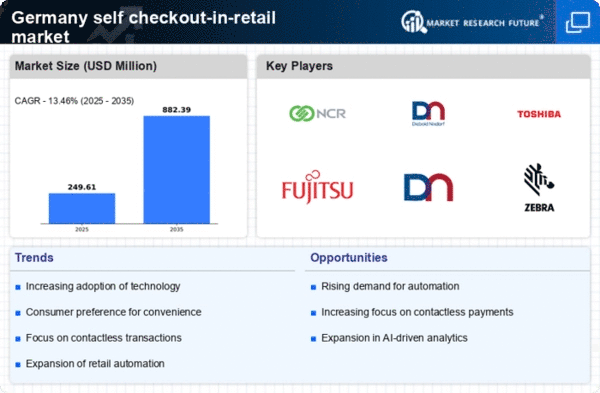
As per Market Research Future analysis, the Germany Self Checkout In Retail Market size was estimated at 220.0 USD Million in 2024. The Self Checkout-in-retail market is projected to grow from 249.61 USD Million in 2025 to 882.39 USD Million by 2035, exhibiting a compound annual growth rate (CAGR) of 13.4% during the forecast period 2025 - 2035

Key Market Trends & Highlights

The Germany self checkout-in-retail market is experiencing a robust shift towards technological integration and consumer autonomy.

  • Technological integration is reshaping the self checkout landscape, enhancing operational efficiency.
  • Consumer preference for autonomy is driving the adoption of self checkout systems, particularly among younger demographics.
  • The focus on contactless solutions is becoming increasingly prominent, aligning with evolving consumer expectations.
  • Rising labor costs and consumer demand for efficiency are key drivers propelling the growth of self checkout systems in Germany.

Market Size & Forecast

2024 Market Size 220.0 (USD Million)
2035 Market Size 882.39 (USD Million)
CAGR (2025 - 2035) 13.46%

Major Players

NCR Corporation (US), Diebold Nixdorf (US), Toshiba Global Commerce Solutions (US), Fujitsu (JP), Wincor Nixdorf (DE), Zebra Technologies (US), Sato Holdings (JP), Aldelo (US)

Our Impact
Enabled $4.3B Revenue Impact for Fortune 500 and Leading Multinationals
Partnering with 2000+ Global Organizations Each Year
30K+ Citations by Top-Tier Firms in the Industry

Germany Self Checkout In Retail Market Trends

The Germany Self Checkout In Retail Market is experiencing notable evolution, driven by technological advancements and changing consumer preferences. In Germany, retailers are increasingly adopting self-service solutions to enhance operational efficiency and improve customer experience. This shift appears to be influenced by a growing demand for convenience, as shoppers seek faster and more autonomous ways to complete their purchases. The integration of user-friendly interfaces and mobile payment options seems to facilitate this transition, allowing customers to navigate the checkout process with ease. Furthermore, the emphasis on contactless transactions aligns with contemporary consumer expectations for safety and speed. Moreover, the competitive landscape in the self checkout-in-retail market is intensifying, with various players striving to differentiate their offerings. Retailers are exploring innovative designs and functionalities to attract a diverse customer base. The potential for data analytics to optimize inventory management and personalize shopping experiences is also becoming increasingly relevant. As technology continues to advance, the self checkout-in-retail market is likely to witness further growth, with an emphasis on enhancing user engagement and operational effectiveness. This dynamic environment suggests that retailers must remain agile and responsive to evolving market demands to maintain a competitive edge.

Technological Integration

The The self checkout-in-retail market is witnessing a surge in the integration of advanced technologies. Retailers are increasingly implementing artificial intelligence and machine learning to streamline operations and enhance customer interactions. This trend indicates a shift towards more intelligent systems that can adapt to consumer behavior. Such advancements have the potential to improve efficiency and satisfaction.

Consumer Preference for Autonomy

There is a growing inclination among consumers towards self-service options in the retail environment. Shoppers in Germany appear to favor the autonomy provided by self checkout systems, which allow them to control their purchasing experience. This trend suggests a significant shift in consumer behavior, emphasizing the need for retailers to adapt to these preferences.

Focus on Contactless Solutions

The self checkout-in-retail market is increasingly prioritizing contactless payment solutions. Retailers are recognizing the importance of providing secure and swift payment methods to enhance the shopping experience. This focus on contactless technology reflects broader consumer trends towards convenience and safety in retail transactions.

Germany Self Checkout In Retail Market Drivers

Rising Labor Costs

The The self checkout-in-retail market is experiencing a notable shift due to rising labor costs in Germany. As wages increase, retailers are compelled to seek cost-effective solutions to maintain profitability. The integration of self checkout systems allows retailers to reduce the number of staff required at checkout points, thereby lowering operational expenses. In 2025, labor costs in the retail sector are projected to rise by approximately 5%. This trend is prompting many retailers to invest in self checkout technology. Not only does this help in managing costs, but it also enhances the overall shopping experience by reducing wait times. Consequently, the self checkout-in-retail market is likely to expand as more retailers adopt these systems to streamline operations and improve customer satisfaction.

Technological Advancements

Technological advancements play a crucial role in shaping the self checkout-in-retail market. Innovations such as improved scanning technology, mobile payment options, and user-friendly interfaces are enhancing the functionality of self checkout systems. In Germany, the adoption of advanced technologies is expected to increase by 15% in the next few years, as retailers seek to provide seamless shopping experiences. These advancements not only improve transaction speed but also reduce errors, making self checkout a more reliable option for consumers. As technology continues to evolve, the self checkout-in-retail market is poised for significant growth, driven by the need for efficiency and enhanced customer experiences.

Consumer Demand for Efficiency

In the current retail landscape, consumers in Germany are increasingly demanding efficiency in their shopping experiences. The self checkout-in-retail market is responding to this demand by providing faster transaction processes. Research indicates that 70% of consumers prefer self checkout options to traditional lanes, as they allow for quicker purchases and reduced waiting times. This shift in consumer behavior is driving retailers to implement self checkout systems to meet expectations. Furthermore, the convenience of self checkout aligns with the busy lifestyles of modern consumers, making it a preferred choice. As a result, the self checkout-in-retail market is likely to see continued growth as retailers adapt to these evolving consumer preferences.

Shift Towards Contactless Payments

The The self checkout-in-retail market is witnessing a shift towards contactless payment methods, which are becoming increasingly popular among consumers in Germany. This trend is driven by the desire for convenience and safety during transactions. In 2025, it is estimated that contactless payments will account for over 50% of all retail transactions in the country. Retailers are responding by integrating self checkout systems that support various contactless payment options, including mobile wallets and NFC technology. This shift enhances the shopping experience and aligns with consumer preferences for quick and secure payment methods. As a result, the self checkout-in-retail market is likely to expand as more retailers adopt these technologies to meet consumer demands.

Increased Focus on Customer Experience

In the competitive retail environment of Germany, there is an increased focus on enhancing customer experience, which is significantly impacting the self checkout-in-retail market. Retailers are recognizing that providing a seamless and enjoyable shopping experience is essential for customer retention. Self checkout systems are being designed with user-friendly interfaces and features that cater to customer needs, such as multilingual support and assistance options. This focus on customer experience is expected to drive a 10% increase in the adoption of self checkout systems among retailers in the coming years. By prioritizing customer satisfaction, the self checkout-in-retail market is likely to see sustained growth as retailers strive to differentiate themselves in a crowded marketplace.

Market Segment Insights

By Application: Grocery Stores (Largest) vs. Convenience Stores (Fastest-Growing)

In the Germany self checkout-in-retail market, the application segment is dominated by grocery stores, which hold a substantial market share due to their vast customer base and frequent purchase patterns. Following grocery stores, convenience stores are gaining traction as they cater to on-the-go consumers seeking quick transactions, contributing to their growing share in the overall market. Pharmacies and department stores, while relevant, occupy smaller niches within this segment. Growth trends indicate that convenience stores are the fastest-growing category, fueled by changing consumer behavior favoring quick and efficient shopping experiences. The rise of self-checkout technology enhances customer satisfaction by reducing wait times, leading more retailers to adopt these systems, particularly in urban areas. Additionally, the increasing integration of mobile payment options is expected to bolster growth across all segments.

Grocery Stores: Dominant vs. Convenience Stores: Emerging

Grocery stores remain the dominant player in the application segment due to their ability to serve a diverse range of products and a large number of customers, making them ideal for self-checkout implementations. They benefit from high transaction volumes and frequent repeat customers, which are essential for maintaining profitability in a competitive landscape. On the other hand, convenience stores are emerging as key players, driven by the demand for quick and versatile shopping options. By adopting self-checkout solutions, they enhance operational efficiency and customer experience, attracting a younger customer demographic that prioritizes speed and accessibility. This dynamic suggests a shift in consumer preference towards rapid transactions, positioning convenience stores for substantial growth in the coming years.

By Type: Standalone Machines (Largest) vs. Integrated Solutions (Fastest-Growing)

In the Germany self checkout-in-retail market, Standalone Machines account for a significant share, representing the most prevalent option among retailers. These machines are favored for their simplicity and ease of use, allowing consumers to scan and pay for their items independently, thereby streamlining the checkout process. In contrast, Integrated Solutions are gaining traction, appealing to retailers looking for seamless integration with existing point-of-sale systems. This growing preference indicates a shift towards enhancing the shopping experience through advanced technological solutions. The trend towards Integrated Solutions as the fastest-growing segment is driven by the demand for more efficient and connected retail environments. Retailers are increasingly adopting these solutions to provide a more cohesive user experience, which includes capabilities such as mobile payments and real-time inventory management. The ongoing digital transformation within the retail space reinforces the relevance of Integrated Solutions, establishing them as essential tools for future-focused businesses aiming to enhance operational efficiency and customer satisfaction.

Type: Standalone Machines (Dominant) vs. Integrated Solutions (Emerging)

Standalone Machines are recognized as the dominant force in the Germany self checkout-in-retail market, known for their reliability and user-friendly interface. These machines deliver a straightforward checkout experience, appealing to consumers who appreciate speed and ease. However, Integrated Solutions are emerging as a competitive option, offering advanced features like customer loyalty integration and personalized promotions. This versatility allows retailers to create tailored shopping experiences, which is increasingly attractive in a market that values customer engagement. As technology enhances these solutions, their share is expected to grow, making them a pivotal element for retailers looking to modernize and optimize the checkout process.

By Payment Method: Credit Card (Largest) vs. Mobile Payment (Fastest-Growing)

In the Germany self checkout-in-retail market, the payment method landscape is heavily dominated by credit cards, which hold a significant market share. This method appeals to consumers due to its widely accepted nature and convenience, and it has become a staple in retail transactions. Other payment methods, such as cash and debit cards, still maintain notable shares but are increasingly overshadowed by the growing popularity of mobile payments. The shift towards mobile payments is driven by technological advancements, increased smartphone penetration, and changing consumer preferences that favor fast and secure transaction methods. As retailers invest in technology to enhance customer experience, mobile payments are predicted to grow at an accelerated pace. This evolution indicates a shift in payment behaviors, making mobile payment an emergent trend to watch in the coming years.

Cash (Dominant) vs. Debit Card (Emerging)

Cash remains the dominant payment method in the Germany self checkout-in-retail market, favored by consumers seeking simplicity and those in certain demographics who still prefer traditional methods for transactions. It provides anonymity and direct control over expenses, which appeals to a substantial portion of the population. On the other hand, debit cards are emerging vigorously. With the emphasis on cashless transactions, many consumers are now opting for debit cards for their ease of use and connection to bank accounts. The growing acceptance of debit cards among retailers and ongoing initiatives to promote cashless payments suggest strong future potential for this payment method.

By End Use: Retail (Largest) vs. Hospitality (Fastest-Growing)

In the Germany self checkout-in-retail market, the retail segment holds the largest share, significantly influencing the overall market dynamics. This segment encompasses grocery stores, supermarkets, and convenience shops, where self-checkout systems enhance customer experience and operational efficiency. The hospitality segment, while smaller, is rapidly gaining attention due to the growing inclination of restaurants and hotels towards self-service options, aiming to streamline operations and improve guest satisfaction. On the growth front, both segments are witnessing unique trends. The retail segment is driven by the increasing demand for automation and contactless transactions, with consumers preferring self-checkout for convenience. In contrast, the hospitality segment is experiencing momentum due to the need for faster service and adapting to changing consumer behavior post-pandemic. This evolving landscape presents opportunities for technology integration and innovation in the self-checkout space.

Retail (Dominant) vs. Hospitality (Emerging)

The retail segment is the dominant force in the self checkout-in-retail market, characterized by widespread adoption of self-service kiosks across various grocery and supermarket chains. This segment benefits from a high volume of transactions and customer familiarity, solidifying its market position. Meanwhile, the hospitality segment is emerging, with restaurants and hotels increasingly adopting self-checkout solutions to elevate service efficiency and reduce wait times. This transition is driven by a shift in consumer preferences, where diners and guests prefer quicker, more autonomous interactions. As both segments evolve, they represent contrasting yet complementary dynamics, with retail focusing on volume and hospitality on enhancing the customer experience.

Get more detailed insights about Germany Self Checkout In Retail Market

Key Players and Competitive Insights

The self checkout-in-retail market in Germany is characterized by a dynamic competitive landscape, driven by technological advancements and evolving consumer preferences. Key players such as NCR Corporation (US), Diebold Nixdorf (US), and Toshiba Global Commerce Solutions (US) are at the forefront, each adopting distinct strategies to enhance their market presence. NCR Corporation (US) focuses on innovation through the development of advanced self-service solutions, while Diebold Nixdorf (US) emphasizes partnerships with retailers to optimize customer experiences. Toshiba Global Commerce Solutions (US) is leveraging digital transformation to streamline operations, indicating a collective shift towards technology-driven solutions that shape the competitive environment.
In terms of business tactics, companies are increasingly localizing manufacturing and optimizing supply chains to enhance efficiency and responsiveness. The market structure appears moderately fragmented, with several key players exerting influence over various segments. This fragmentation allows for diverse offerings, yet the collective strategies of these companies suggest a trend towards consolidation and collaboration, particularly in technology integration and customer engagement.
In October 2025, NCR Corporation (US) announced a strategic partnership with a leading supermarket chain to implement AI-driven self-checkout systems. This move is significant as it not only enhances the customer experience through personalized services but also positions NCR as a leader in integrating AI into retail operations. The partnership is expected to drive sales and improve operational efficiency, reflecting a broader trend towards intelligent automation in the market.
Similarly, in September 2025, Diebold Nixdorf (US) launched a new line of self-service kiosks designed specifically for the European market. This initiative underscores the company's commitment to regional customization, allowing it to cater to local consumer preferences and regulatory requirements. The introduction of these kiosks is likely to strengthen Diebold Nixdorf's competitive position by enhancing its product portfolio and expanding its market reach.
In August 2025, Toshiba Global Commerce Solutions (US) unveiled a cloud-based self-checkout solution aimed at improving transaction speed and security. This development is crucial as it aligns with the growing demand for seamless and secure payment options among consumers. By adopting cloud technology, Toshiba is not only enhancing its service offerings but also positioning itself as a forward-thinking player in the self checkout-in-retail market.
As of November 2025, current trends in the competitive landscape include a strong emphasis on digitalization, sustainability, and the integration of AI technologies. Strategic alliances are increasingly shaping the market, enabling companies to pool resources and expertise to innovate more effectively. Looking ahead, competitive differentiation is likely to evolve from traditional price-based strategies to a focus on innovation, technological advancements, and supply chain reliability, suggesting a transformative shift in how companies compete in this sector.

Key Companies in the Germany Self Checkout In Retail Market include

Industry Developments

In recent developments within the German Self-Checkout in Retail Market, companies such as Diebold Nixdorf and NCR Corporation have been focusing on enhancing their technological offerings, responding to an increased demand for contactless payment solutions. The shift towards self-checkout systems has accelerated since the pandemic, with retailers looking to minimize contact between staff and customers. In terms of enterprise movements, in May 2023, Glory Global announced a strategic partnership with a leading supermarket chain, aiming to integrate its self-checkout solutions across multiple locations in Germany. 

Moreover, in July 2022, AURES Technologies introduced a new self-service kiosk tailored for small retailers, enhancing options available in the market. The trend has been complemented by a consistent growth in market valuation, driven by increased investments in automation and efficient customer service solutions. Companies like Zebra Technologies and Fujitsu are also making notable advancements in their product lines, targeting retailers that seek to improve operational efficiencies. Overall, the German market is witnessing significant transformation with technological innovations solidifying the self-checkout segment as a crucial aspect of retail.


Future Outlook

Germany Self Checkout In Retail Market Future Outlook

The self checkout-in-retail market in Germany is projected to grow at a 13.46% CAGR from 2025 to 2035, driven by technological advancements and changing consumer preferences.

New opportunities lie in:

  • Integration of AI-driven analytics for personalized customer experiences.
  • Expansion of mobile payment solutions to enhance transaction efficiency.
  • Development of compact self-checkout units for smaller retail spaces.

By 2035, the market is expected to achieve substantial growth, reflecting evolving retail dynamics.

Market Segmentation

Germany Self Checkout In Retail Market Type Outlook

  • Standalone Machines
  • Integrated Solutions

Germany Self Checkout In Retail Market End Use Outlook

  • Retail
  • Hospitality
  • Entertainment

Germany Self Checkout In Retail Market Application Outlook

  • Grocery Stores
  • Convenience Stores
  • Pharmacies
  • Department Stores

Germany Self Checkout In Retail Market Payment Method Outlook

  • Cash
  • Credit Card
  • Debit Card
  • Mobile Payment

Report Scope

MARKET SIZE 2024 220.0(USD Million)
MARKET SIZE 2025 249.61(USD Million)
MARKET SIZE 2035 882.39(USD Million)
COMPOUND ANNUAL GROWTH RATE (CAGR) 13.46% (2025 - 2035)
REPORT COVERAGE Revenue Forecast, Competitive Landscape, Growth Factors, and Trends
BASE YEAR 2024
Market Forecast Period 2025 - 2035
Historical Data 2019 - 2024
Market Forecast Units USD Million
Key Companies Profiled NCR Corporation (US), Diebold Nixdorf (US), Toshiba Global Commerce Solutions (US), Fujitsu (JP), Wincor Nixdorf (DE), Zebra Technologies (US), Sato Holdings (JP), Aldelo (US)
Segments Covered Application, Type, Payment Method, End Use
Key Market Opportunities Integration of advanced AI technologies enhances efficiency in the self checkout-in-retail market.
Key Market Dynamics Rising consumer preference for convenience drives growth in self checkout technology adoption across retail sectors.
Countries Covered Germany
Leave a Comment

FAQs

What is the anticipated market size of the Germany Self-Checkout in Retail Market by 2035?

The Germany Self-Checkout in Retail Market is expected to reach a value of 750.0 million USD by 2035.

What was the market size of the Germany Self-Checkout in Retail Market in 2024?

In 2024, the market size for the Germany Self-Checkout in Retail Market is projected to be valued at 275.5 million USD.

What is the expected CAGR for the Germany Self-Checkout in Retail Market from 2025 to 2035?

The expected compound annual growth rate (CAGR) for the Germany Self-Checkout in Retail Market from 2025 to 2035 is 9.532%.

Which application segment will contribute the highest value in the market by 2035?

The Grocery Stores application segment is forecasted to contribute the highest value of 400.0 million USD by 2035.

What is the projected market value for Convenience Stores in 2035?

The market value for Convenience Stores in the Germany Self-Checkout in Retail Market is expected to reach 200.0 million USD by 2035.

What will be the market size for Pharmacies in 2024?

In 2024, the market size for Pharmacies within the Germany Self-Checkout in Retail Market will be valued at 30.0 million USD.

Who are the major competitors in the Germany Self-Checkout in Retail Market?

Key players in the market include Diebold Nixdorf, EasyCaisse, Ingenico Group, HP Inc., and Glory Global.

What is the expected market size for Department Stores in 2035?

The expected market size for Department Stores in the Germany Self-Checkout in Retail Market is projected to be 65.0 million USD by 2035.

What growth drivers are influencing the Germany Self-Checkout in Retail Market?

The growth drivers include increasing labor costs and evolving consumer preferences for faster checkout experiences.

How has the market been impacted by recent technological advancements?

Recent technological advancements have led to enhanced self-checkout systems, improving efficiency and customer satisfaction in retail.

Download Free Sample

Kindly complete the form below to receive a free sample of this Report

Compare Licence

×
Features License Type
Single User Multiuser License Enterprise User
Price $4,950 $5,950 $7,250
Maximum User Access Limit 1 User Upto 10 Users Unrestricted Access Throughout the Organization
Free Customization
Direct Access to Analyst
Deliverable Format
Platform Access
Discount on Next Purchase 10% 15% 15%
Printable Versions