×
Request Free Sample ×

Kindly complete the form below to receive a free sample of this Report

* Please use a valid business email

Leading companies partner with us for data-driven Insights

clients tt-cursor
Hero Background

UK Patient Derived Xenograft Model Market

ID: MRFR/HC/50973-HCR
200 Pages
Garvit Vyas
February 2026

UK Patient-Derived Xenograft Model Market Research Report: Size, Share, Trend Analysis By Tumor Type (Lung Cancer, Pancreatic Cancer, Prostate Cancer, Breast Cancer, Other Cancer), By Model Type (Mice, Rats) andBy End-User (Pharmaceutical, Biopharmaceutical Companies, Academic & Research Institutes, CROs, CDMOs) - Growth Outlook & Industry Forecast 2025 To 2035

Share:
Download PDF ×

We do not share your information with anyone. However, we may send you emails based on your report interest from time to time. You may contact us at any time to opt-out.

UK Patient Derived Xenograft Model Market Infographic
Purchase Options

UK Patient Derived Xenograft Model Market Summary

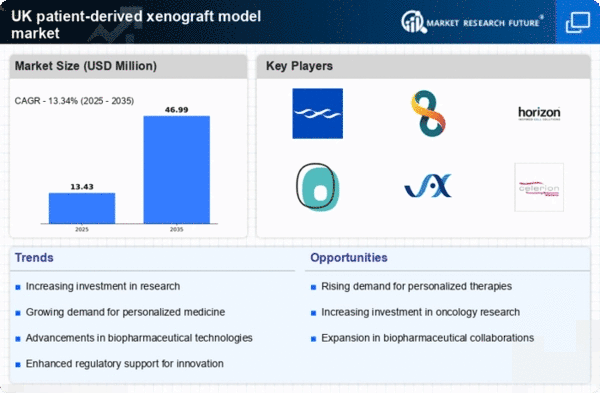
As per Market Research Future analysis, the UK patient-derived xenograft model market size was estimated at 11.85 $ Million in 2024. The UK patient derived-xenograft-model market is projected to grow from 13.43 $ Million in 2025 to 46.99 $ Million by 2035, exhibiting a compound annual growth rate (CAGR) of 13.3% during the forecast period 2025 - 2035

Key Market Trends & Highlights

The UK patient derived-xenograft-model market is poised for growth driven by advancements in personalized medicine and collaborative research efforts.

  • The demand for personalized medicine is rising, indicating a shift towards tailored therapeutic approaches.
  • Collaborative research initiatives are becoming more prevalent, fostering innovation and knowledge sharing among stakeholders.
  • Regulatory support and streamlining processes are enhancing the market landscape, facilitating quicker access to new therapies.
  • Key market drivers include the increasing cancer incidence and advancements in genomic technologies, which are propelling research and development efforts.

Market Size & Forecast

2024 Market Size 11.85 (USD Million)
2035 Market Size 46.99 (USD Million)
CAGR (2025 - 2035) 13.34%

Major Players

Charles River Laboratories (US), Crown Bioscience (US), Horizon Discovery (GB), OncoOne (US), The Jackson Laboratory (US), Celerion (US), Crown Bioscience (TW), Genentech (US)

Our Impact
Enabled $4.3B Revenue Impact for Fortune 500 and Leading Multinationals
Partnering with 2000+ Global Organizations Each Year
30K+ Citations by Top-Tier Firms in the Industry

UK Patient Derived Xenograft Model Market Trends

The patient-derived xenograft model market is currently experiencing notable growth. This growth is driven by advancements in personalized medicine and the increasing demand for more effective cancer therapies. This model allows researchers to study human tumors in a controlled environment, providing insights that are more relevant to clinical outcomes. The ability to tailor treatments based on individual patient profiles is becoming a focal point in oncology, leading to a surge in the adoption of these models. Furthermore, collaborations between academic institutions and pharmaceutical companies are fostering innovation, enhancing the development of novel therapies. In addition, regulatory bodies in the UK are increasingly recognizing the importance of patient derived-xenograft models in drug development. This recognition is likely to streamline the approval processes for new treatments, thereby encouraging investment in research and development. As the healthcare landscape evolves, the patient derived-xenograft-model market is poised to play a crucial role in bridging the gap between laboratory research and clinical application, ultimately improving patient outcomes. The emphasis on precision medicine and the need for more reliable preclinical models suggest a promising future for this market.

Rising Demand for Personalized Medicine

The patient derived-xenograft-model market is witnessing a surge in interest due to the growing emphasis on personalized medicine. Researchers are increasingly utilizing these models to develop tailored therapies that align with individual patient characteristics, enhancing treatment efficacy.

Collaborative Research Initiatives

There is a notable trend towards collaboration between academic institutions and pharmaceutical companies within the patient derived-xenograft-model market. These partnerships are fostering innovation and accelerating the development of new therapeutic strategies, thereby enhancing research capabilities.

Regulatory Support and Streamlining

Regulatory bodies in the UK are beginning to recognize the value of patient derived-xenograft models in the drug development process. This support is likely to lead to more efficient approval pathways for new treatments, encouraging further investment in this area.

UK Patient Derived Xenograft Model Market Drivers

Increasing Cancer Incidence

The rising incidence of cancer in the UK is a pivotal driver for the patient derived-xenograft-model market. As cancer cases continue to escalate, the demand for innovative treatment options intensifies. Patient derived xenograft models offer a unique platform for studying tumor biology and testing therapeutic responses, which is crucial for developing personalized treatment strategies. According to recent statistics, cancer cases in the UK are projected to rise by approximately 20% by 2030, necessitating advanced research models. This trend underscores the importance of patient derived-xenograft models in understanding cancer heterogeneity and improving patient outcomes. Thus, the patient-derived xenograft model market is positioned to grow significantly. Researchers and pharmaceutical companies are seeking effective solutions to combat this growing health crisis.

Regulatory Framework Enhancements

The evolving regulatory landscape in the UK is shaping the patient derived-xenograft-model market. Recent initiatives aimed at streamlining the approval processes for preclinical models are likely to accelerate research timelines and reduce costs. Regulatory bodies are increasingly recognizing the value of patient derived-xenograft models in providing relevant data for drug development, which may lead to more favorable guidelines and support for their use. This regulatory support is crucial for researchers and companies looking to bring innovative therapies to market efficiently. As the framework continues to evolve, it is anticipated that the patient derived-xenograft-model market will experience growth, driven by enhanced compliance and reduced barriers to entry.

Advancements in Genomic Technologies

Technological advancements in genomics are significantly influencing the patient derived-xenograft-model market. The integration of next-generation sequencing (NGS) and CRISPR technologies allows for more precise genetic modifications in xenograft models, enhancing their relevance in preclinical studies. These innovations enable researchers to create models that closely mimic the genetic landscape of human tumors, thereby improving the predictive power of drug responses. The UK has seen a surge in genomic research funding, with investments exceeding £1 billion in recent years, which further propels the development of sophisticated patient derived-xenograft models. As these technologies evolve, they are likely to enhance the utility of patient derived-xenograft models in drug discovery and personalized medicine, driving market growth.

Growing Investment in Oncology Research

The patient derived-xenograft-model market is benefitting from increased investment in oncology research within the UK. Pharmaceutical companies and research institutions are allocating substantial resources to develop novel cancer therapies, with oncology research funding reaching approximately £1.5 billion annually. This financial commitment fosters the creation and utilization of patient derived-xenograft models, which are essential for evaluating the efficacy and safety of new treatments. Furthermore, collaborations between academia and industry are becoming more prevalent, facilitating the sharing of resources and expertise. As the focus on cancer research intensifies, the patient derived-xenograft-model market is expected to expand, driven by the need for reliable preclinical models that can accurately predict clinical outcomes.

Rising Focus on Drug Resistance Studies

The patient-derived xenograft model market is experiencing growth due to an increasing focus on drug resistance studies. As cancer treatments become more sophisticated, understanding the mechanisms of resistance is critical for improving therapeutic efficacy. Patient derived-xenograft models provide a valuable tool for investigating how tumors adapt to therapies, enabling researchers to identify potential resistance pathways. This focus is particularly relevant in the UK, where the prevalence of treatment-resistant cancers is a growing concern. The market is likely to expand as researchers leverage these models to develop strategies that overcome resistance, ultimately leading to more effective cancer treatments. The insights gained from these studies are expected to drive innovation in the patient derived-xenograft-model market.


Market Segment Insights

By Tumor Type: Lung Cancer (Largest) vs. Pancreatic Cancer (Fastest-Growing)

Lung Cancer is the largest segment in the UK patient derived-xenograft-model market, dominating market share due to its high prevalence and significant research focus. Other segments such as Prostate Cancer and Breast Cancer follow, but they hold a comparatively smaller share, reflecting various factors including varying incidence rates and research investments. The segment of Other Cancer includes a variety of tumor types, contributing to a diverse but less concentrated market share. Growth trends across the segment indicate a surge in demand for patient derived-xenograft models in the research community, particularly for Pancreatic Cancer, which is recognized as one of the fastest-growing segments. This is driven by an increasing need for personalized therapies and advanced research methodologies. Moreover, advancements in technology and increasing funding for cancer research are propelling expansion across all tumor types in this market.

Lung Cancer: Dominant vs. Pancreatic Cancer: Emerging

Lung Cancer remains a dominant segment in the UK patient derived-xenograft-model market, attributed to its extensive research initiatives and high prevalence rates, leading to a wealth of available data and models. This dominance is further bolstered by collaborations between research institutions and pharmaceutical companies aimed at developing innovative treatments. In contrast, Pancreatic Cancer is emerging rapidly as a significant segment, motivated by novel discoveries and heightened awareness of the disease's urgency. Despite its challenges, the research community's focus is growing, reflecting an increased investment in understanding the underlying biology and developing effective models that can facilitate better therapeutic strategies. Both segments highlight the critical need for advanced research structures to address the complexities of cancer treatment.

By Model Type: Mice (Largest) vs. Rats (Fastest-Growing)

The UK patient derived-xenograft-model market displays a varied distribution of model types, with mice dominating the segment, holding a significant share due to their well-established use in research. Mice models are preferred for their genetic similarities to humans and their ability to replicate human disease conditions effectively. On the other hand, rats, while smaller in market share, are rapidly gaining traction driven by advancements in their genetic modifications and the increasing demand for alternative models in preclinical trials. Growth trends indicate a notable shift towards using rat models, marked as the fastest-growing segment due to their adaptability and reduced variability. The rise in personalized medicine is fueling interest in patient-derived xenografts, with researchers increasingly utilizing rats for their physiological similarities to human conditions. Innovations in breeding and genetic engineering for these models are expected to further boost their adoption, enhancing their position in the market.

Mice: Dominant vs. Rats: Emerging

Mice represent the dominant model type in the UK patient derived-xenograft-model market, primarily due to their extensive application in therapeutic research and preclinical studies. Their genetic uniformity, alongside the availability of numerous inbred strains, enables researchers to obtain reliable and reproducible results. Conversely, rats are seen as an emerging model type, experiencing rapid growth owing to their unique physiological and anatomical characteristics, which can often mimic human responses more closely than mice. This unique positioning allows for a complementary role alongside mice, expanding their application scope in various fields of research. With ongoing advancements in biotechnology, the potential for rats as significant participants in xenograft studies is set to increase, attracting more investment into rat model research.

By End-user: Pharmaceutical and Biopharmaceutical Companies (Largest) vs. CROs & CDMOs (Fastest-Growing)

The UK patient derived-xenograft-model market exhibits a notable distribution among its key end-user segments. Pharmaceutical and biopharmaceutical companies hold a significant portion of the market share, mainly due to their extensive research and development activities. In contrast, CROs and CDMOs have been gaining traction, driven by the increasing demand for outsourced services and the need for more efficient drug development processes. Growth trends indicate a robust expansion within the CRO and CDMO sectors, as more companies seek to optimize costs and enhance operational efficiency. The rise in collaborations between these organizations and pharmaceutical firms is further accelerating this growth. Additionally, the increasing focus on personalized medicine is reshaping the landscape, making patient-derived models integral to development across all end-user segments.

Pharmaceutical and Biopharmaceutical Companies (Dominant) vs. CROs & CDMOs (Emerging)

Pharmaceutical and biopharmaceutical companies represent the dominant force within the UK patient derived-xenograft-model market, leveraging their established infrastructure, funding, and focus on innovative therapies. These companies prioritize patient-derived models to ensure effective treatment development and to better understand drug responses. On the other hand, CROs and CDMOs are emerging as crucial players, offering valuable support services that cater to the intricate needs of the pharmaceutical sector. Their expertise in managing trials and ensuring compliance allows them to thrive, especially as companies increasingly outsource these functions to maintain a competitive edge in a rapidly evolving environment.

Get more detailed insights about UK Patient Derived Xenograft Model Market

Key Players and Competitive Insights

The patient derived-xenograft-model market is characterized by a dynamic competitive landscape, driven by increasing demand for personalized medicine and advancements in oncology research. Key players such as Charles River Laboratories (US), Horizon Discovery (GB), and Crown Bioscience (US) are at the forefront, each adopting distinct strategies to enhance their market positioning. Charles River Laboratories (US) focuses on innovation through the development of advanced models that mimic human tumors more accurately, thereby improving drug efficacy testing. Horizon Discovery (GB) emphasizes partnerships with academic institutions to leverage cutting-edge research, while Crown Bioscience (US) is expanding its global footprint through strategic acquisitions, enhancing its service offerings in preclinical research.The market structure appears moderately fragmented, with several players vying for market share. Key business tactics include localizing manufacturing to reduce costs and optimize supply chains, which is crucial in maintaining competitive pricing and ensuring timely delivery of products. The collective influence of these companies shapes a competitive environment where innovation and operational efficiency are paramount.

In October Charles River Laboratories (US) announced a collaboration with a leading pharmaceutical company to develop a novel patient-derived xenograft model aimed at accelerating drug discovery processes. This strategic move is likely to enhance their portfolio and solidify their position as a leader in the market, as it aligns with the growing trend towards personalized medicine.

In September Horizon Discovery (GB) launched a new suite of genetically engineered models that cater specifically to rare cancers. This initiative not only diversifies their product offerings but also addresses a significant unmet need in the oncology space, potentially increasing their market share and reinforcing their commitment to innovation.

In August Crown Bioscience (US) completed the acquisition of a biotech firm specializing in advanced imaging technologies for xenograft models. This acquisition is strategically important as it enhances Crown's capabilities in providing comprehensive preclinical services, thereby positioning them to better meet the evolving demands of their clients.

As of November current trends in the patient derived-xenograft-model market include a pronounced shift towards digitalization and AI integration, which are reshaping operational efficiencies and data analytics capabilities. Strategic alliances are increasingly becoming a cornerstone of competitive advantage, allowing companies to pool resources and expertise. Looking ahead, the competitive differentiation is likely to evolve from traditional price-based competition to a focus on innovation, technological advancements, and supply chain reliability, as companies strive to meet the complex demands of the healthcare landscape.

Key Companies in the UK Patient Derived Xenograft Model Market include

Industry Developments

Recent developments in the UK Patient-Derived Xenograft Model Market demonstrate significant progress and ongoing activity among key players. Asterand Bioscience continues to innovate in developing quality PDX models that are more representative of patient tumors. Horizon Discovery has recently expanded its services to include advanced genomic editing, enhancing the utility of PDX models in personalized medicine.

Notably, in August 2022, Crown Bioscience announced its acquisition of the assets of a notable biotech firm, positioning it for rapid growth and expanded offerings in preclinical drug development. Meanwhile, Thermo Fisher Scientific, through strategic partnerships, has integrated advanced technologies to improve PDX model reproducibility. The market shows substantial growth with estimates indicating an increase in valuation due to rising demand for personalized therapies and robust investment in cancer research.

In the past 2-3 years, there have been substantial advancements in the use of PDX models, notably in synergy with immunotherapy, signaling a pivotal shift in cancer treatment approaches in the UK. The continuous increase in funding for research initiatives underpins these trends, with companies like The Jackson Laboratory leading collaborations aimed at enhancing model applications in translational research.

Future Outlook

UK Patient Derived Xenograft Model Market Future Outlook

The Patient Derived Xenograft Model Market is projected to grow at a 13.34% CAGR from 2025 to 2035, driven by advancements in personalized medicine and increasing R&D investments.

New opportunities lie in:

  • Development of tailored xenograft models for specific cancer types
  • Partnerships with biotech firms for innovative drug testing
  • Expansion of biorepository services for patient-derived samples

By 2035, the market is expected to achieve substantial growth, reflecting its critical role in therapeutic advancements.

Market Segmentation

UK Patient Derived Xenograft Model Market End-user Outlook

  • Pharmaceutical and Biopharmaceutical Companies
  • Academic & Research Institutes
  • CROs & CDMOs

UK Patient Derived Xenograft Model Market Model Type Outlook

  • Mice
  • Rats

UK Patient Derived Xenograft Model Market Tumor Type Outlook

  • Lung Cancer
  • Pancreatic Cancer
  • Prostate Cancer
  • Breast Cancer
  • Other Cancer

Report Scope

MARKET SIZE 2024 11.85(USD Million)
MARKET SIZE 2025 13.43(USD Million)
MARKET SIZE 2035 46.99(USD Million)
COMPOUND ANNUAL GROWTH RATE (CAGR) 13.34% (2025 - 2035)
REPORT COVERAGE Revenue Forecast, Competitive Landscape, Growth Factors, and Trends
BASE YEAR 2024
Market Forecast Period 2025 - 2035
Historical Data 2019 - 2024
Market Forecast Units USD Million
Key Companies Profiled Charles River Laboratories (US), Crown Bioscience (US), Horizon Discovery (GB), OncoOne (US), The Jackson Laboratory (US), Celerion (US), Crown Bioscience (TW), Genentech (US)
Segments Covered Tumor Type, Model Type, End-user
Key Market Opportunities Advancements in personalized medicine drive demand for innovative patient derived-xenograft-model solutions.
Key Market Dynamics Rising demand for personalized medicine drives innovation in patient derived-xenograft-model development and application.
Countries Covered UK
Leave a Comment

FAQs

What is the expected market size of the UK Patient-Derived Xenograft Model market in 2024?

The UK Patient-Derived Xenograft Model market is anticipated to reach a value of 16.0 million USD in 2024.

What will be the market value of the UK Patient-Derived Xenograft Model market by 2035?

By 2035, the market is projected to grow to approximately 80.0 million USD.

What is the expected compound annual growth rate (CAGR) of the UK Patient-Derived Xenograft Model market from 2025 to 2035?

The market is expected to experience a CAGR of 15.756% during the period from 2025 to 2035.

Which tumor type is projected to hold the largest market share in the UK Patient-Derived Xenograft Model market by 2035?

The Breast Cancer segment is expected to dominate the market with a projected value of 20.0 million USD by 2035.

What are the expected market sizes for Lung Cancer and Pancreatic Cancer in 2024?

Lung Cancer is projected to be valued at 3.2 million USD and Pancreatic Cancer at 2.4 million USD in 2024.

What will be the market size for the Prostate Cancer segment by 2035?

The Prostate Cancer segment is anticipated to reach a market size of 10.0 million USD by 2035.

Who are the key players in the UK Patient-Derived Xenograft Model market?

Major players in the market include Asterand Bioscience, Horizon Discovery, Medimmune, and Thermo Fisher Scientific.

What are the market size projections for the Other Cancer segment in 2024 and by 2035?

The Other Cancer segment is expected to be valued at 4.4 million USD in 2024 and grow to 22.0 million USD by 2035.

What is the projected market size for Breast Cancer in 2024?

The Breast Cancer segment is expected to have a market value of 4.0 million USD in 2024.

What growth opportunities exist in the UK Patient-Derived Xenograft Model market?

The growth opportunities stem from advancements in cancer research and the increasing need for personalized medicine solutions.

Download Free Sample

Kindly complete the form below to receive a free sample of this Report

Compare Licence

×
Features License Type
Single User Multiuser License Enterprise User
Price $4,950 $5,950 $7,250
Maximum User Access Limit 1 User Upto 10 Users Unrestricted Access Throughout the Organization
Free Customization
Direct Access to Analyst
Deliverable Format
Platform Access
Discount on Next Purchase 10% 15% 15%
Printable Versions