×
Request Free Sample ×

Kindly complete the form below to receive a free sample of this Report

* Please use a valid business email

Leading companies partner with us for data-driven Insights

clients tt-cursor
Hero Background

India Patient Derived Xenograft Model Market

ID: MRFR/HC/50976-HCR
200 Pages
Garvit Vyas
February 2026

India Patient-Derived Xenograft Model Market Research Report By Tumor Type (Lung Cancer, Pancreatic Cancer, Prostate Cancer, Breast Cancer, Other Cancer), By Model Type (Mice, Rats) andBy End-User (Pharmaceutical, Biopharmaceutical Companies, Academic & Research Institutes, CROs, CDMOs) - Growth & Industry Forecast 2025 To 2035

Share:
Download PDF ×

We do not share your information with anyone. However, we may send you emails based on your report interest from time to time. You may contact us at any time to opt-out.

India Patient Derived Xenograft Model Market Infographic
Purchase Options

India Patient Derived Xenograft Model Market Summary

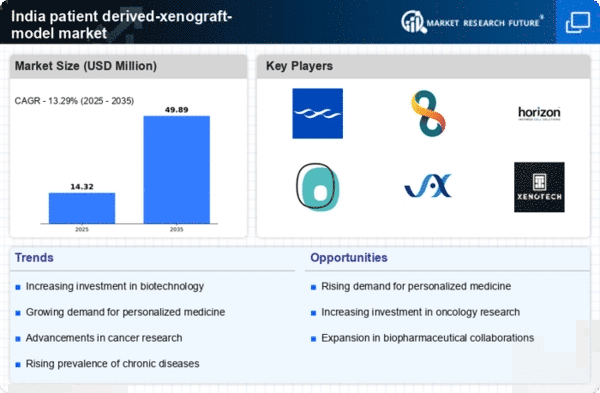
As per Market Research Future analysis, the India Patient Derived Xenograft Model Market size was estimated at 12.64 $ Million in 2024. The Patient Derived-xenograft-model market is projected to grow from 14.32 $ Million in 2025 to 49.89 $ Million by 2035, exhibiting a compound annual growth rate (CAGR) of 13.2% during the forecast period 2025 - 2035

Key Market Trends & Highlights

The India The patient derived-xenograft-model market is poised for substantial growth. This growth is driven by rising cancer incidence and technological advancements.

  • The market is witnessing a notable increase in demand for personalized medicine, particularly in oncology.
  • Technological advancements in xenograft models are enhancing research capabilities and outcomes.
  • The biopharmaceutical sector is expanding rapidly, contributing to the market's growth trajectory.
  • Key drivers include increasing research funding and rising awareness of cancer research, which are fueling market expansion.

Market Size & Forecast

2024 Market Size 12.64 (USD Million)
2035 Market Size 49.89 (USD Million)
CAGR (2025 - 2035) 13.29%

Major Players

Charles River Laboratories (US), Crown Bioscience (US), Horizon Discovery (GB), OncoOne (US), The Jackson Laboratory (US), XenoTech (US), Celerion (US), CureMetrix (US)

Our Impact
Enabled $4.3B Revenue Impact for Fortune 500 and Leading Multinationals
Partnering with 2000+ Global Organizations Each Year
30K+ Citations by Top-Tier Firms in the Industry

India Patient Derived Xenograft Model Market Trends

The India Patient Derived Xenograft Model Market is experiencing notable growth. This growth is driven by advancements in cancer research and personalized medicine. This market is characterized by the use of human tumor tissues implanted in immunocompromised mice, allowing for the study of tumor behavior and response to therapies. The increasing prevalence of cancer in India has led to a heightened demand for innovative research models that can provide more accurate predictions of treatment outcomes. Furthermore, collaborations between academic institutions and biotechnology firms are fostering the development of more sophisticated xenograft models, which may enhance the efficacy of drug discovery processes. In addition, regulatory support from government bodies is likely to play a crucial role in shaping the future of the patient derived-xenograft-model market. Initiatives aimed at promoting research and development in biotechnology are expected to create a conducive environment for market expansion. As researchers seek to understand the complexities of cancer biology, the patient derived-xenograft-model market appears poised for sustained growth, with potential applications extending beyond oncology into other therapeutic areas. The integration of advanced technologies, such as genomics and bioinformatics, may enhance the capabilities of these models. This enhancement could lead to more personalized treatment strategies for patients.

Rising Cancer Incidence

The increasing incidence of cancer in India is driving demand for patient derived-xenograft models. As the healthcare system seeks to address this challenge, researchers are turning to these models for insights into tumor behavior and treatment responses.

Technological Advancements

Innovations in biotechnology are enhancing the capabilities of patient derived-xenograft models. The integration of advanced techniques, such as CRISPR and next-generation sequencing, is likely to improve the accuracy and relevance of these models in research.

Regulatory Support

Government initiatives aimed at promoting research in biotechnology are expected to bolster the patient derived-xenograft model market. Supportive regulations may facilitate collaborations between academia and industry, fostering innovation and development.

India Patient Derived Xenograft Model Market Drivers

Increasing Research Funding

The patient derived-xenograft-model market in India is experiencing a surge in research funding from both governmental and private sectors. This influx of financial resources is likely to enhance the development of innovative cancer therapies and personalized medicine approaches. In 2025, the Indian government allocated approximately $1.5 billion to cancer research initiatives, which is expected to bolster the capabilities of research institutions and biotechnology firms. As a result, the patient derived-xenograft-model market is poised for growth, as these models are essential for preclinical testing and understanding tumor biology. The increased funding may also facilitate collaborations between academic institutions and industry players, further driving advancements in this market.

Collaborative Research Initiatives

Collaborative research initiatives between academic institutions and industry players are becoming more prevalent in India, which is likely to benefit the patient derived-xenograft-model market. These partnerships facilitate the sharing of resources, expertise, and data, leading to accelerated advancements in cancer research. For instance, several universities have established partnerships with biotechnology firms to develop innovative cancer therapies using patient derived-xenograft models. Such collaborations not only enhance the quality of research but also increase the visibility and application of these models in clinical settings. As these initiatives continue to grow, the patient derived-xenograft-model market is expected to expand accordingly.

Rising Awareness of Cancer Research

There is a notable increase in awareness regarding cancer research and its significance in India, which is positively impacting the patient derived-xenograft-model market. Educational campaigns and initiatives by non-profit organizations and healthcare institutions are fostering a better understanding of cancer biology and treatment options among the general public. This heightened awareness is likely to lead to increased participation in clinical trials and research studies, thereby driving demand for patient derived-xenograft models. As more patients become informed about their treatment options, the market may see a rise in the utilization of these models for developing targeted therapies.

Expansion of Biopharmaceutical Sector

The biopharmaceutical sector in India is expanding rapidly, which is likely to have a favorable impact on the patient derived-xenograft-model market. With the increasing number of biopharmaceutical companies focusing on oncology, there is a growing need for reliable preclinical models to test new drug candidates. The biopharmaceutical market in India is projected to reach $100 billion by 2025, indicating a robust growth trajectory. This expansion is expected to drive investments in research and development, thereby increasing the demand for patient derived-xenograft models as essential tools for drug discovery and development.

Growing Demand for Personalized Medicine

There is a growing demand for personalized medicine in India. As healthcare providers increasingly recognize the importance of tailoring treatments to individual patients, the need for effective preclinical models becomes paramount. Patient derived-xenograft models allow researchers to study the unique characteristics of tumors from individual patients, leading to more effective treatment strategies. This trend is supported by a report indicating that the personalized medicine market in India is projected to reach $10 billion by 2026, reflecting a compound annual growth rate (CAGR) of 12%. Consequently, This market is likely to benefit from this shift towards personalized healthcare solutions.


Market Segment Insights

By Tumor Type: Lung Cancer (Largest) vs. Breast Cancer (Fastest-Growing)

In the India patient derived-xenograft-model market, lung cancer accounts for the largest share, reflecting the high incidence and prevalence of this disease in the region. It significantly dominates the tumor type segment, showcasing the critical need for effective treatment models. Conversely, other cancers like pancreatic and prostate are also represented but with a smaller share compared to lung and breast cancer. The growth trends in the segment reveal that breast cancer is emerging as the fastest-growing area within the market. This increase can be attributed to several factors, including greater awareness of the disease, advancements in research, and the rising number of patient registrations for clinical trials. These elements are driving innovation and investment in patient-derived xenograft models specifically aimed at breast cancer treatment.

Lung Cancer: Dominant vs. Breast Cancer: Emerging

Lung cancer remains a dominant force within the India patient derived-xenograft-model market, characterized by high demand for personalized treatment approaches and extensive research funding. This segment benefits from established pipeline drugs and extensive clinical data that underscore its relevance. On the other hand, breast cancer, now recognized as an emerging segment, is experiencing a rapid upswing due to increasing incidences and a proactive stance towards early detection and treatment. The growing focus on individualized therapy, particularly through innovative xenograft models, is expected to bolster this market, as stakeholders aim to address the unique biological behaviors of breast tumors.

By Model Type: Mice (Largest) vs. Rats (Fastest-Growing)

In the India patient derived-xenograft-model market, the distribution of model types shows a clear preference for mice, which dominate the market share due to their well-established use in preclinical studies. Mice models make up a significant portion of the research and development processes, providing researchers with reliable data and insights. Conversely, rat models, while smaller in share, are being increasingly recognized for their utility in specific areas of research and are on an upward trend. The growth of the rat model segment can be attributed to various factors including advancements in genetic manipulation techniques and the need for models that better mimic human diseases. As researchers look for more relevant data for therapeutic developments, the demand for rats is gaining momentum, marking them as the fastest-growing segment in this market. Their physiological and behavioral characteristics make them suitable for numerous drug testing and efficacy studies, complementing the traditional reliance on mice models.

Model Type: Mice (Dominant) vs. Rats (Emerging)

Mice have long been the dominant model in the India patient derived-xenograft-model market due to their extensive genetic and biological similarity to humans, which makes them ideal for preclinical research. Their established protocols and availability make them a preferred choice for researchers. On the other hand, rats are emerging as an important alternative because of their larger body size, which allows for more complex surgical and therapeutic interventions. As the focus shifts towards more representative models that enhance translational research, rats are gaining prominence. This shift is driven by the need for improved understanding of diseases and the effects of treatments in a manner that closely reflects human conditions.

By End-user: Pharmaceutical and Biopharmaceutical Companies (Largest) vs. Academic & Research Institutes (Fastest-Growing)

In the India patient derived-xenograft-model market, the distribution of market share among end-users reveals that pharmaceutical and biopharmaceutical companies hold the largest portion due to their high demand for innovative therapeutic solutions. Conversely, academic and research institutes represent the fastest-growing segment, as their focus on novel research methodologies and academic advancements drive increasing investments into patient-derived xenograft models. Growth trends indicate that the pharmaceutical and biopharmaceutical companies are expanding their collaborative efforts with academic institutions to foster innovation in drug development. Additionally, the rising trend of precision medicine has bolstered the demand for patient-derived xenograft models as research institutes increasingly adopt these models to enhance their studies. The integration of cutting-edge technologies further fuels this dynamism in the market.

Pharmaceutical and Biopharmaceutical Companies (Dominant) vs. CROs & CDMOs (Emerging)

Pharmaceutical and biopharmaceutical companies dominate the India patient derived-xenograft-model market due to their extensive R&D investments and a strong demand for personalized medicine solutions. This segment greatly benefits from partnerships with CROs and CDMOs who provide specialized expertise and resources in drug development processes. As an emerging segment, CROs and CDMOs are increasingly recognized for their critical role in driving efficiency and innovation, facilitating the rapid advancement of pharmaceutical research and product development. The growth of CROs is supported by a surge in outsourcing activities from pharmaceutical companies seeking to optimize costs and enhance operational scalability. Together, these segments represent a dynamic interplay that is shaping the future landscape of the market.

Get more detailed insights about India Patient Derived Xenograft Model Market

Key Players and Competitive Insights

The patient derived-xenograft-model market is currently characterized by a dynamic competitive landscape, driven by increasing demand for personalized medicine and advancements in oncology research. Key players such as Charles River Laboratories (US), Crown Bioscience (US), and Horizon Discovery (GB) are strategically positioned to leverage their expertise in preclinical models and drug development. Charles River Laboratories (US) focuses on innovation through continuous investment in R&D, enhancing their portfolio of patient-derived xenograft models. Meanwhile, Crown Bioscience (US) emphasizes partnerships with biopharmaceutical companies to expand their service offerings, thereby enhancing their market presence. Horizon Discovery (GB) appears to be concentrating on digital transformation, integrating advanced technologies into their operations to streamline processes and improve model accuracy. Collectively, these strategies contribute to a competitive environment that is increasingly focused on innovation and collaboration.In terms of business tactics, companies are localizing manufacturing and optimizing supply chains to enhance operational efficiency. The market structure is moderately fragmented, with several players vying for market share. This fragmentation allows for diverse offerings, yet the influence of key players remains significant, as they set industry standards and drive technological advancements.

In October Charles River Laboratories (US) announced a strategic partnership with a leading biopharmaceutical firm to develop novel patient-derived xenograft models tailored for specific cancer types. This collaboration is likely to enhance their capabilities in personalized medicine, positioning them as a leader in the market. The partnership underscores the importance of collaboration in advancing research and development in oncology.

In September Crown Bioscience (US) expanded its operations in India by establishing a new facility dedicated to patient-derived xenograft models. This move is indicative of their commitment to regional expansion and reflects the growing demand for localized solutions in drug development. The facility is expected to enhance their service delivery and reduce turnaround times for clients in the region.

In August Horizon Discovery (GB) launched a new suite of digital tools designed to improve the accuracy and efficiency of patient-derived xenograft models. This initiative highlights the increasing integration of technology in the market, as companies seek to enhance their offerings through digital solutions. The launch is anticipated to attract a broader client base, particularly those focused on precision medicine.

As of November current trends in the patient derived-xenograft-model market include a strong emphasis on digitalization, sustainability, and the integration of artificial intelligence (AI) in research processes. Strategic alliances are increasingly shaping the competitive landscape, as companies recognize the value of collaboration in driving innovation. Looking ahead, competitive differentiation is likely to evolve from traditional price-based competition to a focus on technological advancements, innovation, and supply chain reliability. This shift suggests that companies that prioritize R&D and strategic partnerships will be better positioned to thrive in the evolving market.

Key Companies in the India Patient Derived Xenograft Model Market include

Industry Developments

Recent developments in the India Patient-Derived Xenograft Model Market have seen notable growth due to advancements in cancer research and personalized medicine. Companies such as Bioneer Corporation and Horizon Discovery continue to innovate, enhancing the accuracy of xenograft models for preclinical studies. In September 2022, Celerion expanded its services in India, catering to the growing demand for patient-derived models, while Crown Bioscience reported increased collaborations with Indian biotech firms to enhance their R&D capabilities.

Notable mergers and acquisitions include Thermo Fisher Scientific's acquisition of a biotech firm in July 2023, which complements its patient-derived xenograft portfolio. This move has been viewed positively, leading to a boost in stock valuation for Thermo Fisher Scientific as it enhances its market share within India. Additionally, Eli Lilly and Company has initiated partnerships with local research institutions to further develop their patient-derived models, reflecting the growing emphasis on localized solutions.

The market has been influenced significantly over the last two years, with increased investments and governmental support for biomedical research contributing to an expanding landscape for patient-derived xenograft technologies in India.

Future Outlook

India Patient Derived Xenograft Model Market Future Outlook

The Patient Derived Xenograft Model Market is projected to grow at a 13.29% CAGR from 2025 to 2035, driven by advancements in personalized medicine and increasing R&D investments.

New opportunities lie in:

  • Development of specialized PDX models for rare cancers
  • Partnerships with biotech firms for co-development
  • Expansion of biorepository services for patient samples

By 2035, the market is expected to achieve substantial growth, driven by innovation and strategic collaborations.

Market Segmentation

India Patient Derived Xenograft Model Market End-user Outlook

  • Pharmaceutical and Biopharmaceutical Companies
  • Academic & Research Institutes
  • CROs & CDMOs

India Patient Derived Xenograft Model Market Model Type Outlook

  • Mice
  • Rats

India Patient Derived Xenograft Model Market Tumor Type Outlook

  • Lung Cancer
  • Pancreatic Cancer
  • Prostate Cancer
  • Breast Cancer
  • Other Cancer

Report Scope

MARKET SIZE 2024 12.64(USD Million)
MARKET SIZE 2025 14.32(USD Million)
MARKET SIZE 2035 49.89(USD Million)
COMPOUND ANNUAL GROWTH RATE (CAGR) 13.29% (2025 - 2035)
REPORT COVERAGE Revenue Forecast, Competitive Landscape, Growth Factors, and Trends
BASE YEAR 2024
Market Forecast Period 2025 - 2035
Historical Data 2019 - 2024
Market Forecast Units USD Million
Key Companies Profiled Charles River Laboratories (US), Crown Bioscience (US), Horizon Discovery (GB), OncoOne (US), The Jackson Laboratory (US), XenoTech (US), Celerion (US), CureMetrix (US)
Segments Covered Tumor Type, Model Type, End-user
Key Market Opportunities Advancements in personalized medicine drive demand for innovative patient derived-xenograft-model solutions.
Key Market Dynamics Rising demand for personalized medicine drives growth in the patient derived-xenograft-model market amid evolving regulatory frameworks.
Countries Covered India
Leave a Comment

FAQs

What is the projected market size for the India Patient-Derived Xenograft Model Market in 2024?

The projected market size for the India Patient-Derived Xenograft Model Market in 2024 is valued at 12.8 million USD.

What will the India Patient-Derived Xenograft Model Market be valued at by 2035?

By 2035, the India Patient-Derived Xenograft Model Market is expected to reach a value of 51.2 million USD.

What is the expected CAGR for the India Patient-Derived Xenograft Model Market from 2025 to 2035?

The expected CAGR for the India Patient-Derived Xenograft Model Market from 2025 to 2035 is 13.431%.

Which segment of tumor types leads the India Patient-Derived Xenograft Model Market in 2024?

In 2024, the Lung Cancer segment leads the India Patient-Derived Xenograft Model Market with a value of 3.5 million USD.

What will be the market value of the Pancreatic Cancer segment in 2035?

The Pancreatic Cancer segment is expected to be valued at 10.2 million USD by 2035.

Who are the key players in the India Patient-Derived Xenograft Model Market?

Key players in the India Patient-Derived Xenograft Model Market include Bioneer Corporation, Horizon Discovery, Celerion, and Thermo Fisher Scientific among others.

What is the expected market size for the Prostate Cancer segment in 2024?

In 2024, the Prostate Cancer segment is projected to be valued at 2.2 million USD.

How much is the Breast Cancer segment expected to generate in 2035?

By 2035, the Breast Cancer segment is expected to generate a market value of 11.8 million USD.

What is the market size for Other Cancer types in 2024?

Other Cancer types in the India Patient-Derived Xenograft Model Market are valued at 1.9 million USD in 2024.

What are some emerging trends in the India Patient-Derived Xenograft Model Market?

Emerging trends in the India Patient-Derived Xenograft Model Market include increased research in personalized medicine and advancements in cancer therapies.

Download Free Sample

Kindly complete the form below to receive a free sample of this Report

Compare Licence

×
Features License Type
Single User Multiuser License Enterprise User
Price $4,950 $5,950 $7,250
Maximum User Access Limit 1 User Upto 10 Users Unrestricted Access Throughout the Organization
Free Customization
Direct Access to Analyst
Deliverable Format
Platform Access
Discount on Next Purchase 10% 15% 15%
Printable Versions