×
Request Free Sample ×

Kindly complete the form below to receive a free sample of this Report

* Please use a valid business email

Leading companies partner with us for data-driven Insights

clients tt-cursor
Hero Background

UK Packaging Printing Market

ID: MRFR/PCM/55359-HCR
200 Pages
Snehal Singh
February 2026

UK Packaging Printing Market Research Report By Technology (flexography, gravure, digital) and By Application (food & beverage, personal care, pharmaceutical, others)-Forecast to 2035

Share:
Download PDF ×

We do not share your information with anyone. However, we may send you emails based on your report interest from time to time. You may contact us at any time to opt-out.

UK Packaging Printing Market Infographic
Purchase Options

UK Packaging Printing Market Summary

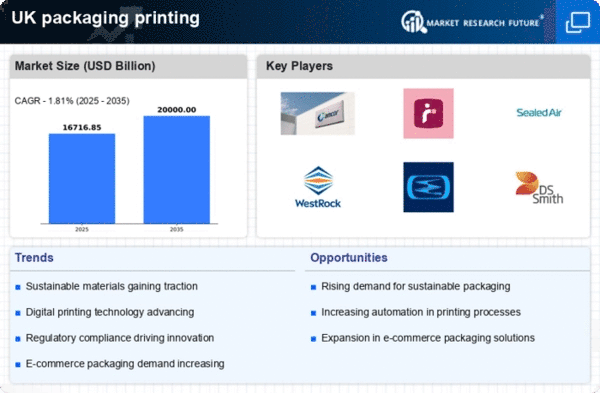
As per Market Research Future analysis, the UK packaging printing market size was estimated at 16419.66 USD Billion in 2024. The UK packaging printing market is projected to grow from 16716.85 USD Billion in 2025 to 20000.0 USD Billion by 2035, exhibiting a compound annual growth rate (CAGR) of 1.8% during the forecast period 2025 - 2035

Key Market Trends & Highlights

The UK packaging printing market is experiencing a transformative shift towards sustainability and technological integration.

  • Sustainability initiatives are becoming increasingly prevalent, reflecting a broader consumer demand for eco-friendly solutions.
  • Technological advancements in printing processes are enhancing efficiency and reducing waste, thereby attracting investment.
  • Customization and personalization are driving growth, particularly in the food and beverage segment, which remains the largest in the market.
  • E-commerce growth and consumer preferences for eco-friendly packaging are key drivers propelling the market forward.

Market Size & Forecast

2024 Market Size 16419.66 (USD Billion)
2035 Market Size 20000.0 (USD Billion)
CAGR (2025 - 2035) 1.81%

Major Players

Amcor (AU), Mondi (GB), Sealed Air (US), WestRock (US), Smurfit Kappa (IE), DS Smith (GB), Graphic Packaging Holding (US), International Paper (US), Ball Corporation (US)

Our Impact
Enabled $4.3B Revenue Impact for Fortune 500 and Leading Multinationals
Partnering with 2000+ Global Organizations Each Year
30K+ Citations by Top-Tier Firms in the Industry

UK Packaging Printing Market Trends

The packaging printing market is currently experiencing a dynamic evolution, driven by various factors that shape consumer preferences and industry practices. Sustainability has emerged as a pivotal concern, with businesses increasingly adopting eco-friendly materials and processes. This shift not only aligns with consumer demand for greener options but also reflects regulatory pressures aimed at reducing environmental impact. Furthermore, technological advancements in printing techniques are enhancing efficiency and quality, allowing for more intricate designs and faster production times. As a result, companies are better positioned to meet the diverse needs of their clientele while maintaining competitive pricing. In addition to sustainability and technology, the packaging printing market is witnessing a notable trend towards customization. Brands are recognizing the value of personalized packaging as a means to engage consumers and differentiate themselves in a crowded marketplace. This trend is further supported by the rise of e-commerce, where unique packaging can enhance the unboxing experience and foster brand loyalty. Overall, the interplay of these factors suggests a vibrant and evolving landscape for the packaging printing market, with opportunities for innovation and growth in the coming years.

Sustainability Initiatives

The emphasis on sustainability within the packaging printing market is becoming increasingly pronounced. Companies are exploring biodegradable materials and eco-friendly inks, responding to consumer demand for environmentally responsible products. This trend is likely to continue as regulations tighten and public awareness of environmental issues grows.

Technological Advancements

Innovations in printing technology are transforming the packaging printing market. Digital printing, for instance, allows for shorter runs and quicker turnaround times, catering to the demand for customized solutions. These advancements not only improve efficiency but also enhance the quality of printed materials.

Customization and Personalization

The trend towards customization is reshaping the packaging printing market. Brands are leveraging unique designs and personalized packaging to create memorable consumer experiences. This approach is particularly relevant in the e-commerce sector, where distinctive packaging can significantly impact customer satisfaction and brand loyalty.

UK Packaging Printing Market Drivers

E-commerce Growth

The rise of e-commerce in the UK has a profound impact on the packaging printing market. As online shopping continues to expand, the demand for innovative and attractive packaging solutions increases. Retailers are seeking packaging that not only protects products but also enhances the unboxing experience for consumers. In 2025, the e-commerce sector is projected to account for approximately 30% of total retail sales in the UK, driving the need for efficient packaging solutions. This trend compels packaging manufacturers to adapt quickly, offering designs that cater to the unique requirements of online sales, such as lightweight materials and easy-to-open features. Consequently, the packaging printing market is likely to witness a surge in demand for custom printed packaging that aligns with brand identity and consumer expectations.

Regulatory Compliance

Regulatory compliance is a critical driver for the packaging printing market in the UK. The government has implemented stringent regulations regarding packaging materials, labeling, and waste management. These regulations aim to reduce environmental impact and promote recycling. For instance, the UK government has set ambitious targets to eliminate avoidable plastic waste by 2042, which influences packaging design and materials used. Companies in the packaging printing market must ensure that their products meet these regulations to avoid penalties and maintain market access. This compliance not only drives innovation in sustainable packaging solutions but also encourages businesses to invest in eco-friendly materials and processes. As a result, the packaging printing market is likely to experience growth as companies seek to align with regulatory standards while appealing to environmentally conscious consumers.

Technological Integration in Production

Technological integration in production processes is reshaping the packaging printing market. Advancements in printing technology, such as digital printing and automation, are enhancing efficiency and reducing production costs. In the UK, the adoption of digital printing technology is expected to grow by approximately 15% annually, as it allows for shorter production runs and greater customization. This technological shift enables packaging manufacturers to respond swiftly to market demands and consumer preferences. Moreover, automation in production lines streamlines operations, reducing lead times and minimizing waste. As a result, companies in the packaging printing market are likely to invest in these technologies to improve their competitive edge and meet the evolving needs of clients. The integration of technology not only enhances productivity but also fosters innovation in packaging design and functionality.

Rising Demand for Custom Packaging Solutions

The rising demand for custom packaging solutions is a notable driver in the packaging printing market. As brands strive to differentiate themselves in a crowded marketplace, unique and personalized packaging has become essential. In the UK, businesses are increasingly recognizing the value of custom packaging in enhancing brand identity and consumer engagement. Approximately 60% of UK consumers report that they are more likely to purchase a product if it features distinctive packaging. This trend encourages packaging manufacturers to offer tailored solutions that reflect the brand's ethos and resonate with target audiences. Consequently, the packaging printing market is likely to see a surge in demand for bespoke designs, innovative materials, and creative printing techniques. This focus on customization not only enhances consumer experience but also drives brand loyalty and repeat purchases.

Consumer Preferences for Eco-Friendly Packaging

Consumer preferences are shifting towards eco-friendly packaging solutions, significantly influencing the packaging printing market. In the UK, a growing number of consumers are prioritizing sustainability in their purchasing decisions. Research indicates that approximately 70% of UK consumers are willing to pay more for products with sustainable packaging. This trend compels brands to adopt environmentally friendly materials and printing techniques, thereby driving innovation within the packaging printing market. Companies are increasingly investing in biodegradable, recyclable, and compostable materials to meet consumer demand. This shift not only enhances brand loyalty but also positions companies favorably in a competitive market. As the trend towards sustainability continues, the packaging printing market is expected to evolve, with a focus on developing packaging solutions that align with consumer values and environmental responsibility.


Market Segment Insights

By Material Type: Plastic (Largest) vs. Paper (Fastest-Growing)

In the UK packaging printing market, the material type segment reveals a diverse distribution of market shares. Plastic currently dominates this segment, accounting for the largest share due to its versatility, durability, and adaptability across various packaging needs. Paper, while less prevalent, is gaining traction among environmentally conscious consumers and businesses, leading to an increase in its market share despite its smaller initial footprint. The growth trends within this segment are driven primarily by a rising demand for sustainable packaging solutions. As consumers increasingly prioritize eco-friendly products, paper is becoming a preferred choice for many brands aiming to reduce their carbon footprint. Conversely, plastic remains vital for certain packaging applications where durability and functionality are paramount, but its growth may be tempered by regulatory pressures and shifts towards recycling initiatives.

Plastic (Dominant) vs. Paper (Emerging)

Plastic packaging remains the dominant force in the material type segment due to its extensive applications, including food safety and preservation. Its lightweight nature and cost-effectiveness make it a preferred choice among manufacturers. Furthermore, technological advancements in plastic production and recycling are boosting its market position. In contrast, paper packaging is an emerging choice, especially among brands focusing on sustainability. Paper's biodegradability and consumer preferences for greener alternatives are enhancing its market appeal. The competition between plastic and paper reflects broader shifts towards environmental consciousness, shaping future trends in the UK packaging printing market.

By Printing Technology: Flexographic Printing (Largest) vs. Digital Printing (Fastest-Growing)

The UK packaging printing market has seen varied distribution among its printing technology segments, with Flexographic Printing leading in market share due to its efficiency in mass production and versatility across various substrates. Digital Printing, while smaller in its share, is rapidly gaining traction, appealing to businesses seeking customization and shorter production runs.

Flexographic Printing (Dominant) vs. Digital Printing (Emerging)

Flexographic Printing is characterized by its high-speed capabilities and flexibility, making it the go-to technology for large-scale orders in packaging. It thrives in producing high-quality prints on a variety of materials, from flexible packaging to labels. On the other hand, Digital Printing is emerging as a disruptive technology, favored for its capabilities in short runs and quick turnaround times. Its rise is fueled by the increasing demand for personalized packaging solutions and reduced setup costs, attracting smaller businesses and customizable product lines.

By End Use Industry: Food and Beverage (Largest) vs. Pharmaceuticals (Fastest-Growing)

In the UK packaging printing market, the Food and Beverage segment commands a substantial share, reflecting the essential nature of packaging in ensuring product safety and brand visibility. Pharmaceuticals follow closely, driven by stringent regulations and the need for effective information display. Cosmetics and Consumer Goods, while significant, occupy smaller portions of the overall market share. The growth trends within the end-use industry reveal that the Pharmaceuticals segment is the fastest-growing, thanks to the rising investment in healthcare and increased demand for packaged medicines. Conversely, the Food and Beverage segment remains dominant, fueled by evolving consumer preferences towards convenient, sustainable packaging solutions that enhance branding and reduce environmental impact.

Food and Beverage (Dominant) vs. Cosmetics (Emerging)

The Food and Beverage segment stands as the dominant player in the UK packaging printing market, characterized by its extensive use of vibrant graphics and innovative designs that appeal to consumers. This segment emphasizes functionality and eye-catching presentation to attract buyers. In contrast, the Cosmetics segment, though emerging, is gaining traction by focusing on eco-friendly packaging and unique branding solutions. While Food and Beverage prioritizes volume and distribution efficiency, Cosmetics is navigating a niche market that values aesthetic appeal and sustainability, positioning it as a significant segment with growth potential in the future.

By Packaging Type: Labels (Largest) vs. Flexible Packaging (Fastest-Growing)

In the UK packaging printing market, labels command the largest share, offering significant visibility and branding opportunities for products across various sectors. Rigid packaging follows closely, as it is favored for its strength and appeal in sectors that require high product protection. Flexible packaging and corrugated boxes hold essential positions, serving specific needs in convenience and logistics, respectively. The growth of flexible packaging in particular has been remarkable, driven by its versatility and the changing preferences of consumers towards lightweight and recyclable materials. Moreover, technological advancements in printing techniques further enhance the visual appeal and durability of these products, fostering increased adoption rates. Labels continue to dominate, especially in retail, while corrugated boxes benefit from e-commerce growth, highlighting a dynamic landscape within the segment.

Labels (Dominant) vs. Corrugated Boxes (Emerging)

Labels represent the dominant force in the UK packaging printing market, known for their ability to convey essential product information while enhancing brand identity. Their versatility allows them to be applied across a wide range of packaging types, making them indispensable in the retail sector. On the other hand, corrugated boxes are emerging as a vital segment, driven by the rise of e-commerce and the need for sturdy, protective packaging during transit. Although they may not currently compete with labels in volume, innovations in design and sustainability are propelling them into a growing market position, particularly as consumers increasingly favor eco-friendly packaging solutions.

Get more detailed insights about UK Packaging Printing Market

Key Players and Competitive Insights

The packaging printing market in the UK is characterized by a dynamic competitive landscape, driven by factors such as sustainability, technological advancements, and evolving consumer preferences. Major players like Amcor (AU), Mondi (GB), and DS Smith (GB) are strategically positioned to leverage these trends. Amcor (AU) focuses on innovation in sustainable packaging solutions, while Mondi (GB) emphasizes its commitment to circular economy principles. DS Smith (GB) is enhancing its operational efficiency through digital transformation initiatives. Collectively, these strategies not only enhance their market presence but also shape a competitive environment that increasingly prioritizes sustainability and innovation.Key business tactics employed by these companies include localizing manufacturing and optimizing supply chains to enhance responsiveness to market demands. The market structure appears moderately fragmented, with several key players exerting influence over various segments. This fragmentation allows for a diverse range of offerings, yet the collective strength of these major companies suggests a competitive environment where collaboration and strategic partnerships are becoming increasingly vital.

In September Amcor (AU) announced a partnership with a leading technology firm to develop smart packaging solutions that integrate digital features for enhanced consumer engagement. This strategic move is significant as it aligns with the growing trend towards digitalization in packaging, potentially allowing Amcor to capture a larger share of the market by offering innovative solutions that meet consumer demands for interactivity and information.

In October Mondi (GB) launched a new line of recyclable packaging products aimed at reducing plastic waste. This initiative not only reinforces Mondi's commitment to sustainability but also positions the company favorably in a market increasingly driven by eco-conscious consumer behavior. The introduction of these products is likely to enhance Mondi's competitive edge, as businesses seek to align with sustainability goals.

In August DS Smith (GB) expanded its operations by acquiring a local packaging firm, thereby increasing its production capacity and market reach. This acquisition is strategically important as it allows DS Smith to strengthen its foothold in the UK market while enhancing its ability to offer customized solutions to clients. Such moves indicate a trend towards consolidation in the market, where companies seek to bolster their capabilities through strategic acquisitions.

As of November the competitive trends in the packaging printing market are increasingly defined by digitalization, sustainability, and the integration of AI technologies. Strategic alliances are shaping the landscape, enabling companies to pool resources and expertise to innovate more effectively. Looking ahead, competitive differentiation is likely to evolve from traditional price-based competition to a focus on innovation, technological advancements, and supply chain reliability. This shift underscores the importance of adaptability and forward-thinking strategies in maintaining a competitive edge.

Key Companies in the UK Packaging Printing Market include

Industry Developments

The UK Packaging Printing Market has recently experienced several notable developments. In September 2023, Mondi Group announced its plans to enhance its sustainable packaging solutions, aligning with the UK's focus on reducing plastic waste. Similarly, Graham Packaging is advancing innovative lightweight container designs aimed at improving resource efficiency.

In terms of mergers and acquisitions, Amcor completed its acquisition of a leading UK flexible packaging firm in August 2023, strengthening its product offerings in the regional market.

Despite the challenges posed by economic fluctuations, the packaging sector remains robust, with companies like DS Smith reporting a significant year-on-year growth of 10% in its packaging business for Q3 2023. The continual emphasis on eco-friendly materials is shaping the landscape as Smurfit Kappa expands its portfolio with sustainable products.

Furthermore, Quad/Graphics is eyeing technological advancements through investments in digital printing to meet the evolving demands of the market. Over the past couple of years, the rise in e-commerce has further propelled the packaging printing industry, supporting companies such as Printpack in their pursuit of innovation to cater to diverse consumer needs in the UK.

Future Outlook

UK Packaging Printing Market Future Outlook

The packaging printing market is projected to grow at 1.81% CAGR from 2025 to 2035, driven by sustainability trends, technological advancements, and increasing demand for customized solutions.

New opportunities lie in:

  • Invest in digital printing technologies for faster turnaround and reduced waste.
  • Develop eco-friendly packaging materials to meet regulatory demands and consumer preferences.
  • Expand into e-commerce packaging solutions to capitalize on the growing online retail market.

By 2035, the packaging printing market is expected to be robust, driven by innovation and sustainability.

Market Segmentation

UK Packaging Printing Market Material Type Outlook

  • Plastic
  • Paper
  • Metal
  • Glass

UK Packaging Printing Market Packaging Type Outlook

  • Labels
  • Flexible Packaging
  • Rigid Packaging
  • Corrugated Boxes

UK Packaging Printing Market End Use Industry Outlook

  • Food and Beverage
  • Pharmaceuticals
  • Cosmetics
  • Consumer Goods

UK Packaging Printing Market Printing Technology Outlook

  • Flexographic Printing
  • Digital Printing
  • Rotogravure Printing
  • Offset Printing

Report Scope

MARKET SIZE 2024 16419.66(USD Billion)
MARKET SIZE 2025 16716.85(USD Billion)
MARKET SIZE 2035 20000.0(USD Billion)
COMPOUND ANNUAL GROWTH RATE (CAGR) 1.81% (2025 - 2035)
REPORT COVERAGE Revenue Forecast, Competitive Landscape, Growth Factors, and Trends
BASE YEAR 2024
Market Forecast Period 2025 - 2035
Historical Data 2019 - 2024
Market Forecast Units USD Billion
Key Companies Profiled Amcor (AU), Mondi (GB), Sealed Air (US), WestRock (US), Smurfit Kappa (IE), DS Smith (GB), Graphic Packaging Holding (US), International Paper (US), Ball Corporation (US)
Segments Covered Material Type, Printing Technology, End Use Industry, Packaging Type
Key Market Opportunities Adoption of sustainable materials and digital printing technologies enhances growth in the packaging printing market.
Key Market Dynamics Technological advancements drive innovation in packaging printing, enhancing efficiency and sustainability in the UK market.
Countries Covered UK
Leave a Comment

FAQs

What is the expected market size of the UK Packaging Printing Market in 2024?

The UK Packaging Printing Market is expected to be valued at 11.2 billion USD in 2024.

What will the market value of the UK Packaging Printing Market be by 2035?

By 2035, the UK Packaging Printing Market is projected to be valued at 18.46 billion USD.

What is the expected compound annual growth rate (CAGR) for the UK Packaging Printing Market from 2025 to 2035?

The expected CAGR for the UK Packaging Printing Market from 2025 to 2035 is 4.65 percent.

Which technology segment is expected to dominate the UK Packaging Printing Market by 2035?

By 2035, the flexography segment is expected to dominate with a market value of 6.5 billion USD.

What is the market value for the digital technology segment in the UK Packaging Printing Market in 2024?

The digital technology segment is valued at 3.7 billion USD in 2024.

Who are the key players in the UK Packaging Printing Market?

Key players include Mondi Group, Amcor, Smurfit Kappa, and Printpack among others.

What is the estimated market size for the gravure technology segment in 2024?

The gravure technology segment is estimated to have a market size of 3.5 billion USD in 2024.

What are some of the growth drivers for the UK Packaging Printing Market?

Growth drivers include increasing demand for sustainable packaging solutions and innovations in printing technology.

What challenges does the UK Packaging Printing Market currently face?

The market faces challenges such as the rising costs of raw materials and stringent regulations on packaging.

How will the UK Packaging Printing Market be impacted by emerging trends?

Emerging trends like digital transformation and eco-friendly packaging options are expected to significantly influence market growth.

Download Free Sample

Kindly complete the form below to receive a free sample of this Report

Compare Licence

×
Features License Type
Single User Multiuser License Enterprise User
Price $4,950 $5,950 $7,250
Maximum User Access Limit 1 User Upto 10 Users Unrestricted Access Throughout the Organization
Free Customization
Direct Access to Analyst
Deliverable Format
Platform Access
Discount on Next Purchase 10% 15% 15%
Printable Versions