×
Request Free Sample ×

Kindly complete the form below to receive a free sample of this Report

* Please use a valid business email

Leading companies partner with us for data-driven Insights

clients tt-cursor
Hero Background

UK Freight Management System Market

ID: MRFR/ICT/58543-HCR
200 Pages
Garvit Vyas
February 2026

UK Freight Management System Market Research Report: By Components (Solutions, Services), By End Users (Third-party Logistics, Forwarders, Brokers, Shippers, Carriers) andBy Transportations Mode (Road Freight, Ocean Freight, Air Freight, Rail Freight)- Forecast to 2035

Share:
Download PDF ×

We do not share your information with anyone. However, we may send you emails based on your report interest from time to time. You may contact us at any time to opt-out.

UK Freight Management System Market Infographic
Purchase Options

UK Freight Management System Market Summary

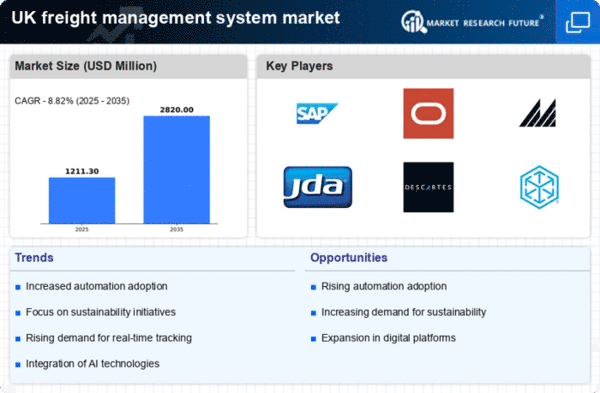
As per Market Research Future analysis, the UK freight management system market size was estimated at 1113.12 USD Million in 2024. The UK freight management-system market is projected to grow from 1211.3 USD Million in 2025 to 2820.0 USD Million by 2035, exhibiting a compound annual growth rate (CAGR) of 8.8% during the forecast period 2025 - 2035

Key Market Trends & Highlights

The UK freight management system is experiencing a transformative shift towards digitalization and sustainability.

  • The largest segment in the UK freight management-system market is the e-commerce sector, which continues to expand rapidly.
  • Sustainability initiatives are becoming increasingly critical as companies seek to reduce their carbon footprints and enhance operational efficiency.
  • Regulatory compliance is driving the adoption of advanced freight management solutions to meet evolving legal standards.
  • Technological advancements and rising fuel costs are key drivers influencing the market's growth trajectory.

Market Size & Forecast

2024 Market Size 1113.12 (USD Million)
2035 Market Size 2820.0 (USD Million)
CAGR (2025 - 2035) 8.82%

Major Players

SAP (DE), Oracle (US), Manhattan Associates (US), JDA Software (US), Descartes Systems Group (CA), C.H. Robinson (US), Kuebix (US), Transporeon (DE), Project44 (US)

Our Impact
Enabled $4.3B Revenue Impact for Fortune 500 and Leading Multinationals
Partnering with 2000+ Global Organizations Each Year
30K+ Citations by Top-Tier Firms in the Industry

UK Freight Management System Market Trends

The freight management-system market is currently experiencing a transformative phase, driven by advancements in technology and the increasing demand for efficient logistics solutions. As businesses strive to optimize their supply chains, the integration of digital tools and platforms has become paramount. This shift not only enhances operational efficiency but also improves visibility and control over freight processes. Moreover, the emphasis on sustainability is reshaping the landscape, as companies seek to reduce their carbon footprints and adopt greener practices. Consequently, the freight management-system market is evolving to accommodate these new priorities, fostering innovation and collaboration among stakeholders. In addition, regulatory changes and economic factors are influencing the dynamics of the freight management-system market. The UK government is actively promoting initiatives aimed at enhancing transportation infrastructure and streamlining customs processes. These efforts are likely to facilitate smoother trade operations and bolster the competitiveness of businesses. As the market continues to adapt to these developments, it appears poised for growth, with opportunities for both established players and new entrants to capitalize on emerging trends and technologies.

Digital Transformation

The freight management-system market is witnessing a significant shift towards digitalization. Companies are increasingly adopting cloud-based solutions and advanced analytics to enhance operational efficiency. This trend enables real-time tracking, improved data management, and better decision-making capabilities, ultimately leading to cost savings and increased customer satisfaction.

Sustainability Initiatives

There is a growing focus on sustainability within the freight management-system market. Businesses are actively seeking ways to minimize their environmental impact by adopting eco-friendly practices. This includes optimizing routes, utilizing alternative fuels, and implementing green technologies, which not only benefit the environment but also appeal to environmentally conscious consumers.

Regulatory Compliance

The freight management-system market is heavily influenced by regulatory changes. The UK government is implementing new policies aimed at improving transportation efficiency and safety. Companies must stay abreast of these regulations to ensure compliance, which can lead to enhanced operational practices and a more competitive edge in the market.

UK Freight Management System Market Drivers

E-commerce Growth

The rapid growth of e-commerce is significantly impacting the freight management-system market. With online retail sales in the UK projected to reach £200 billion by 2025, logistics providers are under pressure to enhance their delivery capabilities. This surge in demand for efficient freight solutions necessitates advanced management systems that can handle increased shipment volumes and provide timely deliveries. Consequently, companies are investing in freight management systems to streamline operations, improve inventory management, and enhance customer service. The ability to adapt to the e-commerce boom is crucial for success in the freight management-system market.

Rising Fuel Costs

Rising fuel costs are a critical driver influencing the freight management-system market. Fluctuations in oil prices can significantly impact transportation expenses, prompting logistics companies to seek more efficient solutions. In the UK, fuel prices have seen an increase of approximately 20% over the past year, which has led to a heightened focus on cost management within the freight sector. As a result, companies are increasingly turning to freight management systems that offer fuel optimization features, enabling them to reduce operational costs and improve profitability. This trend underscores the importance of adopting advanced technologies in the freight management-system market.

Focus on Cost Efficiency

Cost efficiency remains a paramount concern for businesses operating within the freight management-system market. As competition intensifies, companies are compelled to streamline their operations and reduce overhead costs. This focus on cost efficiency is driving the adoption of advanced freight management systems that facilitate better resource allocation and operational optimization. By leveraging data analytics and automation, businesses can identify inefficiencies and implement strategies to minimize waste. The potential for cost savings is substantial, with some companies reporting reductions in logistics costs by as much as 25% after implementing these systems. This trend highlights the critical role of cost management in the freight management-system market.

Technological Advancements

The freight management-system market is experiencing a surge in technological advancements, which are reshaping logistics operations. Innovations such as artificial intelligence (AI), machine learning, and the Internet of Things (IoT) are enhancing operational efficiency and decision-making processes. For instance, AI-driven analytics can optimize route planning, potentially reducing transportation costs by up to 15%. Furthermore, the integration of IoT devices allows for real-time tracking of shipments, improving visibility and customer satisfaction. As these technologies become more accessible, companies in the freight management-system market are likely to adopt them to remain competitive and meet evolving customer demands.

Customer Demand for Transparency

In the freight management-system market, there is a growing demand for transparency and visibility in supply chain operations. Customers are increasingly expecting real-time updates on their shipments, which necessitates the implementation of sophisticated tracking systems. This demand for transparency is driving companies to invest in freight management solutions that provide comprehensive visibility throughout the logistics process. By offering enhanced tracking capabilities, businesses can improve customer satisfaction and build trust. As the market evolves, the ability to provide transparent information will likely become a key differentiator for companies operating in the freight management-system market.


Market Segment Insights

By Components: Solutions (Largest) vs. Services (Fastest-Growing)

In the UK freight management-system market, Solutions hold a significant share compared to Services, making them the largest component within this sector. Businesses increasingly prefer integrated Solutions that provide comprehensive functionalities, allowing for streamlined operations and enhanced logistical efficiency. In contrast, Services are gaining traction, attributing to the rise in demand for specialized freight management support leading to their growing significance. The growth trends in this segment are favorably tilting towards Services, which are seen as the fastest-growing category. Factors driving this growth include the increasing complexity of supply chains and the necessity for tailored solutions, as firms seek to optimize their operations and reduce costs. Additionally, advancements in technology, such as real-time tracking and analytics, are propelling the demand for innovative Services in freight management.

Solutions: Dominant vs. Services: Emerging

Solutions in the UK freight management-system market are characterized by their capacity to offer integrated and customizable platforms that enhance operational efficiency and decision-making processes. This dominance is anchored in the ability to streamline various logistics functions, from inventory management to shipment tracking. On the other hand, Services represent an emerging segment focused on providing expert support and specialized solutions tailored to the unique needs of businesses. This includes consulting, technology integration, and ongoing operational support, reflecting a shift towards more dynamic and responsive freight management strategies that can adapt to evolving market demands.

By End-Users: Third-party Logistics (Largest) vs. Brokers (Fastest-Growing)

In the UK freight management-system market, the market share distribution among end-users reveals the dominance of third-party logistics, which plays a crucial role in handling complex supply chain operations for various industries. This segment holds a significant part of the market, leveraging technology and efficient processes to manage logistics services effectively. Following this, brokers enjoy a growing share as they connect shippers with carriers, facilitating smoother transportation and logistics activities. Growth trends indicate that while third-party logistics remains the largest segment due to their established networks and expertise, brokers are emerging as the fastest-growing category. The increasing demand for e-commerce solutions and real-time freight tracking drives the growth of brokers. This trend is further supported by the need for streamlined communication between different parties involved in the shipping process, showcasing the evolving landscape of the UK freight management-system market.

Third-party Logistics (Dominant) vs. Brokers (Emerging)

Third-party logistics (3PL) serves as the dominant player in the UK freight management-system market, offering integrated solutions that encompass transportation, warehousing, and distribution. These providers capitalize on their established networks and expertise to enhance operational efficiency for shippers and carriers. Advantages include reduced costs, improved service levels, and flexibility to adapt to changing market conditions. On the other hand, brokers are becoming an emerging force in the market, connecting shippers with available carriers and ensuring optimal route selection. Their role is particularly significant in the context of increasing e-commerce activities, where brokers can leverage technology to offer transparency and speed in the shipping process. This dynamic illustrates a shift in how logistics are managed in the UK market, with both segments playing critical roles.

By Transportation Mode: Road Freight (Largest) vs. Air Freight (Fastest-Growing)

Within the UK freight management-system market, Road Freight holds the largest share, making it the predominant mode of transportation for goods. Ocean Freight follows, providing significant capacity for importing and exporting products. Air Freight, while smaller in market share, plays a crucial role for time-sensitive deliveries. Rail Freight, though less common, serves specific industries and regions effectively. Each mode contributes uniquely to the market dynamics and overall freight strategy. Growth trends reflect a burgeoning demand for faster and more efficient transportation solutions. The rise of e-commerce has particularly boosted Air Freight, as businesses require quick delivery options to remain competitive. Road Freight's growth is driven by infrastructure development and increased consumer demand for convenience. Sustainability initiatives are also prompting shifts toward more efficient modes, such as Rail Freight, diversifying the transportation landscape.

Road Freight (Dominant) vs. Rail Freight (Emerging)

Road Freight dominates the UK freight management-system market due to its flexibility and extensive network, allowing swift adaptability to changing logistics needs. It is ideal for short to medium distances, making it significantly advantageous for local deliveries. Rail Freight, on the other hand, is emerging as a sustainable and cost-effective alternative, especially for bulk shipments over longer distances. Its capacity for handling heavy loads and reduced carbon emissions positions it favorably as businesses look for eco-conscious solutions. While currently less utilized compared to Road Freight, Rail Freight's advantages could push its growth, particularly in sectors prioritizing price and environmental impact.

Get more detailed insights about UK Freight Management System Market

Key Players and Competitive Insights

The freight management-system market is currently characterized by a dynamic competitive landscape, driven by the increasing demand for efficiency and transparency in supply chain operations. Key players such as SAP (DE), Oracle (US), and Descartes Systems Group (CA) are actively shaping the market through strategic innovations and partnerships. SAP (DE) focuses on integrating advanced analytics and AI capabilities into its solutions, enhancing operational efficiency for clients. Meanwhile, Oracle (US) emphasizes cloud-based solutions, which facilitate real-time data access and decision-making, thereby improving customer service and operational agility. Descartes Systems Group (CA) is leveraging its expertise in logistics to provide comprehensive solutions that streamline freight operations, indicating a trend towards specialization in service offerings.
The market structure appears moderately fragmented, with a mix of established players and emerging companies vying for market share. Key business tactics include localizing services to meet regional demands and optimizing supply chains to reduce costs. This competitive environment is influenced by the collective actions of major players, who are increasingly focusing on digital transformation and customer-centric solutions to maintain their market positions.
In September 2025, SAP (DE) announced a strategic partnership with a leading logistics provider to enhance its freight management capabilities. This collaboration aims to integrate real-time tracking and predictive analytics into SAP's existing platform, potentially improving supply chain visibility and responsiveness. Such partnerships are indicative of a broader trend towards collaborative innovation in the market.
In October 2025, Oracle (US) launched a new suite of AI-driven tools designed to optimize freight routing and reduce operational costs. This initiative reflects Oracle's commitment to leveraging cutting-edge technology to enhance its service offerings. The introduction of these tools is likely to position Oracle as a leader in the digital transformation of freight management, appealing to companies seeking to improve efficiency and reduce their carbon footprint.
In August 2025, Descartes Systems Group (CA) expanded its operations in the UK by acquiring a regional logistics software firm. This acquisition is expected to bolster Descartes' market presence and enhance its service portfolio, allowing for more tailored solutions to meet local customer needs. Such strategic moves highlight the importance of regional expansion in a competitive landscape where localized solutions are increasingly valued.
As of November 2025, the freight management-system market is witnessing significant trends towards digitalization, sustainability, and AI integration. Companies are forming strategic alliances to enhance their technological capabilities and service offerings, reflecting a shift from traditional price-based competition to a focus on innovation and reliability. This evolution suggests that future competitive differentiation will hinge on the ability to leverage technology effectively, ensuring that supply chains are not only efficient but also resilient and sustainable.

Key Companies in the UK Freight Management System Market include

Industry Developments

Recent developments in the UK Freight Management System Market have shown significant activity, particularly in the realm of mergers and acquisitions. In October 2023, UPS Supply Chain Solutions acquired a regional logistics firm to expand its service capabilities across the UK, enhancing its operational efficiency. Kuehne + Nagel recently reported on its strategic partnerships formed in September 2023, focusing on improving supply chain resilience amidst global disruptions. Meanwhile, DPDgroup has been working towards energy-efficient last-mile delivery options and announced investments following a robust growth trajectory in its revenue this year.

Menzies Distribution also unveiled plans in August 2023 to optimize its fleet with cutting-edge logistics technology to enhance delivery efficiency. Notably, DB Schenker has been ramping up its operations in the UK, emphasizing automation and digitalization in its freight solutions to improve service delivery. The growth in market valuations for these companies indicates a strong momentum in the sector, with various firms innovating to meet shifting consumer demands and regulatory pressures, particularly regarding sustainability initiatives outlined by the UK government. This trend showcases a broader adaptation to the evolving freight landscape in the region.

Future Outlook

UK Freight Management System Market Future Outlook

The freight management-system market is projected to grow at an 8.82% CAGR from 2025 to 2035, driven by technological advancements, increased e-commerce, and demand for efficiency.

New opportunities lie in:

  • Integration of AI-driven analytics for predictive logistics optimization.
  • Development of blockchain solutions for enhanced supply chain transparency.
  • Expansion of automated freight tracking systems to improve operational efficiency.

By 2035, the market is expected to achieve substantial growth, driven by innovation and evolving customer needs.

Market Segmentation

UK Freight Management System Market End-Users Outlook

  • Third-party Logistics
  • Forwarders
  • Brokers
  • Shippers
  • Carriers

UK Freight Management System Market Components Outlook

  • Solutions
  • Services

UK Freight Management System Market Transportation Mode Outlook

  • Road Freight
  • Ocean Freight
  • Air Freight
  • Rail Freight

Report Scope

MARKET SIZE 2024 1113.12(USD Million)
MARKET SIZE 2025 1211.3(USD Million)
MARKET SIZE 2035 2820.0(USD Million)
COMPOUND ANNUAL GROWTH RATE (CAGR) 8.82% (2025 - 2035)
REPORT COVERAGE Revenue Forecast, Competitive Landscape, Growth Factors, and Trends
BASE YEAR 2024
Market Forecast Period 2025 - 2035
Historical Data 2019 - 2024
Market Forecast Units USD Million
Key Companies Profiled SAP (DE), Oracle (US), Manhattan Associates (US), JDA Software (US), Descartes Systems Group (CA), C.H. Robinson (US), Kuebix (US), Transporeon (DE), Project44 (US)
Segments Covered Components, End-Users, Transportation Mode
Key Market Opportunities Integration of advanced analytics and automation enhances efficiency in the freight management-system market.
Key Market Dynamics Technological advancements drive efficiency in freight management systems, reshaping competitive dynamics and regulatory compliance in the UK.
Countries Covered UK
Leave a Comment

FAQs

What is the expected market size of the UK Freight Management System Market in 2024?

The expected market size of the UK Freight Management System Market in 2024 is valued at 1.5 USD Billion.

What is the projected market size of the UK Freight Management System Market by 2035?

The projected market size of the UK Freight Management System Market by 2035 is expected to be 3.4 USD Billion.

What is the expected CAGR for the UK Freight Management System Market from 2025 to 2035?

The expected CAGR for the UK Freight Management System Market from 2025 to 2035 is 7.723%.

What are the major components of the UK Freight Management System Market?

The major components of the UK Freight Management System Market are divided into solutions and services.

What is the market size for solutions in the UK Freight Management System Market for the year 2024?

The market size for solutions in the UK Freight Management System Market is valued at 0.9 USD Billion in the year 2024.

What is the projected market value for services in the UK Freight Management System Market by 2035?

The projected market value for services in the UK Freight Management System Market by 2035 is expected to reach 1.4 USD Billion.

What are the key players in the UK Freight Management System Market?

The key players in the UK Freight Management System Market include Palletways, UPS Supply Chain Solutions, Kuehne + Nagel, and DPDgroup among others.

How will the market for UK Freight Management Systems grow regionally?

The UK Freight Management System Market is expected to grow significantly across various regions due to increasing logistics and transportation needs.

What are some key growth drivers for the UK Freight Management System Market?

Key growth drivers for the UK Freight Management System Market include increasing demand for efficient logistics and advancements in technology.

How do the current global economic conditions impact the UK Freight Management System Market?

The current global economic conditions are expected to influence the UK Freight Management System Market through shifts in supply chain dynamics and operational costs.

Download Free Sample

Kindly complete the form below to receive a free sample of this Report

Compare Licence

×
Features License Type
Single User Multiuser License Enterprise User
Price $4,950 $5,950 $7,250
Maximum User Access Limit 1 User Upto 10 Users Unrestricted Access Throughout the Organization
Free Customization
Direct Access to Analyst
Deliverable Format
Platform Access
Discount on Next Purchase 10% 15% 15%
Printable Versions