Regulatory Compliance and Safety Standards
Regulatory compliance and safety standards are increasingly influencing the Transfer Switch Market. Governments and regulatory bodies are implementing stringent guidelines to ensure safety and reliability in power systems. For instance, the National Fire Protection Association (NFPA) has established codes that necessitate the use of transfer switches in certain applications. This regulatory landscape compels businesses to adopt compliant solutions, thereby driving market growth. The emphasis on safety not only enhances operational reliability but also mitigates risks associated with power outages. Consequently, manufacturers are focusing on developing transfer switches that meet these evolving standards, which could further stimulate market expansion.
Growing Demand for Uninterrupted Power Supply
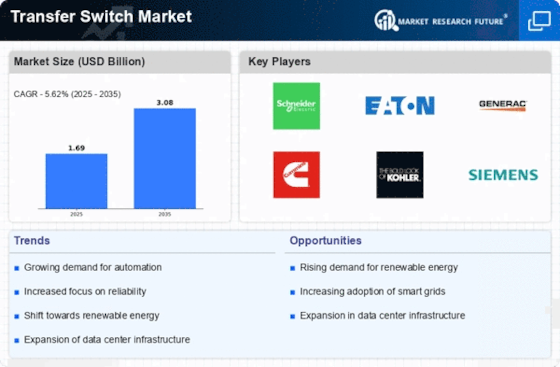
The increasing reliance on uninterrupted power supply across various sectors appears to be a primary driver for the Transfer Switch Market. Industries such as healthcare, data centers, and manufacturing require constant power to maintain operations. According to recent data, the demand for backup power solutions is projected to grow at a compound annual growth rate of approximately 6% over the next five years. This trend indicates a heightened awareness of the need for reliable power sources, thereby propelling the transfer switch market forward. As organizations invest in infrastructure to ensure operational continuity, the transfer switch market is likely to experience significant growth, driven by the necessity for seamless power transitions.
Increased Focus on Renewable Energy Integration
The increased focus on renewable energy integration is significantly influencing the Transfer Switch Market. As nations strive to meet sustainability goals, the incorporation of renewable energy sources into existing power grids is becoming more prevalent. Transfer switches play a vital role in facilitating this integration by enabling smooth transitions between traditional and renewable energy sources. Market analysis indicates that the share of renewable energy in the global energy mix is projected to reach 30% by 2030. This shift not only enhances energy security but also drives the demand for transfer switches that can accommodate diverse energy inputs, thereby fostering market growth.
Rising Investment in Infrastructure Development
Rising investment in infrastructure development is a crucial driver for the Transfer Switch Market. Governments and private entities are allocating substantial funds towards enhancing energy infrastructure, particularly in emerging economies. This investment is aimed at improving power reliability and expanding access to electricity. As infrastructure projects proliferate, the demand for transfer switches is likely to increase, given their essential role in ensuring seamless power transitions. Recent reports indicate that infrastructure spending is expected to grow by 8% annually, which could significantly impact the transfer switch market as new facilities and upgrades necessitate reliable power solutions.
Technological Advancements in Transfer Switches
Technological advancements are reshaping the Transfer Switch Market, with innovations enhancing functionality and efficiency. The integration of smart technologies, such as remote monitoring and automated controls, is becoming increasingly prevalent. These advancements allow for real-time performance tracking and predictive maintenance, which can significantly reduce downtime. Market data suggests that the adoption of smart transfer switches is expected to rise, with a projected increase of 15% in the next few years. This trend indicates a shift towards more sophisticated solutions that cater to the evolving needs of consumers, thereby driving the overall market forward.