×
Request Free Sample ×

Kindly complete the form below to receive a free sample of this Report

* Please use a valid business email

Leading companies partner with us for data-driven Insights

clients tt-cursor
Hero Background

Spain Radiology Information System Market

ID: MRFR/MED/54304-HCR
200 Pages
Rahul Gotadki
February 2026

Spain Radiology Information System Market Research Report: Size, Share, Trend Analysis By Component (Software, Services, Hardware), By Deployment Type (Cloud-Based, On-Premise), By Functionality (Radiology Reporting, Patient Management, Workflow Management, Image Management) and By End Users (Hospitals, Diagnostic Centers, Ambulatory Surgical Centers) - Growth Outlook & Industry Forecast 2025 To 2035

Share:
Download PDF ×

We do not share your information with anyone. However, we may send you emails based on your report interest from time to time. You may contact us at any time to opt-out.

Spain Radiology Information System Market Infographic
Purchase Options

Spain Radiology Information System Market Summary

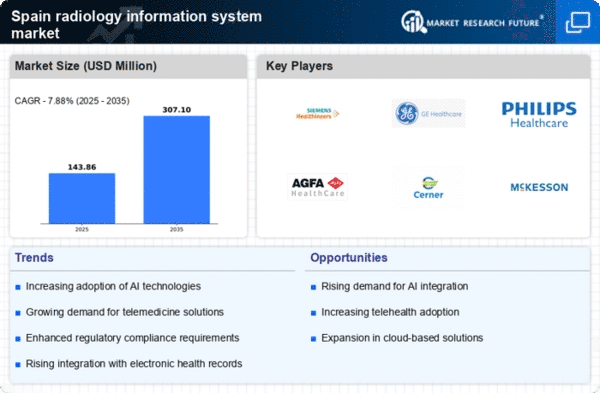
As per Market Research Future analysis, the Spain radiology information system market size was estimated at 133.35 USD Million in 2024. The Spain radiology information-system market is projected to grow from 143.86 USD Million in 2025 to 307.1 USD Million by 2035, exhibiting a compound annual growth rate (CAGR) of 7.8% during the forecast period 2025 - 2035

Key Market Trends & Highlights

The Spain radiology information system market is poised for substantial growth driven by technological advancements and regulatory support.

  • The integration of Artificial Intelligence is transforming diagnostic accuracy and operational efficiency in radiology.
  • Cloud-based solutions are gaining traction, enabling seamless data access and collaboration among healthcare providers.
  • The largest segment in the market is the diagnostic imaging segment, while the fastest-growing segment is tele-radiology services.
  • Technological advancements in imaging techniques and the growing demand for telemedicine services are key drivers of market expansion.

Market Size & Forecast

2024 Market Size 133.35 (USD Million)
2035 Market Size 307.1 (USD Million)
CAGR (2025 - 2035) 7.88%

Major Players

Siemens Healthineers (DE), GE Healthcare (US), Philips Healthcare (NL), Agfa HealthCare (BE), Cerner Corporation (US), McKesson Corporation (US), IBM Watson Health (US), Merge Healthcare (US)

Our Impact
Enabled $4.3B Revenue Impact for Fortune 500 and Leading Multinationals
Partnering with 2000+ Global Organizations Each Year
30K+ Citations by Top-Tier Firms in the Industry

Spain Radiology Information System Market Trends

The radiology information-system market in Spain is currently experiencing notable advancements driven by technological innovations and increasing demand for efficient healthcare solutions. The integration of artificial intelligence and machine learning into radiology systems appears to enhance diagnostic accuracy and streamline workflows. Furthermore, the growing emphasis on patient-centered care suggests a shift towards systems that prioritize user experience and accessibility. As healthcare providers seek to improve operational efficiency, the adoption of cloud-based solutions is likely to rise, enabling remote access to imaging data and facilitating collaboration among medical professionals. In addition, regulatory frameworks in Spain are evolving to support the implementation of advanced radiology information systems. This regulatory environment may encourage investments in digital health technologies, fostering a competitive landscape. The focus on data security and patient privacy is paramount, as stakeholders navigate the complexities of compliance with local and European regulations. Overall, the radiology information-system market in Spain is poised for growth, driven by innovation, regulatory support, and a commitment to enhancing patient outcomes.

Integration of Artificial Intelligence

The incorporation of artificial intelligence into radiology information systems is transforming diagnostic processes. AI algorithms assist radiologists in interpreting images more accurately and efficiently, potentially reducing human error. This trend indicates a shift towards more automated workflows, allowing healthcare professionals to focus on complex cases.

Cloud-Based Solutions

The adoption of cloud-based radiology information systems is gaining traction among healthcare providers. These solutions offer flexibility, scalability, and remote access to imaging data, which is particularly beneficial in collaborative environments. This trend may enhance the efficiency of radiology departments and improve patient care.

Regulatory Support for Digital Health

The evolving regulatory landscape in Spain is increasingly supportive of digital health initiatives. This environment encourages the development and implementation of advanced radiology information systems. Compliance with data protection regulations is crucial, as it fosters trust among patients and healthcare providers.

Spain Radiology Information System Market Drivers

Rising Healthcare Expenditure

The increase in healthcare expenditure in Spain is a significant driver for the radiology information-system market. As the government allocates more funds to healthcare, there is a corresponding rise in investments in advanced medical technologies, including radiology information systems. Recent reports indicate that healthcare spending in Spain is projected to grow by approximately 5% annually, reflecting a commitment to improving healthcare infrastructure. This trend suggests that healthcare facilities are more likely to invest in modern radiology information systems to enhance operational efficiency and patient care. Consequently, the market is poised for growth as providers seek to leverage these systems to meet the evolving demands of the healthcare landscape.

Increased Focus on Patient-Centric Care

The shift towards patient-centric care in Spain is driving changes in the radiology information-system market. Healthcare providers are increasingly prioritizing patient engagement and satisfaction, which necessitates the implementation of systems that enhance communication and accessibility. Radiology information systems that offer patient portals, appointment scheduling, and easy access to imaging results are becoming essential. This focus on patient-centric solutions is likely to contribute to market growth, as facilities strive to improve the overall patient experience. Furthermore, studies indicate that patient satisfaction scores are closely linked to the efficiency of information systems, suggesting that investments in these technologies could yield significant returns in terms of patient loyalty and trust.

Growing Demand for Telemedicine Services

The rising demand for telemedicine services in Spain is significantly impacting the radiology information-system market. As healthcare providers increasingly adopt remote consultation and diagnostic services, the need for robust radiology information systems becomes paramount. These systems facilitate the efficient sharing of imaging data and reports between radiologists and referring physicians, thereby enhancing patient care. According to recent data, the telemedicine market in Spain is anticipated to reach €1 billion by 2026, indicating a substantial growth trajectory. This trend suggests that radiology information systems must evolve to support telehealth initiatives, ensuring seamless integration and communication across various platforms.

Regulatory Changes Promoting Digital Health

Recent regulatory changes in Spain are fostering a more favorable environment for the radiology information-system market. The government is actively promoting digital health initiatives, which include the adoption of electronic health records and interoperable systems. These regulations are designed to enhance data sharing and improve healthcare delivery across the country. As a result, radiology information systems that comply with these regulations are likely to see increased adoption among healthcare providers. The market is expected to benefit from these regulatory frameworks, which aim to streamline processes and improve the quality of care. This regulatory support may also encourage investment in innovative technologies that align with national health objectives.

Technological Advancements in Imaging Techniques

The radiology information-system market in Spain is experiencing a notable transformation due to rapid technological advancements in imaging techniques. Innovations such as 3D imaging, digital radiography, and advanced MRI technologies are enhancing diagnostic accuracy and efficiency. These advancements are likely to drive the adoption of sophisticated radiology information systems, as healthcare providers seek to integrate these technologies into their workflows. The market is projected to grow at a CAGR of approximately 8% over the next five years, reflecting the increasing demand for high-quality imaging solutions. Furthermore, the integration of these advanced imaging techniques into radiology information systems is expected to improve patient outcomes and streamline operations within healthcare facilities.


Market Segment Insights

By Component: Software (Largest) vs. Services (Fastest-Growing)

In the Spain radiology information-system market, the component segment is characterized by a diverse range of offerings including software, services, and hardware. Software accounts for the largest share, driven by increasing demand for efficient radiology workflows and better data management capabilities. Services are also significant, providing essential support and integration services to enhance the functionality of hardware and software products. The growth trends indicate a dynamic landscape for the component segment, with services exhibiting the fastest growth rate due to rising healthcare demands and the need for advanced radiological services. As hospitals and clinics continue to adopt digital solutions, the emphasis on software will persist, while services will grow as healthcare providers seek improved operational efficiency and patient outcomes.

Software (Dominant) vs. Services (Emerging)

Software is the dominant component in the Spain radiology information-system market, primarily due to its critical role in managing imaging data and delivering insights to healthcare professionals. The advancements in software solutions, including artificial intelligence and machine learning capabilities, enhance diagnostic accuracy and streamline workflows. In contrast, services represent an emerging field, becoming increasingly important as healthcare providers recognize the necessity of technical support and specialized services to maximize the effectiveness of their radiology systems. This trend is fueled by the complexity of modern healthcare environments, where a robust service infrastructure ensures the seamless operation of medical imaging solutions.

By Deployment Type: Cloud-Based (Largest) vs. On-Premise (Fastest-Growing)

In the Spain radiology information-system market, the deployment type segments exhibit a diverse distribution, with cloud-based solutions currently holding the largest market share. This deployment method has gained traction due to its flexibility, cost-effectiveness, and ease of integration with existing systems, catering well to the evolving needs of healthcare facilities. Conversely, while on-premise solutions represent a smaller segment, they are rapidly emerging as a preferred option among institutions that prioritize data security and control over their infrastructure. The growth trends in this segment are heavily influenced by factors such as increasing demand for interoperability and seamless data access among healthcare providers. Cloud-based systems benefit from their scalability and the rising acceptance of digital transformation in healthcare. Meanwhile, on-premise solutions are seeing increased interest due to regulatory concerns regarding data privacy and patient security, propelling their adoption among healthcare institutions that require stringent compliance with local regulations.

Cloud-Based (Dominant) vs. On-Premise (Emerging)

Cloud-based deployment is currently the dominant approach in the Spain radiology information-system market, favored for its superior scalability, reduced maintenance costs, and enhanced collaborative capabilities. It allows healthcare organizations to access and share radiology data seamlessly and securely, fostering improved patient outcomes. On the other hand, on-premise solutions are emerging as a viable option for institutions that require stricter control over their data and workflows. These solutions cater to organizations that prefer to retain physical, local infrastructure to comply with stringent data protection regulations. Together, these deployment types reflect the dual focus of healthcare providers on flexibility and security in their radiology practices.

By Functionality: Radiology Reporting (Largest) vs. Patient Management (Fastest-Growing)

In the Spain radiology information-system market, Radiology Reporting currently holds the largest market share among the functionality segment values, driven by the increasing demand for efficient diagnostic processes and real-time reporting. Patient Management follows closely, experiencing rapid growth as healthcare providers seek to enhance patient engagement and streamline administrative tasks, catering to the evolving needs of healthcare facilities and patients alike. The growth trends in this segment are significantly influenced by the adoption of advanced technologies such as AI and cloud-based solutions. Workflow Management is also gaining traction as organizations strive for optimized operations and better resource allocation. The increasing focus on interoperability between systems and regulatory compliance further fuels the market demand, positioning the functionality segment for remarkable advancement.

Radiology Reporting (Dominant) vs. Workflow Management (Emerging)

Radiology Reporting stands as the dominant functionality in the Spain radiology information-system market, characterized by its comprehensive solutions that enhance reporting quality and turnaround times for radiology professionals. It facilitates improved communication and collaboration among medical staff, ensuring accurate and timely diagnosis. On the other hand, Workflow Management is emerging, addressing the need for seamless integration of processes within radiology departments. It emphasizes efficiency, resource management, and streamlined operations, which are crucial for maintaining high standards in patient care and meeting the growing demands of the healthcare sector. Both functionalities play pivotal roles in shaping the future landscape of radiology information systems.

By End User: Hospitals (Largest) vs. Diagnostic Centers (Fastest-Growing)

The distribution of market share among the end user segments reveals that hospitals hold the largest share in the Spain radiology information-system market, driven by their consistent demand for advanced imaging technologies and integrated data systems. Diagnostic centers are not far behind, with a growing presence fueled by the increasing trend of outsourced imaging services and specialized diagnostics, appealing to a wide array of patients seeking prompt services. Growth trends within this segment indicate that as hospitals continue to invest in digital transformation and integrated healthcare systems, the demand for comprehensive radiology solutions is expected to increase. Conversely, diagnostic centers are experiencing rapid growth due to consumer preferences for more accessible and convenient imaging services, which are also supported by advancements in technology and regulatory changes that favor outpatient care.

Hospitals (Dominant) vs. Diagnostic Centers (Emerging)

Hospitals serve as the dominant players in the Spain radiology information-system market, benefiting from substantial infrastructure investment and the necessity for comprehensive healthcare services. Their extensive capabilities enable them to integrate advanced radiology systems that enhance patient care quality and operational efficiency. On the other hand, diagnostic centers represent an emerging segment, capitalizing on the rising trend of specialized services driven by consumer demand for convenience and speed. These centers often leverage innovative technologies to provide cost-effective solutions, thereby complementing traditional hospital offerings and attracting a broader patient demographic.

Get more detailed insights about Spain Radiology Information System Market

Key Players and Competitive Insights

The radiology information-system market in Spain is characterized by a dynamic competitive landscape, driven by technological advancements and an increasing demand for efficient healthcare solutions. Major players such as Siemens Healthineers (DE), GE Healthcare (US), and Philips Healthcare (NL) are at the forefront, each adopting distinct strategies to enhance their market presence. Siemens Healthineers (DE) emphasizes innovation through the integration of artificial intelligence (AI) in imaging solutions, aiming to improve diagnostic accuracy and workflow efficiency. Meanwhile, GE Healthcare (US) focuses on regional expansion and partnerships with local healthcare providers to enhance service delivery and accessibility. Philips Healthcare (NL) is also investing heavily in digital transformation, particularly in cloud-based solutions that facilitate remote diagnostics and patient management, thereby shaping a competitive environment that prioritizes technological integration and patient-centric services.The business tactics employed by these companies reflect a concerted effort to optimize operations and adapt to local market needs. Localizing manufacturing and supply chain optimization are prevalent strategies, allowing companies to reduce costs and improve service responsiveness. The market structure appears moderately fragmented, with several key players exerting influence while also facing competition from emerging firms. This fragmentation fosters innovation as companies strive to differentiate their offerings in a crowded marketplace.

In October Siemens Healthineers (DE) announced a strategic partnership with a leading Spanish hospital network to implement AI-driven radiology solutions. This collaboration is poised to enhance diagnostic capabilities and streamline workflows, reflecting Siemens' commitment to leveraging technology for improved patient outcomes. The strategic importance of this partnership lies in its potential to set a benchmark for AI integration in radiology, positioning Siemens as a leader in this niche.

In September GE Healthcare (US) launched a new cloud-based platform designed to facilitate real-time data sharing among healthcare providers. This initiative aims to enhance collaboration and improve patient care by providing instant access to imaging data. The strategic significance of this move is underscored by the growing trend towards digital health solutions, which are increasingly becoming essential in modern healthcare delivery.

In August Philips Healthcare (NL) unveiled a new suite of imaging solutions that incorporate advanced analytics and machine learning capabilities. This launch is indicative of Philips' focus on innovation and its commitment to enhancing diagnostic precision. The strategic relevance of this development lies in its alignment with the broader industry trend towards data-driven decision-making, which is likely to redefine standards in radiology.

As of November the competitive trends in the radiology information-system market are increasingly defined by digitalization, sustainability, and AI integration. Strategic alliances among key players are shaping the landscape, fostering collaboration that enhances technological capabilities and service delivery. Looking ahead, competitive differentiation is expected to evolve, with a shift from price-based competition to a focus on innovation, technology, and supply chain reliability. This transition suggests that companies that prioritize these elements will likely gain a competitive edge in the rapidly evolving market.

Key Companies in the Spain Radiology Information System Market include

Industry Developments

In recent months, the Spain Radiology Information System Market has been witnessing significant developments. Key companies, including Philips Healthcare and Siemens Healthineers, are actively investing in technological enhancements to improve diagnostic efficiency and patient outcomes. Furthermore, March 2023, GE Healthcare announced partnerships with several regional hospitals to integrate their Artificial Intelligence capabilities into existing Radiology Information Systems, aiming to streamline workflows. 

Notably, in April 2023, Cerner Corporation made headlines as it acquired a local software developer focusing on enhancing data interoperability within health systems, showcasing a strategic move to bolster its market presence. The market has seen an uptick in valuation due to increased demand for digital healthcare solutions post-COVID-19, with market growth supported by government initiatives aimed at improving public health infrastructure. 

Recent figures suggest a compound annual growth rate that is set to accelerate, particularly with advancements from companies like IBM Watson Health and Agfa HealthCare focusing on predictive analytics. These advancements not only reflect the urgency for modernized healthcare solutions in Spain but also the commitment of these companies to lead innovative transformations in radiology practices.


Future Outlook

Spain Radiology Information System Market Future Outlook

The Radiology Information System Market in Spain is projected to grow at a 7.88% CAGR from 2025 to 2035, driven by technological advancements, increasing healthcare demands, and enhanced data management solutions.

New opportunities lie in:

  • Integration of AI-driven diagnostic tools for improved accuracy and efficiency.
  • Development of cloud-based platforms for remote access and data sharing.
  • Expansion of mobile radiology applications to enhance patient engagement and service delivery.

By 2035, the market is expected to achieve substantial growth, reflecting evolving healthcare needs and technological innovations.

Market Segmentation

Spain Radiology Information System Market End User Outlook

  • Hospitals
  • Diagnostic Centers
  • Ambulatory Surgical Centers

Spain Radiology Information System Market Component Outlook

  • Software
  • Services
  • Hardware

Spain Radiology Information System Market Functionality Outlook

  • Radiology Reporting
  • Patient Management
  • Workflow Management
  • Image Management

Spain Radiology Information System Market Deployment Type Outlook

  • Cloud-Based
  • On-Premise

Report Scope

MARKET SIZE 2024133.35(USD Million)
MARKET SIZE 2025143.86(USD Million)
MARKET SIZE 2035307.1(USD Million)
COMPOUND ANNUAL GROWTH RATE (CAGR)7.88% (2025 - 2035)
REPORT COVERAGERevenue Forecast, Competitive Landscape, Growth Factors, and Trends
BASE YEAR2024
Market Forecast Period2025 - 2035
Historical Data2019 - 2024
Market Forecast UnitsUSD Million
Key Companies ProfiledSiemens Healthineers (DE), GE Healthcare (US), Philips Healthcare (NL), Agfa HealthCare (BE), Cerner Corporation (US), McKesson Corporation (US), IBM Watson Health (US), Merge Healthcare (US)
Segments CoveredComponent, Deployment Type, Functionality, End User
Key Market OpportunitiesIntegration of artificial intelligence for enhanced diagnostic accuracy in the radiology information-system market.
Key Market DynamicsTechnological advancements drive competitive dynamics in the radiology information-system market, enhancing efficiency and patient care.
Countries CoveredSpain
Leave a Comment

FAQs

What is the expected market size of the Spain Radiology Information System Market in 2024?

The Spain Radiology Information System Market is expected to be valued at 133.2 million USD in 2024.

What will be the market value in 2035 for the Spain Radiology Information System Market?

By 2035, the Spain Radiology Information System Market is projected to reach a value of 321.3 million USD.

What is the expected CAGR for the Spain Radiology Information System Market from 2025 to 2035?

The expected compound annual growth rate (CAGR) for the Spain Radiology Information System Market from 2025 to 2035 is 8.334%.

Who are the major players in the Spain Radiology Information System Market?

Key players in the Spain Radiology Information System Market include companies such as Philips Healthcare, Siemens Healthineers, and GE Healthcare.

What is the value of the software segment in the Spain Radiology Information System Market for 2024?

The software segment of the Spain Radiology Information System Market is valued at 53.2 million USD in 2024.

How much will the services component be worth in the Spain Radiology Information System Market by 2035?

By 2035, the services component is expected to be valued at 120.5 million USD in the Spain Radiology Information System Market.

What are the growth drivers for the Spain Radiology Information System Market?

The Spain Radiology Information System Market is driven by advancements in imaging technology and increased demand for effective healthcare solutions.

What challenges does the Spain Radiology Information System Market currently face?

The Spain Radiology Information System Market faces challenges such as data security concerns and high implementation costs.

What is the expected market value of hardware in the Spain Radiology Information System Market for 2035?

In 2035, the hardware segment of the Spain Radiology Information System Market is expected to reach a value of 67.7 million USD.

How will current global scenarios impact the Spain Radiology Information System Market?

Current global scenarios may lead to disruptions in supply chains and affect the overall growth and investment in the Spain Radiology Information System Market.

Download Free Sample

Kindly complete the form below to receive a free sample of this Report

Compare Licence

×
Features License Type
Single User Multiuser License Enterprise User
Price $4,950 $5,950 $7,250
Maximum User Access Limit 1 User Upto 10 Users Unrestricted Access Throughout the Organization
Free Customization
Direct Access to Analyst
Deliverable Format
Platform Access
Discount on Next Purchase 10% 15% 15%
Printable Versions