×
Request Free Sample ×

Kindly complete the form below to receive a free sample of this Report

* Please use a valid business email

Leading companies partner with us for data-driven Insights

clients tt-cursor
Hero Background

UK Radiology Information System Market

ID: MRFR/HC/54297-HCR
200 Pages
Rahul Gotadki
February 2026

UK Radiology Information System Market Research Report: Size, Share, Trend Analysis By Component (Software, Services, Hardware), By Deployment Type (Cloud-Based, On-Premise), By Functionality (Radiology Reporting, Patient Management, Workflow Management, Image Management) and By End Users (Hospitals, Diagnostic Centers, Ambulatory Surgical Centers) - Growth Outlook & Industry Forecast 2025 To 2035

Share:
Download PDF ×

We do not share your information with anyone. However, we may send you emails based on your report interest from time to time. You may contact us at any time to opt-out.

UK Radiology Information System Market Infographic
Purchase Options

UK Radiology Information System Market Summary

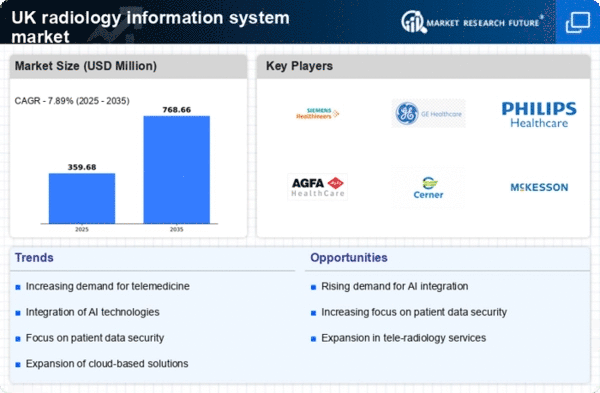
As per Market Research Future analysis, the UK radiology information system market size was estimated at 333.38 USD Million in 2024. The UK radiology information-system market is projected to grow from 359.68 USD Million in 2025 to 768.66 USD Million by 2035, exhibiting a compound annual growth rate (CAGR) of 7.8% during the forecast period 2025 - 2035

Key Market Trends & Highlights

The UK radiology information-system market is experiencing a transformative shift driven by technological advancements and evolving patient needs.

  • The integration of Artificial Intelligence is reshaping diagnostic processes and enhancing operational efficiency.
  • Interoperability and data sharing are becoming essential for seamless communication across healthcare systems.
  • Patient-centric features are increasingly prioritized to improve user experience and engagement in healthcare services.
  • Technological advancements in imaging and the growing demand for telemedicine solutions are key drivers propelling market growth.

Market Size & Forecast

2024 Market Size 333.38 (USD Million)
2035 Market Size 768.66 (USD Million)
CAGR (2025 - 2035) 7.89%

Major Players

Siemens Healthineers (DE), GE Healthcare (US), Philips Healthcare (NL), Agfa HealthCare (BE), Cerner Corporation (US), McKesson Corporation (US), Merge Healthcare (US), eRAD (US)

Our Impact
Enabled $4.3B Revenue Impact for Fortune 500 and Leading Multinationals
Partnering with 2000+ Global Organizations Each Year
30K+ Citations by Top-Tier Firms in the Industry

UK Radiology Information System Market Trends

The radiology information system market is currently experiencing notable transformations. These changes are driven by advancements in technology and the increasing demand for efficient healthcare solutions. The integration of artificial intelligence and machine learning into radiology systems enhances diagnostic accuracy and streamlines workflows. This trend is likely to improve patient outcomes while reducing operational costs for healthcare providers. Furthermore, the emphasis on interoperability among various healthcare systems suggests a shift towards more cohesive data management practices, enabling seamless sharing of patient information across platforms. In addition, the growing focus on patient-centered care is influencing the development of radiology information systems. Healthcare providers are increasingly prioritizing user-friendly interfaces and enhanced patient engagement features. This shift may lead to improved patient satisfaction and adherence to treatment plans. As the radiology information-system market evolves, it is essential for stakeholders to remain adaptable and responsive to these emerging trends, ensuring that they meet the changing needs of healthcare professionals and patients alike.

Integration of Artificial Intelligence

The incorporation of artificial intelligence into radiology information systems is transforming diagnostic processes. AI algorithms are being utilized to analyze imaging data, potentially increasing accuracy and efficiency in identifying conditions. This trend may lead to quicker diagnoses and improved patient care.

Interoperability and Data Sharing

A growing emphasis on interoperability is evident within the radiology information-system market. Systems that facilitate seamless data sharing among healthcare providers are becoming increasingly important. This trend could enhance collaboration and improve patient outcomes by ensuring that all relevant information is readily accessible.

Patient-Centric Features

The focus on patient-centered care is shaping the development of radiology information systems. Enhanced user interfaces and features that promote patient engagement are being prioritized. This trend may lead to higher levels of patient satisfaction and better adherence to medical recommendations.

UK Radiology Information System Market Drivers

Rising Healthcare Expenditure

The radiology information system market is benefiting from the rising healthcare expenditure in the UK. Increased funding for healthcare services is enabling hospitals and clinics to invest in advanced radiology information systems that enhance operational efficiency and patient care. According to recent data, the UK healthcare budget is expected to grow by approximately 5% annually, providing a conducive environment for the adoption of innovative technologies. This financial support allows healthcare providers to upgrade their systems, integrate new functionalities, and improve overall service delivery. As a result, the radiology information-system market is likely to expand, driven by the need for modern solutions that align with the evolving demands of the healthcare landscape.

Increased Focus on Patient Safety

Patient safety is a paramount concern within the healthcare sector, and this focus is increasingly impacting the radiology information-system market. In the UK, healthcare providers are prioritizing systems that enhance patient safety through features such as error reduction, improved data accuracy, and streamlined workflows. The implementation of advanced radiology information systems can significantly mitigate risks associated with misdiagnosis and treatment delays. As hospitals and clinics invest in technologies that promote patient safety, the radiology information-system market is likely to witness growth. This trend reflects a broader commitment to quality care and patient-centered practices, which are essential for maintaining high standards in healthcare.

Regulatory Compliance and Standards

Regulatory compliance plays a pivotal role in shaping the radiology information-system market. In the UK, stringent regulations regarding data protection, patient privacy, and healthcare standards necessitate that radiology information systems adhere to specific guidelines. The General Data Protection Regulation (GDPR) and the Health and Social Care Act impose rigorous requirements on data handling and patient consent. As healthcare providers strive to meet these regulations, the demand for compliant radiology information systems is expected to rise. This compliance not only ensures legal adherence but also enhances patient trust and safety. Consequently, the radiology information-system market is likely to see increased investment in systems that prioritize regulatory compliance, thereby fostering a more secure healthcare environment.

Technological Advancements in Imaging

The radiology information system market is experiencing a surge in technological advancements, particularly in imaging modalities. Innovations such as 3D imaging, digital radiography, and advanced MRI techniques are enhancing diagnostic accuracy and efficiency. The integration of these technologies into radiology information systems is crucial for improving workflow and patient outcomes. In the UK, the market for advanced imaging technologies is projected to grow at a CAGR of approximately 8% over the next five years. This growth is driven by the increasing demand for precise diagnostics and the need for systems that can handle complex imaging data. As hospitals and clinics adopt these advanced systems, the radiology information-system market is likely to expand significantly, reflecting the importance of cutting-edge technology in modern healthcare.

Growing Demand for Telemedicine Solutions

The rise of telemedicine is significantly influencing the radiology information-system market. As healthcare providers in the UK increasingly adopt telehealth solutions, the need for robust radiology information systems that support remote diagnostics and consultations is becoming apparent. This shift is driven by the desire to improve access to care, particularly in rural areas where specialist services may be limited. The market for telemedicine in the UK is projected to reach £2 billion by 2026, indicating a substantial opportunity for radiology information systems that can integrate seamlessly with telehealth platforms. By facilitating remote access to imaging data and enabling real-time consultations, these systems are poised to play a critical role in the evolving landscape of healthcare delivery.


Market Segment Insights

By Component: Software (Largest) vs. Services (Fastest-Growing)

In the UK radiology information-system market, Software holds the largest market share, demonstrating its critical role in streamlining radiology workflows and enhancing diagnostic capabilities. Services, while currently smaller in terms of market share, are rapidly gaining traction as healthcare providers increasingly seek comprehensive support and improved operational efficiency, reflecting a shift towards integrated solutions. The growth trends in this segment show a notable increase in the adoption of cloud-based software solutions, which are driving the demand for innovation and scalability in service offerings. Additionally, advancements in artificial intelligence and machine learning are propelling the development of software applications tailored for radiology, which significantly impacts the market landscape and creates new opportunities for service providers.

Services (Dominant) vs. Hardware (Emerging)

In the context of the UK radiology information-system market, Services are seen as the dominant component, providing essential support and expertise to healthcare organizations. This segment includes consulting, installation, and maintenance services, which are invaluable for maximizing operational efficiency and ensuring system reliability. On the other hand, Hardware is an emerging segment, comprising imaging devices and infrastructure needed to run radiology software. Although it currently trails behind in market presence, advancements in hardware technology and integration capabilities are positioning it for future growth, making it a `must-watch` segment in the evolving radiology landscape.

By Deployment Type: Cloud-Based (Largest) vs. On-Premise (Fastest-Growing)

In the UK radiology information-system market, the deployment types are prominently divided between cloud-based and on-premise solutions. Cloud-based systems are currently dominating the market, capturing a significant share due to their flexibility, lower upfront costs, and ease of integration with existing healthcare systems. On-premise solutions, while less prevalent, are experiencing a surge in interest as organizations prioritize data control and security, driven by the need for compliance with regulations. Growth trends within this segment indicate a robust shift towards cloud-based solutions as healthcare providers adapt to remote access and telehealth solutions. The demand for increased interoperability among healthcare systems further propels cloud adoption, with on-premise solutions rapidly evolving to incorporate hybrid functionalities. The market is expected to see substantial transformations, driven by technological advancements and increasing investments in digital transformation initiatives.

Cloud-Based (Dominant) vs. On-Premise (Emerging)

Cloud-based systems in the UK radiology information-system market are recognized for their scalability, cost-effectiveness, and ability to facilitate real-time data sharing among healthcare professionals. This deployment type allows healthcare organizations to minimize infrastructure costs and enhances collaboration through secure internet access. On the other hand, on-premise solutions are characterized by their robust security measures and control over sensitive patient data. This deployment type is becoming increasingly attractive to organizations that prioritize compliance and data integrity, leading to significant investments in upgrading on-premise capabilities. Both segments are competing for market share, with cloud solutions leading in growth due to evolving technological demands while on-premise solutions carve out a niche in security-focused environments.

By Functionality: Radiology Reporting (Largest) vs. Patient Management (Fastest-Growing)

In the UK radiology information-system market, Radiology Reporting emerges as the largest segment, commanding a significant share of the market. This segment is essential for generating accurate and timely reports, ensuring quality control, and enhancing clinical decisions. Its dominance is driven by the increasing demand for efficient reporting mechanisms that integrate seamlessly with existing health IT infrastructures. On the other hand, Patient Management is the fastest-growing segment, responding to the growing emphasis on patient-centered care and streamlined processes. This segment focuses on improving patient experiences, ensuring better treatment outcomes, and managing appointments and follow-ups effectively. Growth trends in the UK radiology information-system market are characterized by technological advancements and increasing adoption of digital health solutions. The surge in data analytics and AI-driven technologies plays a crucial role in enhancing functionality across all segments. With an emphasis on interoperability and integration of systems, the market continues to adapt to evolving healthcare needs. Furthermore, the demand for remote healthcare solutions has accelerated the need for innovative functionalities that bolster communication, workflow efficiency, and patient management, thereby propelling rapid growth across various segments.

Radiology Reporting (Dominant) vs. Workflow Management (Emerging)

Radiology Reporting serves as the dominant force within the UK radiology information-system market, offering robust features that facilitate the quick generation of reports and integration with other medical systems. Its established position is supported by healthcare providers' growing need for accuracy and speed in diagnostics. Conversely, Workflow Management is emerging as a critical segment, driven by the demand for enhanced operational efficiencies and reduced turnaround times in radiology departments. While still gaining traction, it is starting to introduce innovative solutions that automate processes and enhance productivity. Both segments are essential contributors to the overall improvement of healthcare delivery, with Radiology Reporting maintaining its strong foothold while Workflow Management rises to meet modern operational challenges.

By End User: Hospitals (Largest) vs. Diagnostic Centers (Fastest-Growing)

In the UK radiology information-system market, the distribution among end users showcases significant dominance by hospitals, which capture the largest market share due to their extensive infrastructure and comprehensive service capabilities. Diagnostic centers follow closely, with an increasing share driven by their specialized services and the rising demand for outpatient procedures, while ambulatory surgical centers hold a smaller yet notable portion of the market. Growth trends indicate a robust expansion in diagnostic centers, attributed to advancements in imaging technologies and the shift towards more outpatient services. The push for operational efficiency and rapid response to patient needs is fostering a more significant role for these centers. On the other hand, hospitals continue to innovate and integrate advanced radiology information systems to enhance patient care and streamline workflow, maintaining their lead in the market.

Hospitals (Dominant) vs. Diagnostic Centers (Emerging)

Hospitals serve as the dominant end users in the UK radiology information-system market, leveraging their large-scale operations and diverse patient bases to implement advanced technologies. Their significant investments in radiology systems enhance diagnostic accuracy and patient management. Conversely, diagnostic centers are seen as emerging players, capitalizing on the trend of outpatient care and efficient service delivery. These centers focus on specialized radiology services, providing fast turnaround times and catering to a growing patient population seeking immediate and precise diagnostic solutions. The competitive landscape is evolving, with both segments innovating to meet changing healthcare needs.

Get more detailed insights about UK Radiology Information System Market

Key Players and Competitive Insights

The radiology information-system market is currently characterized by a dynamic competitive landscape, driven by technological advancements and an increasing demand for efficient healthcare solutions. Key players such as Siemens Healthineers (DE), GE Healthcare (US), and Philips Healthcare (NL) are at the forefront, each adopting distinct strategies to enhance their market positioning. Siemens Healthineers (DE) emphasizes innovation through its focus on artificial intelligence (AI) integration, aiming to streamline workflows and improve diagnostic accuracy. Meanwhile, GE Healthcare (US) is pursuing regional expansion, particularly in underserved markets, to capture a broader customer base. Philips Healthcare (NL) is concentrating on digital transformation, leveraging cloud-based solutions to enhance data accessibility and interoperability, which collectively shapes a competitive environment that is increasingly reliant on technological prowess and strategic partnerships.
In terms of business tactics, companies are localizing manufacturing and optimizing supply chains to enhance operational efficiency. The market appears moderately fragmented, with several key players exerting substantial influence. This structure allows for a diverse range of offerings, yet the collective strategies of these companies indicate a trend towards consolidation, as they seek to leverage synergies and enhance their competitive edge.
In October 2025, Siemens Healthineers (DE) announced a strategic partnership with a leading AI firm to develop advanced imaging solutions. This collaboration is poised to enhance Siemens' product offerings, enabling the integration of cutting-edge AI technologies into their radiology systems. The strategic importance of this move lies in its potential to significantly improve diagnostic capabilities, thereby positioning Siemens as a leader in innovation within the market.
In September 2025, GE Healthcare (US) launched a new initiative aimed at expanding its presence in rural healthcare settings across the UK. This initiative includes the deployment of mobile imaging units equipped with advanced radiology information systems. The strategic significance of this action is multifaceted; it not only addresses the accessibility challenges faced by rural populations but also strengthens GE's brand presence in a competitive landscape increasingly focused on equitable healthcare delivery.
In August 2025, Philips Healthcare (NL) unveiled a new cloud-based platform designed to enhance data sharing among healthcare providers. This platform aims to facilitate seamless communication and collaboration, which is critical in today’s interconnected healthcare environment. The strategic relevance of this development is underscored by the growing emphasis on interoperability, suggesting that Philips is positioning itself to meet the evolving needs of healthcare systems.
As of November 2025, the competitive trends within the radiology information-system market are increasingly defined by digitalization, sustainability, and AI integration. Strategic alliances are becoming more prevalent, as companies recognize the value of collaboration in driving innovation. Looking ahead, competitive differentiation is likely to evolve from traditional price-based competition towards a focus on technological innovation, enhanced service delivery, and supply chain reliability. This shift indicates a market poised for transformation, where the ability to adapt and innovate will be paramount for sustained success.

Key Companies in the UK Radiology Information System Market include

Industry Developments

The UK Radiology Information System Market has recently experienced significant developments, marked by increasing investments from major players. Philips Healthcare continues to innovate in the field, enhancing interoperability in imaging technologies. Visage Imaging has focused on improving efficiency through advanced visualization techniques. Carestream Health has expanded its cloud-based solutions, allowing greater accessibility for healthcare providers across the UK. 

Furthermore, in June 2023, Siemens Healthineers announced the acquisition of a leading software firm to bolster its imaging solutions aimed at improving patient care and operational efficiency. There has also been a notable increase in the demand for AI-driven technologies within these systems, with companies like GE Healthcare championing AI integration to streamline workflows. 

The UK's National Health Service has indicated significant budget allocations towards updating radiology systems and integrating data analytics to enhance decision-making processes. Additionally, the ongoing COVID-19 pandemic has accelerated the push toward digital solutions and teleradiology, further impacting the market's growth trajectory in recent years.


Future Outlook

UK Radiology Information System Market Future Outlook

The Radiology Information System Market is projected to grow at a 7.89% CAGR from 2025 to 2035, driven by technological advancements, increasing demand for imaging services, and enhanced data management solutions.

New opportunities lie in:

  • Integration of AI-driven diagnostic tools for improved accuracy and efficiency.
  • Development of cloud-based platforms for remote access and data sharing.
  • Expansion of mobile radiology applications to enhance patient engagement and service delivery.

By 2035, the market is expected to achieve substantial growth, driven by innovation and strategic investments.

Market Segmentation

UK Radiology Information System Market End User Outlook

  • Hospitals
  • Diagnostic Centers
  • Ambulatory Surgical Centers

UK Radiology Information System Market Component Outlook

  • Software
  • Services
  • Hardware

UK Radiology Information System Market Functionality Outlook

  • Radiology Reporting
  • Patient Management
  • Workflow Management
  • Image Management

UK Radiology Information System Market Deployment Type Outlook

  • Cloud-Based
  • On-Premise

Report Scope

MARKET SIZE 2024 333.38(USD Million)
MARKET SIZE 2025 359.68(USD Million)
MARKET SIZE 2035 768.66(USD Million)
COMPOUND ANNUAL GROWTH RATE (CAGR) 7.89% (2025 - 2035)
REPORT COVERAGE Revenue Forecast, Competitive Landscape, Growth Factors, and Trends
BASE YEAR 2024
Market Forecast Period 2025 - 2035
Historical Data 2019 - 2024
Market Forecast Units USD Million
Key Companies Profiled Siemens Healthineers (DE), GE Healthcare (US), Philips Healthcare (NL), Agfa HealthCare (BE), Cerner Corporation (US), McKesson Corporation (US), Merge Healthcare (US), eRAD (US)
Segments Covered Component, Deployment Type, Functionality, End User
Key Market Opportunities Integration of artificial intelligence for enhanced diagnostic accuracy in the radiology information-system market.
Key Market Dynamics Technological advancements drive competitive dynamics in the radiology information-system market, enhancing efficiency and patient care.
Countries Covered UK
Leave a Comment

FAQs

What is the expected market size of the UK Radiology Information System Market in 2024?

The UK Radiology Information System Market is expected to be valued at 416.25 million USD in 2024.

What will the UK Radiology Information System Market be valued at by 2035?

By 2035, the market is anticipated to reach a value of 964.12 million USD.

What is the expected compound annual growth rate (CAGR) for the UK Radiology Information System Market from 2025 to 2035?

The expected CAGR for the market from 2025 to 2035 is 7.935%.

Which segment of the market is expected to have the largest share in 2024?

In 2024, the Software segment is expected to hold the largest share, valued at 166.25 million USD.

What is the estimated growth of the Software segment by 2035?

The Software segment is projected to grow to 387.52 million USD by 2035.

What are the key players in the UK Radiology Information System Market?

Key players in the market include Philips Healthcare, Cerner, Epic Systems, and GE Healthcare among others.

How much revenue will the Services segment generate in 2024?

The Services segment is projected to generate 160 million USD in revenue in 2024.

What is the market value for the Hardware segment in 2035?

The Hardware segment is expected to reach a market value of 198.96 million USD by 2035.

What opportunities exist for growth in the UK Radiology Information System Market?

Opportunities for growth include advancements in radiology technology and increasing demand for efficient patient management systems.

How will the current global trends impact the UK Radiology Information System Market?

Current global trends, such as increased digitalization in healthcare, are likely to positively impact the UK Radiology Information System Market.

Download Free Sample

Kindly complete the form below to receive a free sample of this Report

Compare Licence

×
Features License Type
Single User Multiuser License Enterprise User
Price $4,950 $5,950 $7,250
Maximum User Access Limit 1 User Upto 10 Users Unrestricted Access Throughout the Organization
Free Customization
Direct Access to Analyst
Deliverable Format
Platform Access
Discount on Next Purchase 10% 15% 15%
Printable Versions