×
Request Free Sample ×

Kindly complete the form below to receive a free sample of this Report

* Please use a valid business email

Leading companies partner with us for data-driven Insights

clients tt-cursor
Hero Background

Germany Radiology Information System Market

ID: MRFR/MED/54298-HCR
200 Pages
Rahul Gotadki
February 2026

Germany Radiology Information System Market Research Report: Size, Share, Trend Analysis By Component (Software, Services, Hardware), By Deployment Type (Cloud-Based, On-Premise), By Functionality (Radiology Reporting, Patient Management, Workflow Management, Image Management) and By End Users (Hospitals, Diagnostic Centers, Ambulatory Surgical Centers)– Competitor Industry Analysis and Trends Forecast Till 2035

Share:
Download PDF ×

We do not share your information with anyone. However, we may send you emails based on your report interest from time to time. You may contact us at any time to opt-out.

Germany Radiology Information System Market Infographic
Purchase Options

Germany Radiology Information System Market Summary

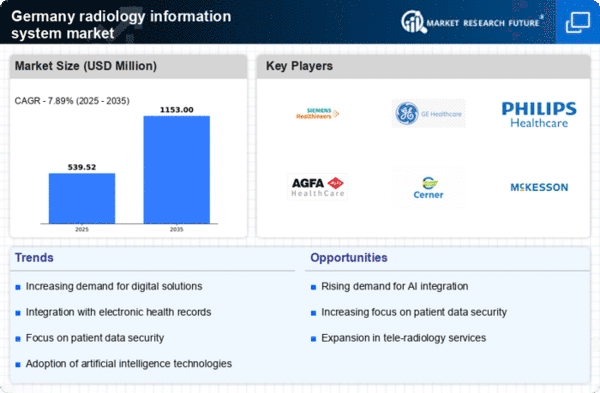
As per Market Research Future analysis, the Germany radiology information system market size was estimated at 500.07 USD Million in 2024. The Germany radiology information-system market is projected to grow from 539.52 USD Million in 2025 to 1153.0 USD Million by 2035, exhibiting a compound annual growth rate (CAGR) of 7.8% during the forecast period 2025 - 2035

Key Market Trends & Highlights

The Germany The radiology information system market is poised for growth, driven by technological advancements and regulatory support.

  • The integration of Artificial Intelligence is transforming diagnostic processes and enhancing efficiency in radiology departments.
  • Interoperability remains a focal point, facilitating seamless data exchange among healthcare systems and improving patient outcomes.
  • Regulatory support for digital health initiatives is fostering innovation and adoption of advanced radiology solutions.
  • Technological advancements in imaging and rising demand for telemedicine solutions are key drivers propelling market expansion.

Market Size & Forecast

2024 Market Size 500.07 (USD Million)
2035 Market Size 1153.0 (USD Million)
CAGR (2025 - 2035) 7.89%

Major Players

Siemens Healthineers (DE), GE Healthcare (US), Philips Healthcare (NL), Agfa HealthCare (BE), Cerner Corporation (US), McKesson Corporation (US), IBM Watson Health (US), Merge Healthcare (US)

Our Impact
Enabled $4.3B Revenue Impact for Fortune 500 and Leading Multinationals
Partnering with 2000+ Global Organizations Each Year
30K+ Citations by Top-Tier Firms in the Industry

Germany Radiology Information System Market Trends

The radiology information system market is currently experiencing notable advancements. This growth is driven by the increasing demand for efficient healthcare solutions. In Germany, healthcare providers are increasingly adopting digital technologies to enhance patient care and streamline operations. This shift is largely influenced by the need for improved data management and interoperability among various healthcare systems. As a result, radiology information systems are becoming integral to the workflow of medical facilities, facilitating better communication and collaboration among healthcare professionals. Moreover, the emphasis on patient-centered care is prompting the integration of advanced analytics and artificial intelligence into radiology information systems. These technologies are expected to enhance diagnostic accuracy and optimize treatment plans. The regulatory environment in Germany supports innovation in this sector. Initiatives aimed at promoting digital health solutions are also in place. Consequently, the radiology information-system market is poised for growth, as stakeholders recognize the potential benefits of adopting these systems in their practices. This trend indicates a shift towards more efficient, data-driven healthcare delivery, which may ultimately lead to improved patient outcomes and satisfaction.

Integration of Artificial Intelligence

The incorporation of artificial intelligence into radiology information systems is becoming increasingly prevalent. This trend suggests that AI can enhance diagnostic capabilities, streamline workflows, and reduce human error. As healthcare providers in Germany seek to improve efficiency, the demand for AI-driven solutions is likely to rise.

Focus on Interoperability

Interoperability among various healthcare systems is a critical focus within the radiology information-system market. The ability to share data seamlessly across platforms is essential for improving patient care. In Germany, efforts to enhance interoperability are being prioritized, indicating a shift towards more connected healthcare environments.

Regulatory Support for Digital Health

The regulatory landscape in Germany is evolving to support the adoption of digital health technologies. This trend indicates that government initiatives are fostering innovation within the radiology information-system market. By creating a favorable environment for digital solutions, stakeholders are encouraged to invest in advanced systems that improve healthcare delivery.

Germany Radiology Information System Market Drivers

Technological Advancements in Imaging

The radiology information-system market is experiencing a surge in technological advancements, particularly in imaging modalities. Innovations such as 3D imaging, digital radiography, and advanced MRI techniques are enhancing diagnostic accuracy and efficiency. In Germany, the adoption of these technologies is expected to increase, driven by a growing demand for precise diagnostics. The market for imaging systems is projected to reach approximately €1.5 billion by 2026, indicating a robust growth trajectory. These advancements not only improve patient outcomes but also streamline workflows within healthcare facilities, thereby propelling the radiology information-system market forward.

Growing Emphasis on Patient-Centric Care

There is a notable shift towards patient-centric care in the healthcare sector, which is influencing the radiology information-system market. Healthcare providers in Germany are increasingly focusing on enhancing patient experiences and outcomes. This shift necessitates the implementation of systems that allow for better communication, data sharing, and personalized treatment plans. As a result, radiology information systems that prioritize patient engagement and data accessibility are likely to see heightened demand. This trend aligns with the broader movement towards value-based care, which is expected to reshape the market landscape in the coming years.

Rising Demand for Telemedicine Solutions

The increasing demand for telemedicine solutions is significantly impacting the radiology information-system market. As healthcare providers in Germany seek to expand their reach and improve access to care, tele-radiology services are becoming more prevalent. This trend is likely to drive the integration of radiology information systems with telehealth platforms, facilitating remote consultations and diagnostics. The telemedicine market in Germany is anticipated to grow at a CAGR of around 25% over the next few years, which could lead to a corresponding increase in the adoption of radiology information systems to support these services.

Regulatory Changes Favoring Digital Solutions

Recent regulatory changes in Germany are favoring the adoption of digital solutions within the healthcare sector, including the radiology information-system market. The government has introduced policies aimed at promoting digital health technologies, which encourages healthcare providers to invest in modern information systems. These regulations are designed to enhance data security, interoperability, and patient privacy, which are essential for the successful implementation of radiology information systems. As compliance with these regulations becomes increasingly important, the market is expected to witness a surge in demand for systems that meet these evolving standards.

Increased Investment in Healthcare Infrastructure

Germany's commitment to enhancing its healthcare infrastructure is a critical driver for the radiology information-system market. The government has been investing significantly in modernizing healthcare facilities, which includes upgrading radiology departments with advanced information systems. This investment is projected to exceed €10 billion by 2025, reflecting a strong focus on improving healthcare delivery. As hospitals and clinics adopt more sophisticated radiology information systems, the overall efficiency and effectiveness of radiological services are likely to improve, thereby fostering market growth.


Market Segment Insights

By Component: Software (Largest) vs. Services (Fastest-Growing)

In the Germany radiology information-system market, the component segment showcases a significant distribution of market share among software, services, and hardware. Software holds the largest portion, driven by the increasing adoption of digital solutions in healthcare settings. Services, while not as dominant in share, are experiencing rapid growth due to rising demand for technical support and system integration. Growth trends in this segment are closely tied to technological advancements and increased investment in health IT systems. The push for enhanced operational efficiency and improved patient care has led to an uptick in software demand. Additionally, services continue to emerge as a crucial area, driven by the need for ongoing support and customization of radiology information systems to meet specific healthcare needs.

Software (Dominant) vs. Services (Emerging)

The software component in the Germany radiology information system market is currently the dominant player. It is characterized by high demand for sophisticated imaging solutions and data management systems. Its robust market position is supported by ongoing innovation and the integration of AI technologies that enhance diagnostic accuracy. On the other hand, the services sector is deemed emerging, with a significant rise in offerings such as training, maintenance, and consultancy. This segment thrives on the complexity and customization of radiology systems, catering to specific operational demands within healthcare facilities. As hospitals and clinics seek to optimize their workflows, the services aspect is becoming increasingly critical, reflecting a shift towards holistic support in technology adoption.

By Deployment Type: Cloud-Based (Largest) vs. On-Premise (Fastest-Growing)

In the Germany radiology information-system market, the deployment types are primarily divided into cloud-based and on-premise solutions. Cloud-based systems capture the largest share, primarily due to their flexibility, ease of access, and reduced infrastructure costs. This segment allows healthcare providers to access radiology information from anywhere, which is increasingly important in today's digital healthcare landscape. In contrast, on-premise solutions, while capturing a smaller share, are gaining traction among organizations that prioritize data security and control over their internal processes. The growth trends in the deployment type segment are significantly influenced by the increasing adoption of cloud technology in healthcare settings. Factors driving this shift include the need for scalability, lower operational costs, and improved interoperability among systems. Organizations are progressively migrating to cloud-based solutions as they seek to enhance patient care and streamline operations. On-premise solutions, although slower in growth, remain relevant for facilities requiring robust data governance and regulatory compliance. Companies are continuously innovating their offerings to meet the evolving needs of healthcare providers.

Deployment Type: Cloud-Based (Dominant) vs. On-Premise (Emerging)

In the Germany radiology information-system market, cloud-based solutions are the dominant deployment type, recognized for their scalability and cost-effectiveness, appealing to a wide range of healthcare providers. These systems enable real-time data access and collaboration among healthcare professionals, significantly enhancing operational efficiency and patient outcomes. Conversely, on-premise solutions are deemed as emerging, as they cater to organizations that prefer maintaining control over sensitive data within their local infrastructure. This segment emphasizes strong data security measures and compliance with stringent regulations, attracting facilities that prioritize safeguarding patient information while integrating advanced radiology technologies.

By Functionality: Radiology Reporting (Largest) vs. Patient Management (Fastest-Growing)

In the Germany radiology information-system market, Radiology Reporting holds the largest market share, widely adopted due to its essential role in generating accurate and timely reports for radiological exams. Patient Management follows as the fastest-growing segment, reflecting an increasing emphasis on enhancing patient experiences and improving overall efficiency within healthcare facilities. Its growth underscores the evolving landscape of healthcare technology aimed at optimizing patient engagement and satisfaction. The growth trends within this segment are driven by advancements in technology and the rising demand for integrated solutions. Workflow Management is also gaining traction as healthcare providers seek to streamline operations and reduce bottlenecks. Meanwhile, Image Management is critical for efficiently handling and storing imaging data, ensuring accessibility for healthcare professionals, and enhancing diagnostic capabilities, contributing to a holistic approach to patient care.

Radiology Reporting (Dominant) vs. Workflow Management (Emerging)

Radiology Reporting is recognized as the dominant force in the Germany radiology information-system market, providing essential tools for generating detailed reports that improve clinical decision-making. Its comprehensive features include dictation capabilities and standardized templates, which facilitate consistency and improve the quality of reports. On the other hand, Workflow Management is an emerging segment, focusing on optimizing clinical processes, enhancing collaboration among departments, and reducing administrative burdens. As healthcare systems evolve, the need for robust workflow solutions becomes increasingly pertinent, supporting efficiency and effective resource allocation. Both segments play crucial roles in ensuring that healthcare providers can deliver high-quality patient care while adapting to changing technological landscapes.

By End User: Hospitals (Largest) vs. Diagnostic Centers (Fastest-Growing)

In the Germany radiology information-system market, hospitals hold the largest share, dominating the end-user segment due to their extensive patient base and need for advanced radiology solutions. Diagnostic centers are also significant players, capturing a growing market share as they increasingly adopt sophisticated imaging technologies to enhance patient diagnosis and care. The growth trends within this segment are driven by advancements in imaging technologies, increased patient throughput demands, and regulatory support for improving healthcare infrastructure. Ambulatory surgical centers are emerging as essential players, leveraging their flexibility and efficiency in providing diagnostic services. However, hospitals remain dominant due to their comprehensive service offerings, while diagnostic centers grow rapidly as specialized consumer preferences evolve.

Hospitals (Dominant) vs. Diagnostic Centers (Emerging)

Hospitals continue to play a dominant role in the Germany radiology information-system market, largely due to their established infrastructure, wide-ranging diagnostic capabilities, and integration with other healthcare services. Their significant financial resources allow them to invest in innovative technologies, ensuring patient care excellence. On the other hand, diagnostic centers are emerging strongly, focusing on targeted imaging solutions that cater specifically to outpatient populations. They provide convenience and specialized services, which appeal to patients seeking quicker, more accessible diagnostic processes. This dynamic individualization in service offerings contributes to their rise within the market, as they adapt more responsively to healthcare trends.

Get more detailed insights about Germany Radiology Information System Market

Key Players and Competitive Insights

The radiology information-system market in Germany is characterized by a dynamic competitive landscape, driven by technological advancements and increasing demand for efficient healthcare solutions. Key players such as Siemens Healthineers (DE), GE Healthcare (US), and Philips Healthcare (NL) are at the forefront, each adopting distinct strategies to enhance their market presence. Siemens Healthineers (DE) focuses on innovation through the development of advanced imaging technologies and integrated solutions, while GE Healthcare (US) emphasizes partnerships with healthcare providers to improve patient outcomes. Philips Healthcare (NL) is leveraging digital transformation to enhance its product offerings, particularly in AI-driven diagnostics, which collectively shapes a competitive environment that prioritizes technological superiority and customer-centric solutions.
The market structure appears moderately fragmented, with several players vying for market share. Key business tactics include localizing manufacturing to reduce costs and optimize supply chains, which is crucial in maintaining competitive pricing. The collective influence of these major companies fosters a competitive atmosphere where innovation and operational efficiency are paramount, allowing them to respond swiftly to market demands and regulatory changes.
In October 2025, Siemens Healthineers (DE) announced a strategic partnership with a leading German hospital network to implement its latest AI-powered radiology solutions. This collaboration aims to streamline workflows and enhance diagnostic accuracy, reflecting Siemens' commitment to integrating cutting-edge technology into clinical practice. Such partnerships not only bolster Siemens' market position but also signify a broader trend towards collaborative innovation in the healthcare sector.
In September 2025, GE Healthcare (US) launched a new cloud-based platform designed to facilitate remote access to radiology data, thereby improving efficiency and accessibility for healthcare providers. This move underscores GE's focus on digital solutions that cater to the evolving needs of healthcare systems, particularly in enhancing telehealth capabilities. The introduction of this platform is likely to strengthen GE's competitive edge by addressing the growing demand for remote healthcare services.
In August 2025, Philips Healthcare (NL) unveiled a new suite of AI-driven imaging tools aimed at improving diagnostic workflows in radiology departments. This initiative not only enhances Philips' product portfolio but also aligns with the increasing emphasis on AI integration within healthcare. By prioritizing AI capabilities, Philips positions itself as a leader in the digital transformation of radiology, potentially reshaping the competitive landscape.
As of November 2025, current trends in the radiology information-system market are heavily influenced by digitalization, sustainability, and the integration of AI technologies. Strategic alliances among key players are increasingly shaping the competitive landscape, fostering innovation and enhancing service delivery. The shift from price-based competition to a focus on technological advancement and supply chain reliability is evident, suggesting that future competitive differentiation will hinge on the ability to innovate and adapt to changing market dynamics.

Key Companies in the Germany Radiology Information System Market include

Industry Developments

The Germany Radiology Information System Market has recently witnessed significant developments, notably in technological integration and partnerships among key players. Philips and Siemens Healthineers have expanded their offerings by integrating advanced Artificial Intelligence capabilities into their radiology systems, enhancing diagnostic accuracy. In September 2023, Cerner Corporation completed the acquisition of a small but innovative health technology firm, augmenting its data analytics capabilities in the radiology domain. 

The market has also been influenced by a growth trend, with reports indicating that the market valuation is projected to rise substantially, driven by an increasing demand for efficient workflow management and improved patient outcomes. Notably, the emphasis on interoperability is becoming a focal point, with Change Healthcare and GE Healthcare collaborating with stakeholders to facilitate seamless data exchange across platforms. 

Major happenings such as the introduction of new software updates by Allscripts Healthcare Solutions in August 2023 to enhance user experience and analytics capabilities have further contributed to the dynamic nature of the market. The push for digital health solutions, backed by favorable regulatory conditions in Germany, underscores the ongoing transformation within the radiology sector.

Future Outlook

Germany Radiology Information System Market Future Outlook

The Radiology Information System Market is projected to grow at a 7.89% CAGR from 2025 to 2035, driven by technological advancements, increasing demand for efficient healthcare solutions, and regulatory support.

New opportunities lie in:

  • Integration of AI-driven diagnostic tools for enhanced accuracy
  • Development of cloud-based radiology platforms for remote access
  • Expansion of mobile radiology applications for on-the-go diagnostics

By 2035, the market is expected to achieve substantial growth, reflecting evolving healthcare needs.

Market Segmentation

Germany Radiology Information System Market End User Outlook

  • Hospitals
  • Diagnostic Centers
  • Ambulatory Surgical Centers

Germany Radiology Information System Market Component Outlook

  • Software
  • Services
  • Hardware

Germany Radiology Information System Market Functionality Outlook

  • Radiology Reporting
  • Patient Management
  • Workflow Management
  • Image Management

Germany Radiology Information System Market Deployment Type Outlook

  • Cloud-Based
  • On-Premise

Report Scope

MARKET SIZE 2024 500.07(USD Million)
MARKET SIZE 2025 539.52(USD Million)
MARKET SIZE 2035 1153.0(USD Million)
COMPOUND ANNUAL GROWTH RATE (CAGR) 7.89% (2025 - 2035)
REPORT COVERAGE Revenue Forecast, Competitive Landscape, Growth Factors, and Trends
BASE YEAR 2024
Market Forecast Period 2025 - 2035
Historical Data 2019 - 2024
Market Forecast Units USD Million
Key Companies Profiled Siemens Healthineers (DE), GE Healthcare (US), Philips Healthcare (NL), Agfa HealthCare (BE), Cerner Corporation (US), McKesson Corporation (US), IBM Watson Health (US), Merge Healthcare (US)
Segments Covered Component, Deployment Type, Functionality, End User
Key Market Opportunities Integration of artificial intelligence enhances diagnostic accuracy in the radiology information-system market.
Key Market Dynamics Technological advancements and regulatory changes drive innovation in the radiology information-system market.
Countries Covered Germany
Leave a Comment

FAQs

What is the expected market size of the Germany Radiology Information System Market in 2024?

The market is expected to be valued at 499.5 million USD in 2024.

What is the projected market size for the Germany Radiology Information System Market by 2035?

The market is projected to reach 1112.0 million USD by 2035.

What is the expected compound annual growth rate (CAGR) for the Germany Radiology Information System Market from 2025 to 2035?

The expected CAGR for the market is 7.547% during the forecast period of 2025 to 2035.

Which component has the highest market valuation in 2024 within the Germany Radiology Information System Market?

The software component is valued at 199.8 million USD in 2024.

What is the anticipated valuation of services in the Germany Radiology Information System Market by 2035?

The services component is expected to be valued at 388.3 million USD by 2035.

Who are the major players in the Germany Radiology Information System Market?

Key players include Philips, Nuance Communications, Cerner Corporation, Siemens Healthineers, and GE Healthcare.

What is the estimated value of the hardware component in the Germany Radiology Information System Market in 2024?

The hardware component is estimated to be valued at 119.8 million USD in 2024.

What market growth opportunities exist for the Germany Radiology Information System Market?

The growth opportunities lie in the increasing adoption of digital health solutions and advancements in radiology technologies.

How does the overall growth rate of the Germany Radiology Information System Market compare regionally?

The market shows significant growth potential, particularly in urban centers with advanced healthcare facilities.

What is the expected valuation of the software component in the Germany Radiology Information System Market by 2035?

The software component is projected to reach 456.3 million USD by 2035.

Download Free Sample

Kindly complete the form below to receive a free sample of this Report

Compare Licence

×
Features License Type
Single User Multiuser License Enterprise User
Price $4,950 $5,950 $7,250
Maximum User Access Limit 1 User Upto 10 Users Unrestricted Access Throughout the Organization
Free Customization
Direct Access to Analyst
Deliverable Format
Platform Access
Discount on Next Purchase 10% 15% 15%
Printable Versions