×
Request Free Sample ×

Kindly complete the form below to receive a free sample of this Report

* Please use a valid business email

Leading companies partner with us for data-driven Insights

clients tt-cursor
Hero Background

South Korea Minimally Invasive Surgery Devices Market

ID: MRFR/HC/48807-HCR
200 Pages
Rahul Gotadki
February 2026

South Korea Minimally Invasive Surgery Devices Market Research Report By Application (General Surgery, Cardiothoracic Surgery, Gynecological Surgery, Urological Surgery, Orthopedic Surgery), By Product Type (Endoscopes, Robotic Surgery Systems, Laparoscopic Surgical Instruments, Visualization Systems, Access Devices), By End Use (Hospitals, Ambulatory Surgical Centers, Specialty Clinics) and By Technology (Video-Assisted Thoracoscopic Surgery, Transcatheter Aortic Valve Replacement, Natural Orifice Transluminal Endoscopic Surgery) -Forecast to 2035

Share:
Download PDF ×

We do not share your information with anyone. However, we may send you emails based on your report interest from time to time. You may contact us at any time to opt-out.

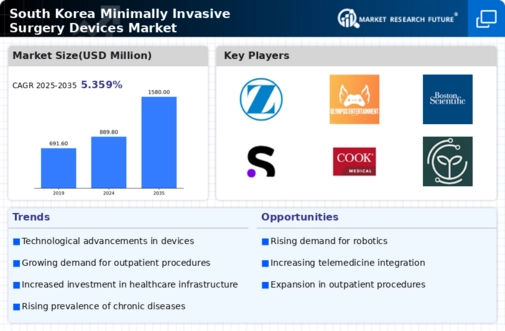
South Korea Minimally Invasive Surgery Devices Market Infographic
Purchase Options

South Korea Minimally Invasive Surgery Devices Market Summary

As per Market Research Future analysis, the South Korea minimally invasive-surgery-devices market size was estimated at 460.62 USD Million in 2024. The South Korea minimally invasive-surgery-devices market is projected to grow from 505.3 USD Million in 2025 to 1275.0 USD Million by 2035, exhibiting a compound annual growth rate (CAGR) of 9% during the forecast period 2025 - 2035

Key Market Trends & Highlights

The South Korea minimally invasive-surgery-devices market is poised for substantial growth, driven by technological advancements and increasing patient demand.

  • Technological advancements in surgical devices are enhancing precision and reducing recovery times.
  • The largest segment in this market is the laparoscopic devices segment, which continues to dominate due to its widespread application.
  • Outpatient procedures are witnessing a rising demand, reflecting a shift towards less invasive treatment options.
  • Key market drivers include the increasing prevalence of chronic diseases and regulatory support for innovative medical devices.

Market Size & Forecast

2024 Market Size 460.62 (USD Million)
2035 Market Size 1275.0 (USD Million)
CAGR (2025 - 2035) 9.7%

Major Players

Medtronic (US), Johnson & Johnson (US), Boston Scientific (US), Stryker (US), Abbott Laboratories (US), B. Braun Melsungen AG (DE), Olympus Corporation (JP), Smith & Nephew (GB), Intuitive Surgical (US)

Our Impact
Enabled $4.3B Revenue Impact for Fortune 500 and Leading Multinationals
Partnering with 2000+ Global Organizations Each Year
30K+ Citations by Top-Tier Firms in the Industry

South Korea Minimally Invasive Surgery Devices Market Trends

The minimally invasive-surgery-devices market in South Korea is experiencing notable growth, driven by advancements in technology and increasing demand for less invasive surgical options. The healthcare sector is witnessing a shift towards procedures that minimize patient recovery time and reduce hospital stays. This trend is largely influenced by the aging population and rising prevalence of chronic diseases, which necessitate efficient surgical interventions. Furthermore, The South Korean government is actively promoting healthcare innovation, supporting the development and adoption of advanced surgical devices. As a result, manufacturers are focusing on research and development to enhance device capabilities and improve patient outcomes. In addition, the competitive landscape of the minimally invasive-surgery-devices market is evolving, with both domestic and international players striving to capture market share. Collaborations between healthcare providers and technology firms are becoming increasingly common, fostering innovation and improving access to cutting-edge surgical solutions. The emphasis on training and education for healthcare professionals is also crucial, as it ensures that the latest techniques and devices are utilized effectively. Overall, the market appears poised for continued expansion, driven by technological advancements and a commitment to improving surgical care in South Korea.

Technological Advancements

The minimally invasive-surgery-devices market is witnessing rapid technological advancements, particularly in robotic-assisted surgery and imaging technologies. These innovations enhance precision and reduce complications, making procedures safer and more effective. As healthcare providers adopt these technologies, patient outcomes improve, leading to increased demand.

Rising Demand for Outpatient Procedures

There is a growing trend towards outpatient procedures within the minimally invasive-surgery-devices market. Patients prefer surgeries that allow for same-day discharge, which aligns with the healthcare system's focus on efficiency and cost-effectiveness. This shift is likely to drive the development of devices tailored for outpatient use.

Government Support and Regulation

The South Korean government is actively supporting the minimally invasive-surgery-devices market through favorable regulations and funding for research initiatives. This support encourages innovation and the introduction of new devices, ultimately enhancing the quality of surgical care available to patients.

South Korea Minimally Invasive Surgery Devices Market Drivers

Expansion of Healthcare Infrastructure

The expansion of healthcare infrastructure in South Korea is significantly impacting the minimally invasive-surgery-devices market. With government initiatives aimed at enhancing healthcare facilities and services, there is an increasing number of hospitals and surgical centers equipped with advanced surgical technologies. The South Korean government has invested heavily in healthcare infrastructure, with expenditures reaching approximately $20 billion in recent years. This investment facilitates the adoption of minimally invasive techniques, as more facilities are equipped to perform such procedures. As the healthcare landscape evolves, the availability of state-of-the-art surgical devices is expected to drive the growth of the minimally invasive-surgery-devices market.

Growing Awareness and Patient Preference

There is a notable increase in awareness regarding the benefits of minimally invasive procedures among patients in South Korea. Patients are increasingly informed about the advantages, such as reduced pain, shorter recovery times, and minimal scarring. Surveys indicate that over 70% of patients prefer minimally invasive options when available, reflecting a shift in patient expectations. This growing preference is prompting healthcare providers to adopt these techniques more widely, thereby driving the minimally invasive-surgery-devices market. As patients become more proactive in their healthcare choices, the demand for innovative surgical solutions is likely to continue rising, further propelling market growth.

Increasing Prevalence of Chronic Diseases

The rising incidence of chronic diseases in South Korea is a pivotal driver for the minimally invasive-surgery-devices market. Conditions such as cardiovascular diseases, diabetes, and obesity are becoming more prevalent, necessitating advanced surgical interventions. According to health statistics, approximately 30% of the population is affected by chronic ailments, leading to a growing demand for surgical solutions that minimize recovery time and complications. This trend is likely to propel the adoption of minimally invasive techniques, as they offer reduced hospital stays and quicker recovery, aligning with patient preferences for less invasive options. The increasing burden of chronic diseases thus appears to be a significant factor influencing the growth of the minimally invasive-surgery-devices market in South Korea.

Technological Innovations in Surgical Devices

Technological advancements in surgical devices are transforming the landscape of the minimally invasive-surgery-devices market. Innovations such as robotic-assisted surgery, advanced imaging techniques, and enhanced surgical instruments are enhancing precision and outcomes. For instance, the integration of AI and machine learning in surgical procedures is improving decision-making and operational efficiency. The market for robotic surgical systems alone is projected to reach approximately $1.5 billion by 2026 in South Korea. These innovations not only improve surgical outcomes but also reduce the overall cost of procedures, making them more accessible. Consequently, the continuous evolution of technology is a crucial driver for the growth of the minimally invasive-surgery-devices market.

Regulatory Support for Innovative Medical Devices

Regulatory support for innovative medical devices is a crucial driver for the minimally invasive-surgery-devices market. The South Korean government has established a regulatory framework that encourages the development and approval of advanced surgical technologies. This supportive environment facilitates faster market entry for new devices, which is essential for maintaining competitiveness in the healthcare sector. Recent reforms have streamlined the approval process, reducing the time for new devices to reach the market by approximately 30%. Such regulatory advancements not only foster innovation but also enhance patient access to cutting-edge surgical solutions, thereby propelling the growth of the minimally invasive-surgery-devices market.


Market Segment Insights

By Application: General Surgery (Largest) vs. Cardiothoracic Surgery (Fastest-Growing)

The application segment in the South Korea minimally invasive-surgery-devices market exhibits diverse distribution, with General Surgery holding the largest market share due to its widespread usage in various surgical interventions. This segment benefits from the increasing preference for minimally invasive procedures that reduce recovery time and improve patient outcomes. Following closely is Cardiothoracic Surgery, which, while smaller in market share, is rapidly gaining traction as advancements in technology support more complex surgeries performed less invasively. Growth trends across the application segment indicate a significant shift towards adopting innovative techniques in Gynecological and Urological Surgery. The key drivers include an increasing incidence of chronic diseases, heightened awareness regarding the benefits of minimally invasive procedures, and continuous development of advanced surgical tools. The rise in elective surgeries and investment in healthcare infrastructure are also propelling this segment's growth, particularly in Orthopedic Surgery, which is witnessing an upward trend as patients seek quicker recovery options.

General Surgery (Dominant) vs. Urological Surgery (Emerging)

General Surgery remains the dominant application in the South Korea minimally invasive-surgery-devices market, characterized by its extensive range of procedures and high patient turnover. This segment includes various surgical operations such as appendectomies and hernia repairs, leveraging advanced minimally invasive techniques for improved surgical outcomes. On the other hand, Urological Surgery is an emerging segment that is gradually gaining recognition for its advancements in treating conditions like kidney stones and prostate issues through minimally invasive methods. The growing acceptance of robotic-assisted surgeries and increased prevalence of urological conditions are key factors contributing to the growth of this segment, ultimately enhancing patient care and operational efficiency in healthcare settings.

By Product Type: Endoscopes (Largest) vs. Robotic Surgery Systems (Fastest-Growing)

The South Korea minimally invasive-surgery-devices market is characterized by a diverse array of product types, with endoscopes currently holding the largest market share. This segment is widely used across various surgical procedures, contributing significantly to its dominance. Robotic surgery systems, while smaller in market share, are emerging rapidly due to their innovative applications and increasing adoption in surgical settings. Growth in this segment is primarily driven by advancements in technology and the rising preference for minimally invasive procedures among healthcare providers. Factors such as improved patient outcomes, reduced recovery times, and a decrease in post-operative complications are fueling the demand for these devices. As hospitals invest in advanced technology, the robotic surgery systems are expected to become the fastest-growing segment, catering to a wider range of surgical specialties.

Endoscopes (Dominant) vs. Robotic Surgery Systems (Emerging)

Endoscopes are the dominant product type in the South Korea minimally invasive-surgery-devices market, known for their versatility and effectiveness in diagnostic and therapeutic procedures. They are extensively used in gastroenterology and pulmonology, making them a critical component of surgical techniques that demand precision. Robotic surgery systems, while currently considered an emerging segment, are gaining traction due to their ability to enhance surgical accuracy and reduce invasiveness. These systems are becoming increasingly popular, especially in complex surgeries like urology and gynecology, where traditional methods may pose higher risks and longer recovery times. As such, the market outlook for robotic surgery systems remains promising, with continuous innovations leading to greater adoption.

By End-use: Hospitals (Largest) vs. Ambulatory Surgical Centers (Fastest-Growing)

In the South Korea minimally invasive-surgery-devices market, hospitals hold the largest market share among end-users, driven by the high volume of surgical procedures performed and their integration of advanced surgical technologies. Ambulatory surgical centers are also significant, but they represent a smaller share compared to hospitals. Specialty clinics cater to specific procedures and have a niche market presence, but their overall impact remains relatively limited compared to the broader hospital sector. Growth trends indicate that ambulatory surgical centers are emerging as the fastest-growing segment within this market. This growth is fueled by the increasing preference for outpatient surgeries, which offer patients lower costs and quicker recovery times. Furthermore, advancements in minimally invasive techniques and equipment in these centers support this trend, leading to broader adoption among both providers and patients.

Hospitals (Dominant) vs. Ambulatory Surgical Centers (Emerging)

Hospitals are the dominant end-user in the South Korea minimally invasive-surgery-devices market, characterized by their ability to handle complex procedures and invest in high-tech surgical equipment. They benefit from established patient bases and extensive resources for training and technology integration. Ambulatory surgical centers, while emerging, are gaining traction due to increasing surgical volumes and patient preference for outpatient procedures. These centers focus on efficiency, lower costs, and improved patient experiences, positioning them favorably for future growth. Their agility in adopting new technologies and procedures enhances their competitiveness, making them a crucial player in the evolving surgical landscape.

By Technology: Video-Assisted Thoracoscopic Surgery (Largest) vs. Transcatheter Aortic Valve Replacement (Fastest-Growing)

Video-Assisted Thoracoscopic Surgery (VATS) currently holds the largest market share within the segment values, driven by its wide acceptance and efficacy in complex thoracic procedures. Its popularity among surgeons in the South Korea minimally invasive-surgery-devices market has solidified its standing as a trusted method for lung surgeries and biopsy processes. In contrast, Transcatheter Aortic Valve Replacement (TAVR) is rapidly gaining traction due to an increasing aging population suffering from aortic stenosis, making it a significant challenger in market distribution. Growth trends indicate that TAVR is the fastest-growing segment, propelled by technological advancements and its minimally invasive nature, which reduce patient recovery time. Additionally, the rising prevalence of cardiovascular diseases is fueling demand for innovative surgical options within the South Korea minimally invasive-surgery-devices market. Natural Orifice Transluminal Endoscopic Surgery (NOTES) is also emerging as a novel approach, but its adoption rate is currently lower compared to VATS and TAVR.
Technology: Video-Assisted Thoracoscopic Surgery (Dominant) vs. Transcatheter Aortic Valve Replacement (Emerging)

Video-Assisted Thoracoscopic Surgery (VATS) is characterized by its minimally invasive approach, allowing for reduced trauma and quicker recovery for patients undergoing thoracic procedures. It dominates the market by offering effective solutions for lung surgeries while enhancing surgical precision. Meanwhile, Transcatheter Aortic Valve Replacement (TAVR) stands out as an emerging technology in the market, offering a less invasive alternative to traditional valve replacement surgeries. Its design caters to patients who are at high surgical risk, thus expanding treatment options. The combination of superior outcomes with lower complication rates for TAVR is aligning it towards a robust growth trajectory, making it a compelling option in the evolving landscape of surgical devices.

Get more detailed insights about South Korea Minimally Invasive Surgery Devices Market

Key Players and Competitive Insights

The minimally invasive-surgery-devices market in South Korea is characterized by a dynamic competitive landscape, driven by technological advancements and an increasing demand for less invasive surgical options. Key players such as Medtronic (US), Johnson & Johnson (US), and Intuitive Surgical (US) are at the forefront, focusing on innovation and strategic partnerships to enhance their market presence. Medtronic (US) emphasizes its commitment to developing cutting-edge technologies, while Johnson & Johnson (US) leverages its extensive portfolio to cater to diverse surgical needs. Intuitive Surgical (US) continues to lead in robotic-assisted surgery, indicating a strong focus on automation and precision in surgical procedures. Collectively, these strategies contribute to a competitive environment that prioritizes technological innovation and patient outcomes.In terms of business tactics, companies are increasingly localizing manufacturing to reduce costs and enhance supply chain efficiency. This approach not only mitigates risks associated with The minimally invasive-surgery-devices market demands. The competitive structure of the market appears moderately fragmented, with several players vying for market share. However, the influence of major companies remains substantial, as they set industry standards and drive innovation.

In October Medtronic (US) announced the launch of a new line of minimally invasive surgical instruments designed to improve patient recovery times. This strategic move is likely to enhance Medtronic's competitive edge by addressing the growing demand for faster recovery solutions in surgical procedures. The introduction of these instruments aligns with the company's broader strategy of innovation and patient-centric care, potentially increasing its market share in South Korea.

In September Johnson & Johnson (US) entered into a partnership with a local South Korean healthcare provider to expand its reach in the region. This collaboration is expected to facilitate the introduction of advanced surgical technologies and training programs, thereby enhancing the overall quality of surgical care. Such strategic alliances may prove crucial in navigating the competitive landscape, as they allow for localized expertise and tailored solutions that resonate with healthcare professionals and patients alike.

In August Intuitive Surgical (US) reported a significant investment in artificial intelligence (AI) technologies to enhance its robotic surgical systems. This investment underscores the company's commitment to integrating AI into surgical procedures, which could lead to improved precision and outcomes. As AI continues to evolve, Intuitive Surgical's proactive approach may position it favorably against competitors, particularly in a market that increasingly values technological advancements.

As of November current trends in the minimally invasive-surgery-devices market indicate a strong shift towards digitalization and sustainability. Companies are increasingly focusing on integrating AI and machine learning into their products, which enhances surgical precision and operational efficiency. Strategic alliances are becoming more prevalent, as firms recognize the value of collaboration in driving innovation. Looking ahead, competitive differentiation is likely to evolve from traditional price-based competition to a focus on technological innovation, reliability in supply chains, and enhanced patient outcomes. This shift suggests that companies that prioritize these aspects will be better positioned to thrive in the evolving market landscape.

Key Companies in the South Korea Minimally Invasive Surgery Devices Market include

Industry Developments

The South Korea Minimally Invasive Surgery Devices Market has been witnessing significant growth and activity lately. Recent developments include a rising demand for innovative technologies due to an increased incidence of chronic diseases and the aging population. Companies like Intuitive Surgical and Medtronic have expanded their product offerings to cater to this demand. In September 2023, Zimmer Biomet announced a strategic partnership with a local healthcare provider to enhance the distribution of their surgical devices in South Korea, indicating positive enhancements in market accessibility. Additionally, in August 2023, Boston Scientific completed the acquisition of a local firm specializing in robotic surgery, further strengthening its presence in the region. The investments made by major players like Johnson and Johnson and Stryker in Research and Development are amplifying competition and driving innovation in the market. Over the past couple of years, a noteworthy shift occurred in June 2022, with Olympus reinforcing its market position through new product launches aimed at improving patient outcomes. This surge in market activity underscores the potential of the South Korean Minimally Invasive Surgery Devices Market to innovate and meet the increasing healthcare needs of its population.

Future Outlook

South Korea Minimally Invasive Surgery Devices Market Future Outlook

The Minimally Invasive Surgery Devices Market is projected to grow at a 9.7% CAGR from 2025 to 2035, driven by technological advancements, increasing patient demand, and cost-effectiveness.

New opportunities lie in:

  • Development of AI-driven surgical assistance tools
  • Expansion of telemedicine platforms for remote consultations
  • Investment in biodegradable surgical devices for sustainability

By 2035, the market is expected to achieve substantial growth, driven by innovation and evolving healthcare needs.

Market Segmentation

South Korea Minimally Invasive Surgery Devices Market End-use Outlook

  • Hospitals
  • Ambulatory Surgical Centers
  • Specialty Clinics

South Korea Minimally Invasive Surgery Devices Market Technology Outlook

  • Video-Assisted Thoracoscopic Surgery
  • Transcatheter Aortic Valve Replacement
  • Natural Orifice Transluminal Endoscopic Surgery

South Korea Minimally Invasive Surgery Devices Market Application Outlook

  • General Surgery
  • Cardiothoracic Surgery
  • Gynecological Surgery
  • Urological Surgery
  • Orthopedic Surgery

South Korea Minimally Invasive Surgery Devices Market Product Type Outlook

  • Endoscopes
  • Robotic Surgery Systems
  • Laparoscopic Surgical Instruments
  • Visualization Systems
  • Access Devices

Report Scope

MARKET SIZE 2024 460.62(USD Million)
MARKET SIZE 2025 505.3(USD Million)
MARKET SIZE 2035 1275.0(USD Million)
COMPOUND ANNUAL GROWTH RATE (CAGR) 9.7% (2025 - 2035)
REPORT COVERAGE Revenue Forecast, Competitive Landscape, Growth Factors, and Trends
BASE YEAR 2024
Market Forecast Period 2025 - 2035
Historical Data 2019 - 2024
Market Forecast Units USD Million
Key Companies Profiled Medtronic (US), Johnson & Johnson (US), Boston Scientific (US), Stryker (US), Abbott Laboratories (US), B. Braun Melsungen AG (DE), Olympus Corporation (JP), Smith & Nephew (GB), Intuitive Surgical (US)
Segments Covered Application, Product Type, End-use, Technology
Key Market Opportunities Advancements in robotic-assisted surgery enhance precision and patient outcomes in the minimally invasive-surgery-devices market.
Key Market Dynamics Technological advancements drive growth in minimally invasive surgery devices, enhancing patient outcomes and operational efficiency.
Countries Covered South Korea
Leave a Comment

FAQs

What is the expected market size of the South Korea Minimally Invasive Surgery Devices Market in 2024?

The market is expected to be valued at 889.75 million USD in 2024.

What is the projected market size of the South Korea Minimally Invasive Surgery Devices Market by 2035?

By 2035, the market is projected to grow to 1580.0 million USD.

What is the expected CAGR for the South Korea Minimally Invasive Surgery Devices Market from 2025 to 2035?

The expected CAGR for this period is 5.359%.

What is the market size for General Surgery applications in the South Korea Minimally Invasive Surgery Devices Market in 2024?

The market size for General Surgery applications is valued at 300.0 million USD in 2024.

How large is the Cardiothoracic Surgery segment within the South Korea Minimally Invasive Surgery Devices Market in 2024?

In 2024, the Cardiothoracic Surgery segment is valued at 180.0 million USD.

Which companies are the major players in the South Korea Minimally Invasive Surgery Devices Market?

Major players include Zimmer Biomet, Intuitive Surgical, Olympus, and Medtronic.

What is the market size forecast for Gynecological Surgery applications by 2035?

By 2035, the market size for Gynecological Surgery applications is expected to reach 270.0 million USD.

What growth is expected for the Urological Surgery segment in the South Korea Minimally Invasive Surgery Devices Market from 2024 to 2035?

The Urological Surgery segment is projected to grow from 130.0 million USD in 2024 to 230.0 million USD by 2035.

What are some key growth drivers for the South Korea Minimally Invasive Surgery Devices Market?

Key growth drivers include technological advancements and increasing patient preference for less invasive procedures.

What is the market size for Orthopedic Surgery applications in 2024 and its forecast by 2035?

The Orthopedic Surgery segment is valued at 129.75 million USD in 2024 and is expected to reach 220.0 million USD by 2035.

Download Free Sample

Kindly complete the form below to receive a free sample of this Report

Compare Licence

×
Features License Type
Single User Multiuser License Enterprise User
Price $4,950 $5,950 $7,250
Maximum User Access Limit 1 User Upto 10 Users Unrestricted Access Throughout the Organization
Free Customization
Direct Access to Analyst
Deliverable Format
Platform Access
Discount on Next Purchase 10% 15% 15%
Printable Versions