×
Request Free Sample ×

Kindly complete the form below to receive a free sample of this Report

* Please use a valid business email

Leading companies partner with us for data-driven Insights

clients tt-cursor
Hero Background

South Korea Home Security Camera Market

ID: MRFR/ICT/60137-HCR
200 Pages
Aarti Dhapte
February 2026

South Korea Home Security Camera Market Size, Share and Trends Analysis Report By Product (Dome Security Camera, Bullet Security Camera, IP Security Camera), By Type (Indoor Security Camera, Outdoor Security Camera), By Resolution (Non-HD, HD) and By Services (Professional, Managed)- Forecast to 2035

Share:
Download PDF ×

We do not share your information with anyone. However, we may send you emails based on your report interest from time to time. You may contact us at any time to opt-out.

South Korea Home Security Camera Market Infographic
Purchase Options

South Korea Home Security Camera Market Summary

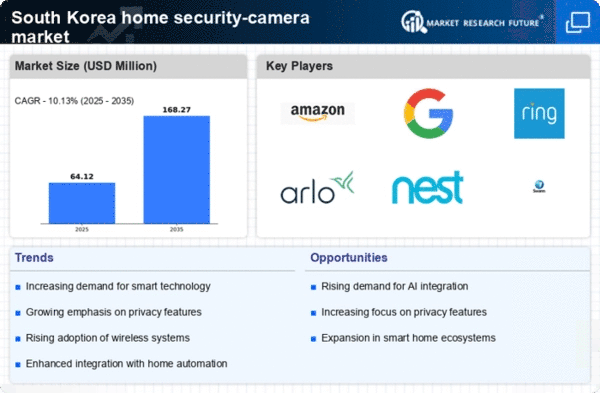
As per Market Research Future analysis, the South Korea home security-camera market size was estimated at 58.22 $ Million in 2024. The South Korea home security-camera market is projected to grow from 64.12 $ Million in 2025 to 168.27 $ Million by 2035, exhibiting a compound annual growth rate (CAGR) of 10.1% during the forecast period 2025 - 2035

Key Market Trends & Highlights

The South Korea home security-camera market is experiencing robust growth driven by technological advancements and rising consumer awareness.

  • The market is increasingly integrating with smart home systems, enhancing user convenience and functionality.
  • There is a growing emphasis on privacy and data security, reflecting consumer concerns over surveillance.
  • Subscription-based services are on the rise, providing consumers with flexible payment options and ongoing support.
  • Key market drivers include increasing crime rates and rising awareness of home security, which are propelling demand for advanced security solutions.

Market Size & Forecast

2024 Market Size 58.22 (USD Million)
2035 Market Size 168.27 (USD Million)
CAGR (2025 - 2035) 10.13%

Major Players

Amazon (US), Google (US), Ring (US), Arlo Technologies (US), Nest Labs (US), Swann Communications (AU), Lorex Technology (CA), Reolink (CN), TP-Link (CN)

Our Impact
Enabled $4.3B Revenue Impact for Fortune 500 and Leading Multinationals
Partnering with 2000+ Global Organizations Each Year
30K+ Citations by Top-Tier Firms in the Industry

South Korea Home Security Camera Market Trends

The home security-camera market in South Korea is currently experiencing a notable transformation, driven by advancements in technology and increasing consumer awareness regarding safety. The proliferation of smart home devices has led to a surge in demand for integrated security solutions. Consumers are increasingly seeking systems that offer remote monitoring capabilities, high-definition video quality, and advanced features such as motion detection and night vision. This shift reflects a broader trend towards enhancing home security through innovative technology, which appears to resonate well with the tech-savvy population of South Korea. Moreover, the regulatory environment in South Korea is evolving to support the growth of the home security-camera market. Government initiatives aimed at improving public safety and reducing crime rates have encouraged homeowners to invest in security systems. The rise in urbanization and the corresponding increase in residential properties have further fueled this demand. As a result, manufacturers are likely to focus on developing user-friendly products that cater to the specific needs of South Korean consumers, potentially leading to a more competitive landscape in the coming years.

Integration with Smart Home Systems

The trend towards integrating home security cameras with smart home systems is becoming increasingly prevalent. Consumers are looking for seamless connectivity with devices such as smart locks, alarms, and lighting systems. This integration not only enhances security but also provides convenience, allowing users to control multiple aspects of their home environment from a single platform.

Emphasis on Privacy and Data Security

As concerns regarding privacy and data security grow, manufacturers in the home security-camera market are placing greater emphasis on protecting user information. Enhanced encryption methods and transparent data handling practices are becoming essential features. This trend reflects a broader societal demand for accountability and trust in technology.

Rise of Subscription-Based Services

There is a noticeable shift towards subscription-based services for home security cameras. Consumers are increasingly opting for models that offer cloud storage and professional monitoring as part of a subscription package. This trend suggests a preference for flexible payment options and ongoing support, which may enhance user experience and satisfaction.

South Korea Home Security Camera Market Drivers

Government Initiatives

Government initiatives aimed at enhancing public safety are influencing the home security-camera market. In South Korea, local authorities have been promoting the installation of surveillance systems in residential areas to deter crime and improve community safety. Programs that offer subsidies or tax incentives for homeowners who invest in security technology are becoming more prevalent. These initiatives not only encourage the adoption of security cameras but also foster a culture of safety within neighborhoods. As a result, the home security-camera market is likely to benefit from increased sales driven by these supportive policies. The collaboration between government bodies and private sector companies may further enhance the development of innovative security solutions tailored to meet the needs of South Korean consumers.

Increasing Crime Rates

The rise in crime rates in South Korea has been a pivotal driver for the home security-camera market. As urban areas experience higher instances of theft and vandalism, homeowners are increasingly investing in security solutions. Reports indicate that property crimes have surged by approximately 15% over the past few years, prompting a heightened demand for surveillance systems. This trend is particularly pronounced in metropolitan regions, where the need for enhanced security measures is critical. The home security-camera market is responding to this demand by offering advanced features such as high-definition video, night vision, and motion detection. Consequently, consumers are more inclined to purchase these systems to safeguard their properties, thereby propelling market growth. The increasing awareness of personal safety and the desire to protect assets are likely to sustain this trend in the foreseeable future.

Technological Advancements

Technological innovations are significantly shaping the home security-camera market. The introduction of artificial intelligence (AI) and machine learning capabilities has enhanced the functionality of security cameras, allowing for features such as facial recognition and real-time alerts. In South Korea, the integration of these technologies is becoming commonplace, with a reported 30% of new installations incorporating smart features. This evolution not only improves the effectiveness of surveillance systems but also appeals to tech-savvy consumers who prioritize cutting-edge solutions. Furthermore, advancements in cloud storage options enable users to access footage remotely, adding an extra layer of convenience. As technology continues to evolve, the home security-camera market is expected to expand, driven by consumer demand for more sophisticated and user-friendly security solutions.

Growth of E-commerce Platforms

The expansion of e-commerce platforms in South Korea is significantly impacting the home security-camera market. With the convenience of online shopping, consumers are more inclined to purchase security cameras through digital channels. Reports suggest that online sales of home security products have increased by over 25% in recent years, driven by the ease of access to a wide range of products and competitive pricing. E-commerce platforms also provide consumers with the ability to compare features and read reviews, which enhances their purchasing confidence. As more consumers turn to online shopping for their security needs, the home security-camera market is likely to see sustained growth. This trend may also encourage manufacturers to enhance their online presence and marketing strategies to capture the attention of potential buyers.

Rising Awareness of Home Security

There is a growing awareness among South Korean consumers regarding the importance of home security, which is driving the home security-camera market. Educational campaigns and media coverage highlighting the benefits of surveillance systems have contributed to this heightened awareness. Surveys indicate that approximately 70% of homeowners now consider security cameras a necessary investment for their properties. This shift in perception is leading to increased sales of security cameras, as consumers seek to protect their homes and families. Additionally, the rise of social media platforms has facilitated the sharing of personal experiences related to home security, further influencing purchasing decisions. As awareness continues to grow, the home security-camera market is expected to expand, with consumers increasingly prioritizing safety and security in their homes.


Market Segment Insights

By Product: Dome Security Camera (Largest) vs. IP Security Camera (Fastest-Growing)

The South Korea home security-camera market exhibits a competitive landscape among the dominant product segments. Dome security cameras are currently the largest segment, capturing a significant portion of market share due to their versatility and suitability for both indoor and outdoor use. Conversely, bullet security cameras have established a stable market presence, although they lag behind in share compared to dome cameras. Meanwhile, IP security cameras are on the rise, increasingly favored for their advanced features and remote accessibility, facilitating greater market penetration. In terms of growth trends, the IP security camera segment is experiencing the fastest expansion in the South Korea home security-camera market. This growth is attributed to the increasing demand for smart home devices, heightened security concerns, and advancements in technology like artificial intelligence for enhanced monitoring. The changing consumer preferences towards integrated security solutions and remote access capabilities are driving this growth, positioning IP cameras as a future leader in the market.

Dome Security Camera (Dominant) vs. Bullet Security Camera (Emerging)

Dome security cameras hold a dominant position in the South Korea home security-camera market, recognized for their discreet appearance and wide-angle views. These cameras are particularly suitable for retail environments and public places due to their ability to blend into a variety of settings while providing the coverage needed for effective surveillance. Their established reputation stems from their robustness and the perception of enhanced security they offer. In contrast, bullet security cameras represent an emerging segment that is gaining traction, primarily due to their weather-resistant designs and long-range capabilities. While they are commonly used in outdoor applications and are more noticeable, bullet cameras are becoming increasingly integrated into residential setups, driven by the growing trend of DIY security installations.

By Type: Indoor Security Camera (Largest) vs. Outdoor Security Camera (Fastest-Growing)

In the South Korea home security-camera market, the indoor security camera segment holds the largest market share, significantly overshadowing its counterpart. The preference for indoor systems stems from their ability to monitor activities within households effectively, ensuring safety and security for families. Meanwhile, outdoor security cameras are gaining momentum, appealing to homeowners who prioritize external surveillance due to rising concerns about property security. The balance of preference reflects a growing awareness about comprehensive safety measures. Growth trends indicate that outdoor security cameras are emerging as the fastest-growing segment in this market. The surge is driven by an increasing demand for advanced outdoor surveillance technologies that offer features such as motion detection, night vision, and remote monitoring. As neighborhoods become more connected through smart technologies, outdoor cameras are increasingly viewed as essential safety investments, providing peace of mind and deterring potential threats.

Indoor Security Cameras (Dominant) vs. Outdoor Security Cameras (Emerging)

Indoor security cameras are characterized by their ability to integrate seamlessly within home environments, offering features such as real-time alerts, two-way audio, and connectivity to smart home systems. This segment is favored by consumers for indoor monitoring, ensuring comprehensive safety inside the home. Conversely, outdoor security cameras are emerging due to their advanced functionalities designed for external surveillance. These models often include weatherproof designs, high-resolution imaging, and enhanced night vision capabilities. Consumers are investing in outdoor cameras to protect their properties, driven by increased crime rates and a desire for proactive safety measures. The strong performance of both segments highlights the holistic approach homeowners are adopting towards security.

By Resolution: HD (Largest) vs. Non-HD (Fastest-Growing)

In the South Korea home security-camera market, HD cameras currently dominate the market with a significant share due to their superior image quality and advanced features compared to Non-HD options. Non-HD cameras, while still relevant, occupy a smaller portion of the market as consumers increasingly prefer higher resolution for effective surveillance. The growth trajectory for Non-HD cameras is notable, as they are recognized for their affordability and ease of access. This segment is attracting budget-conscious consumers who prioritize basic functionality over high-end features. The shift towards smart home systems also supports the demand for Non-HD cameras, making them an emerging option in a technology-driven market.

HD (Dominant) vs. Non-HD (Emerging)

HD cameras are characterized by their clarity and detail, making them the preferred choice for security applications where visual precision is critical. They offer features such as higher resolutions, night vision capabilities, and advanced motion detection, appealing to consumers seeking reliable security solutions. In contrast, Non-HD cameras serve an essential role in entry-level security, offering basic surveillance functionalities at competitive price points. This accessibility attracts consumers who require budget-friendly options, and as technology advances, the Non-HD segment is poised to grow rapidly, indicating a shifting preference as users look for cost-effective ways to enhance home security.

By Service: Managed (Largest) vs. Professional (Fastest-Growing)

In the South Korea home security-camera market, the service segment is predominantly dominated by managed services, reflecting a significant portion of the overall market share. The increasing preference for complete security solutions has led to managed services catering to both residential and commercial users. Conversely, professional services are carving out a rapidly growing niche, appealing to consumers seeking high customization and advanced security features. Growth in the service segment is driven by various factors, including the rising concerns over safety, technological advancements in security solutions, and a shift towards integrated security systems. Consumers are increasingly seeking comprehensive solutions provided by managed services, while the demand for professional services is escalating due to their ability to offer tailored solutions, increasing customer satisfaction and retention.

Service: Managed (Dominant) vs. Professional (Emerging)

Managed services are currently the dominant force in the service segment of the South Korea home security-camera market, offering holistic solutions that encompass installation, maintenance, and monitoring. This service model attracts a wide array of clients due to its convenience and reduction of technical complexity for users. On the other hand, professional services are emerging rapidly, providing specialized installations and configurations catering to unique customer needs. The flexibility and expertise associated with professional services enable them to increasingly capture a share of the market as consumers look for personalized security options that managed services may not fully address. Together, these services represent a dynamic interplay between established and growing trends in security service preferences.

Get more detailed insights about South Korea Home Security Camera Market

Key Players and Competitive Insights

The home security-camera market in South Korea is characterized by a dynamic competitive landscape, driven by technological advancements and increasing consumer demand for enhanced security solutions. Major players such as Amazon (US), Google (US), and Arlo Technologies (US) are strategically positioned to leverage innovation and digital transformation. Amazon (US) focuses on integrating its security offerings with its broader ecosystem, while Google (US) emphasizes AI-driven features in its Nest Labs (US) products. Arlo Technologies (US) is known for its commitment to high-quality video resolution and user-friendly interfaces, which collectively shape a competitive environment that prioritizes technological sophistication and user experience.Key business tactics within this market include localizing manufacturing and optimizing supply chains to enhance responsiveness to consumer needs. The competitive structure appears moderately fragmented, with several key players vying for market share. This fragmentation allows for diverse offerings, yet the influence of major companies remains substantial, as they set trends and standards that smaller players often follow.

In October Amazon (US) announced the launch of a new line of security cameras that integrate seamlessly with its Alexa ecosystem. This strategic move is significant as it not only enhances the functionality of its devices but also strengthens customer loyalty by creating a more interconnected home environment. The integration of voice-activated features is likely to appeal to tech-savvy consumers seeking convenience and efficiency in their security solutions.

In September Google (US) unveiled an upgraded version of its Nest Cam, featuring advanced AI capabilities that allow for real-time threat detection and alerts. This development underscores Google's commitment to innovation and positions its products as leaders in the market. The emphasis on AI integration suggests a shift towards more proactive security measures, which could redefine consumer expectations and set new benchmarks for competitors.

In August Arlo Technologies (US) expanded its product line to include solar-powered security cameras, catering to the growing demand for sustainable technology. This strategic initiative not only aligns with global sustainability trends but also differentiates Arlo's offerings in a crowded market. By addressing environmental concerns, Arlo may attract a segment of consumers who prioritize eco-friendly solutions in their purchasing decisions.

As of November current trends in the home security-camera market include a strong focus on digitalization, sustainability, and the integration of AI technologies. Strategic alliances among key players are shaping the competitive landscape, fostering innovation and collaboration. Looking ahead, it appears that competitive differentiation will increasingly hinge on technological advancements and supply chain reliability, rather than solely on price. This shift suggests that companies will need to invest in R&D and partnerships to maintain a competitive edge in an evolving market.

Key Companies in the South Korea Home Security Camera Market include

Industry Developments

In recent months, the South Korea Home Security Camera Market has seen notable developments, with companies like Hikvision, Samsung, and Hanwha Techwin continuously innovating to enhance their offerings. The increasing demand for residential security solutions, particularly during the COVID-19 pandemic, has accelerated market growth, with a significant rise in home automation and smart home technologies. For instance, there was a substantial uptick in consumer interest for smart cameras integrated with Artificial Intelligence features in early 2023. 

Furthermore, in August 2023, LG Electronics announced a strategic partnership with a local tech firm to enhance its home security solutions, reflecting a trend toward collaboration for improved technology. Notably, Dahua Technology has introduced advanced surveillance solutions, catering to specific security needs in urban areas. Moreover, residential security camera sales surged by 15% in the first half of 2023, indicating a robust growth trajectory in this sector, amid rising concerns about safety and security across South Korea.

Future Outlook

South Korea Home Security Camera Market Future Outlook

The Home Security Camera Market is projected to grow at a 10.13% CAGR from 2025 to 2035, driven by technological advancements, increasing safety concerns, and rising demand for smart home integration.

New opportunities lie in:

  • Development of AI-driven analytics for enhanced security insights.
  • Expansion into subscription-based monitoring services for recurring revenue.
  • Partnerships with smart home device manufacturers for integrated solutions.

By 2035, the market is expected to achieve substantial growth, positioning itself as a leader in home security solutions.

Market Segmentation

South Korea Home Security Camera Market Type Outlook

  • Indoor Security Camera
  • Outdoor Security Camera

South Korea Home Security Camera Market Product Outlook

  • Dome Security Camera
  • Bullet Security Camera
  • IP Security Camera

South Korea Home Security Camera Market Service Outlook

  • Professional
  • Managed

South Korea Home Security Camera Market Resolution Outlook

  • Non-HD
  • HD

Report Scope

MARKET SIZE 2024 58.22(USD Million)
MARKET SIZE 2025 64.12(USD Million)
MARKET SIZE 2035 168.27(USD Million)
COMPOUND ANNUAL GROWTH RATE (CAGR) 10.13% (2025 - 2035)
REPORT COVERAGE Revenue Forecast, Competitive Landscape, Growth Factors, and Trends
BASE YEAR 2024
Market Forecast Period 2025 - 2035
Historical Data 2019 - 2024
Market Forecast Units USD Million
Key Companies Profiled Amazon (US), Google (US), Ring (US), Arlo Technologies (US), Nest Labs (US), Swann Communications (AU), Lorex Technology (CA), Reolink (CN), TP-Link (CN)
Segments Covered Product, Type, Resolution, Service
Key Market Opportunities Integration of artificial intelligence enhances user experience in the home security-camera market.
Key Market Dynamics Rising consumer demand for advanced features drives innovation in the home security-camera market.
Countries Covered South Korea
Leave a Comment

FAQs

What is the expected market size of the South Korea Home Security Camera Market in 2024?

In 2024, the South Korea Home Security Camera Market is expected to be valued at 61.6 million USD.

What is the projected market size for the South Korea Home Security Camera Market by 2035?

By 2035, the South Korea Home Security Camera Market is projected to reach 153.6 million USD.

What is the expected CAGR for the South Korea Home Security Camera Market from 2025 to 2035?

The market is expected to grow at a CAGR of 8.661% during the forecast period from 2025 to 2035.

Which product segment is expected to dominate the South Korea Home Security Camera Market in 2024?

In 2024, the IP Security Camera segment is expected to lead the market with a valuation of 23.1 million USD.

What will be the market size of the Dome Security Camera segment by 2035?

The Dome Security Camera segment is projected to reach a market size of 49.0 million USD by 2035.

Who are the key players in the South Korea Home Security Camera Market?

Major players include Hikvision, Samsung, Amcrest, and Hanwha Techwin.

What market size is expected for Bullet Security Cameras in 2035?

The Bullet Security Camera segment is anticipated to be valued at 45.5 million USD in 2035.

What are the growth drivers of the South Korea Home Security Camera Market?

The market growth is driven by increasing security concerns and advancements in technology for home surveillance.

What are the key applications of home security cameras in South Korea?

Key applications include residential security, retail surveillance, and monitoring of public spaces.

How will the current market trends impact the Home Security Camera Market in South Korea?

Current trends like the integration of AI and cloud technology are expected to enhance the market's growth and scope.

Download Free Sample

Kindly complete the form below to receive a free sample of this Report

Compare Licence

×
Features License Type
Single User Multiuser License Enterprise User
Price $4,950 $5,950 $7,250
Maximum User Access Limit 1 User Upto 10 Users Unrestricted Access Throughout the Organization
Free Customization
Direct Access to Analyst
Deliverable Format
Platform Access
Discount on Next Purchase 10% 15% 15%
Printable Versions