×
Request Free Sample ×

Kindly complete the form below to receive a free sample of this Report

* Please use a valid business email

Leading companies partner with us for data-driven Insights

clients tt-cursor
Hero Background

South Korea Energy Drinks Market

ID: MRFR/FnB/56589-HCR
128 Pages
Snehal Singh
February 2026

South Korea Energy Drinks Market Size, Share, Industry Trend & Analysis Research Report By Product Type Outlook (Drinks, Shots, Mixers), By Packaging Type Outlook (Cans, Bottle, Others), By Type Outlook (Conventional, Organic) and By Distribution Channel Outlook (On-Trade, Off-Trade) - Forecast to 2035

Share:
Download PDF ×

We do not share your information with anyone. However, we may send you emails based on your report interest from time to time. You may contact us at any time to opt-out.

South Korea Energy Drinks Market Infographic
Purchase Options

South Korea Energy Drinks Market Summary

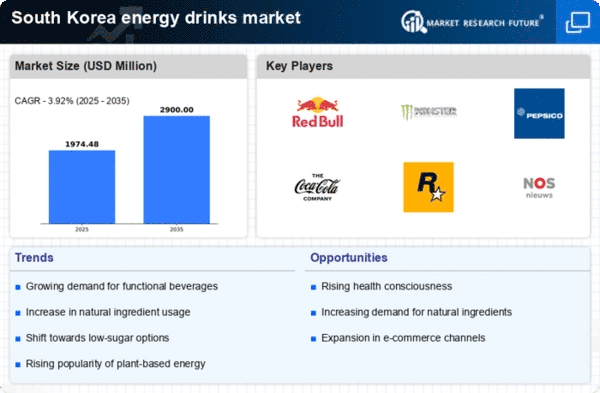
As per Market Research Future analysis, the South Korea energy drinks market size was estimated at 1900.0 USD Million in 2024. The South Korea energy drinks market is projected to grow from 1974.48 USD Million in 2025 to 2900.0 USD Million by 2035, exhibiting a compound annual growth rate (CAGR) of 3.9% during the forecast period 2025 - 2035

Key Market Trends & Highlights

The South Korea energy drinks market is experiencing a shift towards health-conscious and sustainable products.

  • Health-conscious formulations are gaining traction among consumers, reflecting a broader trend towards wellness.
  • E-commerce expansion is reshaping the distribution landscape, making energy drinks more accessible to a wider audience.
  • Sustainability initiatives are becoming increasingly important, as brands seek to align with environmentally conscious consumers.
  • The rising demand for functional beverages and increased health awareness are key drivers propelling market growth.

Market Size & Forecast

2024 Market Size 1900.0 (USD Million)
2035 Market Size 2900.0 (USD Million)
CAGR (2025 - 2035) 3.92%

Major Players

Red Bull (AT), Monster Beverage (US), PepsiCo (US), Coca-Cola (US), Rockstar (US), NOS (US), 5-hour Energy (US), Bang Energy (US)

Our Impact
Enabled $4.3B Revenue Impact for Fortune 500 and Leading Multinationals
Partnering with 2000+ Global Organizations Each Year
30K+ Citations by Top-Tier Firms in the Industry

South Korea Energy Drinks Market Trends

The energy drinks market in South Korea is currently experiencing a dynamic evolution, characterized by shifting consumer preferences and increasing health consciousness. As individuals become more aware of the potential health implications associated with traditional energy drinks, there is a noticeable trend towards products that offer functional benefits. This includes beverages enriched with vitamins, minerals, and natural ingredients, appealing to a demographic that prioritizes wellness alongside energy enhancement. Furthermore, the rise of e-commerce platforms has transformed the purchasing landscape, allowing consumers to access a wider variety of products conveniently. This shift not only enhances market accessibility but also encourages brands to innovate and diversify their offerings to meet the demands of a tech-savvy population. In addition, the energy drinks market is witnessing a growing inclination towards sustainable practices. Companies are increasingly focusing on eco-friendly packaging and sourcing ingredients responsibly, reflecting a broader societal shift towards environmental stewardship. This trend resonates particularly well with younger consumers, who are more likely to support brands that align with their values. As the market continues to adapt to these evolving consumer expectations, it appears poised for further growth, driven by innovation and a commitment to sustainability.

Health-Conscious Formulations

There is a marked shift towards energy drinks that incorporate health-oriented ingredients. Consumers are increasingly seeking beverages that not only provide energy but also offer nutritional benefits, such as added vitamins and natural extracts. This trend reflects a broader movement towards wellness and preventive health.

E-Commerce Expansion

The rise of online shopping platforms is reshaping how consumers purchase energy drinks. With the convenience of home delivery and a wider selection available online, brands are adapting their marketing strategies to engage with consumers through digital channels, enhancing accessibility.

Sustainability Initiatives

A growing emphasis on environmental responsibility is influencing product development within the energy drinks market. Companies are adopting sustainable practices, including eco-friendly packaging and ethically sourced ingredients, to appeal to environmentally conscious consumers.

South Korea Energy Drinks Market Drivers

Increased Health Awareness

The energy drinks market in South Korea is experiencing a shift as consumers become more health-conscious. There is a growing awareness of the potential health risks associated with excessive caffeine and sugar consumption. As a result, many consumers are seeking alternatives that offer lower sugar content and natural ingredients. This trend is prompting brands within the energy drinks market to reformulate their products to meet these demands. In 2025, it is estimated that products labeled as 'low-sugar' or 'natural' will account for approximately 40% of total sales, indicating a significant shift in consumer preferences towards healthier options.

Innovative Marketing Strategies

The energy drinks market in South Korea is witnessing a transformation driven by innovative marketing strategies. Brands are leveraging social media platforms and influencer partnerships to engage with consumers more effectively. This approach not only enhances brand visibility but also fosters a sense of community among consumers. In 2025, it is projected that digital marketing expenditures in the energy drinks market will increase by 25%, reflecting the shift towards online engagement. Companies are also focusing on experiential marketing, creating events and promotions that allow consumers to interact with the brand in immersive ways, thereby strengthening brand loyalty.

Expansion of Distribution Channels

The energy drinks market in South Korea is benefiting from the expansion of distribution channels. Retailers are increasingly recognizing the potential of energy drinks and are dedicating more shelf space to these products. Additionally, the rise of convenience stores and online platforms is facilitating easier access for consumers. In 2025, it is projected that online sales will account for around 20% of total energy drinks market sales, reflecting the growing trend of e-commerce. The energy drinks market is responding by enhancing its distribution strategies to ensure that products are readily available to consumers, thereby driving overall market growth.

Youth Culture and Lifestyle Trends

The energy drinks market in South Korea is significantly influenced by the lifestyle choices of the youth demographic. Young consumers, particularly those aged 18-30, are increasingly drawn to energy drinks as part of their active and social lifestyles. This demographic is known for its preference for convenience and on-the-go consumption, which aligns with the portable nature of energy drinks. In 2025, it is estimated that this age group contributes to over 50% of the total market share. The energy drinks market is capitalizing on this trend by launching targeted marketing campaigns and product lines that resonate with the aspirations and preferences of younger consumers.

Rising Demand for Functional Beverages

The energy drinks market in South Korea experiences a notable surge in demand for functional beverages. Consumers increasingly seek products that offer more than just energy, such as enhanced cognitive function, improved physical performance, and added vitamins. This trend is reflected in the market's growth, with functional energy drinks accounting for approximately 30% of total sales in 2025. The energy drinks market is adapting to these preferences by introducing innovative formulations that cater to health-conscious consumers. As a result, brands are investing in research and development to create products that align with the evolving consumer expectations, thereby driving market expansion.


Market Segment Insights

By Type: Standard Energy Drinks (Largest) vs. Organic Energy Drinks (Fastest-Growing)

In the South Korea energy drinks market, Standard Energy Drinks dominate the segment, holding a significant share due to their widespread availability and established consumer preferences. Organic Energy Drinks, while smaller in comparison, are rapidly gaining traction as health-conscious consumers seek cleaner, more natural alternatives to traditional options. Growth trends indicate a shift towards healthier choices, with Organic Energy Drinks positioned as the fastest-growing segment, driven by increasing awareness of the adverse effects of artificial ingredients and added sugars. Additionally, Sugar-Free Energy Drinks continue to appeal to the fitness market, complementing this growing trend for sustainable and health-oriented products.

Standard Energy Drinks (Dominant) vs. Organic Energy Drinks (Emerging)

Standard Energy Drinks are characterized by their high caffeine content and energetic formulations, making them the go-to choice for consumers seeking immediate stimulation. With an established market presence and extensive marketing strategies, they maintain dominance despite competition from other segments. On the other hand, Organic Energy Drinks represent an emerging category that appeals to health-focused individuals who prioritize organic ingredients and sustainable sourcing. This segment is experiencing a swift rise in popularity, as brands innovate to include functional benefits such as vitamins, electrolytes, and natural flavors, aligning with the health and wellness trends observed in consumer behavior.

By Distribution Channel: Supermarkets (Largest) vs. Online Retail (Fastest-Growing)

In the South Korea energy drinks market, supermarkets account for the largest share among distribution channels, driven by their extensive reach and consumer trust. Convenience stores follow closely, capitalizing on impulse buying, while online retail is gaining traction, especially post-pandemic. Health and fitness stores, while smaller in share, cater to niche markets focused on health-conscious consumers. Growth trends indicate that online retail is the fastest-growing channel, propelled by increased e-commerce adoption and changing consumer preferences toward convenience. Supermarkets maintain strong positions, but innovations and targeted promotions in online spaces are attracting younger demographics. Additionally, health and fitness stores are witnessing a renewed interest as consumers become more health-aware, enhancing their growth prospects in this competitive landscape.

Supermarkets: Dominant vs. Online Retail: Emerging

Supermarkets are the dominant distribution channel in the South Korea energy drinks market, leveraging their widespread locations and robust inventory to attract a diverse customer base. These retail giants often implement promotional strategies that increase visibility and drive sales volume. On the other hand, online retail is emerging as a significant player, driven by the convenience of home delivery and a growing preference for online shopping. This channel is particularly appealing to tech-savvy younger consumers seeking variety and quick purchases. As the online segment grows, it encourages traditional stores to adapt, highlighting changing consumer behaviors focused on accessibility and personalized shopping experiences.

By Consumer Demographics: Teenagers (Largest) vs. Young Adults (Fastest-Growing)

In the South Korea energy drinks market, Teenagers represent the largest segment, driven by trends in social media and lifestyle choices that influence their consumption habits. Meanwhile, Young Adults are rapidly catching up, witnessing substantial growth as they align their consumption with high-energy lifestyles and productivity demands. The growth trends in this market are influenced by increasing health awareness and fitness consciousness among these demographics. Fitness Enthusiasts are also emerging strongly, seeking energy drinks that promise performance and recovery benefits. These trends are fueled by marketing campaigns directed at younger consumers, making energy drinks a staple in their daily routines.

Teenagers: Dominant vs. Young Adults: Emerging

Teenagers dominate the energy drinks segment due to their strong affinity for trendy flavors and brands, heavily influenced by social media marketing and peer recommendations. This group often seeks products that enhance their lifestyle, such as energy and convenience during study hours. On the other hand, Young Adults, while currently an emerging segment, are rapidly growing in preference as they increasingly integrate energy drinks into their daily routines for both work and social occasions. They tend to favor healthier options and brands that emphasize low sugar and natural ingredients, reflecting broader health and wellness trends.

By Packaging Type: Cans (Largest) vs. Bottles (Fastest-Growing)

In the South Korea energy drinks market, the packaging type segment showcases a noteworthy distribution among cans, bottles, and pouches. Currently, cans dominate the market, representing the largest share of consumer preferences due to their convenience and portability. Bottles follow closely, appealing to consumers looking for larger servings and often healthier options. Pouches, while gaining attention, remain a smaller segment compared to cans and bottles, although they cater to niche markets focusing on-the-go consumption and eco-friendliness. Growth trends in the packaging type segment are driven by shifting consumer preferences and increasing health awareness. Cans continue to lead due to their lightweight nature and recycling capabilities, while bottles are becoming the fastest-growing option as brands innovate with multi-functional designs. The rise of pouches is attributed to consumers' desire for sustainable options and quick consumption formats, further shaping the competitive landscape of the market.

Cans (Dominant) vs. Bottles (Emerging)

Cans are the dominant packaging type in the South Korea energy drinks market, characterized by their lightweight design, which facilitates distribution and consumption on the go. The sleek appearance and ease of recycling make cans a favored choice among consumers who prioritize convenience and environmental responsibility. Bottles, although emerging, are rapidly gaining market traction, particularly among health-conscious consumers who prefer larger servings and reusable packaging options. Both packaging types are continuously evolving, with brands exploring innovative designs and functionalities to cater to changing consumer preferences, positioning them as key players in the competitive landscape of the market.

Get more detailed insights about South Korea Energy Drinks Market

Key Players and Competitive Insights

The energy drinks market in South Korea is characterized by a dynamic competitive landscape, driven by evolving consumer preferences and increasing demand for functional beverages. Major players such as Red Bull (AT), Monster Beverage (US), and PepsiCo (US) are actively shaping the market through innovative product offerings and strategic partnerships. Red Bull (AT) continues to leverage its strong brand equity and marketing prowess, focusing on lifestyle branding and extreme sports sponsorships to enhance consumer engagement. Meanwhile, Monster Beverage (US) emphasizes product diversification, introducing new flavors and formulations to cater to health-conscious consumers, thereby expanding its market share. PepsiCo (US) is strategically positioning itself through acquisitions and collaborations, aiming to integrate energy drinks into its broader beverage portfolio, which reflects a trend towards holistic health and wellness solutions.Key business tactics employed by these companies include localizing manufacturing and optimizing supply chains to enhance operational efficiency. The market structure appears moderately fragmented, with several key players competing for market share while also facing challenges from emerging brands. This competitive environment is further influenced by the collective strategies of established companies, which often set the tone for market trends and consumer expectations.

In October Monster Beverage (US) announced a partnership with a leading South Korean health and wellness brand to co-develop a new line of energy drinks infused with natural ingredients. This strategic move is likely to resonate with the growing consumer demand for healthier alternatives, positioning Monster as a frontrunner in the health-conscious segment of the market. The collaboration not only enhances product appeal but also strengthens Monster's distribution network within South Korea, potentially increasing its market penetration.

In September Red Bull (AT) launched a limited-edition flavor inspired by traditional Korean ingredients, aiming to connect with local consumers on a cultural level. This initiative reflects Red Bull's strategy of localization, which may enhance brand loyalty and consumer affinity in a competitive market. By integrating local flavors, Red Bull appears to be reinforcing its commitment to understanding and catering to regional tastes, which could yield positive results in brand perception and sales.

In August PepsiCo (US) unveiled a new marketing campaign targeting younger consumers through digital platforms and social media influencers. This campaign emphasizes the brand's commitment to sustainability and health, aligning with current consumer trends that prioritize environmental responsibility. By leveraging digital channels, PepsiCo is likely to enhance its engagement with a tech-savvy demographic, potentially driving sales growth in the energy drinks sector.

As of November current competitive trends in the energy drinks market include a pronounced focus on digitalization, sustainability, and the integration of artificial intelligence in product development and marketing strategies. Strategic alliances are increasingly shaping the landscape, as companies seek to enhance their innovation capabilities and market reach. Looking ahead, competitive differentiation is expected to evolve, with a shift from price-based competition towards innovation, technology, and supply chain reliability. This transition may redefine how companies position themselves in the market, emphasizing the importance of unique product offerings and sustainable practices.

Key Companies in the South Korea Energy Drinks Market include

Industry Developments

Recent developments in the South Korea Energy Drinks Market indicate a competitive landscape with significant growth potential. In September 2023, Monster Beverage announced an expansion of its product line tailored to local preferences, leveraging consumer research to introduce flavors appealing to South Korean taste. Furthermore, Pocari Sweat has been actively promoting its hydration-focused products as part of a health trend, experiencing a noticeable increase in market share.

On the merger and acquisition front, while there have been no recent significant transactions reported directly involving companies such as Coca Cola or Red Bull within South Korea, both companies continue to explore partnerships that enhance their distribution networks. 

Over the last two to three years, the market has witnessed an increase in the consumption of energy drinks, aided by the rise of health-conscious consumers valuing functional beverages. According to the South Korean government, the energy drinks market is projected to grow as younger demographics increasingly seek beverages with functional benefits. The market expansion is also reflected in the strategies of other key players like Haitai Confectionery and Dr Pepper Snapple Group, emphasizing innovative marketing and product development tailored to local preferences.

Future Outlook

South Korea Energy Drinks Market Future Outlook

The Energy Drinks Market in South Korea is projected to grow at a 3.92% CAGR from 2025 to 2035, driven by increasing health consciousness and demand for functional beverages.

New opportunities lie in:

  • Development of plant-based energy drink lines
  • Expansion into e-commerce platforms for direct sales
  • Partnerships with fitness centers for exclusive product offerings

By 2035, the market is expected to achieve robust growth and diversification.

Market Segmentation

South Korea Energy Drinks Market Type Outlook

  • Standard Energy Drinks
  • Organic Energy Drinks
  • Sugar-Free Energy Drinks
  • Functional Energy Drinks

South Korea Energy Drinks Market Packaging Type Outlook

  • Cans
  • Bottles
  • Pouches

South Korea Energy Drinks Market Distribution Channel Outlook

  • Supermarkets
  • Convenience Stores
  • Online Retail
  • Health and Fitness Stores

South Korea Energy Drinks Market Consumer Demographics Outlook

  • Teenagers
  • Young Adults
  • Middle-Aged Adults
  • Fitness Enthusiasts

Report Scope

MARKET SIZE 2024 1900.0(USD Million)
MARKET SIZE 2025 1974.48(USD Million)
MARKET SIZE 2035 2900.0(USD Million)
COMPOUND ANNUAL GROWTH RATE (CAGR) 3.92% (2025 - 2035)
REPORT COVERAGE Revenue Forecast, Competitive Landscape, Growth Factors, and Trends
BASE YEAR 2024
Market Forecast Period 2025 - 2035
Historical Data 2019 - 2024
Market Forecast Units USD Million
Key Companies Profiled Red Bull (AT), Monster Beverage (US), PepsiCo (US), Coca-Cola (US), Rockstar (US), NOS (US), 5-hour Energy (US), Bang Energy (US)
Segments Covered Type, Distribution Channel, Consumer Demographics, Packaging Type
Key Market Opportunities Growing demand for natural ingredients and functional benefits in the energy drinks market.
Key Market Dynamics Rising consumer preference for healthier energy drink options drives innovation and competition in the market.
Countries Covered South Korea
Leave a Comment

FAQs

What is the expected market size of the South Korea Energy Drinks Market in 2024?

The South Korea Energy Drinks Market is expected to be valued at 2.5 USD Billion in 2024.

What will be the expected market valuation for the South Korea Energy Drinks Market by 2035?

By 2035, the expected market valuation for the South Korea Energy Drinks Market is projected to reach 5.0 USD Billion.

What is the compound annual growth rate (CAGR) for the South Korea Energy Drinks Market from 2025 to 2035?

The expected CAGR for the South Korea Energy Drinks Market from 2025 to 2035 is 6.504%.

Which product type is dominating the South Korea Energy Drinks Market and what is its estimated value in 2024?

The 'Drinks' product type is dominating the South Korea Energy Drinks Market, valued at 1.25 USD Billion in 2024.

What will be the value of the 'Shots' segment in the South Korea Energy Drinks Market by 2035?

The 'Shots' segment is expected to be valued at 1.5 USD Billion in 2035.

Who are the major players in the South Korea Energy Drinks Market?

Some major players in the South Korea Energy Drinks Market include Red Bull, Monster Beverage, Pocari Sweat, and Coca Cola.

What is the projected size of the 'Mixers' segment in the South Korea Energy Drinks Market in 2024?

The 'Mixers' segment in the South Korea Energy Drinks Market is projected to be valued at 0.5 USD Billion in 2024.

What market trends should be anticipated in the South Korea Energy Drinks Market from 2025 to 2035?

Anticipated trends in the South Korea Energy Drinks Market include innovation in flavors, health-conscious formulations, and sustainability practices.

How does the South Korea Energy Drinks Market project growth in different segments by 2035?

By 2035, the market segments are projected to reach 2.5 USD Billion for 'Drinks', 1.5 USD Billion for 'Shots', and 1.0 USD Billion for 'Mixers'.

What are the growth drivers for the South Korea Energy Drinks Market?

Key growth drivers include increasing consumer demand for energy-boosting beverages and rising participation in active lifestyles.

Download Free Sample

Kindly complete the form below to receive a free sample of this Report

Compare Licence

×
Features License Type
Single User Multiuser License Enterprise User
Price $4,950 $5,950 $7,250
Maximum User Access Limit 1 User Upto 10 Users Unrestricted Access Throughout the Organization
Free Customization
Direct Access to Analyst
Deliverable Format
Platform Access
Discount on Next Purchase 10% 15% 15%
Printable Versions