×
Request Free Sample ×

Kindly complete the form below to receive a free sample of this Report

* Please use a valid business email

Leading companies partner with us for data-driven Insights

clients tt-cursor
Hero Background

South Korea Dental Lasers Market

ID: MRFR/HC/52314-HCR
200 Pages
Rahul Gotadki
February 2026

South Korea Dental Lasers Market Research Report: Size, Share, Trend Analysis By Applications (Periodontal Treatment, Crown Lengthening, Teeth Whitening, Soft Tissue Surgery, Endodontic Procedures), By Types (Diode Laser, YAG Laser, CO2 Laser, Nd:YAG Laser, Erbium Laser), By End Use (Dental Clinics, Hospitals, Research Laboratories, Academic Institutions) and By Configuration (Portable, Standalone, Tabletop, Robotic) - Growth Outlook & Industry Forecast 2025 To 2035

Share:
Download PDF ×

We do not share your information with anyone. However, we may send you emails based on your report interest from time to time. You may contact us at any time to opt-out.

South Korea Dental Lasers Market Infographic
Purchase Options

South Korea Dental Lasers Market Summary

As per Market Research Future analysis, the South Korea dental lasers market size was estimated at 37.53 USD Million in 2024. The South Korea dental lasers market is projected to grow from 40.74 USD Million in 2025 to 92.55 USD Million by 2035, exhibiting a compound annual growth rate (CAGR) of 8.5% during the forecast period 2025 - 2035

Key Market Trends & Highlights

The South Korea dental lasers market is poised for growth driven by technological advancements and increasing demand for aesthetic treatments.

  • Technological advancements in dental lasers are enhancing treatment efficacy and patient outcomes.
  • the aesthetic treatment segment represents the largest share, reflecting a growing consumer preference for cosmetic dental procedures.
  • The fastest-growing segment is minimally invasive procedures, which cater to patient desires for less discomfort and quicker recovery.
  • Rising awareness of oral health and a growing preference for minimally invasive procedures are key drivers of market expansion.

Market Size & Forecast

2024 Market Size 37.53 (USD Million)
2035 Market Size 92.55 (USD Million)
CAGR (2025 - 2035) 8.55%

Major Players

Biolase (US), Dentsply Sirona (US), Sirona Dental Systems (US), Fotona (SI), Mectron (IT), A.R.C. Laser (DE), Convergent Dental (US), LightScalpel (US), Zolar Technology (US)

Our Impact
Enabled $4.3B Revenue Impact for Fortune 500 and Leading Multinationals
Partnering with 2000+ Global Organizations Each Year
30K+ Citations by Top-Tier Firms in the Industry

South Korea Dental Lasers Market Trends

The dental lasers market is experiencing notable growth, fueled by technological advancements and increasing awareness of minimally invasive procedures. In South Korea, the adoption of dental lasers is becoming more prevalent among practitioners, as these devices offer enhanced precision and reduced recovery times for patients. The integration of laser technology into dental practices improves treatment outcomes and elevates patient satisfaction. Furthermore, the government’s support for innovative healthcare solutions is likely to bolster the market's expansion, as dental professionals seek to incorporate cutting-edge tools into their practices. Moreover, the rising demand for cosmetic dentistry is influencing the dental lasers market. Patients are increasingly seeking aesthetic enhancements, which often require advanced laser treatments. This trend is further supported by the growing emphasis on oral health and hygiene among the South Korean population. As dental clinics continue to invest in state-of-the-art equipment, the market is poised for sustained growth. The combination of technological advancements, patient preferences, and supportive policies suggests a promising future for the dental lasers market in South Korea.

Technological Advancements

The dental lasers market is witnessing rapid technological innovations, leading to the development of more efficient and versatile laser systems. These advancements enhance treatment capabilities, allowing for a broader range of applications in dental procedures.

Increased Demand for Aesthetic Treatments

There is a growing trend towards cosmetic dentistry in South Korea, with patients increasingly seeking laser treatments for aesthetic enhancements. This demand is driving the adoption of dental lasers, as they provide effective solutions for various cosmetic procedures.

Government Support for Healthcare Innovation

The South Korean government is actively promoting healthcare innovation, which includes the integration of advanced technologies like dental lasers. This support is likely to encourage dental practitioners to adopt these tools, further expanding the market.

South Korea Dental Lasers Market Drivers

Rising Awareness of Oral Health

The increasing awareness of oral health among the South Korean population is driving the dental lasers market. As individuals become more informed about the importance of dental hygiene and the benefits of advanced dental treatments, the demand for innovative solutions like dental lasers is likely to rise. This trend is supported by various health campaigns and educational programs aimed at promoting better oral care. The dental lasers market is expected to benefit from this heightened awareness, as patients seek treatment options that are both less invasive and more effective. Furthermore, the market is projected to grow at a CAGR of approximately 8% over the next few years, indicating a robust interest in laser technology for dental procedures.

Increasing Investment in Dental Healthcare

The rising investment in dental healthcare infrastructure in South Korea is a significant driver for the dental lasers market. Both public and private sectors are channeling funds into modernizing dental facilities and upgrading equipment. This investment trend is likely to enhance the availability of advanced dental technologies, including lasers, in clinics across the country. As dental practices upgrade their equipment to meet patient demands for high-quality care, the adoption of laser systems is expected to increase. The dental lasers market may see a substantial boost, with projections indicating a market size growth of approximately $100 million by 2028.

Technological Integration in Dental Practices

The integration of advanced technologies in dental practices is a key driver for the dental lasers market. South Korean dental clinics are increasingly incorporating digital tools and laser systems to improve diagnostic accuracy and treatment efficiency. This technological synergy not only enhances patient experiences but also streamlines clinical workflows. As dental professionals seek to provide high-quality care, the demand for sophisticated laser systems is expected to rise. The dental lasers market is likely to witness a growth trajectory fueled by this trend, with an anticipated market value reaching $150 million by 2027, reflecting the increasing investment in dental technology.

Regulatory Support for Innovative Dental Solutions

Regulatory bodies in South Korea are actively supporting the development and adoption of innovative dental solutions, including lasers. This support is crucial for the dental lasers market, as it facilitates the approval and commercialization of new laser technologies. Streamlined regulatory processes and incentives for research and development are likely to encourage manufacturers to invest in advanced laser systems. As a result, the market may experience accelerated growth, with an expected increase in product offerings and enhanced competition among key players. This regulatory environment is anticipated to contribute to a projected market expansion of 20% over the next five years.

Growing Preference for Minimally Invasive Procedures

There is a notable shift towards minimally invasive dental procedures in South Korea, which is significantly impacting the dental lasers market. Patients increasingly prefer treatments that reduce discomfort and recovery time, making dental lasers an attractive option. These lasers offer precision and efficiency, allowing for procedures such as cavity removal and gum reshaping with minimal tissue damage. As a result, dental practitioners are adopting laser technology to meet patient expectations and enhance treatment outcomes. The dental lasers market is likely to see a surge in adoption rates, with an estimated increase of 15% in usage among dental clinics over the next five years.


Market Segment Insights

By Application: Periodontal Treatment (Largest) vs. Teeth Whitening (Fastest-Growing)

The South Korea dental lasers market demonstrates a diverse application distribution with Periodontal Treatment securing the largest market share among the various segment values. Crown Lengthening and Soft Tissue Surgery follow closely, showcasing their vital roles in modern dental practices. Conversely, Teeth Whitening emerges as a fast-growing application, reflecting a shifting consumer preference towards aesthetic enhancements. This indicates a dynamic balance between therapeutic and cosmetic applications in the dental laser landscape. Growth trends in the application segment are driven by technological advancements and increasing demand for minimally invasive procedures. As dental professionals adopt cutting-edge laser technologies, patients benefit from reduced treatment times and enhanced comfort. Additionally, the rising focus on cosmetic dentistry contributes significantly to the popularity of Teeth Whitening, allowing dental practices to attract a broader clientele seeking both functional and aesthetic solutions.

Periodontal Treatment (Dominant) vs. Teeth Whitening (Emerging)

Periodontal Treatment stands out as the dominant application in the South Korea dental lasers market, primarily due to its critical role in addressing gum diseases and enhancing oral health. This segment benefits from high acceptance among dental professionals and patients alike, offering effective solutions with minimal discomfort. In contrast, Teeth Whitening represents an emerging application driven by the increasing popularity of cosmetic dentistry. As more patients seek aesthetically pleasing outcomes, the demand for Teeth Whitening procedures is rapidly growing, supported by innovations in laser technology that promise enhanced results and faster treatments. The synergy between these segments contributes to the overall health and beauty aspirations of patients, making them cornerstones of dental practices.

By Type: Diode Laser (Largest) vs. CO2 Laser (Fastest-Growing)

In the South Korea dental lasers market, the segment distribution reveals that Diode Lasers hold the largest share due to their versatility and efficiency in various dental procedures. These lasers are predominantly used for soft tissue surgeries, providing precise results and reduced healing times. Meanwhile, CO2 Lasers are rapidly gaining traction, driven by their effectiveness in hard and soft tissue applications, which positions them as a valuable addition to dental practices. The growth trends in this segment are influenced by the increasing demand for minimally invasive procedures and advancements in laser technology. Dental practitioners are increasingly adopting lasers as they enhance patient comfort and procedural performance. Additionally, ongoing innovations in laser systems are expected to further propel the adoption rate, particularly for CO2 Lasers, which are becoming known for their rapid operation and enhanced surgical outcomes.

Diode Laser (Dominant) vs. CO2 Laser (Emerging)

Diode Lasers are currently the dominant force in the South Korea dental lasers market, recognized for their efficiency in treating various dental issues, including periodontal disease and tooth whitening. Their compact size and relatively lower cost make them a preferred choice for many dental practitioners. In contrast, CO2 Lasers are emerging as a significant segment due to their exceptional capabilities in both hard and soft tissue surgery. They offer high precision and are particularly beneficial in the treatment of complex cases. As dental professionals seek to expand their treatment capabilities, the growing recognition of CO2 Lasers as a versatile tool is likely to enhance their market presence in the coming years.

By End Use: Dental Clinics (Largest) vs. Hospitals (Fastest-Growing)

In the South Korea dental lasers market, the distribution of market shares among the end-use segments highlights a significant predominance of dental clinics, which hold the largest share due to their widespread adoption of advanced laser technologies for cosmetic and therapeutic procedures. Hospitals follow, showcasing a growing segment as they increasingly integrate these lasers into surgical practices, significantly enhancing patient outcomes and operational efficiencies. Growth trends indicate that while dental clinics remain the stalwart of market stability, hospitals are rapidly emerging as the fastest-growing segment due to the expanding capabilities and applications of dental lasers in complex surgeries. Factors driving this growth include technological advancements, increasing patient awareness of laser treatments, and the efficacy of lasers in reducing pain and recovery time, which has instigated a notable shift in treatment paradigms across various healthcare settings.

Dental Clinics (Dominant) vs. Hospitals (Emerging)

Dental clinics are positioned as the dominant force in the end-use segments, leveraging the high demand for cosmetic dental procedures, including teeth whitening and periodontal treatments. Their ability to offer enhanced patient care through the latest laser technologies has solidified their market position. Conversely, hospitals represent an emerging sector with increasing adoption of dental lasers, particularly for surgical uses. The integration of these technologies in hospital settings reflects a broader trend towards minimally invasive procedures, promising improved patient recovery times and outcomes. As hospitals continue to expand their service offerings, the demand for laser technologies is expected to surge, indicating a shift in treatment strategies and patient management in dental care.

By Configuration: Standalone (Largest) vs. Portable (Fastest-Growing)

In the South Korea dental lasers market, the segment distribution reveals that the Standalone configuration holds the largest market share due to its extensive application and high efficiency in dental procedures. On the other hand, the Portable configuration, while currently smaller in market share, is rapidly gaining traction owing to its convenience and increasing demand for mobile dental solutions, particularly in rural areas. Growth trends in this segment are significantly driven by technological advancements and the increasing focus on minimally invasive procedures. The demand for Robotic lasers is also on the rise as practitioners seek precision and automation in dental surgeries. Moreover, the emerging trend of portability in dental technology reflects a shift towards flexible treatment options, making Portable devices the fastest-growing segment in the market.

Standalone (Dominant) vs. Portable (Emerging)

The Standalone configuration is characterized by its powerful performance and is widely used in clinical settings, making it the dominant player in the South Korea dental lasers market. These devices are equipped with advanced features that enhance precision and reduce treatment time. In contrast, Portable devices are emerging rapidly, appealing to a broader range of practitioners due to their ease of use and flexibility. They are particularly advantageous for mobile dental clinics and community health initiatives, where space and mobility constraints are critical. As technology evolves, both Standalone and Portable configurations are expected to play pivotal roles in shaping the future of dental treatments, with each serving distinct but complementary needs in the healthcare landscape.

Get more detailed insights about South Korea Dental Lasers Market

Key Players and Competitive Insights

The dental lasers market in South Korea is characterized by a dynamic competitive landscape, driven by technological advancements and increasing demand for minimally invasive dental procedures. Key players such as Biolase (US), Dentsply Sirona (US), and Fotona (SI) are at the forefront, each adopting distinct strategies to enhance their market presence. Biolase (US) focuses on innovation, particularly in developing advanced laser systems that cater to a wide range of dental applications. Dentsply Sirona (US), on the other hand, emphasizes strategic partnerships and acquisitions to bolster its product portfolio and expand its reach. Fotona (SI) is noted for its commitment to research and development, which positions it as a leader in high-performance laser technology. Collectively, these strategies contribute to a competitive environment that is increasingly centered around technological differentiation and customer-centric solutions.In terms of business tactics, companies are localizing manufacturing and optimizing supply chains to enhance operational efficiency. The market structure appears moderately fragmented, with several players vying for market share. This fragmentation is indicative of a competitive environment where innovation and customer service are paramount. The influence of key players is significant, as they not only drive technological advancements but also set industry standards that smaller firms often strive to meet.

In October Dentsply Sirona (US) announced a strategic partnership with a leading South Korean dental school to develop training programs focused on laser technology. This initiative is likely to enhance the company’s visibility and credibility in the region, while simultaneously fostering a new generation of dental professionals skilled in advanced laser applications. Such collaborations may also facilitate the adoption of Dentsply Sirona’s products in clinical settings, thereby driving sales growth.

In September Biolase (US) launched a new line of dental lasers specifically designed for periodontal treatments, which are gaining traction in South Korea. This product introduction not only reflects Biolase’s commitment to innovation but also addresses the growing demand for effective periodontal care. The strategic importance of this launch lies in its potential to capture a larger market share by meeting the specific needs of dental practitioners and patients alike.

In August Fotona (SI) expanded its distribution network in South Korea by partnering with local dental suppliers. This move is indicative of Fotona’s strategy to enhance its market penetration and improve accessibility to its advanced laser systems. By leveraging local expertise, Fotona may effectively navigate the competitive landscape and respond to regional market demands more swiftly.

As of November current trends in the dental lasers market include a pronounced shift towards digitalization, sustainability, and the integration of artificial intelligence (AI) in dental practices. Strategic alliances are increasingly shaping the competitive landscape, enabling companies to pool resources and expertise. Looking ahead, it appears that competitive differentiation will evolve from traditional price-based competition to a focus on innovation, technological advancements, and supply chain reliability. This shift suggests that companies that prioritize R&D and customer engagement will likely emerge as leaders in the market.

Key Companies in the South Korea Dental Lasers Market include

Industry Developments

The South Korea Dental Lasers Market has witnessed significant developments recently, driven by increased demand for precise dental treatments and advancements in laser technology. Several companies, including MediLaser, Dentium, and BIOLASE, are focusing on innovation and expanding their product lines to cater to changing consumer needs. In September 2023, a notable acquisition occurred when Dentsply Sirona acquired KaVo Kerr, enhancing their combined portfolios in dental technology and strengthening their market presence. Furthermore, the demand for dental lasers is expected to grow due to the rising prevalence of oral health issues and an increase in cosmetic dental procedures.

The market valuation has expanded greatly as awareness regarding the benefits of laser treatments rises, positively impacting overall growth. In the past few years, South Korea has also seen increased investments directed towards Research and Development in dental technology, with companies like Hamamatsu Photonics and Mectron enhancing their technology offerings. The collaboration between various healthcare organizations and technological firms is further propelling advancements in the dental laser sector, solidifying South Korea's position as a leader in this niche market.

Future Outlook

South Korea Dental Lasers Market Future Outlook

The Dental Lasers Market is projected to grow at 8.55% CAGR from 2025 to 2035, driven by technological advancements, increasing dental procedures, and rising patient awareness.

New opportunities lie in:

  • Development of portable dental laser units for mobile clinics.
  • Integration of AI for enhanced laser treatment precision.
  • Expansion into tele-dentistry services utilizing laser technology.

By 2035, the dental lasers market is expected to achieve substantial growth and innovation.

Market Segmentation

South Korea Dental Lasers Market Type Outlook

  • Diode Laser
  • YAG Laser
  • CO2 Laser
  • Nd:YAG Laser
  • Erbium Laser

South Korea Dental Lasers Market End Use Outlook

  • Dental Clinics
  • Hospitals
  • Research Laboratories
  • Academic Institutions

South Korea Dental Lasers Market Application Outlook

  • Periodontal Treatment
  • Crown Lengthening
  • Teeth Whitening
  • Soft Tissue Surgery
  • Endodontic Procedures

South Korea Dental Lasers Market Configuration Outlook

  • Portable
  • Standalone
  • Tabletop
  • Robotic

Report Scope

MARKET SIZE 2024 37.53(USD Million)
MARKET SIZE 2025 40.74(USD Million)
MARKET SIZE 2035 92.55(USD Million)
COMPOUND ANNUAL GROWTH RATE (CAGR) 8.55% (2025 - 2035)
REPORT COVERAGE Revenue Forecast, Competitive Landscape, Growth Factors, and Trends
BASE YEAR 2024
Market Forecast Period 2025 - 2035
Historical Data 2019 - 2024
Market Forecast Units USD Million
Key Companies Profiled Biolase (US), Dentsply Sirona (US), Sirona Dental Systems (US), Fotona (SI), Mectron (IT), A.R.C. Laser (DE), Convergent Dental (US), LightScalpel (US), Zolar Technology (US)
Segments Covered Application, Type, End Use, Configuration
Key Market Opportunities Growing demand for minimally invasive procedures drives innovation in the dental lasers market.
Key Market Dynamics Rising demand for minimally invasive procedures drives innovation and competition in the dental lasers market.
Countries Covered South Korea
Leave a Comment

FAQs

What is the expected market size of the South Korea Dental Lasers Market in 2024?

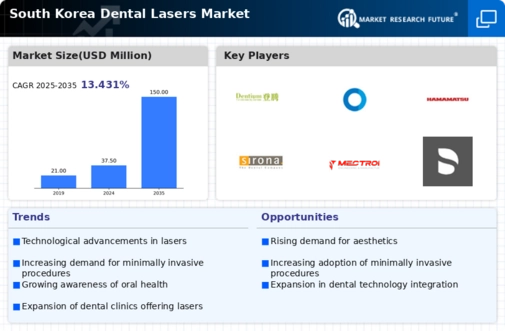
The South Korea Dental Lasers Market is expected to be valued at 37.5 million USD in 2024.

What is the projected market size for the South Korea Dental Lasers Market by 2035?

By 2035, the South Korea Dental Lasers Market is projected to reach a value of 150.0 million USD.

What is the expected compound annual growth rate (CAGR) for the South Korea Dental Lasers Market from 2025 to 2035?

The expected CAGR for the South Korea Dental Lasers Market from 2025 to 2035 is 13.431%.

Which application segment is expected to dominate the South Korea Dental Lasers Market by 2035?

By 2035, the Periodontal Treatment application segment is expected to dominate with a market value of 34.0 million USD.

What is the expected market value for Soft Tissue Surgery within the South Korea Dental Lasers Market in 2024?

The Soft Tissue Surgery application within the South Korea Dental Lasers Market is expected to be valued at 9.0 million USD in 2024.

Who are the key players in the South Korea Dental Lasers Market?

Key players in the South Korea Dental Lasers Market include MediLaser, Dentium, and Dentsply Sirona.

What is the market size for Teeth Whitening in the South Korea Dental Lasers Market by 2035?

The Teeth Whitening application segment is expected to reach a market size of 28.0 million USD by 2035.

What challenges and opportunities exist in the South Korea Dental Lasers Market?

Key opportunities include technological advancements while challenges may stem from competition and regulatory barriers.

How has the application of Endodontic Procedures evolved in the South Korea Dental Lasers Market from 2024 to 2035?

The market for Endodontic Procedures is expected to grow from 7.0 million USD in 2024 to 28.0 million USD by 2035.

What trends are currently shaping the South Korea Dental Lasers Market?

Emerging trends include increased adoption of dental lasers for various procedures and growing awareness of dental aesthetics.

Download Free Sample

Kindly complete the form below to receive a free sample of this Report

Compare Licence

×
Features License Type
Single User Multiuser License Enterprise User
Price $4,950 $5,950 $7,250
Maximum User Access Limit 1 User Upto 10 Users Unrestricted Access Throughout the Organization
Free Customization
Direct Access to Analyst
Deliverable Format
Platform Access
Discount on Next Purchase 10% 15% 15%
Printable Versions