×
Request Free Sample ×

Kindly complete the form below to receive a free sample of this Report

* Please use a valid business email

Leading companies partner with us for data-driven Insights

clients tt-cursor
Hero Background

South Korea Medical Lasers Market

ID: MRFR/MED/49779-HCR
200 Pages
Rahul Gotadki
February 2026

South Korea Medical Lasers Market Research Report: Size, Share, Trend Analysis By Applications (Surgery, Dermatology, Ophthalmology, Dentistry, Gynecology), By Product Type (Solid State Lasers, Gas Lasers, Diode Lasers, Fiber Lasers, Excimer Lasers), By End Use (Hospitals, Outpatient Clinics, Ambulatory Surgical Centers, Research Institutes, Dental Clinics) and By Technology (Contemporary, Traditional, Portable, Robotic) - Growth Outlook & Industry Forecast 2025 To 2035

Share:
Download PDF ×

We do not share your information with anyone. However, we may send you emails based on your report interest from time to time. You may contact us at any time to opt-out.

South Korea Medical Lasers Market Infographic
Purchase Options

South Korea Medical Lasers Market Summary

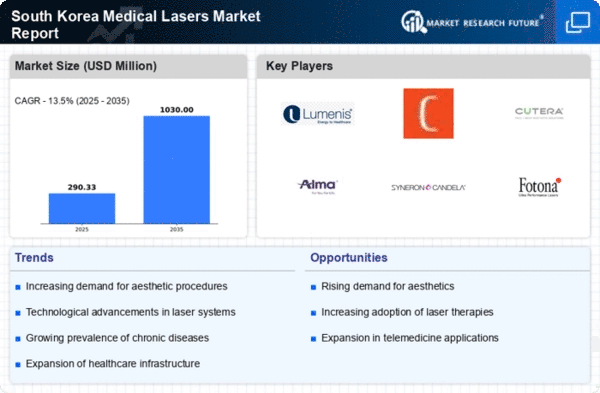
As per Market Research Future analysis, the South Korea medical lasers market size was estimated at 255.8 USD Million in 2024. The South Korea medical lasers market is projected to grow from 290.33 USD Million in 2025 to 1030.0 USD Million by 2035, exhibiting a compound annual growth rate (CAGR) of 13% during the forecast period 2025 - 2035

Key Market Trends & Highlights

The South Korea medical lasers market is poised for substantial growth driven by technological advancements and increasing demand for aesthetic procedures.

  • Technological advancements in laser systems are enhancing treatment efficacy and safety in the medical lasers market.
  • The aesthetic segment represents the largest share of the market, driven by rising consumer interest in cosmetic procedures.
  • The fastest-growing segment is the surgical lasers, reflecting a shift towards minimally invasive surgical techniques.
  • Increasing healthcare expenditure and the rising prevalence of chronic diseases are key drivers propelling market growth.

Market Size & Forecast

2024 Market Size 255.8 (USD Million)
2035 Market Size 1030.0 (USD Million)
CAGR (2025 - 2035) 13.5%

Major Players

Lumenis (IL), Cynosure (US), Cutera (US), Alma Lasers (IL), Syneron Medical (IL), Fotona (SI), Quanta System (IT), Bausch Health (CA)

Our Impact
Enabled $4.3B Revenue Impact for Fortune 500 and Leading Multinationals
Partnering with 2000+ Global Organizations Each Year
30K+ Citations by Top-Tier Firms in the Industry

South Korea Medical Lasers Market Trends

the medical lasers market in South Korea is experiencing notable advancements, driven by technological innovations and a growing demand for minimally invasive procedures. The healthcare sector is witnessing a shift towards laser-based treatments, which are perceived to offer enhanced precision and reduced recovery times. This trend is further supported by the growing prevalence of skin disorders and the rising interest in aesthetic procedures among the population. As a result, healthcare providers are increasingly adopting medical lasers to improve patient outcomes and streamline treatment processes. Moreover, the regulatory environment in South Korea appears to be evolving, with authorities focusing on ensuring the safety and efficacy of medical laser devices. This regulatory support may encourage further investment in research and development, fostering a competitive landscape. Additionally, the collaboration between medical professionals and technology developers is likely to enhance the capabilities of laser systems, leading to more effective applications in various medical fields. Overall, the medical lasers market is poised for growth, reflecting the dynamic nature of healthcare in South Korea.

Technological Advancements

the medical lasers market is experiencing rapid technological advancements, with innovations in laser types and delivery systems. These developments enhance treatment efficacy and broaden the range of applications, from dermatology to ophthalmology. As new technologies emerge, healthcare providers are likely to adopt these advanced systems to improve patient care.

Rising Demand for Aesthetic Procedures

There is a growing demand for aesthetic procedures in South Korea, contributing to the expansion of the medical lasers market. Consumers are increasingly seeking non-invasive treatments for skin rejuvenation and hair removal, driving the adoption of laser technologies. This trend reflects a cultural shift towards prioritizing personal appearance and wellness.

Regulatory Support and Safety Standards

The regulatory framework surrounding medical lasers is becoming more robust, with authorities emphasizing safety and efficacy. This regulatory support may facilitate the introduction of new products and technologies into the market. As safety standards improve, healthcare providers may feel more confident in utilizing advanced laser systems for various treatments.

South Korea Medical Lasers Market Drivers

Increasing Healthcare Expenditure

The medical lasers market in South Korea is experiencing growth due to the rising healthcare expenditure. The government has been investing significantly in healthcare infrastructure, which has led to an increase in the adoption of advanced medical technologies, including lasers. In 2023, healthcare spending in South Korea reached approximately $200 billion, reflecting a growth rate of around 6% annually. This trend indicates a strong commitment to enhancing healthcare services, which is likely to drive the demand for medical lasers. As hospitals and clinics upgrade their equipment to provide better patient care, the medical lasers market is expected to benefit from this increased investment. Furthermore, the growing awareness of the benefits of laser treatments among healthcare providers and patients alike is anticipated to further stimulate market growth.

Supportive Regulatory Environment

The medical lasers market in South Korea benefits from a supportive regulatory environment that facilitates the approval and adoption of new technologies. The Ministry of Food and Drug Safety (MFDS) has established clear guidelines for the evaluation and approval of medical devices, including lasers. This regulatory framework encourages manufacturers to invest in research and development, knowing that their products can be brought to market efficiently. In recent years, the MFDS has expedited the approval process for innovative laser systems, which has contributed to the growth of the medical lasers market. As regulatory support continues, it is likely that more advanced laser technologies will enter the market, further enhancing treatment options available to healthcare providers and patients.

Rising Prevalence of Chronic Diseases

The medical lasers market is also being propelled by the increasing prevalence of chronic diseases in South Korea. Conditions such as diabetes, cardiovascular diseases, and skin disorders are becoming more common, necessitating advanced treatment options. According to recent statistics, approximately 30% of the South Korean population is affected by chronic diseases, which has led to a surge in demand for effective treatment modalities. Medical lasers offer minimally invasive solutions that are often preferred by both patients and healthcare providers. This trend is likely to continue, as the population ages and the incidence of chronic conditions rises. Consequently, the medical lasers market is expected to expand as healthcare facilities seek to incorporate laser technologies into their treatment protocols.

Growing Aesthetic and Cosmetic Procedures

the medical lasers market is influenced by the growing interest in aesthetic and cosmetic procedures among the South Korean population. The country is known for its beauty standards, and there is a high demand for non-invasive cosmetic treatments. In 2023, the aesthetic procedure market in South Korea was valued at approximately $3 billion, with laser treatments accounting for a substantial share. This trend is likely to continue as more individuals seek out laser treatments for skin rejuvenation, hair removal, and other cosmetic enhancements. The medical lasers market is poised to benefit from this increasing consumer interest, as clinics and dermatology practices expand their offerings to include advanced laser technologies. This shift towards aesthetic procedures is expected to drive innovation and investment in the medical lasers market.

Technological Innovations in Laser Systems

Technological innovations are playing a crucial role in shaping the medical lasers market in South Korea. The development of new laser technologies, such as fractional lasers and picosecond lasers, has enhanced the efficacy and safety of treatments. These advancements allow for more precise targeting of tissues, resulting in improved patient outcomes and reduced recovery times. In 2023, the introduction of next-generation laser systems has been met with enthusiasm from healthcare providers, as they seek to offer the latest treatment options. This trend suggests that ongoing research and development in laser technology will continue to drive the medical lasers market forward. As manufacturers invest in innovation, the market is likely to see an influx of advanced products that cater to the evolving needs of healthcare professionals and patients.


Market Segment Insights

By Application: Surgery (Largest) vs. Dermatology (Fastest-Growing)

The South Korea medical lasers market displays a dynamic distribution within its application segment, where Surgery emerges as the largest field due to its wide adoption in various surgical procedures. Dermatology follows closely, demonstrating significant market potential driven by the rising demand for cosmetic and dermatological treatments, thus reflecting robust growth. Growth trends in this segment are influenced by technological advancements and increasing healthcare expenditures. The preference for minimally invasive procedures is boosting the use of medical lasers in Ophthalmology and Gynecology as well, indicating a shift towards safer treatment options. Factors such as an aging population and a growing awareness of aesthetic procedures further propel the demand across the applications in the segment.

Surgery (Dominant) vs. Dermatology (Emerging)

Surgery is the dominant application in the South Korea medical lasers market, favored for its efficacy in achieving precision and minimal recovery times compared to traditional surgical methods. The segment benefits from advancements in laser technologies that enhance surgical outcomes and patient comfort. Conversely, Dermatology is an emerging field, gaining traction as aesthetic medicine becomes increasingly popular. The dermatological applications of medical lasers address skin conditions and cosmetic demands, driving innovations and expanding service offerings. With a rising number of clinics adopting laser systems for treatments like hair removal and skin rejuvenation, the segment positions itself for substantial growth in the coming years.

By Product Type: Diode Lasers (Largest) vs. Fiber Lasers (Fastest-Growing)

In the South Korea medical lasers market, Diode Lasers hold the largest market share due to their widespread application and efficiency in various medical procedures. Their adaptability and performance have positioned them as the preferred choice among healthcare providers, leading to significant market penetration. Comparatively, Fiber Lasers, while currently smaller in market share, are gaining traction due to their versatile applications and increasing acceptance in surgical procedures. Growth trends in this segment indicate a shift towards more advanced laser technologies, particularly those that offer improved energy efficiency and precision. The rising demand for minimally invasive surgeries significantly drives the adoption of innovative laser solutions. Additionally, as technological advancements continue, healthcare providers are increasingly seeking more effective tools for patient care, further contributing to the rapid growth of newer technologies like Fiber Lasers.

Diode Lasers (Dominant) vs. Fiber Lasers (Emerging)

Diode Lasers are recognized for their dominant position in the South Korea medical lasers market, primarily due to their compact size, efficiency, and versatility in treating a variety of medical conditions. Their effectiveness in performing aesthetic and surgical procedures makes them a go-to option for practitioners. Conversely, Fiber Lasers are emerging as a strong alternative, offering unique advantages such as higher precision and the ability to deliver energy through flexible fibers. This capability allows for intricate surgical applications that are less invasive, making Fiber Lasers an attractive choice for modern surgical needs. As both of these technologies evolve, their specific advantages are shaping the dynamics of the South Korea medical lasers market.

By End Use: Hospitals (Largest) vs. Outpatient Clinics (Fastest-Growing)

In the South Korea medical lasers market, hospitals dominate the end use segment, accounting for a significant share due to their extensive infrastructure and adoption of advanced medical technologies. Outpatient clinics, while smaller in share, are gaining traction as they become increasingly equipped to offer specialized laser treatments, catering to a growing patient base seeking convenient and less invasive options. The growth trends in this segment are driven by factors such as increasing health awareness among the population and a rise in chronic diseases that require advanced treatment options. Additionally, technological advancements have enhanced the efficacy and safety of medical lasers, allowing outpatient clinics to emerge as the fastest-growing segment. As healthcare evolves, these clinics position themselves to meet the demand for innovative treatment solutions, thereby stimulating market growth.

Hospitals: Dominant vs. Outpatient Clinics: Emerging

Hospitals hold a dominant position in the South Korea medical lasers market, characterized by their comprehensive service offerings and substantial investment in advanced medical equipment. They leverage the latest technologies to deliver high-quality patient care, making them the preferred choice for complex and specialized treatments. Conversely, outpatient clinics are emerging as a key segment, fueled by the increasing preference for convenience and efficient healthcare services. These clinics focus on offering laser treatments in a more patient-friendly setting, leading to shorter recovery times and lower costs. As they evolve, they are anticipated to play an essential role in expanding access to laser treatments across various medical specialties, thereby reshaping the competitive landscape of the market.

By Technology: Contemporary (Largest) vs. Portable (Fastest-Growing)

The South Korea medical lasers market exhibits a diverse landscape, with the Contemporary technology segment capturing the largest market share due to its advanced features and effectiveness in various medical applications. This segment's dominance is bolstered by continuous innovations and widespread adoption in hospitals and clinics, further enhancing its market presence. In contrast, the Portable technology segment is emerging as the fastest-growing area within the market, driven by an increasing demand for convenient and flexible treatment options. As healthcare providers aim to streamline operations and deliver services in diverse settings, portable solutions are becoming essential, reflecting a shift towards more accessible healthcare delivery systems.

Technology: Contemporary (Dominant) vs. Portable (Emerging)

Contemporary technology in the South Korea medical lasers market is characterized by its state-of-the-art design and high performance, making it the preferred choice among medical practitioners. Its applications span various fields such as dermatology, surgery, and ophthalmology due to its precision and minimal invasiveness. In contrast, the Portable technology segment is gaining traction for its ability to facilitate treatments in remote locations and provide flexibility. This emerging segment caters particularly well to outpatient services and home healthcare, allowing practitioners to adapt to changing patient needs while maintaining quality care.

Get more detailed insights about South Korea Medical Lasers Market

Key Players and Competitive Insights

The medical lasers market in South Korea is characterized by a dynamic competitive landscape, driven by technological advancements and increasing demand for minimally invasive procedures. Key players such as Lumenis (IL), Cynosure (US), and Alma Lasers (IL) are strategically positioned to leverage innovation and regional expansion. Lumenis (IL) focuses on developing cutting-edge laser technologies, while Cynosure (US) emphasizes a diverse product portfolio catering to various medical applications. Alma Lasers (IL) is known for its commitment to research and development, which enhances its competitive edge. Collectively, these strategies foster a robust environment where innovation and operational efficiency are paramount.In terms of business tactics, companies are increasingly localizing manufacturing to reduce costs and enhance supply chain efficiency. The market structure appears moderately fragmented, with several players vying for market share. This fragmentation allows for a variety of offerings, yet the influence of major companies remains significant, as they set trends and standards that smaller firms often follow.

In October Lumenis (IL) announced the launch of its latest laser system, which integrates advanced AI capabilities to enhance treatment precision. This strategic move not only positions Lumenis (IL) as a leader in technological innovation but also addresses the growing demand for personalized medical solutions. The incorporation of AI is likely to attract a broader customer base, thereby increasing market penetration.

In September Cynosure (US) expanded its distribution network in South Korea by partnering with local medical device distributors. This strategic alliance is expected to enhance Cynosure's (US) market presence and improve access to its innovative laser solutions. By leveraging local expertise, Cynosure (US) may effectively navigate regulatory challenges and better meet the specific needs of South Korean healthcare providers.

In August Alma Lasers (IL) entered into a collaboration with a prominent South Korean university to advance research in laser applications for dermatology. This partnership underscores Alma's (IL) commitment to innovation and positions the company at the forefront of emerging trends in medical lasers. Such collaborations are likely to yield new insights and technologies that can be commercialized, further solidifying Alma's (IL) competitive stance.

As of November the competitive trends in the medical lasers market are increasingly defined by digitalization, sustainability, and the integration of AI technologies. Strategic alliances are shaping the landscape, enabling companies to pool resources and expertise. Looking ahead, competitive differentiation is expected to evolve, with a shift from price-based competition to a focus on innovation, technological advancements, and supply chain reliability. This transition may redefine market dynamics, compelling companies to invest in R&D and strategic partnerships to maintain a competitive edge.

Key Companies in the South Korea Medical Lasers Market include

Industry Developments

The South Korea Medical Lasers Market has seen significant developments recently, particularly in relation to technological advancements and product launches. Companies such as SRA Technologies and Lutronic are focusing on innovation to enhance treatment efficacy and patient comfort. In terms of market value, Fotona and Cutera have reported notable growth attributed to the increasing demand for minimally invasive procedures, with a shift towards aesthetic applications. In July 2023, Revance Therapeutics announced a strategic partnership with Hologic to expand its product offerings in the non-surgical facial aesthetic segment, further driving competition. 

Regarding mergers and acquisitions, in August 2023, Bausch Health finalized its acquisition of a leading laser technology firm, bolstering its position within the South Korean market. At the same time, Cynosure and Lumenis are continually expanding their market presence through collaborations aimed at the development of advanced laser systems. Over the past couple of years, there have been significant regulatory changes enhancing the approval processes for new laser technologies, with South Korea's Ministry of Food and Drug Safety actively overseeing these developments to ensure patient safety and efficacy.

Future Outlook

South Korea Medical Lasers Market Future Outlook

The Medical Lasers Market in South Korea is projected to grow at a 13.5% CAGR from 2025 to 2035, driven by technological advancements, increasing healthcare expenditure, and rising demand for minimally invasive procedures.

New opportunities lie in:

  • Development of portable laser systems for outpatient settings.
  • Expansion of laser applications in dermatology and aesthetic treatments.
  • Partnerships with telemedicine platforms for remote laser consultations.

By 2035, the medical lasers market is expected to achieve substantial growth, positioning itself as a leader in innovative healthcare solutions.

Market Segmentation

South Korea Medical Lasers Market End Use Outlook

  • Hospitals
  • Outpatient Clinics
  • Ambulatory Surgical Centers
  • Research Institutes
  • Dental Clinics

South Korea Medical Lasers Market Technology Outlook

  • Contemporary
  • Traditional
  • Portable
  • Robotic

South Korea Medical Lasers Market Application Outlook

  • Surgery
  • Dermatology
  • Ophthalmology
  • Dentistry
  • Gynecology

South Korea Medical Lasers Market Product Type Outlook

  • Solid State Lasers
  • Gas Lasers
  • Diode Lasers
  • Fiber Lasers
  • Excimer Lasers

Report Scope

MARKET SIZE 2024 255.8(USD Million)
MARKET SIZE 2025 290.33(USD Million)
MARKET SIZE 2035 1030.0(USD Million)
COMPOUND ANNUAL GROWTH RATE (CAGR) 13.5% (2025 - 2035)
REPORT COVERAGE Revenue Forecast, Competitive Landscape, Growth Factors, and Trends
BASE YEAR 2024
Market Forecast Period 2025 - 2035
Historical Data 2019 - 2024
Market Forecast Units USD Million
Key Companies Profiled Lumenis (IL), Cynosure (US), Cutera (US), Alma Lasers (IL), Syneron Medical (IL), Fotona (SI), Quanta System (IT), Bausch Health (CA)
Segments Covered Application, Product Type, End Use, Technology
Key Market Opportunities Advancements in minimally invasive procedures drive growth in the medical lasers market.
Key Market Dynamics Rising demand for minimally invasive procedures drives innovation and competition in the medical lasers market.
Countries Covered South Korea
Leave a Comment

FAQs

What is the expected market size of the South Korea Medical Lasers Market in 2024?

The South Korea Medical Lasers Market is expected to be valued at 230.0 million USD in 2024.

What will be the projected market size of the South Korea Medical Lasers Market by 2035?

By 2035, the South Korea Medical Lasers Market is projected to reach a value of 490.0 million USD.

What is the expected compound annual growth rate (CAGR) for the South Korea Medical Lasers Market between 2025 and 2035?

The expected CAGR for the South Korea Medical Lasers Market from 2025 to 2035 is 7.118%.

Which application segment of the South Korea Medical Lasers Market is expected to have the largest market size in 2024?

In 2024, the Surgery segment is expected to have the largest market size, valued at 80.0 million USD.

What is the projected market size for the Ophthalmology application segment by 2035?

The Ophthalmology application segment is projected to reach a market size of 90.0 million USD by 2035.

Which key players are dominating the South Korea Medical Lasers Market?

Major players in the South Korea Medical Lasers Market include SRA Technologies, Fotona, Cutera, and Revance Therapeutics.

What is the expected market size for the Dermatology application segment in 2024?

The Dermatology application segment is expected to be valued at 50.0 million USD in 2024.

How much is the Dentistry segment expected to grow by 2035?

The Dentistry segment is expected to grow to 70.0 million USD by 2035.

What are the growth opportunities in the South Korea Medical Lasers Market?

The growth opportunities include advancements in laser technology and increasing demand for minimally invasive procedures.

How does the gynecology application segment compare in value between 2024 and 2035?

The gynecology application segment is expected to grow from 30.0 million USD in 2024 to 60.0 million USD by 2035.

Download Free Sample

Kindly complete the form below to receive a free sample of this Report

Compare Licence

×
Features License Type
Single User Multiuser License Enterprise User
Price $4,950 $5,950 $7,250
Maximum User Access Limit 1 User Upto 10 Users Unrestricted Access Throughout the Organization
Free Customization
Direct Access to Analyst
Deliverable Format
Platform Access
Discount on Next Purchase 10% 15% 15%
Printable Versions