×
Request Free Sample ×

Kindly complete the form below to receive a free sample of this Report

* Please use a valid business email

Leading companies partner with us for data-driven Insights

clients tt-cursor
Hero Background

Offshore Autonomous Underwater Vehicle Market

ID: MRFR/AD/6741-CR
168 Pages
Swapnil Palwe
August 2019

Offshore Autonomous Underwater Vehicle (AUV) Market Size, Share, Industry Trend & Analysis Research Report Information by Type (Shallow, Medium and Large), Technology (Communication, Collision Avoidance, Navigation, Imaging and Propulsion), Payload (Sensors, Cameras, Synthetic Aperture Sonars and others), Application (Military & Defense; Oil & Gas; Oceanography; Environmental Protection and Monitoring; Archaeological and Exploration and Search and Salvage Operations) and Region (North America, Europe, Asia Pacific, Middle East and Africa and Latin America) - Forecast to 2035

Share:
Download PDF ×

We do not share your information with anyone. However, we may send you emails based on your report interest from time to time. You may contact us at any time to opt-out.

Offshore Autonomous Underwater Vehicle Market Infographic
Purchase Options

Offshore Autonomous Underwater Vehicle Market Summary

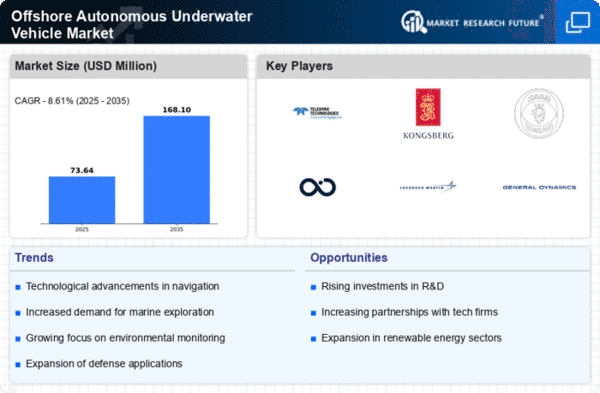
As per MRFR analysis, the Offshore Autonomous Underwater Vehicle Market Size was estimated at 67.8 USD Million in 2024. The Offshore Autonomous Underwater Vehicle industry is projected to grow from 73.6 USD Million in 2025 to 168.1 USD Million by 2035, exhibiting a compound annual growth rate (CAGR) of 8.61 during the forecast period 2025 - 2035.

Key Market Trends & Highlights

The Offshore Autonomous Underwater Vehicle Market is poised for substantial growth driven by technological advancements and increasing demand across various sectors.

  • North America remains the largest market for offshore autonomous underwater vehicles, driven by robust military applications.
  • The Asia-Pacific region is emerging as the fastest-growing market, fueled by rising investments in marine research and environmental monitoring.
  • The military segment continues to dominate the market, while the scientific research segment is experiencing rapid growth due to heightened interest in oceanographic studies.
  • Key market drivers include the rising demand for marine exploration and increased investment in defense and security initiatives.

Market Size & Forecast

2024 Market Size 67.8 (USD Million)
2035 Market Size 168.1 (USD Million)
CAGR (2025 - 2035) 8.61%

Major Players

Teledyne Technologies (US), Kongsberg Gruppen (NO), Saab AB (SE), Ocean Infinity (GB), Lockheed Martin (US), General Dynamics (US), Boeing (US), Fugro (NL), Subsea 7 (GB)

Our Impact
Enabled $4.3B Revenue Impact for Fortune 500 and Leading Multinationals
Partnering with 2000+ Global Organizations Each Year
30K+ Citations by Top-Tier Firms in the Industry

Offshore Autonomous Underwater Vehicle Market Trends

The Offshore Autonomous Underwater Vehicle Market is currently experiencing a notable transformation, driven by advancements in technology and increasing demand for underwater exploration. The integration of artificial intelligence and machine learning into these vehicles enhances their operational capabilities, allowing for more efficient data collection and analysis. This evolution is particularly relevant in sectors such as marine research, oil and gas exploration, and environmental monitoring, where precision and reliability are paramount. Furthermore, the growing emphasis on sustainable practices is prompting companies to invest in eco-friendly designs and energy-efficient systems, which could reshape the competitive landscape of the market. In addition, the Offshore Autonomous Underwater Vehicle Market is witnessing a surge in collaboration between private enterprises and governmental organizations. Such partnerships are likely to facilitate the development of innovative solutions tailored to specific industry needs. As regulatory frameworks evolve to accommodate these technologies, the market may see an influx of new entrants, fostering a dynamic environment characterized by rapid innovation. Overall, the Offshore Autonomous Underwater Vehicle Market appears poised for substantial growth, driven by technological advancements and collaborative efforts across various sectors.

Technological Advancements

The Offshore Autonomous Underwater Vehicle Market is significantly influenced by rapid technological advancements. Innovations in sensor technology, navigation systems, and communication capabilities are enhancing the performance and reliability of these vehicles. As a result, operators can conduct more complex missions with greater accuracy, which is essential for applications such as underwater mapping and resource exploration.

Sustainability Initiatives

There is a growing trend towards sustainability within the Offshore Autonomous Underwater Vehicle Market. Companies are increasingly focusing on developing environmentally friendly vehicles that minimize ecological impact. This shift is driven by both regulatory pressures and consumer demand for greener technologies, leading to the creation of energy-efficient designs and alternative power sources.

Collaborative Efforts

The Offshore Autonomous Underwater Vehicle Market is seeing an increase in collaborative efforts between various stakeholders. Partnerships between private companies, research institutions, and government agencies are fostering innovation and accelerating the development of new technologies. Such collaborations are likely to enhance the market's adaptability to changing industry needs and regulatory environments.

Offshore Autonomous Underwater Vehicle Market Drivers

Market Growth Projections

The Global Offshore Autonomous Underwater Vehicle Market AUV Market Industry is poised for substantial growth, with projections indicating a market value of 0.44 USD Billion in 2024, escalating to 4.24 USD Billion by 2035. This trajectory suggests a remarkable compound annual growth rate of 22.9% from 2025 to 2035. Such growth is indicative of the increasing reliance on AUVs across various sectors, including marine research, defense, and environmental monitoring. The expanding applications of AUVs, coupled with technological advancements and rising investments, contribute to this optimistic outlook. Stakeholders are likely to focus on innovation and strategic partnerships to capitalize on emerging opportunities in the market.

Technological Advancements in AUVs

Technological advancements play a pivotal role in shaping the Global Offshore Autonomous Underwater Vehicle Market AUV Market Industry. Innovations in sensors, navigation systems, and battery technologies enhance the operational capabilities of AUVs, allowing for longer missions and more precise data collection. These advancements not only improve the efficiency of underwater operations but also reduce operational costs, making AUVs more attractive to various sectors. As organizations seek to leverage cutting-edge technology for marine applications, the market is likely to witness significant growth. The integration of artificial intelligence and machine learning into AUV systems further indicates a trend towards smarter, more autonomous vehicles.

Rising Demand for Marine Exploration

The Global Offshore Autonomous Underwater Vehicle Market AUV Market Industry experiences a surge in demand driven by the increasing need for marine exploration. As industries such as oil and gas, environmental monitoring, and marine research expand, the utilization of AUVs becomes essential for efficient data collection and analysis. In 2024, the market is valued at 0.44 USD Billion, reflecting the growing reliance on these technologies. The ability of AUVs to operate in challenging underwater environments enhances their appeal, suggesting a robust growth trajectory. By 2035, the market is projected to reach 4.24 USD Billion, indicating a compound annual growth rate of 22.9% from 2025 to 2035.

Increased Investment in Marine Research

The Global Offshore Autonomous Underwater Vehicle Market AUV Market Industry benefits from increased investment in marine research initiatives. Governments and private entities are recognizing the importance of understanding marine ecosystems and resources, leading to enhanced funding for research projects. This investment is crucial for the development and deployment of AUVs, which are instrumental in gathering data on oceanographic conditions, biodiversity, and climate change impacts. The growing emphasis on sustainable practices and environmental conservation further propels the demand for AUVs in research settings. As funding continues to rise, the market is expected to expand, reflecting the critical role of AUVs in advancing marine science.

Growing Applications in Defense and Security

The Global Offshore Autonomous Underwater Vehicle Market AUV Market Industry is significantly influenced by the growing applications of AUVs in defense and security. Military organizations are increasingly adopting AUVs for surveillance, reconnaissance, and mine detection operations. The ability of AUVs to operate stealthily and gather intelligence in hostile environments enhances their value in national security strategies. As geopolitical tensions rise, the demand for advanced underwater capabilities is likely to increase, driving market growth. Furthermore, collaborations between defense contractors and technology firms are expected to yield innovative AUV solutions, further solidifying their role in modern defense operations.

Environmental Regulations and Sustainability Initiatives

The Global Offshore Autonomous Underwater Vehicle Market AUV Market Industry is shaped by stringent environmental regulations and sustainability initiatives. As governments worldwide implement policies aimed at protecting marine environments, the demand for AUVs that can conduct environmentally friendly assessments and monitoring rises. AUVs equipped with advanced sensors can provide critical data for compliance with regulations, facilitating sustainable practices in industries such as fishing, shipping, and oil exploration. This alignment with environmental goals not only enhances the market appeal of AUVs but also encourages investment in their development. The focus on sustainability is likely to drive innovation and adoption in the coming years.


Market Segment Insights

By Application: Military (Largest) vs. Scientific Research (Fastest-Growing)

The Offshore Autonomous Underwater Vehicle (AUV) market is characterized by a diverse application landscape, with military applications holding the largest share. This segment has been driving significant investments due to the increasing focus on national security and the growing demand for sophisticated surveillance and reconnaissance operations. In parallel, the scientific research segment is gaining traction and showing strong potential for growth, fueled by advancements in technology and increasing funding for marine research initiatives. Another notable segment is commercial exploration, which is also witnessing considerable expansion as companies seek to harness underwater resources. Environmental monitoring is increasingly vital due to climate change awareness, while underwater inspection services support the growing oil and gas industrial activities. Overall, all segments are projected to coexist and thrive as the AUV technology matures, addressing various underwater operational needs.

Military (Dominant) vs. Scientific Research (Emerging)

In the Offshore Autonomous Underwater Vehicle market, the Military segment remains dominant due to enhanced funding and strategic initiatives aimed at improving maritime security. This segment's vehicles are designed for extended endurance, enabling complex missions such as mine detection, anti-submarine warfare, and reconnaissance. Conversely, the Scientific Research segment is emerging rapidly, driven by the desire for advanced tools to explore and monitor oceanic environments. Scientific AUVs are equipped with sophisticated sensors to collect data, contributing to our understanding of marine ecosystems and climate change impacts. As research initiatives expand, particularly in the areas of biodiversity and ocean health, the demand for AUVs in this segment is expected to increase significantly.

By End Use: Oil and Gas (Largest) vs. Marine Research (Fastest-Growing)

In the Offshore Autonomous Underwater Vehicle Market, the end use segment exhibits a diverse distribution among key sectors like Oil and Gas, Marine Research, Defense, Telecommunications, and Renewable Energy. Notably, the Oil and Gas sector holds a dominant position due to its extensive operational requirements for underwater inspections, maintenance, and exploration activities. Following closely is Marine Research, which has gained traction thanks to the increasing demand for environmental monitoring and exploration of marine ecosystems, making it a significant contributor to the market's dynamics.

Oil and Gas: Dominant vs. Marine Research: Emerging

The Oil and Gas sector is regarded as the dominant end use for Offshore Autonomous Underwater Vehicles, attributed to its critical needs for underwater intelligence that supports drilling and production operations. This field requires reliable, advanced AUVs that can operate efficiently in challenging underwater environments, ensuring safety and reducing operational costs. In contrast, Marine Research represents an emerging sector in this market, fueled by heightened global attention on marine conservation and sustainability. AUVs are increasingly utilized for complex underwater tasks, including data collection and ecosystem assessments, reflecting their growing importance in scientific exploration and research endeavors.

By Vehicle Type: Remotely Operated Vehicle (Largest) vs. Autonomous Underwater Vehicle (Fastest-Growing)

The Offshore Autonomous Underwater Vehicle Market is composed of various vehicle types, with Remotely Operated Vehicles (ROVs) commanding a significant share. They are widely utilized in subsea inspections, repairs, and data collection, solidifying their position as the largest segment. Conversely, Autonomous Underwater Vehicles (AUVs) are gaining momentum, rapidly expanding due to technological advancements and increasing applications in environmental monitoring and deep-sea exploration. As the industry evolves, the growth trends indicate a heightened demand for AUVs, driven by the need for enhanced automation and reduced operational costs. Factors such as improved energy efficiency, advanced sonar technologies, and integration with artificial intelligence are propelling the adoption of AUVs, making them a focus for future investments and innovations in the market.

Remotely Operated Vehicle (Dominant) vs. Autonomous Underwater Vehicle (Emerging)

Remotely Operated Vehicles have established themselves as the dominant force in the Offshore Autonomous Underwater Vehicle Market, primarily due to their established reliability and versatility in operations. These vehicles are highly controllable, allowing operators to perform complex tasks in challenging subsea environments, making them essential for oil and gas, telecommunications, and underwater construction industries. In contrast, Autonomous Underwater Vehicles represent an emerging segment, characterized by their capability to operate independently and cover large areas without human intervention. AUVs are particularly sought for environmental monitoring and research applications, credited with advancing underwater mapping and survey technologies. As the market embraces increasing automation, AUVs are positioned to carve out a significant share of the market, attracting attention from developers and researchers.

By Technology: Navigation Systems (Largest) vs. Sensor Technology (Fastest-Growing)

In the Offshore Autonomous Underwater Vehicle Market, the technology segment is characterized by various key players in navigation systems, communication systems, power systems, and sensor technology. Navigation systems currently hold the largest market share, attributed to their critical role in AUV operations, enabling accurate positioning and route planning. Sensor technology, while currently smaller in market share, is the fastest-growing segment, driven by advancements in data collection capabilities and an increasing demand for environmental monitoring.

Technology: Navigation Systems (Dominant) vs. Sensor Technology (Emerging)

Navigation systems in the Offshore Autonomous Underwater Vehicle Market are recognized for their integral role in ensuring operational efficiency and safety. These systems provide precise geolocation, facilitate obstacle avoidance, and enable mission planning, solidifying their position as the dominant technology. In contrast, sensor technology is emerging as the fastest-growing area due to rapid innovations, including enhanced imaging, sonar capabilities, and environmental sensing. As AUVs are increasingly deployed for research and commercial purposes, the demand for sophisticated sensor technology will continue to rise, enabling more complex data analysis and broader applications.

By Payload Capacity: Heavyweight (Largest) vs. Medium Weight (Fastest-Growing)

In the Offshore Autonomous Underwater Vehicle Market, the payload capacity segment exhibits pronounced differentiation among its values. The heavyweight category is currently the largest segment, recognized for its ability to carry substantial equipment and missions, crucial in deep-sea exploration and heavy-duty tasks. Meanwhile, the medium weight segment, gaining traction, is rapidly growing due to advancements in technology that enhance operational efficiency while ensuring a robust balance between payload and maneuverability. As the demand for underwater exploration continues to rise, particularly in oil and gas, environmental monitoring, and scientific research, the growth trends reflect a shifting preference toward vehicles that offer versatility. The medium weight category is particularly appealing to emerging markets where budget constraints drive the need for efficient yet capable vehicles, thus, its status as the fastest-growing segment bolsters its market relevance in the face of evolving operational requirements.

Payload Capacity: Heavyweight (Dominant) vs. Medium Weight (Emerging)

The heavyweight segment of the Offshore Autonomous Underwater Vehicle Market is characterized by its robust construction and high endurance, allowing it to undertake extensive deep-sea tasks, including construction, maintenance, and scientific data collection. These vehicles are typically equipped with advanced technologies and larger sensors, making them essential for missions where substantial payloads are necessary. In contrast, the medium weight category presents a compelling alternative for operators who seek a balance between payload capacity and operational efficiency. These vehicles are often more maneuverable, allowing for greater adaptability in varied underwater environments, thereby catering to a broader range of applications from research to surveillance. As technology progresses, the medium weight segment is becoming increasingly sophisticated, showcasing its potential as an emerging leader in the market.

Get more detailed insights about Offshore Autonomous Underwater Vehicle Market

Regional Insights

North America : Market Leader in Innovation

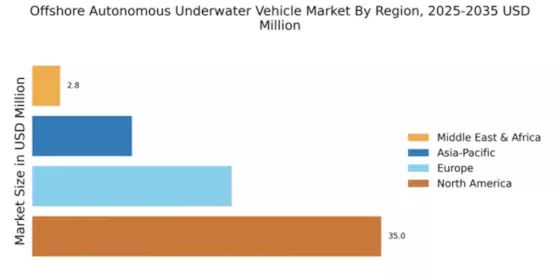
North America is poised to maintain its leadership in the Offshore Autonomous Underwater Vehicle (AUV) market, holding a significant 35.0% share. The region's growth is driven by advancements in technology, increasing demand for underwater exploration, and robust investments in defense and research sectors. Regulatory support from agencies like the U.S. Navy and NOAA further catalyzes market expansion, ensuring compliance and safety in underwater operations. The competitive landscape is dominated by key players such as Teledyne Technologies, Lockheed Martin, and Boeing, which are at the forefront of innovation. The U.S. remains the leading country, leveraging its technological prowess and extensive funding for AUV development. Collaborations between private firms and government entities enhance the region's capabilities, positioning it as a hub for underwater vehicle technology.

Europe : Emerging Hub for AUVs

Europe is emerging as a significant player in the Offshore Autonomous Underwater Vehicle market, with a market share of 20.0%. The region's growth is fueled by a strong focus on sustainability and environmental monitoring, alongside increasing investments in marine research. Regulatory frameworks from the European Union promote innovation and safety in underwater technologies, driving demand for AUVs in various sectors, including oil and gas, and environmental protection. Leading countries such as Norway, the UK, and Germany are at the forefront of AUV development, supported by companies like Kongsberg Gruppen and Saab AB. The competitive landscape is characterized by collaborations between academia and industry, fostering innovation. The presence of established players and a growing number of startups enhances the region's capabilities, making Europe a key market for AUV technology.

Asia-Pacific : Rapidly Growing Market

Asia-Pacific is witnessing rapid growth in the Offshore Autonomous Underwater Vehicle market, currently holding a 10.0% share. The region's expansion is driven by increasing investments in marine research and exploration, particularly in countries like China and Japan. Government initiatives aimed at enhancing maritime security and environmental monitoring are also significant growth catalysts, creating a favorable regulatory environment for AUV deployment. China is leading the charge in AUV technology, with substantial investments from both government and private sectors. The competitive landscape includes key players like Fugro and various local firms that are innovating to meet regional demands. As the market matures, collaborations between international and local companies are expected to enhance technological capabilities and market penetration in the region.

Middle East and Africa : Emerging Market Potential

The Middle East and Africa region is gradually emerging in the Offshore Autonomous Underwater Vehicle market, with a market share of 2.8%. The growth is primarily driven by the need for resource exploration and environmental monitoring in offshore oil and gas sectors. Governments are increasingly recognizing the importance of AUVs for enhancing operational efficiency and safety in underwater operations, leading to supportive regulatory frameworks. Countries like South Africa and the UAE are taking the lead in adopting AUV technology, with investments aimed at improving marine research capabilities. The competitive landscape is still developing, with a mix of local and international players entering the market. As awareness of AUV benefits grows, the region is expected to see increased adoption and innovation in underwater vehicle technologies.

Offshore Autonomous Underwater Vehicle Market Regional Image

Key Players and Competitive Insights

The Offshore Autonomous Underwater Vehicle Market is currently characterized by a dynamic competitive landscape, driven by technological advancements and increasing demand for underwater exploration and surveillance. Key players such as Teledyne Technologies (US), Kongsberg Gruppen (NO), and Ocean Infinity (GB) are at the forefront, each adopting distinct strategies to enhance their market positioning. Teledyne Technologies (US) focuses on innovation, particularly in sensor technology and data analytics, which appears to be a critical factor in their competitive edge. Meanwhile, Kongsberg Gruppen (NO) emphasizes regional expansion, particularly in the North Sea, where they have established partnerships with local energy companies to enhance operational efficiency. Ocean Infinity (GB) is leveraging digital transformation, utilizing AI and machine learning to optimize their underwater operations, which collectively shapes a competitive environment that is increasingly reliant on technological prowess and strategic collaborations.In terms of business tactics, companies are localizing manufacturing and optimizing supply chains to enhance responsiveness to market demands. The market structure is moderately fragmented, with several players vying for dominance, yet the collective influence of major companies like Lockheed Martin (US) and Fugro (NL) is significant. These firms are not only competing on technological capabilities but also on their ability to deliver customized solutions that meet specific client needs, thereby enhancing their market share.

In November Lockheed Martin (US) announced a strategic partnership with a leading marine research institution to develop next-generation autonomous underwater vehicles. This collaboration is poised to enhance Lockheed's capabilities in marine research and surveillance, indicating a shift towards more integrated solutions that combine defense and environmental monitoring. The strategic importance of this partnership lies in its potential to broaden Lockheed's application scope, thereby increasing their competitive advantage in both commercial and governmental sectors.

In October Kongsberg Gruppen (NO) launched a new series of underwater drones designed for deep-sea exploration, which are equipped with advanced imaging technology. This move not only reinforces Kongsberg's commitment to innovation but also positions them as a leader in the deep-sea exploration segment. The introduction of these drones is likely to attract interest from various sectors, including oil and gas, environmental monitoring, and scientific research, thereby expanding their market reach.

In September Ocean Infinity (GB) secured a multi-million dollar contract with a major oil company for the deployment of their autonomous underwater vehicles in offshore operations. This contract underscores Ocean Infinity's growing reputation in the industry and highlights the increasing reliance on autonomous systems for complex underwater tasks. The strategic significance of this contract lies in its potential to enhance operational efficiency and reduce costs for their clients, further solidifying Ocean Infinity's market position.

As of December current competitive trends in the Offshore Autonomous Underwater Vehicle Market are heavily influenced by digitalization, sustainability, and AI integration. Strategic alliances are increasingly shaping the landscape, as companies recognize the need for collaborative approaches to tackle complex underwater challenges. Looking ahead, competitive differentiation is likely to evolve from traditional price-based competition to a focus on innovation, advanced technology, and supply chain reliability. This shift suggests that companies that prioritize R&D and strategic partnerships will be better positioned to thrive in an increasingly competitive environment.

Key Companies in the Offshore Autonomous Underwater Vehicle Market include

Industry Developments

In March 2019, the ECA Group signed a contract worth USD 508.8 million with the Belgian navy to provide AUVs, towed sonars, and my identification & destruction systems (MIDS) composed of ROV for the identification and destruction of mines and unmanned surface vehicles. It further helped improve its financial position in the global Offshore Autonomous Underwater Vehicle Market (AUV) Market.

According to the recent news, Norwegian marine survey contractor Argeo signed an agreement with an undisclosed client to provide autonomous underwater vehicle (AUV) services in the Brazilian oil and gas sector.

Offshore Autonomous Underwater Vehicle Market Industry Developments

  • Q2 2024: Saab secures major contract for autonomous underwater vehicles with European navy Saab announced it won a multi-million dollar contract to supply its Sabertooth autonomous underwater vehicles for mine countermeasure operations to a European naval customer, marking a significant expansion in defense applications for offshore AUVs.
  • Q2 2024: Ocean Infinity launches new Armada fleet of autonomous underwater vehicles Ocean Infinity unveiled its next-generation Armada fleet, featuring advanced autonomous underwater vehicles designed for offshore energy and deep-sea exploration, with operations commencing in the North Sea and Gulf of Mexico.
  • Q3 2024: Fugro partners with Shell for offshore autonomous underwater vehicle deployment Fugro announced a strategic partnership with Shell to deploy autonomous underwater vehicles for subsea inspection and data collection at major offshore oil and gas fields, aiming to improve operational efficiency and safety.
  • Q3 2024: Hydromea raises $15M Series B to scale wireless underwater drone technology Swiss startup Hydromea closed a $15 million Series B funding round to accelerate development and commercialization of its wireless autonomous underwater vehicles for offshore inspection and environmental monitoring.
  • Q4 2024: Kongsberg Maritime opens new AUV manufacturing facility in Norway Kongsberg Maritime inaugurated a state-of-the-art manufacturing facility dedicated to autonomous underwater vehicles in Horten, Norway, expanding its production capacity to meet growing offshore market demand.
  • Q4 2024: Teledyne Marine wins contract for offshore wind farm AUV survey operations Teledyne Marine secured a contract to provide autonomous underwater vehicles for seabed mapping and cable inspection at a major European offshore wind farm, supporting renewable energy infrastructure development.
  • Q1 2025: Blue Ocean Robotics announces launch of new deepwater AUV platform Blue Ocean Robotics introduced its latest deepwater autonomous underwater vehicle platform, designed for extended offshore missions in oil & gas, defense, and environmental research sectors.
  • Q1 2025: Exail secures $30M contract for autonomous underwater vehicles with Asian government Exail, a leading provider of marine robotics, announced a $30 million contract to deliver autonomous underwater vehicles for coastal surveillance and infrastructure inspection to an Asian government agency.
  • Q2 2025: ECA Group partners with TotalEnergies for offshore AUV deployment in West Africa ECA Group entered a partnership with TotalEnergies to deploy autonomous underwater vehicles for subsea asset inspection and environmental monitoring at offshore oil fields in West Africa.
  • Q2 2025: Sonardyne launches new navigation system for offshore autonomous underwater vehicles Sonardyne unveiled its latest navigation and positioning system tailored for autonomous underwater vehicles, enhancing operational accuracy for offshore survey and inspection missions.
  • Q3 2025: L3Harris Technologies wins US Navy contract for advanced autonomous underwater vehicles L3Harris Technologies was awarded a contract by the US Navy to supply advanced autonomous underwater vehicles for mine detection and anti-submarine warfare, strengthening its position in the defense sector.
  • Q3 2025: Ocean Aero announces partnership with BP for offshore AUV environmental monitoring Ocean Aero revealed a new partnership with BP to deploy its hybrid autonomous underwater vehicles for continuous environmental monitoring at offshore oil and gas platforms in the Gulf of Mexico.

Report Overview

The Offshore Autonomous Underwater Vehicle Market (AUV) Marketreport shows the market's tremendous growth at the global level. As per the estimation, the market will successfully attain its CAGR and USD value during the forecast period. The chief factor’s role was highlighted in the report with its effective role and impact. The market segments with their respective application are driving its global growth rate. The regional analysis shows the major regions diversely covered by the Offshore Autonomous Underwater Vehicle Market (AUV) Marketwith rising demand. The further developments will successfully help the market to drive its global growth.

Key Industrial Segments 

By Type

Shallow 

Medium

Large

By Technology

Communication

Collision Avoidance

Navigation

Imaging 

Propulsion

By Payload

Sensors

Cameras

Synthetic Aperture Sonars 

others

By Application

Military &Defense

Oil & Gas

Oceanography

Environmental Protection and Monitoring

Archaeological and Exploration 

Search and Salvage Operations

Future Outlook

Offshore Autonomous Underwater Vehicle Market Future Outlook

The Offshore Autonomous Underwater Vehicle Market is projected to grow at an 8.61% CAGR from 2025 to 2035, driven by advancements in technology, increasing demand for underwater exploration, and environmental monitoring.

New opportunities lie in:

  • Development of AI-driven navigation systems for enhanced operational efficiency.
  • Integration of renewable energy sources for sustainable underwater operations.
  • Expansion into emerging markets with tailored underwater solutions.

By 2035, the market is expected to achieve substantial growth, positioning itself as a leader in underwater technology.

Market Segmentation

Offshore Autonomous Underwater Vehicle Market End Use Outlook

  • Oil and Gas
  • Marine Research
  • Defense
  • Telecommunications
  • Renewable Energy

Offshore Autonomous Underwater Vehicle Market Technology Outlook

  • Navigation Systems
  • Communication Systems
  • Power Systems
  • Sensor Technology

Offshore Autonomous Underwater Vehicle Market Application Outlook

  • Military
  • Scientific Research
  • Commercial Exploration
  • Environmental Monitoring
  • Underwater Inspection

Offshore Autonomous Underwater Vehicle Market Vehicle Type Outlook

  • Remotely Operated Vehicle
  • Autonomous Underwater Vehicle
  • Hybrid Vehicle
  • Surface Vehicle

Offshore Autonomous Underwater Vehicle Market Payload Capacity Outlook

  • Lightweight
  • Medium Weight
  • Heavyweight

Report Scope

MARKET SIZE 202467.8(USD Million)
MARKET SIZE 202573.6(USD Million)
MARKET SIZE 2035168.1(USD Million)
COMPOUND ANNUAL GROWTH RATE (CAGR)8.61% (2025 - 2035)
REPORT COVERAGERevenue Forecast, Competitive Landscape, Growth Factors, and Trends
BASE YEAR2024
Market Forecast Period2025 - 2035
Historical Data2019 - 2024
Market Forecast UnitsUSD Million
Key Companies ProfiledTeledyne Technologies (US), Kongsberg Gruppen (NO), Saab AB (SE), Ocean Infinity (GB), Lockheed Martin (US), General Dynamics (US), Boeing (US), Fugro (NL), Subsea 7 (GB)
Segments CoveredApplication, End Use, Vehicle Type, Technology, Payload Capacity
Key Market OpportunitiesAdvancements in artificial intelligence enhance operational efficiency in the Offshore Autonomous Underwater Vehicle Market.
Key Market DynamicsTechnological advancements and regulatory changes drive innovation and competition in the Offshore Autonomous Underwater Vehicle Market.
Countries CoveredNorth America, Europe, APAC, South America, MEA

Market Highlights

Author
Swapnil Palwe
Team Lead - Research

With a technical background as Bachelor's in Mechanical Engineering, with MBA in Operations Management , Swapnil has 6+ years of experience in market research, consulting and analytics with the tasks of data mining, analysis, and project execution. He is the POC for our clients, for their consulting projects running under the Automotive/A&D domain. Swapnil has worked on major projects in verticals such as Aerospace & Defense, Automotive and many other domain projects. He has worked on projects for fortune 500 companies' syndicate and consulting projects along with several government projects.

Leave a Comment

FAQs

What is the CAGR of the Global Offshore Autonomous Underwater Vehicle (AUV) Market?

Global Offshore Autonomous Underwater Vehicle (AUV) Market’s CAGR is 15.70%.

What is the growth period of the Global Offshore Autonomous Underwater Vehicle (AUV) Market?

Global Offshore Autonomous Underwater Vehicle (AUV) Market will be growing during the years from 2018 to 2024.

How the Global Offshore Autonomous Underwater Vehicle (AUV) Market is overgrowing?

Global Offshore Autonomous Underwater Vehicle (AUV) Market might record impressive growth upward demand for AUVs in the oil & gas industry and boost in military expenditure.

What is the market USP of the Global Offshore Autonomous Underwater Vehicle (AUV) Market?

The market USP of Global Offshore Autonomous Underwater Vehicle (AUV) Market is increasing adoption of offshore AUVs by various countries for oil & gas exploration

What are the main segments of the Global Offshore Autonomous Underwater Vehicle (AUV) Market?

The segments of the global aviation software market are type, technology, payload, and application.

Download Free Sample

Kindly complete the form below to receive a free sample of this Report

Compare Licence

×
Features License Type
Single User Multiuser License Enterprise User
Price $4,950 $5,950 $7,250
Maximum User Access Limit 1 User Upto 10 Users Unrestricted Access Throughout the Organization
Free Customization
Direct Access to Analyst
Deliverable Format
Platform Access
Discount on Next Purchase 10% 15% 15%
Printable Versions