×
Request Free Sample ×

Kindly complete the form below to receive a free sample of this Report

* Please use a valid business email

Leading companies partner with us for data-driven Insights

clients tt-cursor
Hero Background

US Offshore Autonomous Underwater Vehicle Market

ID: MRFR/AD/12158-HCR
100 Pages
Garvit Vyas
February 2026

US Offshore Autonomous Underwater Vehicle Market

Share:
Download PDF ×

We do not share your information with anyone. However, we may send you emails based on your report interest from time to time. You may contact us at any time to opt-out.

US Offshore Autonomous Underwater Vehicle Market Infographic
Purchase Options

US Offshore Autonomous Underwater Vehicle Market Summary

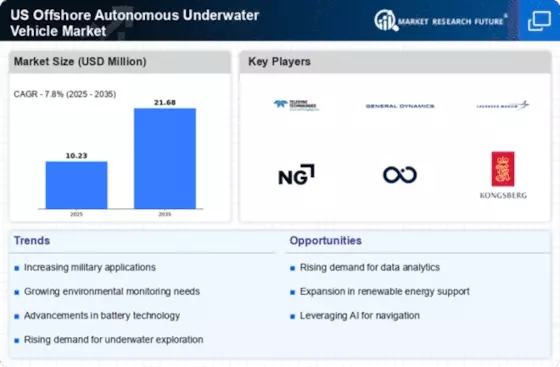
As per analysis, the US Offshore Autonomous Underwater Vehicle Market is projected to grow from USD 9.49 Million in 2024 to USD 21.68 Million by 2035, exhibiting a compound annual growth rate (CAGR) of 7.8% during the forecast period (2025 - 2035).

Key Market Trends & Highlights

The US Offshore Autonomous Underwater Vehicle Market is poised for substantial growth driven by technological advancements and increasing demand across various sectors.

  • The military segment remains the largest contributor to the market, driven by defense applications and national security needs.
  • Scientific research is the fastest-growing segment, reflecting a rising interest in environmental monitoring and marine biodiversity.
  • The oil and gas sector continues to dominate, fueled by ongoing exploration activities and the need for efficient underwater operations.
  • Key market drivers include the growing demand for marine research and the expansion of oil and gas exploration, which are likely to propel market growth.

Market Size & Forecast

2024 Market Size 9.49 (USD Million)
2035 Market Size 21.68 (USD Million)
CAGR (2025 - 2035) 7.8%

Major Players

Teledyne Technologies (US), General Dynamics (US), Lockheed Martin (US), Northrop Grumman (US), Ocean Infinity (US), Kongsberg Gruppen (NO), Saab AB (SE), Boeing (US), L3Harris Technologies (US)

Our Impact
Enabled $4.3B Revenue Impact for Fortune 500 and Leading Multinationals
Partnering with 2000+ Global Organizations Each Year
30K+ Citations by Top-Tier Firms in the Industry

US Offshore Autonomous Underwater Vehicle Market Trends

The US Offshore Autonomous Underwater Vehicle Market is currently experiencing a notable evolution, driven by advancements in technology and increasing demand for underwater exploration. The integration of artificial intelligence and machine learning into autonomous underwater vehicles is enhancing their operational capabilities, allowing for more efficient data collection and analysis. This trend is particularly relevant for industries such as oil and gas, where underwater inspections and maintenance are critical. Furthermore, the growing emphasis on environmental monitoring and marine research is propelling the development of specialized vehicles designed for these purposes. As a result, the market is witnessing a surge in investment and innovation, with various stakeholders seeking to capitalize on the potential applications of these vehicles. In addition to technological advancements, regulatory frameworks are also shaping the landscape of the US Offshore Autonomous Underwater Vehicle Market. Government agencies are increasingly recognizing the importance of these vehicles for national security, environmental protection, and resource management. This recognition is likely to lead to more supportive policies and funding opportunities, fostering further growth in the sector. As the market continues to mature, collaboration between private companies, research institutions, and government entities appears essential for addressing challenges and maximizing the benefits of autonomous underwater technologies. Overall, the US Offshore Autonomous Underwater Vehicle Market is poised for significant growth, driven by innovation, regulatory support, and a diverse range of applications.

Technological Advancements in AI and Robotics

The US Offshore Autonomous Underwater Vehicle Market is witnessing rapid advancements in artificial intelligence and robotics. These technologies enhance the capabilities of underwater vehicles, enabling them to perform complex tasks autonomously. This trend is particularly beneficial for industries such as oil and gas, where efficient inspections and data collection are paramount.

Increased Focus on Environmental Monitoring

There is a growing emphasis on environmental monitoring within the US Offshore Autonomous Underwater Vehicle Market. Autonomous vehicles are being developed specifically for marine research and ecological assessments. This trend reflects a broader commitment to understanding and protecting marine ecosystems, aligning with national priorities.

Regulatory Support and Funding Opportunities

Regulatory frameworks are evolving to support the US Offshore Autonomous Underwater Vehicle Market. Government agencies are recognizing the strategic importance of these technologies for national security and resource management. This recognition is likely to result in increased funding and favorable policies, fostering market growth.

US Offshore Autonomous Underwater Vehicle Market Drivers

Growing Demand for Marine Research

The US Offshore Autonomous Underwater Vehicle Market is experiencing a surge in demand for marine research applications. This growth is driven by the increasing need for data collection in oceanographic studies, which are essential for understanding climate change and marine ecosystems. According to recent data, the US government has allocated significant funding for marine research initiatives, which has led to a rise in the deployment of autonomous underwater vehicles (AUVs) for scientific exploration. These vehicles are capable of operating in challenging underwater environments, providing researchers with valuable insights into ocean health and biodiversity. As the demand for accurate and timely marine data continues to rise, the US Offshore Autonomous Underwater Vehicle Market is likely to expand, attracting investments and fostering innovation in AUV technology.

Expansion of Oil and Gas Exploration

The US Offshore Autonomous Underwater Vehicle Market is significantly influenced by the expansion of oil and gas exploration activities. As energy companies seek to optimize their operations and reduce costs, AUVs are increasingly utilized for subsea inspections, pipeline monitoring, and environmental assessments. The US Energy Information Administration reports that offshore oil production is projected to increase, necessitating advanced technologies for efficient resource management. AUVs offer a cost-effective solution for conducting detailed surveys and inspections in deepwater environments, thereby enhancing operational efficiency. This trend is expected to drive the growth of the US Offshore Autonomous Underwater Vehicle Market, as more companies adopt these technologies to ensure compliance with safety and environmental regulations.

Rising Interest in Renewable Energy Sources

The US Offshore Autonomous Underwater Vehicle Market is benefiting from the rising interest in renewable energy sources, particularly offshore wind energy. As the US government promotes the development of renewable energy projects, AUVs are increasingly employed for site assessments, environmental impact studies, and maintenance of offshore wind farms. The Bureau of Ocean Energy Management has reported a significant increase in offshore wind energy leases, indicating a growing market for AUV applications in this sector. AUVs play a crucial role in ensuring the sustainability and efficiency of renewable energy projects by providing critical data on seabed conditions and marine life. This trend is likely to drive the expansion of the US Offshore Autonomous Underwater Vehicle Market, as stakeholders seek innovative solutions to support the transition to clean energy.

Increased Investment in Defense Applications

The US Offshore Autonomous Underwater Vehicle Market is witnessing increased investment in defense applications, driven by the growing need for advanced surveillance and reconnaissance capabilities. The US Department of Defense has recognized the strategic importance of AUVs in enhancing maritime security and has allocated substantial resources for their development and deployment. AUVs are utilized for various military operations, including mine detection, anti-submarine warfare, and intelligence gathering. This focus on defense applications is likely to propel the growth of the US Offshore Autonomous Underwater Vehicle Market, as defense contractors and technology firms collaborate to develop cutting-edge AUV solutions. The emphasis on national security and maritime dominance is expected to create a robust market environment for AUV technologies.

Advancements in Underwater Communication Technologies

The US Offshore Autonomous Underwater Vehicle Market is poised for growth due to advancements in underwater communication technologies. Enhanced communication systems enable AUVs to transmit data in real-time, facilitating better decision-making and operational efficiency. Recent developments in acoustic communication and underwater wireless networks have improved the capabilities of AUVs, allowing them to operate more effectively in complex underwater environments. This technological evolution is likely to attract investments in the US Offshore Autonomous Underwater Vehicle Market, as companies seek to leverage these innovations for various applications, including military operations, environmental monitoring, and infrastructure inspections. The integration of advanced communication technologies is expected to enhance the functionality and reliability of AUVs, further driving market growth.


Market Segment Insights

By Application: Military (Largest) vs. Scientific Research (Fastest-Growing)

In the US Offshore Autonomous Underwater Vehicle Market, the application segment is divided into five categories: Military, Scientific Research, Commercial, Environmental Monitoring, and Underwater Exploration. Among these, the Military segment holds the largest share due to ongoing investments in defense technologies and the need for surveillance and reconnaissance capabilities. This is closely followed by the Scientific Research segment, which is gaining traction as researchers seek advanced tools for oceanic and environmental studies.

Military: Dominant vs. Scientific Research: Emerging

The Military application of autonomous underwater vehicles is characterized by extensive use in defense operations, such as surveillance, reconnaissance, and mine detection. This segment benefits from significant government funding and technological advancements, positioning it as the dominant force in the market. On the other hand, the Scientific Research application is emerging rapidly, driven by increased demand for oceanographic research and environmental monitoring. As academic and research institutions focus on marine conservation and biodiversity studies, this segment is anticipated to experience robust growth, highlighting the evolving capabilities and adaptability of underwater vehicles in various research initiatives.

By End Use: Oil and Gas (Largest) vs. Marine Research (Fastest-Growing)

In the US Offshore Autonomous Underwater Vehicle Market, the Oil and Gas sector holds the largest market share, driven by the demand for enhanced exploration and production capabilities in challenging offshore environments. Following closely is the Marine Research segment, which, though smaller in size, is rapidly gaining traction as technological advancements make these vehicles increasingly accessible for scientific exploration. Other noteworthy segments include Defense and Renewable Energy, which also contribute to the overall market landscape by introducing innovative applications for underwater technology.

Oil and Gas (Dominant) vs. Marine Research (Emerging)

The Oil and Gas sector remains the dominant player in the US Offshore Autonomous Underwater Vehicle Market, characterized by its critical role in offshore drilling, pipeline inspection, and environmental monitoring. This sector is essential for maximizing resource recovery while minimizing risks associated with underwater operations. In contrast, the Marine Research segment is emerging swiftly, appealing to academic and scientific institutions seeking to leverage autonomous vehicles for data collection and environmental studies. This growth is fueled by increasing investments in research initiatives and a growing recognition of the potential of these vehicles to provide valuable insights into marine ecosystems.

By Vehicle Type: Autonomous Underwater Vehicle (Largest) vs. Remotely Operated Vehicle (Fastest-Growing)

In the US Offshore Autonomous Underwater Vehicle Market, Autonomous Underwater Vehicles (AUVs) hold the largest market share, driven by advances in technology and increasing investment in underwater exploration. Remotely Operated Vehicles (ROVs) follow closely, positioning themselves as critical tools for underwater inspections and repairs. Both segments are crucial, yet they cater to different operational needs, which reflects in their market distribution.

Autonomous Underwater Vehicle (Dominant) vs. Remotely Operated Vehicle (Emerging)

The Autonomous Underwater Vehicle (AUV) segment stands as the dominant player due to its ability to operate independently and efficiently conduct deepwater tasks. These vehicles are equipped with advanced sensors and technology enabling extensive data collection, particularly useful in environmental monitoring, oil and gas exploration, and scientific research. Conversely, Remotely Operated Vehicles (ROVs) are emerging rapidly, driven by their growing application in maintenance and repair operations. Their tethered design allows for real-time control and remote intervention, capturing the attention of industries requiring meticulous underwater operations, thus fueling their market growth.

By Technology: Sonar Technology (Largest) vs. Communication Technology (Fastest-Growing)

In the US Offshore Autonomous Underwater Vehicle Market, sonar technology holds the largest market share, driven by its essential role in underwater mapping and obstacle detection. As a mature technology, it is widely adopted by various sectors including oil and gas, marine research, and environmental monitoring. Communication technology, on the other hand, is gaining traction, attributed to the increasing need for real-time data transmission during underwater operations, which enhances operational efficiency and safety.

Technology: Sonar Technology (Dominant) vs. Communication Technology (Emerging)

Sonar technology remains the dominant force in the US Offshore Autonomous Underwater Vehicle Market due to its advanced capabilities in navigation and object detection. It operates effectively in various underwater conditions, making it indispensable for industries like petroleum and marine conservation. On the contrary, communication technology is emerging rapidly, driven by innovations in wireless and optical communication. This segment is increasingly recognized for its importance in enabling autonomous vehicles to relay information back to operators and enhance situational awareness in real-time, positioning it as a crucial component for future developments in underwater exploration.

By Payload Capacity: Medium Weight (Largest) vs. Heavyweight (Fastest-Growing)

In the US Offshore Autonomous Underwater Vehicle Market, the distribution of market share among the payload capacity segment values reveals that Medium Weight vehicles currently hold the largest share. They are favored for their versatility and capability to perform a wide range of tasks, from geological surveys to environmental monitoring. In contrast, Heavyweight vehicles, while having a smaller market share, are experiencing rapid growth, driven by increasing demand in sectors such as defense and underwater exploration.

Payload Capacity: Medium Weight (Dominant) vs. Heavyweight (Emerging)

Medium Weight Autonomous Underwater Vehicles (AUVs) are considered the dominant players in the payload capacity segment due to their balanced capability, allowing them to efficiently carry sensors and equipment necessary for diverse operations. Their design caters to both commercial and scientific applications, making them versatile options for end-users. Heavyweight AUVs, on the other hand, are emerging rapidly as they offer advanced capabilities for deep-sea exploration and extensive payload functionality. Their growth is fueled by advancements in technology and increasing investments in underwater research, positioning them as valuable assets for missions that require substantial operational reach and payload capacity.

Get more detailed insights about US Offshore Autonomous Underwater Vehicle Market

Key Players and Competitive Insights

The Offshore Autonomous Underwater Vehicle Market is currently characterized by a dynamic competitive landscape, driven by technological advancements and increasing demand for underwater exploration and surveillance. Key players such as Teledyne Technologies (US), General Dynamics (US), and Lockheed Martin (US) are at the forefront, each adopting distinct strategies to enhance their market positioning. Teledyne Technologies (US) emphasizes innovation through continuous investment in R&D, focusing on developing advanced sensors and autonomous systems. Meanwhile, General Dynamics (US) is pursuing strategic partnerships to bolster its capabilities in underwater robotics, thereby enhancing its competitive edge. Lockheed Martin (US) is leveraging its extensive experience in defense to expand its offerings in commercial applications, indicating a shift towards a more diversified operational focus.

The market structure appears moderately fragmented, with several players vying for dominance. Key business tactics include localizing manufacturing to reduce costs and optimize supply chains, which is becoming increasingly vital in maintaining competitiveness. The collective influence of these major players shapes the market dynamics, as they engage in both direct competition and collaborative ventures to address emerging challenges in underwater technology.

In November 2025, Teledyne Technologies (US) announced a partnership with a leading marine research institution to develop next-generation autonomous underwater vehicles equipped with advanced AI capabilities. This collaboration is poised to enhance data collection and analysis, positioning Teledyne as a leader in innovative underwater solutions. The strategic importance of this partnership lies in its potential to accelerate technological advancements and expand market reach.

In December 2025, General Dynamics (US) unveiled a new line of underwater drones designed for commercial applications, targeting sectors such as oil and gas exploration. This move reflects a strategic pivot towards diversifying its product offerings and tapping into new revenue streams. The introduction of these drones is likely to strengthen General Dynamics' market presence and appeal to a broader customer base.

In January 2026, Lockheed Martin (US) secured a contract with the US Navy for the development of autonomous underwater systems aimed at enhancing maritime security. This contract underscores Lockheed's commitment to leveraging its defense expertise in the commercial sector, potentially reshaping its operational focus and reinforcing its competitive position in the market.

As of January 2026, current trends in the Offshore Autonomous Underwater Vehicle Market are increasingly defined by digitalization, sustainability, and AI integration. Strategic alliances are becoming pivotal in shaping the competitive landscape, as companies seek to combine resources and expertise to drive innovation. The shift from price-based competition to a focus on technological advancement and supply chain reliability is evident, suggesting that future competitive differentiation will hinge on the ability to innovate and adapt to evolving market demands.

Key Companies in the US Offshore Autonomous Underwater Vehicle Market include

Future Outlook

US Offshore Autonomous Underwater Vehicle Market Future Outlook

The US Offshore Autonomous Underwater Vehicle Market is projected to grow at a 7.8% CAGR from 2025 to 2035, driven by technological advancements, increased demand for marine exploration, and enhanced defense capabilities.

New opportunities lie in:

  • Development of advanced AI algorithms for autonomous navigation.
  • Integration of renewable energy sources for extended operational range.
  • Partnerships with research institutions for innovative underwater applications.

By 2035, the market is expected to be robust, driven by innovation and strategic partnerships.

Market Segmentation

US Offshore Autonomous Underwater Vehicle Market End Use Outlook

  • Oil and Gas
  • Marine Research
  • Defense
  • Renewable Energy
  • Telecommunications

US Offshore Autonomous Underwater Vehicle Market Technology Outlook

  • Sonar Technology
  • Navigation Technology
  • Communication Technology
  • Power Supply Technology

US Offshore Autonomous Underwater Vehicle Market Application Outlook

  • Military
  • Scientific Research
  • Commercial
  • Environmental Monitoring
  • Underwater Exploration

US Offshore Autonomous Underwater Vehicle Market Vehicle Type Outlook

  • Remotely Operated Vehicle
  • Autonomous Underwater Vehicle
  • Hybrid Vehicle
  • Surface Vehicle

US Offshore Autonomous Underwater Vehicle Market Payload Capacity Outlook

  • Lightweight
  • Medium Weight
  • Heavyweight

Report Scope

MARKET SIZE 20249.49(USD Million)
MARKET SIZE 202510.3(USD Million)
MARKET SIZE 203521.68(USD Million)
COMPOUND ANNUAL GROWTH RATE (CAGR)7.8% (2024 - 2035)
REPORT COVERAGERevenue Forecast, Competitive Landscape, Growth Factors, and Trends
BASE YEAR2024
Market Forecast Period2025 - 2035
Historical Data2019 - 2024
Market Forecast UnitsUSD Million
Key Companies ProfiledTeledyne Technologies (US), General Dynamics (US), Lockheed Martin (US), Northrop Grumman (US), Ocean Infinity (US), Kongsberg Gruppen (NO), Saab AB (SE), Boeing (US), L3Harris Technologies (US)
Segments CoveredApplication, End Use, Vehicle Type, Technology, Payload Capacity
Key Market OpportunitiesAdvancements in underwater robotics and increasing demand for marine data drive growth in the US Offshore Autonomous Underwater Vehicle Market.
Key Market DynamicsTechnological advancements and regulatory shifts drive growth in the US Offshore Autonomous Underwater Vehicle Market.
Countries CoveredUS
Leave a Comment

FAQs

What is the projected market valuation for the US Offshore Autonomous Underwater Vehicle Market in 2035?

The projected market valuation for the US Offshore Autonomous Underwater Vehicle Market in 2035 is 21.68 USD Million.

What was the market valuation for the US Offshore Autonomous Underwater Vehicle Market in 2024?

The market valuation for the US Offshore Autonomous Underwater Vehicle Market in 2024 was 9.49 USD Million.

What is the expected CAGR for the US Offshore Autonomous Underwater Vehicle Market during the forecast period 2025 - 2035?

The expected CAGR for the US Offshore Autonomous Underwater Vehicle Market during the forecast period 2025 - 2035 is 7.8%.

Which companies are considered key players in the US Offshore Autonomous Underwater Vehicle Market?

Key players in the US Offshore Autonomous Underwater Vehicle Market include Teledyne Technologies, General Dynamics, Lockheed Martin, and Northrop Grumman.

What are the primary applications of Offshore Autonomous Underwater Vehicles?

The primary applications of Offshore Autonomous Underwater Vehicles include military, scientific research, commercial, environmental monitoring, and underwater exploration.

How does the market for Autonomous Underwater Vehicles compare to Remotely Operated Vehicles in terms of valuation?

The market for Autonomous Underwater Vehicles is projected to reach 8.56 USD Million, compared to 6.36 USD Million for Remotely Operated Vehicles.

What is the valuation range for the Oil and Gas segment in the US Offshore Autonomous Underwater Vehicle Market?

The valuation range for the Oil and Gas segment in the US Offshore Autonomous Underwater Vehicle Market is between 3.79 and 8.25 USD Million.

What technologies are driving advancements in the Offshore Autonomous Underwater Vehicle Market?

Key technologies driving advancements in the Offshore Autonomous Underwater Vehicle Market include sonar, navigation, communication, and power supply technologies.

What is the expected valuation for the Environmental Monitoring segment by 2035?

The expected valuation for the Environmental Monitoring segment by 2035 is projected to be between 1.0 and 2.5 USD Million.

How does the payload capacity affect the market for Offshore Autonomous Underwater Vehicles?

The market for Offshore Autonomous Underwater Vehicles is segmented by payload capacity, with lightweight vehicles projected to reach 6.36 USD Million, medium weight at 8.56 USD Million, and heavyweight at 6.76 USD Million.

Download Free Sample

Kindly complete the form below to receive a free sample of this Report

Compare Licence

×
Features License Type
Single User Multiuser License Enterprise User
Price $4,950 $5,950 $7,250
Maximum User Access Limit 1 User Upto 10 Users Unrestricted Access Throughout the Organization
Free Customization
Direct Access to Analyst
Deliverable Format
Platform Access
Discount on Next Purchase 10% 15% 15%
Printable Versions