
×
Request Free Sample ×

Kindly complete the form below to receive a free sample of this Report

* Please use a valid business email

Leading companies partner with us for data-driven Insights

clients tt-cursor
Hero Background
English
Chinese
French
Japanese
Korean
German
Spanish

Off-highway Electric Vehicle Market Share

ID: MRFR/AT/10324-HCR
128 Pages
Swapnil Palwe
February 2026

Off-highway Electric Vehicle Market Size, Share & Growth Analysis Report by Vehicle Type (HEV, BEV), by Energy Storage Capacity (<50 kWh, 50–200 kWh, >200 kWh), by Battery Type (Lithium-Ion (Li-Ion), Lead–Acid) and by Application (Mining, Construction, Agriculture, Others) and By Region (North America, Europe, Asia-Pacific, And Rest Of The World) – Trends & Industry Forecast to 2035

Share:
Download PDF ×

We do not share your information with anyone. However, we may send you emails based on your report interest from time to time. You may contact us at any time to opt-out.

Off highway Electric Vehicle Market Infographic
Purchase Options

Market Share

Off highway Electric Vehicle Market Share Analysis

Growing market share competition in the quickly evolving off-highway electric vehicle market is forcing companies to adopt a strategic positioning approach to gain a competitive edge. Focusing on off-highway market segments is one strategy that is regularly used. By identifying and satisfying the needs of specific industries, businesses can carve out a niche market share and establish themselves as leaders in certain applications, such as mining, construction, or agriculture. This targeted approach enhances the value offer overall by empowering companies to tailor their off-highway electric vehicles to the requirements of their respective sectors.

Tech-related innovation is at the core of another important market share positioning strategy. As the electric car market continues to change, manufacturers are trying to set themselves apart from the competition by offering innovative features and capabilities. This could include enhancements to the autonomy, connection, or battery efficiency of off-highway electric vehicles, which would improve their overall productivity and performance. Keeping up with technology developments enables companies to grow their online presence and draw in more customers. Eco-friendly procedures are becoming more and more important in today's business environment. Taking advantage of this, companies that specialize in the off-highway electric vehicle market are positioning themselves as pioneers in environmental conscience. Businesses can appeal to the growing number of environmentally conscious consumers by stressing sustainability in their product offerings and manufacturing processes. This tactic enhances a company's reputation, helps the environment and the market, and supports the global effort to lessen carbon footprints. The off-highway electric vehicle sector's market share standing is subject to the influence of affordability and pricing factors. Finding the ideal balance between maintaining profitability and providing competitive prices is essential in a market where enterprises operating in the off-highway sector heavily weigh costs when making purchases. Manufacturers must continue to be flexible and adaptive as the sector develops, always reevaluating their positioning tactics to maintain an advantage in this fast-paced and cutthroat environment. Companies may increase their market share and support the general expansion and sustainability of the off-highway electric vehicle sector by embracing innovation and comprehending the requirements of their target customers.


Author
Swapnil Palwe
Team Lead - Research

With a technical background as Bachelor's in Mechanical Engineering, with MBA in Operations Management , Swapnil has 6+ years of experience in market research, consulting and analytics with the tasks of data mining, analysis, and project execution. He is the POC for our clients, for their consulting projects running under the Automotive/A&D domain. Swapnil has worked on major projects in verticals such as Aerospace & Defense, Automotive and many other domain projects. He has worked on projects for fortune 500 companies' syndicate and consulting projects along with several government projects.

Leave a Comment

FAQs

What is the projected market valuation for the Off-highway Electric Vehicle Market in 2035?

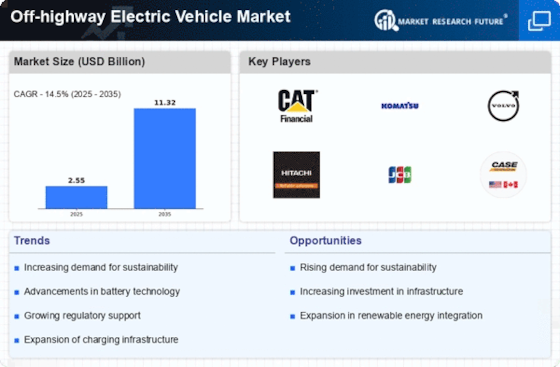
<p>The Off-highway Electric Vehicle Market is projected to reach a valuation of 11.32 USD Billion by 2035.</p>

What was the market valuation for the Off-highway Electric Vehicle Market in 2024?

<p>In 2024, the Off-highway Electric Vehicle Market was valued at 2.552 USD Billion.</p>

What is the expected CAGR for the Off-highway Electric Vehicle Market during the forecast period 2025 - 2035?

<p>The expected CAGR for the Off-highway Electric Vehicle Market during the forecast period 2025 - 2035 is 14.5%.</p>

Which companies are considered key players in the Off-highway Electric Vehicle Market?

<p>Key players in the Off-highway Electric Vehicle Market include Caterpillar, Komatsu, Volvo, Hitachi Construction Machinery, JCB, CASE Construction Equipment, Doosan Infracore, Liebherr, and Wacker Neuson.</p>

What are the projected revenues for Battery Types in the Off-highway Electric Vehicle Market?

<p>The projected revenues for Battery Types indicate that Lithium-Ion batteries may generate 5.2 USD Billion, while Lead-Acid batteries could reach 6.12 USD Billion by 2035.</p>

How does the Off-highway Electric Vehicle Market segment by Energy Storage Capacity?

<p>The Off-highway Electric Vehicle Market segments by Energy Storage Capacity, with projections of 3.45 USD Billion for <50 kWh, 5.12 USD Billion for 50–200 kWh, and 2.73 USD Billion for >200 kWh by 2035.</p>

What applications are driving growth in the Off-highway Electric Vehicle Market?

The applications driving growth in the Off-highway Electric Vehicle Market include Mining and Construction, each projected to generate 3.45 USD Billion, and Agriculture, expected to reach 2.3 USD Billion by 2035.

What is the market outlook for Hybrid Electric Vehicles (HEVs) in the Off-highway Electric Vehicle Market?

The market outlook for Hybrid Electric Vehicles (HEVs) suggests a potential revenue of 3.45 USD Billion by 2035.

What revenue is expected from Battery Electric Vehicles (BEVs) in the Off-highway Electric Vehicle Market?

The expected revenue from Battery Electric Vehicles (BEVs) in the Off-highway Electric Vehicle Market is projected to reach 7.87 USD Billion by 2035.

How does the Off-highway Electric Vehicle Market compare across different applications?

The Off-highway Electric Vehicle Market shows comparable revenues across applications, with Mining and Construction leading at 3.45 USD Billion each, while Agriculture and Others are projected at 2.3 USD Billion by 2035.

Market Summary

As per Market Research Future analysis, the Off-highway Electric Vehicle Market was estimated at 2.552 USD Billion in 2024. The Off-highway Electric Vehicle industry is projected to grow from 2.922 USD Billion in 2025 to 11.32 USD Billion by 2035, exhibiting a compound annual growth rate (CAGR) of 14.5% during the forecast period 2025 - 2035

Key Market Trends & Highlights

The Off-highway Electric Vehicle Market is poised for substantial growth driven by technological advancements and increasing sustainability demands.

  • North America remains the largest market for off-highway electric vehicles, showcasing a robust demand for innovative solutions. Asia-Pacific is emerging as the fastest-growing region, propelled by rapid industrialization and urbanization. The hybrid electric vehicle segment dominates the market, while battery electric vehicles are experiencing the fastest growth due to advancements in battery technology. Key market drivers include technological innovations in electric powertrains and government incentives aimed at promoting sustainable solutions.

Market Size & Forecast

2024 Market Size 2.552 (USD Billion)
2035 Market Size 11.32 (USD Billion)
CAGR (2025 - 2035) 14.5%
Largest Regional Market Share in 2024 North America

Major Players

Caterpillar (US), <a href="https://www.komatsu.com/en-us/products/equipment/trucks/electric-drive-mining-trucks">Komatsu</a> (JP), Volvo (SE), Hitachi Construction Machinery (JP), JCB (GB), CASE Construction Equipment (US), Doosan Infracore (KR), Liebherr (DE), Wacker Neuson (DE)

Market Trends

The Off-highway Electric Vehicle Market is currently experiencing a transformative phase, driven by a confluence of technological advancements and increasing environmental awareness. Manufacturers are actively investing in research and development to enhance battery efficiency and overall vehicle performance. a key focus area highlighted in recent off highway electric vehicle market analysis. This shift towards electrification is not merely a trend but appears to be a fundamental change in how off-highway vehicles are designed and utilized. The growing emphasis on sustainability is prompting companies to explore innovative solutions that reduce emissions and improve energy efficiency, thereby aligning with global environmental goals. and strengthening the electric off-highway vehicle market outlook. Moreover, regulatory frameworks are evolving to support the adoption of electric vehicles in off-highway applications. Governments are implementing policies that incentivize the transition to electric alternatives, which may further accelerate market growth and positively influence off highway electric vehicle market share across key regions.. The integration of smart technologies, such as telematics and automation, is also becoming increasingly prevalent, reflecting emerging off highway electric vehicle market trends.. As the market continues to evolve, stakeholders must remain vigilant to emerging trends and adapt their strategies accordingly, ensuring they remain competitive in this dynamic landscape.

Technological Advancements in Battery Systems

Recent innovations in battery technology are significantly enhancing the performance and range of off-highway electric vehicles. These advancements may lead to longer operational hours and reduced charging times, making electric options more appealing to users.

Sustainability and Environmental Regulations

The growing focus on sustainability is influencing the Off-highway Electric Vehicle Market. Stricter environmental regulations are encouraging manufacturers to develop cleaner alternatives, which could reshape industry standards and practices.

Integration of Smart Technologies

The incorporation of smart technologies, such as telematics and automation, is becoming more common in off-highway electric vehicles. This trend suggests a future where vehicles are not only efficient but also equipped with advanced features that enhance operational effectiveness.

Off highway Electric Vehicle Market Market Drivers

Government Incentives and Support

Government incentives play a crucial role in the growth of the Off-highway Electric Vehicle Market. Various countries are implementing policies that promote the adoption of electric vehicles through tax breaks, grants, and subsidies. These initiatives are designed to reduce the financial burden on manufacturers and consumers, thereby accelerating the transition to electric alternatives. For example, in 2025, several regions have reported increased funding for electric vehicle infrastructure, which is expected to enhance the market's appeal. This support not only encourages investment in electric technologies but also fosters a competitive environment that drives innovation within the Off-highway Electric Vehicle Market.

Advancements in Charging Infrastructure

The development of robust charging infrastructure is a pivotal driver for the Off-highway Electric Vehicle Market. As electric vehicles become more prevalent, the need for efficient and accessible charging solutions is paramount. In 2025, advancements in fast-charging technologies and the establishment of widespread charging networks are expected to facilitate the adoption of electric vehicles in off-highway applications. This infrastructure not only alleviates range anxiety among users but also enhances the operational efficiency of electric machinery. The ongoing investments in charging solutions indicate a commitment to supporting the Off-highway Electric Vehicle Market, thereby fostering its growth.

Rising Demand for Sustainable Solutions

The Off-highway Electric Vehicle Market is witnessing a rising demand for sustainable solutions, driven by increasing awareness of environmental issues. As industries seek to reduce their carbon footprints, electric vehicles are becoming a preferred choice due to their lower emissions compared to traditional diesel-powered machinery. In 2025, the market is projected to expand as companies prioritize sustainability in their operations. This shift is further supported by consumer preferences that favor eco-friendly products, indicating a broader trend towards sustainability. Consequently, the Off-highway Electric Vehicle Market is likely to benefit from this growing demand, leading to increased investments and innovations.

Increased Focus on Operational Efficiency

The Off-highway Electric Vehicle Market is increasingly focused on operational efficiency, which is driving the adoption of electric vehicles. Companies are recognizing that electric machinery can offer lower operating costs, reduced maintenance, and improved productivity. In 2025, the market is likely to see a shift as businesses prioritize investments in electric solutions that enhance their operational capabilities. This focus on efficiency is not only beneficial for the bottom line but also aligns with broader sustainability goals. As a result, the Off-highway Electric Vehicle Market is poised for growth, as more companies transition to electric alternatives to optimize their operations.

Technological Innovations in Electric Powertrains

The Off-highway Electric Vehicle Market is experiencing a surge in technological innovations, particularly in electric powertrains. These advancements enhance the efficiency and performance of electric vehicles, making them more appealing to consumers and businesses alike. For instance, the development of high-torque electric motors and advanced battery management systems has led to improved operational capabilities. As of 2025, the market for electric powertrains is projected to grow significantly, driven by the need for more efficient and sustainable machinery in sectors such as agriculture and construction. This trend indicates a shift towards electrification, which is likely to redefine operational standards in the Off-highway Electric Vehicle Market.

Market Segment Insights

By Type: HEV (Largest) vs. BEV (Fastest-Growing)

In the Off-highway Electric Vehicle Market, the market share distribution reveals that Hybrid Electric Vehicles (HEV) hold a significant share, dominating the segment with their established presence and versatility. They combine the advantages of electric motors and internal combustion engines, making them appealing for various off-highway applications. In contrast, Battery Electric Vehicles (BEV) are rapidly gaining traction, thanks to advancements in battery technology and increased demand for sustainable alternatives. This shift is clearly reflected in the growing preference for BEVs, which cater to the increasing environmental regulations and the push for zero-emission off-highway solutions.

Electric Vehicles: HEV (Dominant) vs. BEV (Emerging)

Hybrid Electric Vehicles (HEV) currently dominate the Off-highway Electric Vehicle Market due to their practicality and efficiency. They are designed to operate using both electric and traditional fuel sources, offering flexibility in various terrains and conditions, which is essential for off-highway applications. On the other hand, Battery Electric Vehicles (BEV) are emerging as a significant force, fueled by technological advancements that enhance battery efficiency, range, and charging infrastructure. With increasing environmental legislation and a societal shift towards sustainability, BEVs are positioned as the future of off-highway electrification, promising lower operating costs and minimal environmental impact.

By Energy Storage Capacity: <50 kWh (Largest) vs. >200 kWh (Fastest-Growing)

In the Off-highway Electric Vehicle Market, the energy storage capacity of &lt;50 kWh holds the largest market share, catering predominantly to lightweight and compact electric vehicles. This segment benefits from the growing demand for smaller vehicles that require less energy storage while still providing adequate performance for off-highway applications. Meanwhile, the &gt;200 kWh segment is rapidly gaining traction, driven by heavy-duty electric vehicles that require significant energy capacity for extended operations. The increasing adoption of these powerful vehicles is reshaping the competitive landscape of energy storage solutions in this market.

Energy Storage Capacity: &lt;50 kWh (Dominant) vs. &gt;200 kWh (Emerging)

The &lt;50 kWh energy storage capacity segment primarily includes small electric vehicles that excel in agility and efficiency, making them ideal for tasks requiring frequent maneuvers and quick energy usage. These vehicles are commonly used in agricultural and construction settings where operators seek sustainable solutions with lower upfront costs. In contrast, the &gt;200 kWh segment is characterized by robust electric vehicles designed for heavy-duty applications. This emerging segment is increasingly favored for its ability to handle large workloads and extended operation times, reflecting a market shift towards more powerful electric solutions that can meet the demands of tough off-highway environments.

By Battery Type: Lithium-Ion (Largest) vs. Lead-Acid (Fastest-Growing)

In the Off-highway Electric Vehicle Market, the two primary battery types dominating the landscape are Lithium-Ion and Lead-Acid. Currently, <a href="https://www.marketresearchfuture.com/reports/lithium-ion-battery-market-979">Lithium-Ion batteries</a> hold a significant market share due to their superior energy density and longer life cycle. This type of battery is favored for its ability to provide effective energy solutions in various off-highway applications, highlighting its importance in the evolving market.

Battery Type: Lithium-Ion (Dominant) vs. Lead-Acid (Emerging)

Lithium-Ion batteries are the dominant force in the Off-highway Electric Vehicle Market, renowned for their efficiency and performance. Their attributes, such as lightweight design and fast charging capabilities, make them the preferred choice for manufacturers looking to enhance the performance of electric vehicles. On the other hand, Lead-Acid batteries, while traditionally viewed as the older technology, are experiencing a resurgence as they become increasingly cost-effective for specific applications. These batteries offer a reliable, though heavier, alternative and continue to evolve, thereby capturing the attention of manufacturers seeking budget-friendly options for less demanding off-highway tasks.

By Application: Mining (Largest) vs. Agriculture (Fastest-Growing)

In the Off-highway Electric Vehicle Market, the application segment is characterized by varied distributions among Mining, Construction, and Agriculture. Mining holds the largest share due to its demand for heavy-duty electric vehicles capable of operating in harsh environments. On the other hand, while Construction has a stable presence, Agriculture is emerging rapidly as the fastest-growing application as farmers look to reduce emissions and improve efficiency with electric alternatives. This shift in preference highlights the changing landscape of the industry. The growth in this segment is driven by technological advancements and the need for sustainable practices across industries. Mining continues to thrive, fueled by investments in more efficient electric machinery, whereas Agriculture is gaining momentum due to increasing environmental regulations and a push for precision farming. The global trend toward electrification is compelling various sectors, especially Agriculture, to innovate, emphasizing electric options that enhance productivity while minimizing carbon footprints.

Mining (Dominant) vs. Construction (Emerging)

Mining has established itself as the dominant application in the Off-highway Electric Vehicle Market, primarily due to its reliance on high-performance electric vehicles designed for rugged terrain and substantial loads. The sector's gradual transition to electrification enables operators to fulfill sustainability goals while enhancing operational efficiency. On the other hand, the Construction sector is emerging as a significant player in this market. With the construction industry's increased focus on reducing emissions and meeting regulatory mandates, electric vehicles are becoming more common on job sites. The Construction sector's flexibility and diverse demands are inspiring innovative electric solutions, indicating its potential to grow rapidly in the coming years.

Get more detailed insights about Off-highway Electric Vehicle Market Research Report—Global Forecast till 2035

Regional Insights

By region, the study provides the Off-highway Electric Vehicle market insights into North America, Europe, Asia-Pacific and Rest of the World. The North America Off-highway Electric Vehicle Market dominated this market in 2022 (45.80%). Off-highway EV adoption in the area has been aided by government financing and incentive schemes designed to promote sustainable energy and cut emissions. Further, the U.S. Off-highway Electric Vehicle market held the largest market share, and the Canada Armor Materials market was the fastest growing market in the North America region.

Further, the major countries studied in the market report are The U.S., Canada, German, France, the UK, Italy, Spain, China, Japan, India, Australia, South Korea, and Brazil.

Figure 2: Off-Highway Electric Vehicle Market Share By Region 2024 (USD Billion)

Europe Off-highway Electric Vehicle market accounts for the second-largest market share. This is due to the transition to electric construction and agricultural equipment has been expedited by strict pollution rules, particularly in metropolitan areas. Further, the German Off-highway Electric Vehicle market held the largest market share, and the UK Off-highway Electric Vehicle market was the fastest growing market in the European region

The Asia-Pacific Off-highway Electric Vehicle Market is expected to grow at the fastest CAGR from 2023 to 2032. This is due to growing concerns about air pollution and the need to cut carbon emissions. Moreover, China’s Off-highway Electric Vehicle market held the largest market share, and the Indian Off-highway Electric Vehicle market was the fastest growing market in the Asia-Pacific region.

Key Players and Competitive Insights

Leading market players are investing heavily in research and development in order to expand their product lines, which will help the off road electric vehicle market, grow even more. The Off-highway Electric Vehicle Market participants are also undertaking a variety of strategic activities to expand their global footprint, with important market developments including new product launches, contractual agreements, mergers and acquisitions, higher investments, and collaboration with other organizations. To expand and survive in a more competitive and rising market climate, Sustainable Off-road Vehicles industry must offer cost-effective items. Manufacturing locally to minimize operational costs is one of the key business tactics used by manufacturers in the global Off-highway Electric Vehicle industry to benefit clients and increase the market sector. In recent years, the Electric UTVs industry has offered some of the most significant advantages to medicine.  Major players in the off road electric vehicle market, including LIEBHERR-International Deutschland GmbH, Cargotec corporation, Clark, CNH Industrial, Narrow Isle inc., Toyota Motor Corporation, SANY Group, Sandvik, Epiroc, Caterpillar, Komatsu Ltd., Hitachi Construction Machinery, DEERE & COMPANY, JCB, AB Volvo, Anhui Heli Co., Ltd., Hyundai Doosan Infracore Co. Ltd. and others, are attempting to increase market demand by investing in research and development operations. LIEBHERR-International Deutschland GmbH was founded in 1949. Construction machinery is designed, manufactured, and supplied globally by Liebherr-International AG (Liebherr). Tower cranes, wheeled loaders, truck cranes, hydraulic excavators, hydraulic rope excavators, pipe-laying machines, dumper trucks, crawler tractors and loaders, concrete batching plants, and truck mixer models are among the goods offered by Liebherr. The organisation also offers logistical, leasing, and hospitality services, as well as supplies of replacement parts and components. Global solutions and service provider for cargo handling is Cargotec Corporation. The business specialises in providing tools, software, and services for smooth cargo movement in a range of sectors, including ports, terminals, distribution hubs, and heavy industries. The solutions offered by Cargotec are created to increase cargo handling processes' productivity, sustainability, and safety.

Key Companies in the Off highway Electric Vehicle Market include

Industry Developments

  • Q1 2025: Komatsu Ltd. unveils new autonomous electric underwater bulldozer Komatsu Ltd. launched an autonomous electric underwater bulldozer designed for submerged construction and dredging, featuring zero emissions and remote control capabilities to enhance efficiency and safety in marine environments.[4]
  • Q3 2024: Volvo Construction Equipment AB unveils new FH Electric truck capable of traveling up to 600 km on a single charge Volvo Construction Equipment AB introduced a new FH Electric truck for long-distance, zero-emission transport, enabling transport companies to operate electric trucks on interregional and long-distance routes for a full working day without recharging.[4]

Future Outlook

Off highway Electric Vehicle Market Future Outlook

The Off-highway Electric Vehicle Market is projected to grow at a 14.5% CAGR from 2025 to 2035, driven by technological advancements, regulatory support, and increasing demand for sustainable solutions.

New opportunities lie in:

  • <p>Development of integrated charging infrastructure for off-highway vehicles. Partnerships with renewable energy providers for sustainable power solutions. Expansion into emerging markets with tailored electric vehicle offerings.</p>

By 2035, the Off-highway Electric Vehicle Market is expected to be robust, reflecting substantial growth and innovation.

Market Segmentation

Off highway Electric Vehicle Market Type Outlook

  • HEV
  • BEV

Off highway Electric Vehicle Market Application Outlook

  • Mining
  • Construction
  • Agriculture
  • Others

Off highway Electric Vehicle Market Battery Type Outlook

  • Lithium-Ion (Li-Ion)
  • Lead–Acid

Off highway Electric Vehicle Market Energy Storage Capacity Outlook

  • <50 kWh
  • 50–200 kWh
  • >200 kWh

Report Scope

MARKET SIZE 2024 2.552(USD Billion)
MARKET SIZE 2025 2.922(USD Billion)
MARKET SIZE 2035 11.32(USD Billion)
COMPOUND ANNUAL GROWTH RATE (CAGR) 14.5% (2025 - 2035)
REPORT COVERAGE Revenue Forecast, Competitive Landscape, Growth Factors, and Trends
BASE YEAR 2024
Market Forecast Period 2025 - 2035
Historical Data 2019 - 2024
Market Forecast Units USD Billion
Key Companies Profiled Caterpillar (US), Komatsu (JP), Volvo (SE), Hitachi Construction Machinery (JP), JCB (GB), CASE Construction Equipment (US), Doosan Infracore (KR), Liebherr (DE), Wacker Neuson (DE)
Segments Covered Vehicle Type, Energy Storage Capacity, Battery Type, Application, Region
Key Market Opportunities Integration of advanced battery technologies enhances efficiency in the Off-highway Electric Vehicle Market.
Key Market Dynamics Rising demand for sustainable solutions drives innovation and competition in the Off-highway Electric Vehicle Market.
Countries Covered North America, Europe, APAC, South America, MEA

FAQs

What is the projected market valuation for the Off-highway Electric Vehicle Market in 2035?

<p>The Off-highway Electric Vehicle Market is projected to reach a valuation of 11.32 USD Billion by 2035.</p>

What was the market valuation for the Off-highway Electric Vehicle Market in 2024?

<p>In 2024, the Off-highway Electric Vehicle Market was valued at 2.552 USD Billion.</p>

What is the expected CAGR for the Off-highway Electric Vehicle Market during the forecast period 2025 - 2035?

<p>The expected CAGR for the Off-highway Electric Vehicle Market during the forecast period 2025 - 2035 is 14.5%.</p>

Which companies are considered key players in the Off-highway Electric Vehicle Market?

<p>Key players in the Off-highway Electric Vehicle Market include Caterpillar, Komatsu, Volvo, Hitachi Construction Machinery, JCB, CASE Construction Equipment, Doosan Infracore, Liebherr, and Wacker Neuson.</p>

What are the projected revenues for Battery Types in the Off-highway Electric Vehicle Market?

<p>The projected revenues for Battery Types indicate that Lithium-Ion batteries may generate 5.2 USD Billion, while Lead-Acid batteries could reach 6.12 USD Billion by 2035.</p>

How does the Off-highway Electric Vehicle Market segment by Energy Storage Capacity?

<p>The Off-highway Electric Vehicle Market segments by Energy Storage Capacity, with projections of 3.45 USD Billion for <50 kWh, 5.12 USD Billion for 50–200 kWh, and 2.73 USD Billion for >200 kWh by 2035.</p>

What applications are driving growth in the Off-highway Electric Vehicle Market?

The applications driving growth in the Off-highway Electric Vehicle Market include Mining and Construction, each projected to generate 3.45 USD Billion, and Agriculture, expected to reach 2.3 USD Billion by 2035.

What is the market outlook for Hybrid Electric Vehicles (HEVs) in the Off-highway Electric Vehicle Market?

The market outlook for Hybrid Electric Vehicles (HEVs) suggests a potential revenue of 3.45 USD Billion by 2035.

What revenue is expected from Battery Electric Vehicles (BEVs) in the Off-highway Electric Vehicle Market?

The expected revenue from Battery Electric Vehicles (BEVs) in the Off-highway Electric Vehicle Market is projected to reach 7.87 USD Billion by 2035.

How does the Off-highway Electric Vehicle Market compare across different applications?

The Off-highway Electric Vehicle Market shows comparable revenues across applications, with Mining and Construction leading at 3.45 USD Billion each, while Agriculture and Others are projected at 2.3 USD Billion by 2035.

  1. SECTION I: EXECUTIVE SUMMARY AND KEY HIGHLIGHTS
    1. | 1.1 EXECUTIVE SUMMARY
    2. | | 1.1.1 Market Overview
    3. | | 1.1.2 Key Findings
    4. | | 1.1.3 Market Segmentation
    5. | | 1.1.4 Competitive Landscape
    6. | | 1.1.5 Challenges and Opportunities
    7. | | 1.1.6 Future Outlook
  2. SECTION II: SCOPING, METHODOLOGY AND MARKET STRUCTURE
    1. | 2.1 MARKET INTRODUCTION
    2. | | 2.1.1 Definition
    3. | | 2.1.2 Scope of the study
    4. | | | 2.1.2.1 Research Objective
    5. | | | 2.1.2.2 Assumption
    6. | | | 2.1.2.3 Limitations
    7. | 2.2 RESEARCH METHODOLOGY
    8. | | 2.2.1 Overview
    9. | | 2.2.2 Data Mining
    10. | | 2.2.3 Secondary Research
    11. | | 2.2.4 Primary Research
    12. | | | 2.2.4.1 Primary Interviews and Information Gathering Process
    13. | | | 2.2.4.2 Breakdown of Primary Respondents
    14. | | 2.2.5 Forecasting Model
    15. | | 2.2.6 Market Size Estimation
    16. | | | 2.2.6.1 Bottom-Up Approach
    17. | | | 2.2.6.2 Top-Down Approach
    18. | | 2.2.7 Data Triangulation
    19. | | 2.2.8 Validation
  3. SECTION III: QUALITATIVE ANALYSIS
    1. | 3.1 MARKET DYNAMICS
    2. | | 3.1.1 Overview
    3. | | 3.1.2 Drivers
    4. | | 3.1.3 Restraints
    5. | | 3.1.4 Opportunities
    6. | 3.2 MARKET FACTOR ANALYSIS
    7. | | 3.2.1 Value chain Analysis
    8. | | 3.2.2 Porter's Five Forces Analysis
    9. | | | 3.2.2.1 Bargaining Power of Suppliers
    10. | | | 3.2.2.2 Bargaining Power of Buyers
    11. | | | 3.2.2.3 Threat of New Entrants
    12. | | | 3.2.2.4 Threat of Substitutes
    13. | | | 3.2.2.5 Intensity of Rivalry
    14. | | 3.2.3 COVID-19 Impact Analysis
    15. | | | 3.2.3.1 Market Impact Analysis
    16. | | | 3.2.3.2 Regional Impact
    17. | | | 3.2.3.3 Opportunity and Threat Analysis
  4. SECTION IV: QUANTITATIVE ANALYSIS
    1. | 4.1 Automobile, BY Type (USD Billion)
    2. | | 4.1.1 HEV
    3. | | 4.1.2 BEV
    4. | 4.2 Automobile, BY Energy Storage Capacity (USD Billion)
    5. | | 4.2.1 200 kWh
    6. | 4.3 Automobile, BY Battery Type (USD Billion)
    7. | | 4.3.1 Lithium-Ion (Li-Ion)
    8. | | 4.3.2 Lead–Acid
    9. | 4.4 Automobile, BY Application (USD Billion)
    10. | | 4.4.1 Mining
    11. | | 4.4.2 Construction
    12. | | 4.4.3 Agriculture
    13. | | 4.4.4 Others
    14. | 4.5 Automobile, BY Region (USD Billion)
    15. | | 4.5.1 North America
    16. | | | 4.5.1.1 US
    17. | | | 4.5.1.2 Canada
    18. | | 4.5.2 Europe
    19. | | | 4.5.2.1 Germany
    20. | | | 4.5.2.2 UK
    21. | | | 4.5.2.3 France
    22. | | | 4.5.2.4 Russia
    23. | | | 4.5.2.5 Italy
    24. | | | 4.5.2.6 Spain
    25. | | | 4.5.2.7 Rest of Europe
    26. | | 4.5.3 APAC
    27. | | | 4.5.3.1 China
    28. | | | 4.5.3.2 India
    29. | | | 4.5.3.3 Japan
    30. | | | 4.5.3.4 South Korea
    31. | | | 4.5.3.5 Malaysia
    32. | | | 4.5.3.6 Thailand
    33. | | | 4.5.3.7 Indonesia
    34. | | | 4.5.3.8 Rest of APAC
    35. | | 4.5.4 South America
    36. | | | 4.5.4.1 Brazil
    37. | | | 4.5.4.2 Mexico
    38. | | | 4.5.4.3 Argentina
    39. | | | 4.5.4.4 Rest of South America
    40. | | 4.5.5 MEA
    41. | | | 4.5.5.1 GCC Countries
    42. | | | 4.5.5.2 South Africa
    43. | | | 4.5.5.3 Rest of MEA
  5. SECTION V: COMPETITIVE ANALYSIS
    1. | 5.1 Competitive Landscape
    2. | | 5.1.1 Overview
    3. | | 5.1.2 Competitive Analysis
    4. | | 5.1.3 Market share Analysis
    5. | | 5.1.4 Major Growth Strategy in the Automobile
    6. | | 5.1.5 Competitive Benchmarking
    7. | | 5.1.6 Leading Players in Terms of Number of Developments in the Automobile
    8. | | 5.1.7 Key developments and growth strategies
    9. | | | 5.1.7.1 New Product Launch/Service Deployment
    10. | | | 5.1.7.2 Merger & Acquisitions
    11. | | | 5.1.7.3 Joint Ventures
    12. | | 5.1.8 Major Players Financial Matrix
    13. | | | 5.1.8.1 Sales and Operating Income
    14. | | | 5.1.8.2 Major Players R&D Expenditure. 2023
    15. | 5.2 Company Profiles
    16. | | 5.2.1 Caterpillar (US)
    17. | | | 5.2.1.1 Financial Overview
    18. | | | 5.2.1.2 Products Offered
    19. | | | 5.2.1.3 Key Developments
    20. | | | 5.2.1.4 SWOT Analysis
    21. | | | 5.2.1.5 Key Strategies
    22. | | 5.2.2 Komatsu (JP)
    23. | | | 5.2.2.1 Financial Overview
    24. | | | 5.2.2.2 Products Offered
    25. | | | 5.2.2.3 Key Developments
    26. | | | 5.2.2.4 SWOT Analysis
    27. | | | 5.2.2.5 Key Strategies
    28. | | 5.2.3 Volvo (SE)
    29. | | | 5.2.3.1 Financial Overview
    30. | | | 5.2.3.2 Products Offered
    31. | | | 5.2.3.3 Key Developments
    32. | | | 5.2.3.4 SWOT Analysis
    33. | | | 5.2.3.5 Key Strategies
    34. | | 5.2.4 Hitachi Construction Machinery (JP)
    35. | | | 5.2.4.1 Financial Overview
    36. | | | 5.2.4.2 Products Offered
    37. | | | 5.2.4.3 Key Developments
    38. | | | 5.2.4.4 SWOT Analysis
    39. | | | 5.2.4.5 Key Strategies
    40. | | 5.2.5 JCB (GB)
    41. | | | 5.2.5.1 Financial Overview
    42. | | | 5.2.5.2 Products Offered
    43. | | | 5.2.5.3 Key Developments
    44. | | | 5.2.5.4 SWOT Analysis
    45. | | | 5.2.5.5 Key Strategies
    46. | | 5.2.6 CASE Construction Equipment (US)
    47. | | | 5.2.6.1 Financial Overview
    48. | | | 5.2.6.2 Products Offered
    49. | | | 5.2.6.3 Key Developments
    50. | | | 5.2.6.4 SWOT Analysis
    51. | | | 5.2.6.5 Key Strategies
    52. | | 5.2.7 Doosan Infracore (KR)
    53. | | | 5.2.7.1 Financial Overview
    54. | | | 5.2.7.2 Products Offered
    55. | | | 5.2.7.3 Key Developments
    56. | | | 5.2.7.4 SWOT Analysis
    57. | | | 5.2.7.5 Key Strategies
    58. | | 5.2.8 Liebherr (DE)
    59. | | | 5.2.8.1 Financial Overview
    60. | | | 5.2.8.2 Products Offered
    61. | | | 5.2.8.3 Key Developments
    62. | | | 5.2.8.4 SWOT Analysis
    63. | | | 5.2.8.5 Key Strategies
    64. | | 5.2.9 Wacker Neuson (DE)
    65. | | | 5.2.9.1 Financial Overview
    66. | | | 5.2.9.2 Products Offered
    67. | | | 5.2.9.3 Key Developments
    68. | | | 5.2.9.4 SWOT Analysis
    69. | | | 5.2.9.5 Key Strategies
    70. | 5.3 Appendix
    71. | | 5.3.1 References
    72. | | 5.3.2 Related Reports
  6. LIST OF FIGURES
    1. | 6.1 MARKET SYNOPSIS
    2. | 6.2 NORTH AMERICA MARKET ANALYSIS
    3. | 6.3 US MARKET ANALYSIS BY TYPE
    4. | 6.4 US MARKET ANALYSIS BY ENERGY STORAGE CAPACITY
    5. | 6.5 US MARKET ANALYSIS BY BATTERY TYPE
    6. | 6.6 US MARKET ANALYSIS BY APPLICATION
    7. | 6.7 CANADA MARKET ANALYSIS BY TYPE
    8. | 6.8 CANADA MARKET ANALYSIS BY ENERGY STORAGE CAPACITY
    9. | 6.9 CANADA MARKET ANALYSIS BY BATTERY TYPE
    10. | 6.10 CANADA MARKET ANALYSIS BY APPLICATION
    11. | 6.11 EUROPE MARKET ANALYSIS
    12. | 6.12 GERMANY MARKET ANALYSIS BY TYPE
    13. | 6.13 GERMANY MARKET ANALYSIS BY ENERGY STORAGE CAPACITY
    14. | 6.14 GERMANY MARKET ANALYSIS BY BATTERY TYPE
    15. | 6.15 GERMANY MARKET ANALYSIS BY APPLICATION
    16. | 6.16 UK MARKET ANALYSIS BY TYPE
    17. | 6.17 UK MARKET ANALYSIS BY ENERGY STORAGE CAPACITY
    18. | 6.18 UK MARKET ANALYSIS BY BATTERY TYPE
    19. | 6.19 UK MARKET ANALYSIS BY APPLICATION
    20. | 6.20 FRANCE MARKET ANALYSIS BY TYPE
    21. | 6.21 FRANCE MARKET ANALYSIS BY ENERGY STORAGE CAPACITY
    22. | 6.22 FRANCE MARKET ANALYSIS BY BATTERY TYPE
    23. | 6.23 FRANCE MARKET ANALYSIS BY APPLICATION
    24. | 6.24 RUSSIA MARKET ANALYSIS BY TYPE
    25. | 6.25 RUSSIA MARKET ANALYSIS BY ENERGY STORAGE CAPACITY
    26. | 6.26 RUSSIA MARKET ANALYSIS BY BATTERY TYPE
    27. | 6.27 RUSSIA MARKET ANALYSIS BY APPLICATION
    28. | 6.28 ITALY MARKET ANALYSIS BY TYPE
    29. | 6.29 ITALY MARKET ANALYSIS BY ENERGY STORAGE CAPACITY
    30. | 6.30 ITALY MARKET ANALYSIS BY BATTERY TYPE
    31. | 6.31 ITALY MARKET ANALYSIS BY APPLICATION
    32. | 6.32 SPAIN MARKET ANALYSIS BY TYPE
    33. | 6.33 SPAIN MARKET ANALYSIS BY ENERGY STORAGE CAPACITY
    34. | 6.34 SPAIN MARKET ANALYSIS BY BATTERY TYPE
    35. | 6.35 SPAIN MARKET ANALYSIS BY APPLICATION
    36. | 6.36 REST OF EUROPE MARKET ANALYSIS BY TYPE
    37. | 6.37 REST OF EUROPE MARKET ANALYSIS BY ENERGY STORAGE CAPACITY
    38. | 6.38 REST OF EUROPE MARKET ANALYSIS BY BATTERY TYPE
    39. | 6.39 REST OF EUROPE MARKET ANALYSIS BY APPLICATION
    40. | 6.40 APAC MARKET ANALYSIS
    41. | 6.41 CHINA MARKET ANALYSIS BY TYPE
    42. | 6.42 CHINA MARKET ANALYSIS BY ENERGY STORAGE CAPACITY
    43. | 6.43 CHINA MARKET ANALYSIS BY BATTERY TYPE
    44. | 6.44 CHINA MARKET ANALYSIS BY APPLICATION
    45. | 6.45 INDIA MARKET ANALYSIS BY TYPE
    46. | 6.46 INDIA MARKET ANALYSIS BY ENERGY STORAGE CAPACITY
    47. | 6.47 INDIA MARKET ANALYSIS BY BATTERY TYPE
    48. | 6.48 INDIA MARKET ANALYSIS BY APPLICATION
    49. | 6.49 JAPAN MARKET ANALYSIS BY TYPE
    50. | 6.50 JAPAN MARKET ANALYSIS BY ENERGY STORAGE CAPACITY
    51. | 6.51 JAPAN MARKET ANALYSIS BY BATTERY TYPE
    52. | 6.52 JAPAN MARKET ANALYSIS BY APPLICATION
    53. | 6.53 SOUTH KOREA MARKET ANALYSIS BY TYPE
    54. | 6.54 SOUTH KOREA MARKET ANALYSIS BY ENERGY STORAGE CAPACITY
    55. | 6.55 SOUTH KOREA MARKET ANALYSIS BY BATTERY TYPE
    56. | 6.56 SOUTH KOREA MARKET ANALYSIS BY APPLICATION
    57. | 6.57 MALAYSIA MARKET ANALYSIS BY TYPE
    58. | 6.58 MALAYSIA MARKET ANALYSIS BY ENERGY STORAGE CAPACITY
    59. | 6.59 MALAYSIA MARKET ANALYSIS BY BATTERY TYPE
    60. | 6.60 MALAYSIA MARKET ANALYSIS BY APPLICATION
    61. | 6.61 THAILAND MARKET ANALYSIS BY TYPE
    62. | 6.62 THAILAND MARKET ANALYSIS BY ENERGY STORAGE CAPACITY
    63. | 6.63 THAILAND MARKET ANALYSIS BY BATTERY TYPE
    64. | 6.64 THAILAND MARKET ANALYSIS BY APPLICATION
    65. | 6.65 INDONESIA MARKET ANALYSIS BY TYPE
    66. | 6.66 INDONESIA MARKET ANALYSIS BY ENERGY STORAGE CAPACITY
    67. | 6.67 INDONESIA MARKET ANALYSIS BY BATTERY TYPE
    68. | 6.68 INDONESIA MARKET ANALYSIS BY APPLICATION
    69. | 6.69 REST OF APAC MARKET ANALYSIS BY TYPE
    70. | 6.70 REST OF APAC MARKET ANALYSIS BY ENERGY STORAGE CAPACITY
    71. | 6.71 REST OF APAC MARKET ANALYSIS BY BATTERY TYPE
    72. | 6.72 REST OF APAC MARKET ANALYSIS BY APPLICATION
    73. | 6.73 SOUTH AMERICA MARKET ANALYSIS
    74. | 6.74 BRAZIL MARKET ANALYSIS BY TYPE
    75. | 6.75 BRAZIL MARKET ANALYSIS BY ENERGY STORAGE CAPACITY
    76. | 6.76 BRAZIL MARKET ANALYSIS BY BATTERY TYPE
    77. | 6.77 BRAZIL MARKET ANALYSIS BY APPLICATION
    78. | 6.78 MEXICO MARKET ANALYSIS BY TYPE
    79. | 6.79 MEXICO MARKET ANALYSIS BY ENERGY STORAGE CAPACITY
    80. | 6.80 MEXICO MARKET ANALYSIS BY BATTERY TYPE
    81. | 6.81 MEXICO MARKET ANALYSIS BY APPLICATION
    82. | 6.82 ARGENTINA MARKET ANALYSIS BY TYPE
    83. | 6.83 ARGENTINA MARKET ANALYSIS BY ENERGY STORAGE CAPACITY
    84. | 6.84 ARGENTINA MARKET ANALYSIS BY BATTERY TYPE
    85. | 6.85 ARGENTINA MARKET ANALYSIS BY APPLICATION
    86. | 6.86 REST OF SOUTH AMERICA MARKET ANALYSIS BY TYPE
    87. | 6.87 REST OF SOUTH AMERICA MARKET ANALYSIS BY ENERGY STORAGE CAPACITY
    88. | 6.88 REST OF SOUTH AMERICA MARKET ANALYSIS BY BATTERY TYPE
    89. | 6.89 REST OF SOUTH AMERICA MARKET ANALYSIS BY APPLICATION
    90. | 6.90 MEA MARKET ANALYSIS
    91. | 6.91 GCC COUNTRIES MARKET ANALYSIS BY TYPE
    92. | 6.92 GCC COUNTRIES MARKET ANALYSIS BY ENERGY STORAGE CAPACITY
    93. | 6.93 GCC COUNTRIES MARKET ANALYSIS BY BATTERY TYPE
    94. | 6.94 GCC COUNTRIES MARKET ANALYSIS BY APPLICATION
    95. | 6.95 SOUTH AFRICA MARKET ANALYSIS BY TYPE
    96. | 6.96 SOUTH AFRICA MARKET ANALYSIS BY ENERGY STORAGE CAPACITY
    97. | 6.97 SOUTH AFRICA MARKET ANALYSIS BY BATTERY TYPE
    98. | 6.98 SOUTH AFRICA MARKET ANALYSIS BY APPLICATION
    99. | 6.99 REST OF MEA MARKET ANALYSIS BY TYPE
    100. | 6.100 REST OF MEA MARKET ANALYSIS BY ENERGY STORAGE CAPACITY
    101. | 6.101 REST OF MEA MARKET ANALYSIS BY BATTERY TYPE
    102. | 6.102 REST OF MEA MARKET ANALYSIS BY APPLICATION
    103. | 6.103 KEY BUYING CRITERIA OF AUTOMOBILE
    104. | 6.104 RESEARCH PROCESS OF MRFR
    105. | 6.105 DRO ANALYSIS OF AUTOMOBILE
    106. | 6.106 DRIVERS IMPACT ANALYSIS: AUTOMOBILE
    107. | 6.107 RESTRAINTS IMPACT ANALYSIS: AUTOMOBILE
    108. | 6.108 SUPPLY / VALUE CHAIN: AUTOMOBILE
    109. | 6.109 AUTOMOBILE, BY TYPE, 2024 (% SHARE)
    110. | 6.110 AUTOMOBILE, BY TYPE, 2024 TO 2035 (USD Billion)
    111. | 6.111 AUTOMOBILE, BY ENERGY STORAGE CAPACITY, 2024 (% SHARE)
    112. | 6.112 AUTOMOBILE, BY ENERGY STORAGE CAPACITY, 2024 TO 2035 (USD Billion)
    113. | 6.113 AUTOMOBILE, BY BATTERY TYPE, 2024 (% SHARE)
    114. | 6.114 AUTOMOBILE, BY BATTERY TYPE, 2024 TO 2035 (USD Billion)
    115. | 6.115 AUTOMOBILE, BY APPLICATION, 2024 (% SHARE)
    116. | 6.116 AUTOMOBILE, BY APPLICATION, 2024 TO 2035 (USD Billion)
    117. | 6.117 BENCHMARKING OF MAJOR COMPETITORS
  7. LIST OF TABLES
    1. | 7.1 LIST OF ASSUMPTIONS
    2. | | 7.1.1
    3. | 7.2 North America MARKET SIZE ESTIMATES; FORECAST
    4. | | 7.2.1 BY TYPE, 2025-2035 (USD Billion)
    5. | | 7.2.2 BY ENERGY STORAGE CAPACITY, 2025-2035 (USD Billion)
    6. | | 7.2.3 BY BATTERY TYPE, 2025-2035 (USD Billion)
    7. | | 7.2.4 BY APPLICATION, 2025-2035 (USD Billion)
    8. | 7.3 US MARKET SIZE ESTIMATES; FORECAST
    9. | | 7.3.1 BY TYPE, 2025-2035 (USD Billion)
    10. | | 7.3.2 BY ENERGY STORAGE CAPACITY, 2025-2035 (USD Billion)
    11. | | 7.3.3 BY BATTERY TYPE, 2025-2035 (USD Billion)
    12. | | 7.3.4 BY APPLICATION, 2025-2035 (USD Billion)
    13. | 7.4 Canada MARKET SIZE ESTIMATES; FORECAST
    14. | | 7.4.1 BY TYPE, 2025-2035 (USD Billion)
    15. | | 7.4.2 BY ENERGY STORAGE CAPACITY, 2025-2035 (USD Billion)
    16. | | 7.4.3 BY BATTERY TYPE, 2025-2035 (USD Billion)
    17. | | 7.4.4 BY APPLICATION, 2025-2035 (USD Billion)
    18. | 7.5 Europe MARKET SIZE ESTIMATES; FORECAST
    19. | | 7.5.1 BY TYPE, 2025-2035 (USD Billion)
    20. | | 7.5.2 BY ENERGY STORAGE CAPACITY, 2025-2035 (USD Billion)
    21. | | 7.5.3 BY BATTERY TYPE, 2025-2035 (USD Billion)
    22. | | 7.5.4 BY APPLICATION, 2025-2035 (USD Billion)
    23. | 7.6 Germany MARKET SIZE ESTIMATES; FORECAST
    24. | | 7.6.1 BY TYPE, 2025-2035 (USD Billion)
    25. | | 7.6.2 BY ENERGY STORAGE CAPACITY, 2025-2035 (USD Billion)
    26. | | 7.6.3 BY BATTERY TYPE, 2025-2035 (USD Billion)
    27. | | 7.6.4 BY APPLICATION, 2025-2035 (USD Billion)
    28. | 7.7 UK MARKET SIZE ESTIMATES; FORECAST
    29. | | 7.7.1 BY TYPE, 2025-2035 (USD Billion)
    30. | | 7.7.2 BY ENERGY STORAGE CAPACITY, 2025-2035 (USD Billion)
    31. | | 7.7.3 BY BATTERY TYPE, 2025-2035 (USD Billion)
    32. | | 7.7.4 BY APPLICATION, 2025-2035 (USD Billion)
    33. | 7.8 France MARKET SIZE ESTIMATES; FORECAST
    34. | | 7.8.1 BY TYPE, 2025-2035 (USD Billion)
    35. | | 7.8.2 BY ENERGY STORAGE CAPACITY, 2025-2035 (USD Billion)
    36. | | 7.8.3 BY BATTERY TYPE, 2025-2035 (USD Billion)
    37. | | 7.8.4 BY APPLICATION, 2025-2035 (USD Billion)
    38. | 7.9 Russia MARKET SIZE ESTIMATES; FORECAST
    39. | | 7.9.1 BY TYPE, 2025-2035 (USD Billion)
    40. | | 7.9.2 BY ENERGY STORAGE CAPACITY, 2025-2035 (USD Billion)
    41. | | 7.9.3 BY BATTERY TYPE, 2025-2035 (USD Billion)
    42. | | 7.9.4 BY APPLICATION, 2025-2035 (USD Billion)
    43. | 7.10 Italy MARKET SIZE ESTIMATES; FORECAST
    44. | | 7.10.1 BY TYPE, 2025-2035 (USD Billion)
    45. | | 7.10.2 BY ENERGY STORAGE CAPACITY, 2025-2035 (USD Billion)
    46. | | 7.10.3 BY BATTERY TYPE, 2025-2035 (USD Billion)
    47. | | 7.10.4 BY APPLICATION, 2025-2035 (USD Billion)
    48. | 7.11 Spain MARKET SIZE ESTIMATES; FORECAST
    49. | | 7.11.1 BY TYPE, 2025-2035 (USD Billion)
    50. | | 7.11.2 BY ENERGY STORAGE CAPACITY, 2025-2035 (USD Billion)
    51. | | 7.11.3 BY BATTERY TYPE, 2025-2035 (USD Billion)
    52. | | 7.11.4 BY APPLICATION, 2025-2035 (USD Billion)
    53. | 7.12 Rest of Europe MARKET SIZE ESTIMATES; FORECAST
    54. | | 7.12.1 BY TYPE, 2025-2035 (USD Billion)
    55. | | 7.12.2 BY ENERGY STORAGE CAPACITY, 2025-2035 (USD Billion)
    56. | | 7.12.3 BY BATTERY TYPE, 2025-2035 (USD Billion)
    57. | | 7.12.4 BY APPLICATION, 2025-2035 (USD Billion)
    58. | 7.13 APAC MARKET SIZE ESTIMATES; FORECAST
    59. | | 7.13.1 BY TYPE, 2025-2035 (USD Billion)
    60. | | 7.13.2 BY ENERGY STORAGE CAPACITY, 2025-2035 (USD Billion)
    61. | | 7.13.3 BY BATTERY TYPE, 2025-2035 (USD Billion)
    62. | | 7.13.4 BY APPLICATION, 2025-2035 (USD Billion)
    63. | 7.14 China MARKET SIZE ESTIMATES; FORECAST
    64. | | 7.14.1 BY TYPE, 2025-2035 (USD Billion)
    65. | | 7.14.2 BY ENERGY STORAGE CAPACITY, 2025-2035 (USD Billion)
    66. | | 7.14.3 BY BATTERY TYPE, 2025-2035 (USD Billion)
    67. | | 7.14.4 BY APPLICATION, 2025-2035 (USD Billion)
    68. | 7.15 India MARKET SIZE ESTIMATES; FORECAST
    69. | | 7.15.1 BY TYPE, 2025-2035 (USD Billion)
    70. | | 7.15.2 BY ENERGY STORAGE CAPACITY, 2025-2035 (USD Billion)
    71. | | 7.15.3 BY BATTERY TYPE, 2025-2035 (USD Billion)
    72. | | 7.15.4 BY APPLICATION, 2025-2035 (USD Billion)
    73. | 7.16 Japan MARKET SIZE ESTIMATES; FORECAST
    74. | | 7.16.1 BY TYPE, 2025-2035 (USD Billion)
    75. | | 7.16.2 BY ENERGY STORAGE CAPACITY, 2025-2035 (USD Billion)
    76. | | 7.16.3 BY BATTERY TYPE, 2025-2035 (USD Billion)
    77. | | 7.16.4 BY APPLICATION, 2025-2035 (USD Billion)
    78. | 7.17 South Korea MARKET SIZE ESTIMATES; FORECAST
    79. | | 7.17.1 BY TYPE, 2025-2035 (USD Billion)
    80. | | 7.17.2 BY ENERGY STORAGE CAPACITY, 2025-2035 (USD Billion)
    81. | | 7.17.3 BY BATTERY TYPE, 2025-2035 (USD Billion)
    82. | | 7.17.4 BY APPLICATION, 2025-2035 (USD Billion)
    83. | 7.18 Malaysia MARKET SIZE ESTIMATES; FORECAST
    84. | | 7.18.1 BY TYPE, 2025-2035 (USD Billion)
    85. | | 7.18.2 BY ENERGY STORAGE CAPACITY, 2025-2035 (USD Billion)
    86. | | 7.18.3 BY BATTERY TYPE, 2025-2035 (USD Billion)
    87. | | 7.18.4 BY APPLICATION, 2025-2035 (USD Billion)
    88. | 7.19 Thailand MARKET SIZE ESTIMATES; FORECAST
    89. | | 7.19.1 BY TYPE, 2025-2035 (USD Billion)
    90. | | 7.19.2 BY ENERGY STORAGE CAPACITY, 2025-2035 (USD Billion)
    91. | | 7.19.3 BY BATTERY TYPE, 2025-2035 (USD Billion)
    92. | | 7.19.4 BY APPLICATION, 2025-2035 (USD Billion)
    93. | 7.20 Indonesia MARKET SIZE ESTIMATES; FORECAST
    94. | | 7.20.1 BY TYPE, 2025-2035 (USD Billion)
    95. | | 7.20.2 BY ENERGY STORAGE CAPACITY, 2025-2035 (USD Billion)
    96. | | 7.20.3 BY BATTERY TYPE, 2025-2035 (USD Billion)
    97. | | 7.20.4 BY APPLICATION, 2025-2035 (USD Billion)
    98. | 7.21 Rest of APAC MARKET SIZE ESTIMATES; FORECAST
    99. | | 7.21.1 BY TYPE, 2025-2035 (USD Billion)
    100. | | 7.21.2 BY ENERGY STORAGE CAPACITY, 2025-2035 (USD Billion)
    101. | | 7.21.3 BY BATTERY TYPE, 2025-2035 (USD Billion)
    102. | | 7.21.4 BY APPLICATION, 2025-2035 (USD Billion)
    103. | 7.22 South America MARKET SIZE ESTIMATES; FORECAST
    104. | | 7.22.1 BY TYPE, 2025-2035 (USD Billion)
    105. | | 7.22.2 BY ENERGY STORAGE CAPACITY, 2025-2035 (USD Billion)
    106. | | 7.22.3 BY BATTERY TYPE, 2025-2035 (USD Billion)
    107. | | 7.22.4 BY APPLICATION, 2025-2035 (USD Billion)
    108. | 7.23 Brazil MARKET SIZE ESTIMATES; FORECAST
    109. | | 7.23.1 BY TYPE, 2025-2035 (USD Billion)
    110. | | 7.23.2 BY ENERGY STORAGE CAPACITY, 2025-2035 (USD Billion)
    111. | | 7.23.3 BY BATTERY TYPE, 2025-2035 (USD Billion)
    112. | | 7.23.4 BY APPLICATION, 2025-2035 (USD Billion)
    113. | 7.24 Mexico MARKET SIZE ESTIMATES; FORECAST
    114. | | 7.24.1 BY TYPE, 2025-2035 (USD Billion)
    115. | | 7.24.2 BY ENERGY STORAGE CAPACITY, 2025-2035 (USD Billion)
    116. | | 7.24.3 BY BATTERY TYPE, 2025-2035 (USD Billion)
    117. | | 7.24.4 BY APPLICATION, 2025-2035 (USD Billion)
    118. | 7.25 Argentina MARKET SIZE ESTIMATES; FORECAST
    119. | | 7.25.1 BY TYPE, 2025-2035 (USD Billion)
    120. | | 7.25.2 BY ENERGY STORAGE CAPACITY, 2025-2035 (USD Billion)
    121. | | 7.25.3 BY BATTERY TYPE, 2025-2035 (USD Billion)
    122. | | 7.25.4 BY APPLICATION, 2025-2035 (USD Billion)
    123. | 7.26 Rest of South America MARKET SIZE ESTIMATES; FORECAST
    124. | | 7.26.1 BY TYPE, 2025-2035 (USD Billion)
    125. | | 7.26.2 BY ENERGY STORAGE CAPACITY, 2025-2035 (USD Billion)
    126. | | 7.26.3 BY BATTERY TYPE, 2025-2035 (USD Billion)
    127. | | 7.26.4 BY APPLICATION, 2025-2035 (USD Billion)
    128. | 7.27 MEA MARKET SIZE ESTIMATES; FORECAST
    129. | | 7.27.1 BY TYPE, 2025-2035 (USD Billion)
    130. | | 7.27.2 BY ENERGY STORAGE CAPACITY, 2025-2035 (USD Billion)
    131. | | 7.27.3 BY BATTERY TYPE, 2025-2035 (USD Billion)
    132. | | 7.27.4 BY APPLICATION, 2025-2035 (USD Billion)
    133. | 7.28 GCC Countries MARKET SIZE ESTIMATES; FORECAST
    134. | | 7.28.1 BY TYPE, 2025-2035 (USD Billion)
    135. | | 7.28.2 BY ENERGY STORAGE CAPACITY, 2025-2035 (USD Billion)
    136. | | 7.28.3 BY BATTERY TYPE, 2025-2035 (USD Billion)
    137. | | 7.28.4 BY APPLICATION, 2025-2035 (USD Billion)
    138. | 7.29 South Africa MARKET SIZE ESTIMATES; FORECAST
    139. | | 7.29.1 BY TYPE, 2025-2035 (USD Billion)
    140. | | 7.29.2 BY ENERGY STORAGE CAPACITY, 2025-2035 (USD Billion)
    141. | | 7.29.3 BY BATTERY TYPE, 2025-2035 (USD Billion)
    142. | | 7.29.4 BY APPLICATION, 2025-2035 (USD Billion)
    143. | 7.30 Rest of MEA MARKET SIZE ESTIMATES; FORECAST
    144. | | 7.30.1 BY TYPE, 2025-2035 (USD Billion)
    145. | | 7.30.2 BY ENERGY STORAGE CAPACITY, 2025-2035 (USD Billion)
    146. | | 7.30.3 BY BATTERY TYPE, 2025-2035 (USD Billion)
    147. | | 7.30.4 BY APPLICATION, 2025-2035 (USD Billion)
    148. | 7.31 PRODUCT LAUNCH/PRODUCT DEVELOPMENT/APPROVAL
    149. | | 7.31.1
    150. | 7.32 ACQUISITION/PARTNERSHIP
    151. | | 7.32.1

Automobile Market Segmentation

Automobile By Type (USD Billion, 2025-2035)

  • HEV
  • BEV

Automobile By Energy Storage Capacity (USD Billion, 2025-2035)

  • <50 kWh
  • 50–200 kWh
  • >200 kWh

Automobile By Battery Type (USD Billion, 2025-2035)

  • Lithium-Ion (Li-Ion)
  • Lead–Acid

Automobile By Application (USD Billion, 2025-2035)

  • Mining
  • Construction
  • Agriculture
  • Others
Infographic

Free Sample Request

Kindly complete the form below to receive a free sample of this Report

Get Free Sample

Customer Strories

Compare Licence

×
Features License Type
Single User Multiuser License Enterprise User
Price $4,950 $5,950 $7,250
Maximum User Access Limit 1 User Upto 10 Users Unrestricted Access Throughout the Organization
Free Customization
Direct Access to Analyst
Deliverable Format
Platform Access
Discount on Next Purchase 10% 15% 15%
Printable Versions