×
Request Free Sample ×

Kindly complete the form below to receive a free sample of this Report

* Please use a valid business email

Leading companies partner with us for data-driven Insights

clients tt-cursor
Hero Background

North America Automobile Iot Market

ID: MRFR/ICT/60684-HCR
200 Pages
Aarti Dhapte
February 2026

North America Automobile IoT Market Size, Share and Trends Analysis Report By Technology (Telematics, Vehicle-to-Everything, Remote Diagnostics, Fleet Management), By Application (Navigation, Safety Security, Remote Vehicle Management, Infotainment), By End Use (Passenger Vehicles, Commercial Vehicles, Electric Vehicles), By Connectivity (Cellular Connectivity, Satellite Connectivity, Wi-Fi Connectivity), and By Regional (US, Canada)-Forecast to 2035

Share:
Download PDF ×

We do not share your information with anyone. However, we may send you emails based on your report interest from time to time. You may contact us at any time to opt-out.

North America Automobile Iot Market Infographic
Purchase Options

North America Automobile Iot Market Summary

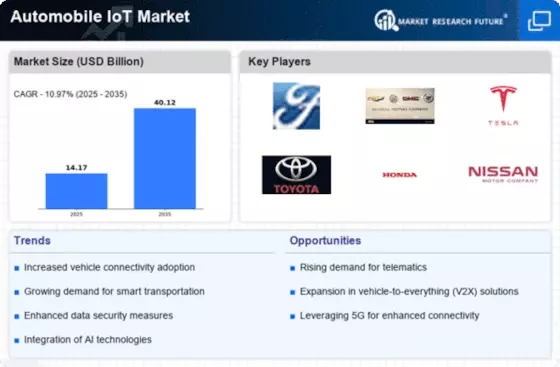
As per analysis, the North America Automobile Iot Market is projected to grow from USD 12.77 Billion in 2024 to USD 40.12 Billion by 2035, exhibiting a compound annual growth rate (CAGR) of 10.97% during the forecast period (2025 - 2035).

Key Market Trends & Highlights

The North America Automobile IoT Market is poised for substantial growth driven by technological advancements and increasing demand for connectivity.

  • The US remains the largest market for Automobile IoT, showcasing a robust demand for enhanced vehicle connectivity.
  • Canada is emerging as the fastest-growing region, reflecting a rising interest in smart transportation solutions.
  • Fleet Management continues to dominate the market, while Predictive Maintenance is rapidly gaining traction among consumers.
  • Key market drivers include the growing demand for connected vehicles and advancements in data analytics, which are shaping the future of the industry.

Market Size & Forecast

2024 Market Size 12.77 (USD Billion)
2035 Market Size 40.12 (USD Billion)
CAGR (2025 - 2035) 10.97%

Major Players

Ford Motor Company (US), General Motors Company (US), Tesla Inc (US), Toyota Motor Corporation (JP), Honda Motor Co Ltd (JP), Nissan Motor Co Ltd (JP), BMW AG (DE), Mercedes-Benz Group AG (DE), Volkswagen AG (DE)

Our Impact
Enabled $4.3B Revenue Impact for Fortune 500 and Leading Multinationals
Partnering with 2000+ Global Organizations Each Year
30K+ Citations by Top-Tier Firms in the Industry

North America Automobile Iot Market Trends

The North America Automobile IoT Market is currently experiencing a transformative phase, driven by advancements in connectivity and data analytics. The integration of Internet of Things (IoT) technologies into vehicles is reshaping the automotive landscape, enhancing safety, efficiency, and user experience. As consumers increasingly demand smarter and more connected vehicles, manufacturers are responding by incorporating IoT solutions that facilitate real-time data exchange and remote monitoring. This trend is not only improving vehicle performance but also enabling predictive maintenance, which can potentially reduce operational costs for both consumers and fleet operators. Moreover, regulatory frameworks in North America are evolving to support the adoption of IoT technologies in the automotive sector. Initiatives aimed at improving road safety and reducing emissions are encouraging the development of connected vehicle systems. The collaboration between automotive manufacturers, technology firms, and government agencies is fostering innovation and creating a conducive environment for the growth of the North America Automobile IoT Market. As the market continues to mature, it appears poised for further expansion, with an increasing focus on sustainability and enhanced user experiences.

Enhanced Vehicle Connectivity

The North America Automobile IoT Market is witnessing a surge in enhanced vehicle connectivity solutions. This trend involves the integration of advanced communication technologies that allow vehicles to connect with each other and infrastructure. Such connectivity facilitates real-time data sharing, which can improve traffic management and enhance safety features. As a result, consumers are likely to benefit from a more seamless driving experience.

Focus on Cybersecurity

With the rise of connected vehicles, the North America Automobile IoT Market is placing a heightened emphasis on cybersecurity measures. Manufacturers are increasingly aware of the potential vulnerabilities associated with IoT technologies. Consequently, there is a growing trend towards implementing robust security protocols to protect user data and ensure the integrity of vehicle systems. This focus on cybersecurity is essential for building consumer trust.

Integration of AI and Machine Learning

The integration of artificial intelligence and machine learning technologies is becoming a prominent trend within the North America Automobile IoT Market. These technologies enable vehicles to analyze vast amounts of data, leading to improved decision-making and enhanced user experiences. As AI continues to evolve, it is expected to play a crucial role in optimizing vehicle performance and personalizing services for drivers.

North America Automobile Iot Market Drivers

Advancements in Data Analytics

Advancements in data analytics are significantly impacting the North America Automobile IoT Market. The ability to collect and analyze vast amounts of data from connected vehicles allows manufacturers to gain insights into consumer behavior, vehicle performance, and maintenance needs. As of January 2026, it is projected that the market for automotive data analytics will reach approximately 5 billion USD in North America. This growth is attributed to the increasing reliance on data-driven decision-making processes within the automotive industry. By leveraging data analytics, companies can enhance their product offerings, improve customer satisfaction, and optimize operational efficiencies. Consequently, the integration of sophisticated analytics tools is likely to become a cornerstone of the North America Automobile IoT Market, driving further innovation and competitiveness.

Rising Focus on Vehicle Safety

The rising focus on vehicle safety is a crucial driver for the North America Automobile IoT Market. Consumers are increasingly prioritizing safety features in their vehicle purchases, leading manufacturers to integrate advanced IoT technologies that enhance safety. Features such as automatic emergency braking, lane-keeping assistance, and adaptive cruise control are becoming standard in many new models. As of January 2026, it is estimated that nearly 60 percent of vehicles sold in North America are equipped with advanced driver-assistance systems (ADAS) that utilize IoT technologies. This trend not only meets consumer demand but also aligns with regulatory pressures for improved safety standards. As a result, the emphasis on safety is likely to continue to propel the growth of the North America Automobile IoT Market.

Growing Demand for Connected Vehicles

The North America Automobile IoT Market is experiencing a surge in demand for connected vehicles, driven by consumer preferences for advanced technology and enhanced driving experiences. As of January 2026, it is estimated that over 70 percent of new vehicles sold in the region are equipped with some form of connectivity. This trend is largely influenced by the increasing integration of IoT technologies, which enable features such as real-time traffic updates, remote diagnostics, and over-the-air software updates. The growing consumer expectation for seamless connectivity is prompting automakers to invest heavily in IoT solutions, thereby propelling the market forward. Furthermore, the proliferation of mobile applications that interact with vehicles is likely to further enhance the appeal of connected cars, making them a central focus in the North America Automobile IoT Market.

Government Regulations and Initiatives

Government regulations and initiatives play a pivotal role in shaping the North America Automobile IoT Market. Regulatory bodies are increasingly mandating the incorporation of IoT technologies to improve vehicle safety and environmental standards. For instance, the National Highway Traffic Safety Administration (NHTSA) has proposed guidelines that encourage the adoption of vehicle-to-everything (V2X) communication systems. These regulations are designed to enhance road safety and reduce traffic congestion, which in turn drives the demand for IoT-enabled vehicles. Additionally, various state governments are offering incentives for manufacturers to develop smart vehicles, further stimulating market growth. As these regulations evolve, they are expected to create a more favorable environment for IoT innovations in the automotive sector, thereby influencing the North America Automobile IoT Market.

Increased Investment in Smart Infrastructure

Increased investment in smart infrastructure is significantly influencing the North America Automobile IoT Market. Governments and private entities are recognizing the importance of developing smart cities that integrate IoT technologies to improve transportation efficiency and safety. As of January 2026, funding for smart infrastructure projects in North America has reached over 10 billion USD, aimed at enhancing connectivity between vehicles and urban infrastructure. This investment facilitates the deployment of IoT solutions such as smart traffic signals, connected parking systems, and real-time monitoring of road conditions. Such advancements not only improve the driving experience but also contribute to reduced congestion and emissions. Consequently, the growth of smart infrastructure is expected to be a key driver in the North America Automobile IoT Market, fostering a more connected and efficient transportation ecosystem.


Market Segment Insights

By Application: Fleet Management (Largest) vs. Predictive Maintenance (Fastest-Growing)

In the North America Automobile IoT Market, the application segment comprises Fleet Management, Vehicle Tracking, Predictive Maintenance, and Remote Diagnostics. Fleet Management commands the largest market share due to its widespread adoption among businesses looking to optimize operations and reduce costs. Vehicle Tracking trails closely, benefiting from consumers' increasing need for enhanced security and operational efficiency. On the other hand, Predictive Maintenance and Remote Diagnostics are gaining traction as businesses seek innovative solutions to minimize downtime and improve service efficiency. The growth trends within this segment are driven by advancements in IoT technologies and the increasing demand for data analytics in the automotive sector. Fleet Management continues to dominate as companies realize the importance of real-time data in managing their fleets effectively. Meanwhile, Predictive Maintenance is emerging as the fastest-growing segment, fueled by the shift towards proactive vehicle servicing and the increasing integration of advanced sensors into cars, enabling timely interventions and cost-effective maintenance strategies.

Fleet Management (Dominant) vs. Predictive Maintenance (Emerging)

Fleet Management is characterized by its comprehensive capabilities of overseeing vehicle operations, enhancing route efficiencies, and providing vital analytics that empower businesses to reduce operational costs. It leverages GPS tracking, telematics, and real-time data to offer businesses a competitive edge in logistics and transportation. Conversely, Predictive Maintenance is emerging as a game-changer, utilizing machine learning and AI to forecast potential vehicle malfunctions before they occur. This shift towards preventive maintenance not only minimizes vehicle downtime but also prolongs the life span of vehicles. Both segments contribute significantly to the North America Automobile IoT market, with Fleet Management remaining a dominant player while Predictive Maintenance showcases rapid growth potential, driven by the adoption of smart technologies.

By Connectivity Technology: Cellular (Largest) vs. Vehicle-to-Everything (Fastest-Growing)

In the North America Automobile IoT Market, Cellular technology leads the connectivity segment with the highest market share due to its widespread adoption and superior network capabilities. Following closely are Satellite and Short Range Communication technologies, which also contribute to the connectivity landscape but at significantly lower shares. Vehicle-to-Everything (V2X) technology is emerging as a pivotal player, driven by increasing demand for improved road safety and traffic management solutions.

Connectivity Technology: Cellular (Dominant) vs. Vehicle-to-Everything (Emerging)

Cellular technology has established its dominance in the North America Automobile IoT Market, primarily due to its reliability, scalability, and extensive infrastructure support. It serves as a backbone for connected vehicles, enabling features like real-time data transmission and remote diagnostics. On the other hand, Vehicle-to-Everything (V2X) technology is heralded as an emerging trend, gaining traction rapidly as automakers seek to enhance vehicle communication with their surroundings. Facilitated by advancements in 5G networks, V2X is pivotal in promoting smart cities and connected vehicle ecosystems, positioning itself as a crucial element for future traffic management and safety protocols.

By End Use: Passenger Vehicles (Largest) vs. Electric Vehicles (Fastest-Growing)

In the North America Automobile IoT Market, the passenger vehicles segment holds the largest market share, significantly outpacing other categories such as commercial and heavy-duty vehicles. This dominance is driven by the growing consumer preference for connected technology, which enhances driving experience through infotainment systems, navigation, and safety features. On the other hand, the electric vehicles segment is experiencing rapid growth, as more consumers and manufacturers shift towards sustainable mobility solutions, supported by government incentives and infrastructure developments that encourage electric vehicle adoption.

Passenger Vehicles (Dominant) vs. Electric Vehicles (Emerging)

Passenger vehicles are currently the dominant segment in the North America Automobile IoT Market, characterized by high consumer demand for advanced connectivity features and enhanced safety systems. This segment benefits from significant investments in technologies that offer real-time data analytics, improving vehicle performance and user experience. In contrast, electric vehicles, while emerging, are gaining traction quickly due to a mix of new model introductions and improved battery technologies. This segment appeals to environmentally-conscious consumers and is bolstered by governmental support for electric mobility initiatives that further drive its growth and adoption.

By Data Type: Telematics Data (Largest) vs. Driver Behavior Data (Fastest-Growing)

In the North America Automobile IoT Market, telematics data currently holds the largest share among various data types. It encompasses information related to vehicle tracking, navigation, and diagnostics, playing a crucial role for automotive manufacturers and service providers. Following this, driver behavior data emerges as a crucial segment that is experiencing rapid growth, driven by the increasing focus on enhancing driver safety and optimizing vehicle performance through real-time monitoring and analytics. The growth trends in this market are significantly supported by technological advancements and a shift in consumer preferences towards more connected and data-driven vehicles. Factors such as the growing demand for advanced driver-assistance systems (ADAS) and the proliferation of mobile applications for real-time data access are further driving the adoption of driver behavior data. Additionally, Vehicle Health Data and Location Data also contribute valuable insights, but they are currently overshadowed by telematics and driver behavior data in terms of market traction and growth potential.

Telematics Data (Dominant) vs. Driver Behavior Data (Emerging)

Telematics data is the dominant force within the North America Automobile IoT Market, primarily due to its broad applications in fleet management, insurance telematics, and connected vehicles. This data type enables real-time tracking and analysis, offering insights into vehicle performance, route optimization, and maintenance needs. On the other hand, driver behavior data is emerging rapidly as a vital segment, driven by innovations in analytics and machine learning. It focuses on understanding driver habits and patterns to improve safety and efficiency. Companies are increasingly leveraging this data to implement reward systems for safe driving, thereby driving its adoption. Together, these data types enhance the overall value proposition of connected vehicles, allowing for tailored services and improved user experience.

By Deployment Type: Cloud-Based (Largest) vs. On-Premises (Fastest-Growing)

In the North America Automobile IoT Market, the deployment type segment illustrates a diverse landscape dominated by Cloud-Based solutions, owing to their scalable nature and integration with advanced analytical tools. On-Premises solutions, however, hold a notable share, appealing to organizations prioritizing data security and control. Hybrid models have also emerged, providing a balanced approach, but they remain less prominent in comparison to their cloud counterparts.

Deployment Type: Cloud-Based (Dominant) vs. On-Premises (Emerging)

Cloud-Based deployment in the North America Automobile IoT Market stands out as the dominant choice, appealing to automakers and suppliers due to its flexibility and cost-effectiveness. This model allows for real-time data processing and seamless integration of IoT devices, enhancing operational efficiency. In contrast, On-Premises deployment is gaining traction as an emerging option, particularly among companies focusing on stringent data privacy regulations. These organizations favor On-Premises solutions for their enhanced security measures, while hybrid models offer a transitional approach, allowing companies to leverage the benefits of both environments. As the market evolves, the demand dynamics between these deployments are expected to shift.

Get more detailed insights about North America Automobile Iot Market

Regional Insights

US : Innovative Technologies Drive Growth

Key markets include California, Texas, and Michigan, where major automotive manufacturers like Ford, General Motors, and Tesla are heavily investing in IoT technologies. The competitive landscape is characterized by a mix of established players and emerging startups, all vying for market share. Local dynamics are influenced by a strong consumer preference for advanced safety features and connectivity. The automotive sector is increasingly integrating IoT applications in areas such as fleet management and autonomous driving.

Canada : Government Support Fuels Innovation

Key markets include Ontario and British Columbia, where local governments are actively supporting IoT initiatives. The competitive landscape features both domestic players and international firms, with significant contributions from companies like Toyota and Honda. The business environment is favorable, with a focus on sustainability and innovation. The automotive sector is leveraging IoT for applications in smart city projects and enhanced vehicle connectivity, aligning with national goals for reducing carbon emissions.

Key Players and Competitive Insights

The North America Automobile IoT Market is characterized by a dynamic competitive landscape, driven by rapid technological advancements and increasing consumer demand for connected vehicles. Major players such as Ford Motor Company (US), General Motors Company (US), and Tesla Inc (US) are at the forefront, each adopting distinct strategies to enhance their market positioning. Ford Motor Company (US) emphasizes innovation through its FordPass platform, which integrates various IoT functionalities to improve user experience. Meanwhile, General Motors Company (US) focuses on strategic partnerships, notably with tech firms, to bolster its autonomous vehicle capabilities. Tesla Inc (US) continues to lead in electric vehicle technology, leveraging its extensive data collection to refine its autonomous driving features, thereby shaping a competitive environment that prioritizes technological superiority and consumer engagement.

In terms of business tactics, companies are increasingly localizing manufacturing and optimizing supply chains to enhance efficiency and responsiveness to market demands. The competitive structure of the market appears moderately fragmented, with several key players exerting substantial influence. This fragmentation allows for a diverse range of innovations and offerings, as companies strive to differentiate themselves in a crowded marketplace.

In December 2025, Ford Motor Company (US) announced a significant investment in its IoT infrastructure, aiming to enhance vehicle connectivity and data analytics capabilities. This move is strategically important as it positions Ford to better compete with tech-centric rivals by improving the overall user experience and operational efficiency of its vehicles. Such investments are likely to yield long-term benefits in customer loyalty and market share.

In November 2025, General Motors Company (US) unveiled a new partnership with a leading AI firm to develop advanced driver-assistance systems. This collaboration is pivotal, as it not only enhances GM's technological prowess but also aligns with the growing trend of integrating AI into automotive applications. By leveraging AI, GM aims to improve safety features and user experience, thereby reinforcing its competitive edge in the market.

In October 2025, Tesla Inc (US) launched an upgraded version of its Full Self-Driving software, which incorporates enhanced machine learning algorithms. This upgrade is crucial for Tesla, as it solidifies its position as a leader in autonomous driving technology. The continuous improvement of its software capabilities is likely to attract more consumers, further differentiating Tesla from traditional automakers.

As of January 2026, the competitive trends in the market are increasingly defined by digitalization, sustainability, and AI integration. Strategic alliances are becoming more prevalent, as companies recognize the need to collaborate to stay ahead in a rapidly evolving landscape. The shift from price-based competition to a focus on innovation, technology, and supply chain reliability is evident, suggesting that future competitive differentiation will hinge on the ability to deliver cutting-edge solutions that meet consumer expectations.

Key Companies in the North America Automobile Iot Market include

Industry Developments

Toyota and NTT announced a broad partnership in October 2024, with plans to invest 500 billion yen by 2030 to create a Mobility AI Platform that will connect cars, infrastructure, and cloud AI capabilities. Pilot systems are anticipated to be operational by 2025. This is a significant step for autonomous and IoT projects around the world.

By releasing a firmware upgrade in March 2025 that enabled in-car AI-driven energy management features including scheduled charging, adaptive routing depending on grid demand, and smart microgrid integration for Model S and Model 3 drivers, Tesla created a stir in North America.

In order to improve uptime and operational efficiency, Microsoft Azure IoT announced earlier in April 2025 that it would be partnering with Ford to build an edge-cloud platform that would enable real-time car diagnostics and predictive maintenance throughout the North American fleet.

In the meanwhile, Honda announced in July 2025 that its North American models with HondaLink 2025 will come with linked car dashboards that integrated AI-based voice assistants, live traffic updates, and over-the-air trial software. These advancements show how infrastructure, cloud connection, and autonomous technology interact dynamically to accelerate IoT capabilities in the automotive sector in North America.

Future Outlook

North America Automobile Iot Market Future Outlook

The North America Automobile IoT Market is projected to grow at a 10.97% CAGR from 2025 to 2035, driven by advancements in connectivity, data analytics, and consumer demand for smart vehicles.

New opportunities lie in:

  • Development of integrated vehicle-to-everything (V2X) communication platforms.
  • Expansion of subscription-based telematics services for fleet management.
  • Implementation of advanced predictive maintenance solutions using IoT data.

By 2035, the market is expected to be robust, driven by innovation and increased adoption of IoT technologies.

Market Segmentation

North America Automobile Iot Market End Use Outlook

  • Passenger Vehicles
  • Commercial Vehicles
  • Electric Vehicles
  • Heavy-Duty Vehicles

North America Automobile Iot Market Data Type Outlook

  • Telematics Data
  • Vehicle Health Data
  • Driver Behavior Data
  • Location Data

North America Automobile Iot Market Application Outlook

  • Fleet Management
  • Vehicle Tracking
  • Predictive Maintenance
  • Remote Diagnostics

North America Automobile Iot Market Deployment Type Outlook

  • On-Premises
  • Cloud-Based
  • Hybrid

North America Automobile Iot Market Connectivity Technology Outlook

  • Cellular
  • Satellite
  • Short Range Communication
  • Vehicle-to-Everything

Report Scope

MARKET SIZE 202412.77(USD Billion)
MARKET SIZE 202514.32(USD Billion)
MARKET SIZE 203540.12(USD Billion)
COMPOUND ANNUAL GROWTH RATE (CAGR)10.97% (2024 - 2035)
REPORT COVERAGERevenue Forecast, Competitive Landscape, Growth Factors, and Trends
BASE YEAR2024
Market Forecast Period2025 - 2035
Historical Data2019 - 2024
Market Forecast UnitsUSD Billion
Key Companies ProfiledFord Motor Company (US), General Motors Company (US), Tesla Inc (US), Toyota Motor Corporation (JP), Honda Motor Co Ltd (JP), Nissan Motor Co Ltd (JP), BMW AG (DE), Mercedes-Benz Group AG (DE), Volkswagen AG (DE)
Segments CoveredApplication, Connectivity Technology, End Use, Data Type, Deployment Type
Key Market OpportunitiesIntegration of advanced connectivity features in electric vehicles enhances consumer engagement in the North America Automobile Iot Market.
Key Market DynamicsRising demand for connected vehicles drives innovation and competition in North America's Automobile Internet of Things market.
Countries CoveredUS, Canada
Leave a Comment

FAQs

What is the projected market valuation of the North America Automobile IoT Market by 2035?

The projected market valuation for the North America Automobile IoT Market is 40.12 USD Billion by 2035.

What was the market valuation of the North America Automobile IoT Market in 2024?

The overall market valuation was 12.77 USD Billion in 2024.

What is the expected CAGR for the North America Automobile IoT Market during the forecast period 2025 - 2035?

The expected CAGR for the North America Automobile IoT Market during the forecast period 2025 - 2035 is 10.97%.

Which application segment is projected to have the highest growth in the North America Automobile IoT Market?

The Predictive Maintenance application segment is projected to grow from 4.16 USD Billion in 2024 to 13.05 USD Billion by 2035.

What are the key players in the North America Automobile IoT Market?

Key players in the market include Ford Motor Company, General Motors Company, Tesla Inc, and Toyota Motor Corporation.

How does the Vehicle-to-Everything connectivity technology segment perform in the market?

The Vehicle-to-Everything connectivity technology segment is expected to grow from 5.77 USD Billion in 2024 to 18.42 USD Billion by 2035.

What is the projected growth for the Cloud-Based deployment type in the North America Automobile IoT Market?

The Cloud-Based deployment type is projected to increase from 5.11 USD Billion in 2024 to 16.05 USD Billion by 2035.

Which end-use segment is anticipated to dominate the North America Automobile IoT Market?

The Passenger Vehicles end-use segment is anticipated to dominate, growing from 4.0 USD Billion in 2024 to 12.5 USD Billion by 2035.

What type of data is expected to see significant growth in the North America Automobile IoT Market?

Location Data is expected to see significant growth, increasing from 4.39 USD Billion in 2024 to 13.8 USD Billion by 2035.

How does the North America Automobile IoT Market compare to other regions?

While specific regional comparisons are not provided, the North America market is characterized by strong growth driven by key players and technological advancements.

Download Free Sample

Kindly complete the form below to receive a free sample of this Report

Compare Licence

×
Features License Type
Single User Multiuser License Enterprise User
Price $4,950 $5,950 $7,250
Maximum User Access Limit 1 User Upto 10 Users Unrestricted Access Throughout the Organization
Free Customization
Direct Access to Analyst
Deliverable Format
Platform Access
Discount on Next Purchase 10% 15% 15%
Printable Versions