×
Request Free Sample ×

Kindly complete the form below to receive a free sample of this Report

* Please use a valid business email

Leading companies partner with us for data-driven Insights

clients tt-cursor
Hero Background

India Automobile Iot Market

ID: MRFR/ICT/60687-HCR
200 Pages
Aarti Dhapte
February 2026

India Automobile IoT Market Research Report By Technology (Telematics, Vehicle-to-Everything, Remote Diagnostics, Fleet Management), By Application (Navigation, Safety Security, Remote Vehicle Management, Infotainment), By End Use (Passenger Vehicles, Commercial Vehicles, Electric Vehicles), and By Connectivity (Cellular Connectivity, Satellite Connectivity, Wi-Fi Connectivity)-Forecast to 2035

Share:
Download PDF ×

We do not share your information with anyone. However, we may send you emails based on your report interest from time to time. You may contact us at any time to opt-out.

India Automobile Iot Market Infographic
Purchase Options

India Automobile Iot Market Summary

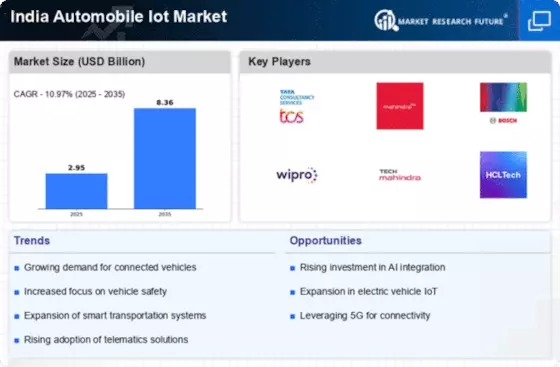
As per analysis, the India Automobile Iot Market is projected to grow from USD 2.98 Billion in 2025 to USD 8.36 Billion by 2035, exhibiting a compound annual growth rate (CAGR) of 10.97% during the forecast period (2025 - 2035).

Key Market Trends & Highlights

The India Automobile IoT market is poised for substantial growth driven by technological advancements and increasing demand for smart vehicles.

  • The Fleet Management segment remains the largest contributor to the market, reflecting a strong demand for enhanced operational efficiency.
  • Vehicle Tracking is emerging as the fastest-growing segment, driven by the increasing need for real-time monitoring and security.
  • Passenger Vehicles dominate the market, while Electric Vehicles are rapidly gaining traction as consumer preferences shift towards sustainability.
  • Key market drivers include rising demand for smart vehicles and supportive government regulations and policies.

Market Size & Forecast

2024 Market Size 2.66 (USD Billion)
2035 Market Size 8.36 (USD Billion)
CAGR (2025 - 2035) 10.97%

Major Players

Tata Consultancy Services (IN), Mahindra & Mahindra (IN), Bosch Limited (IN), Wipro Limited (IN), Tech Mahindra (IN), HCL Technologies (IN), Siemens Limited (IN), NVIDIA Corporation (US), Qualcomm Technologies (US)

Our Impact
Enabled $4.3B Revenue Impact for Fortune 500 and Leading Multinationals
Partnering with 2000+ Global Organizations Each Year
30K+ Citations by Top-Tier Firms in the Industry

India Automobile Iot Market Trends

The India Automobile IoT Market is currently experiencing a transformative phase, driven by advancements in technology and increasing consumer demand for connected vehicles. The integration of Internet of Things (IoT) solutions into automobiles is enhancing vehicle performance, safety, and user experience. As the automotive industry in India evolves, manufacturers are increasingly adopting IoT technologies to streamline operations, improve supply chain management, and offer innovative features to consumers. This shift is not only fostering competition among automakers but also encouraging collaborations with technology firms to develop smart mobility solutions. Furthermore, the government's push for digitalization and smart city initiatives is likely to bolster the adoption of IoT in the automotive sector, creating a conducive environment for growth. In addition to technological advancements, consumer awareness regarding vehicle connectivity and safety features is on the rise. Indian consumers are becoming more informed about the benefits of IoT-enabled vehicles, such as real-time diagnostics, predictive maintenance, and enhanced navigation systems. This growing awareness is prompting manufacturers to invest in research and development to create more sophisticated and user-friendly IoT applications. As the market continues to mature, it appears that the India Automobile IoT Market is poised for substantial growth, driven by a combination of technological innovation, consumer demand, and supportive government policies.

Increased Connectivity Features

The demand for enhanced connectivity features in vehicles is rising in the India Automobile IoT Market. Consumers are increasingly seeking vehicles equipped with advanced infotainment systems, real-time navigation, and seamless smartphone integration. This trend indicates a shift towards a more connected driving experience, where technology plays a crucial role in enhancing convenience and safety.

Focus on Vehicle Safety and Security

There is a growing emphasis on safety and security in the India Automobile IoT Market. Manufacturers are integrating IoT solutions that provide real-time monitoring of vehicle conditions, enabling proactive maintenance and reducing the risk of accidents. This trend reflects a broader commitment to ensuring the safety of drivers and passengers alike.

Government Initiatives and Support

Government initiatives aimed at promoting smart mobility and digitalization are significantly influencing the India Automobile IoT Market. Policies encouraging the adoption of IoT technologies in vehicles are likely to create a favorable environment for innovation and investment. This support from the government is expected to accelerate the development and deployment of IoT solutions in the automotive sector.

India Automobile Iot Market Drivers

Growing Focus on Sustainability

The growing focus on sustainability is emerging as a crucial driver for the India Automobile IoT Market. With increasing awareness of environmental issues, consumers and manufacturers alike are prioritizing eco-friendly practices. The integration of IoT technologies in vehicles facilitates better fuel efficiency and reduced emissions, aligning with global sustainability goals. As of January 2026, the Indian electric vehicle (EV) market is projected to account for 30% of total vehicle sales by 2030, largely due to the adoption of IoT solutions that enhance the performance and appeal of EVs. This shift towards sustainable mobility is prompting automakers to invest in IoT technologies that support greener alternatives, thereby fostering growth in the India Automobile IoT Market.

Rising Demand for Smart Vehicles

The India Automobile IoT Market is experiencing a notable surge in demand for smart vehicles, driven by consumer preferences for enhanced connectivity and automation. As of January 2026, the market for connected cars in India is projected to reach approximately USD 10 billion by 2027, reflecting a compound annual growth rate of around 25%. This trend is largely influenced by the increasing adoption of advanced driver-assistance systems (ADAS) and infotainment features. Consumers are increasingly seeking vehicles that offer seamless integration with mobile devices, real-time navigation, and remote diagnostics. Consequently, automakers are investing heavily in IoT technologies to meet these evolving consumer expectations, thereby propelling the growth of the India Automobile IoT Market.

Expansion of Automotive Ecosystem

The expansion of the automotive ecosystem in India is significantly influencing the India Automobile IoT Market. The rise of startups and technology companies focusing on automotive IoT solutions is creating a dynamic environment for innovation. Collaborations between traditional automakers and tech firms are becoming increasingly common, leading to the development of new products and services that enhance vehicle connectivity and functionality. As of January 2026, the number of IoT startups in the automotive sector is estimated to have increased by 40% over the past two years, indicating a vibrant ecosystem that supports growth. This collaborative approach is likely to drive advancements in the India Automobile IoT Market, as stakeholders work together to create integrated solutions that meet consumer demands.

Technological Advancements in IoT

Technological advancements in IoT are playing a pivotal role in transforming the India Automobile IoT Market. Innovations in sensor technology, data analytics, and cloud computing are enabling the development of sophisticated vehicle systems that enhance safety, efficiency, and user experience. For instance, the integration of artificial intelligence (AI) and machine learning (ML) in vehicle systems allows for predictive maintenance and real-time monitoring, which can significantly reduce operational costs for fleet operators. As of January 2026, the market for IoT-enabled fleet management solutions in India is expected to grow at a CAGR of 20%, indicating a strong inclination towards leveraging technology for improved vehicle performance. This technological evolution is likely to drive further investments in the India Automobile IoT Market.

Government Regulations and Policies

The India Automobile IoT Market is significantly shaped by government regulations and policies aimed at promoting the adoption of IoT technologies in vehicles. The Indian government has introduced various initiatives, such as the National Electric Mobility Mission Plan (NEMMP) and the Faster Adoption and Manufacturing of Hybrid and Electric Vehicles (FAME) scheme, which encourage the integration of IoT solutions in automobiles. These policies not only aim to enhance vehicle efficiency and reduce emissions but also foster innovation in the automotive sector. As a result, automakers are increasingly aligning their strategies with these regulations, leading to a more robust IoT ecosystem in the Indian automotive landscape. The government's commitment to smart transportation solutions is likely to further stimulate growth in the India Automobile IoT Market.


Market Segment Insights

By Application: Fleet Management (Largest) vs. Vehicle Tracking (Fastest-Growing)

In the India Automobile IoT Market, Fleet Management holds the largest market share, driven by the increasing need for efficient vehicle management solutions among businesses. This segment has become crucial for logistics and transportation companies aiming to optimize their operations and reduce costs through enhanced visibility and control over their fleet. On the other hand, Vehicle Tracking is emerging rapidly, favored by the demand for real-time location services among individual vehicle owners and small businesses alike. The capability to monitor vehicles actively is becoming a standard expectation in today's tech-savvy marketplace. The growth trends indicate a strong upward trajectory across all application segments, particularly driven by advancements in connectivity technologies and data analytics. Fleet Management solutions are increasingly integrating AI and machine learning to provide predictive insights, thereby enhancing their service offerings. Meanwhile, the Vehicle Tracking segment is expanding rapidly as safety concerns and theft protection become paramount for consumers. Government initiatives promoting smart transportation and regulatory requirements are also propelling demand for innovative IoT applications in the automotive sector, ensuring long-term market development.

Fleet Management (Dominant) vs. Predictive Maintenance (Emerging)

Fleet Management has established itself as a dominant force in the India Automobile IoT Market, characterized by comprehensive solutions that encompass route optimization, fuel management, and driver performance metrics. This segment empowers businesses to make data-driven decisions, thus enhancing operational efficiency. Conversely, Predictive Maintenance is an emerging segment that focuses on utilizing IoT data to forecast maintenance needs before failures occur, minimizing downtime and repair costs. This solution is gaining traction as more companies recognize the value of proactive vehicle care. These segments cater to a distinct yet interlinked customer base, where Fleet Management prioritizes extensive organizational support, and Predictive Maintenance appeals to companies looking to enhance vehicle longevity and reduce operational disruptions.

By End Use: Passenger Vehicles (Largest) vs. Electric Vehicles (Fastest-Growing)

In the India Automobile IoT Market, passenger vehicles currently hold the largest share, representing a significant portion of overall IoT deployments in the automotive sector. This segment benefits from the increasing consumer demand for connected features, safety enhancements, and overall vehicle performance. Meanwhile, commercial vehicles are notable but lag behind passenger vehicles in terms of market penetration. Electric vehicles, while emerging, are progressively gaining traction due to rising awareness of environmental sustainability and government initiatives supporting electrification. The growth trends within the end-use segments reveal an exciting landscape, particularly for electric vehicles. Factors driving growth include technological advancements, the push for smart mobility solutions, and improved infrastructure for EV charging. Commercial vehicles are also witnessing a steady growth trajectory, attributed to logistics and supply chain optimization. The overall landscape presents an increasing shift towards integrated IoT solutions in both passenger and electric vehicle segments, indicating a broader trend toward connected mobility solutions in India.

Passenger Vehicles: Dominant vs. Electric Vehicles: Emerging

Passenger vehicles dominate the India Automobile IoT market, characterized by their widespread adoption of connected technologies that enhance user experience. This segment is leading in terms of market influence, driven by innovations in smart infotainment systems and enhanced safety features that integrate IoT capabilities. Conversely, electric vehicles are marked as an emerging segment, fueled by a growing eco-conscious consumer base and robust government incentives aimed at reducing carbon footprints. The adoption of IoT in electric vehicles focuses on energy management, efficiency, and real-time data analytics, allowing manufacturers to offer competitive features that cater to tech-savvy customers. As the Indian market adapts to changing consumer preferences, both segments are poised for substantial evolution, with passenger vehicles maintaining dominance and electric vehicles rapidly rising in importance.

By Connectivity Technology: Cellular Technology (Largest) vs. Short Range Communication (Fastest-Growing)

In the India Automobile IoT Market, Cellular Technology dominates the connectivity segment with the largest market share, attributed to its extensive coverage and established infrastructure. Short Range Communication, primarily used for vehicle-to-vehicle and vehicle-to-infrastructure communications, shows the fastest growth as manufacturers adopt it for smart traffic systems and enhanced safety features. The growth of Cellular Technology is driven by the increasing need for reliable and high-speed connectivity in vehicles, enabling applications such as telematics and navigation. Meanwhile, the rising demand for Short Range Communication is fueled by the push for smarter cities and transport systems, leading to an increasing number of connected vehicles that can wirelessly communicate with each other and their surroundings.

Connectivity: Cellular Technology (Dominant) vs. Satellite Communication (Emerging)

Cellular Technology remains the dominant connectivity solution in the India Automobile IoT Market, providing reliable and robust communication for a range of applications. Its extensive infrastructure supports various services including vehicle tracking, emergency response, and real-time diagnostics. As the market evolves, Satellite Communication emerges as an increasingly important player, especially in rural and remote areas where cellular signals may be weak or unavailable. This technology offers unique advantages in terms of global coverage and can seamlessly integrate with cellular networks to enhance connectivity options. The competitive landscape sees Cellular Technology leveraging its established presence while Satellite Communication is positioned as a complementary solution for expansive and connected vehicle networks.

By Component: Sensors (Largest) vs. Telematics Control Unit (Fastest-Growing)

In the Indian Automobile IoT market, the component segment exhibits a diverse distribution of market share across various values. Sensors represent the largest segment, driving significant advancements through their capability to gather extensive real-time data. Following closely are Telematics Control Units, which are witnessing rapid growth, capitalizing on the rising demand for connected vehicles and enhanced fleet management solutions. Embedded Software and Communication Modules also play critical roles, although they command lesser shares compared to Sensors and Telematics Control Units. The growth trends within the Component segment are primarily influenced by the increasing adoption of smart technologies in vehicles and the enhancement of safety features. The push towards electric and autonomous vehicles further accelerates the demand for advanced components such as Telematics Control Units. Moreover, the growing emphasis on vehicle diagnostics, predictive maintenance, and real-time tracking solutions emphasizes the importance of Sensors, driving their adoption in the Indian market.

Sensors (Dominant) vs. Embedded Software (Emerging)

In the India Automobile IoT market, Sensors are recognized as the dominant value, offering critical functionalities such as monitoring vehicle performance and ensuring safety measures. These devices facilitate seamless communication between the vehicle and external ecosystems, greatly enhancing user experience and operational efficiency. On the other hand, Embedded Software is an emerging segment that is rapidly gaining traction. It drives the performance of various hardware components and integrates multiple applications within automotive systems. As the automotive industry shifts towards more sophisticated technologies including V2X communication and automated driving systems, the demand for both Sensors and Embedded Software is poised for substantial growth, each fulfilling complementary roles in enhancing vehicle intelligence and connectivity.

By Data Management: Data Analytics (Largest) vs. Artificial Intelligence (Fastest-Growing)

In the India Automobile IoT Market, the data management segment exhibits a diverse distribution of market share among its key players. Data Analytics stands out as the largest segment, driven by the increasing integration of data-driven decision-making in the automotive sector. On the other hand, Artificial Intelligence is rapidly gaining traction, leveraging its transformative capabilities to enhance user experiences and operational efficiency in vehicles, making it crucial for manufacturers aiming to stay competitive in this evolving landscape.

Data Analytics (Dominant) vs. Artificial Intelligence (Emerging)

Data Analytics dominates the data management segment in the Indian Automobile IoT Market due to its critical role in processing vast amounts of data generated by connected vehicles. This segment facilitates in-depth insights into consumer behavior, vehicle performance, and maintenance needs. It empowers manufacturers with actionable intelligence that leads to improved operational efficiencies. Meanwhile, Artificial Intelligence, although emerging, is making significant strides thanks to advancements in machine learning and AI algorithms. It is enabling features such as predictive maintenance, real-time data processing, and personalized in-car experiences, ensuring its prominence in future automotive technology.

Get more detailed insights about India Automobile Iot Market

Key Players and Competitive Insights

The Automobile IoT Market in India is currently characterized by a dynamic competitive landscape, driven by rapid technological advancements and increasing consumer demand for connected vehicles. Key players such as Tata Consultancy Services (IN), Mahindra & Mahindra (IN), and Bosch Limited (IN) are at the forefront, each adopting distinct strategies to enhance their market positioning. Tata Consultancy Services (IN) focuses on digital transformation and innovation, leveraging its extensive IT expertise to develop smart mobility solutions. Meanwhile, Mahindra & Mahindra (IN) emphasizes regional expansion and sustainability, integrating IoT technologies into its electric vehicle offerings. Bosch Limited (IN) is heavily invested in R&D, particularly in AI and machine learning, to optimize vehicle performance and safety features. Collectively, these strategies contribute to a competitive environment that is increasingly centered around technological innovation and customer-centric solutions.

In terms of business tactics, companies are localizing manufacturing and optimizing supply chains to enhance operational efficiency. The market structure appears moderately fragmented, with several players vying for market share. However, the influence of major companies is significant, as they set benchmarks for quality and innovation that smaller firms strive to meet. This competitive structure fosters an environment where collaboration and strategic partnerships are essential for growth and sustainability.

In December 2025, Tata Consultancy Services (IN) announced a partnership with a leading automotive manufacturer to develop a next-generation connected vehicle platform. This collaboration is poised to enhance the integration of IoT technologies in vehicles, potentially revolutionizing the user experience and operational efficiency. The strategic importance of this partnership lies in TCS's ability to leverage its IT capabilities to create a seamless ecosystem for connected vehicles, thereby strengthening its market position.

In November 2025, Mahindra & Mahindra (IN) launched a new electric vehicle model equipped with advanced IoT features, including real-time diagnostics and predictive maintenance capabilities. This move not only aligns with the growing trend towards sustainability but also positions Mahindra as a leader in the electric mobility space. The introduction of such innovative features is likely to attract environmentally conscious consumers and enhance brand loyalty.

In October 2025, Bosch Limited (IN) unveiled a new AI-driven safety system designed to be integrated into various vehicle models. This system utilizes real-time data analytics to improve driver safety and vehicle performance. The strategic significance of this development is profound, as it underscores Bosch's commitment to enhancing vehicle safety through cutting-edge technology, thereby reinforcing its competitive edge in the market.

As of January 2026, the competitive trends in the Automobile IoT Market are increasingly defined by digitalization, sustainability, and AI integration. Strategic alliances among key players are shaping the landscape, fostering innovation and enhancing product offerings. Looking ahead, it is anticipated that competitive differentiation will evolve, with a shift from price-based competition to a focus on innovation, technology, and supply chain reliability. This transition is likely to redefine market dynamics, compelling companies to invest in advanced technologies and sustainable practices to maintain their competitive advantage.

Key Companies in the India Automobile Iot Market include

Industry Developments

Using platforms like iAlert, ION, and FOTA, Ashok Leyland deployed AI- and IoT-powered connected trucks throughout its commercial fleet in May 2025. These trucks generate and process over 3.2 million data points per hour, allowing for predictive gear shift advice, driver behavior analytics, and efficiency gains of up to 10%.

In the meantime, reports highlight Mahindra & Mahindra's significant R&D investment in autonomous and connected platform technologies, which could position the company as India's strongest engineering innovator in automotive connectivity. In late 2024, the company continued to grow its engineering-led IoT and EV development capabilities.

Additionally, Techarc's India linked Consumer Report from November 2024 predicted that by 2025, Indian passenger cars will have cloud integration, on-device GenAI, and 5G M2M connection, ushering in the "smartphone era" of linked automobiles.

With a focus on AI-based user interfaces, digital clusters, entertainment, and navigation systems specifically designed for the Indian market, Spark Minda and Qualcomm announced an advanced cockpit alliance in July 2025.

All of these innovations, like Spark Minda's state-of-the-art cockpit technology, Mahindra's R&D engine, Ashok Leyland's real-time fleet analytics, and a statewide connected vehicle prediction, highlight India's progress toward intelligent, connected cars.

Future Outlook

India Automobile Iot Market Future Outlook

The India Automobile IoT Market is projected to grow at a 10.97% CAGR from 2025 to 2035, driven by advancements in connectivity, smart vehicle technology, and increasing consumer demand for safety features.

New opportunities lie in:

  • Development of integrated telematics solutions for fleet management.
  • Expansion of predictive maintenance services using IoT analytics.
  • Creation of smart parking solutions leveraging real-time data.

By 2035, the market is expected to be robust, driven by innovation and increased adoption of IoT technologies.

Market Segmentation

India Automobile Iot Market End Use Outlook

  • Passenger Vehicles
  • Commercial Vehicles
  • Two Wheelers
  • Electric Vehicles

India Automobile Iot Market Component Outlook

  • Sensors
  • Telematics Control Unit
  • Embedded Software
  • Communication Modules

India Automobile Iot Market Application Outlook

  • Fleet Management
  • Vehicle Tracking
  • Predictive Maintenance
  • Remote Diagnostics
  • Driver Behavior Monitoring

India Automobile Iot Market Data Management Outlook

  • Data Analytics
  • Cloud Computing
  • Edge Computing
  • Artificial Intelligence

India Automobile Iot Market Connectivity Technology Outlook

  • Cellular Technology
  • Satellite Communication
  • Short Range Communication
  • Vehicle to Everything

Report Scope

MARKET SIZE 20242.66(USD Billion)
MARKET SIZE 20252.98(USD Billion)
MARKET SIZE 20358.36(USD Billion)
COMPOUND ANNUAL GROWTH RATE (CAGR)10.97% (2024 - 2035)
REPORT COVERAGERevenue Forecast, Competitive Landscape, Growth Factors, and Trends
BASE YEAR2024
Market Forecast Period2025 - 2035
Historical Data2019 - 2024
Market Forecast UnitsUSD Billion
Key Companies ProfiledTata Consultancy Services (IN), Mahindra & Mahindra (IN), Bosch Limited (IN), Wipro Limited (IN), Tech Mahindra (IN), HCL Technologies (IN), Siemens Limited (IN), NVIDIA Corporation (US), Qualcomm Technologies (US)
Segments CoveredApplication, End Use, Connectivity Technology, Component, Data Management
Key Market OpportunitiesIntegration of advanced connectivity solutions enhances vehicle safety and efficiency in the India Automobile Iot Market.
Key Market DynamicsRising demand for connected vehicles drives innovation in India’s Automobile Internet of Things market.
Countries CoveredIndia
Leave a Comment

FAQs

What is the current valuation of the India Automobile IoT Market?

As of 2024, the market valuation was 2.66 USD Billion.

What is the projected market size for the India Automobile IoT Market by 2035?

The market is expected to reach a valuation of 8.36 USD Billion by 2035.

What is the expected CAGR for the India Automobile IoT Market during the forecast period 2025 - 2035?

The market is projected to grow at a CAGR of 10.97% during the forecast period.

Which application segments are driving growth in the India Automobile IoT Market?

Key application segments include Fleet Management, Vehicle Tracking, and Predictive Maintenance, with Fleet Management projected to grow from 0.8 to 2.5 USD Billion.

What are the leading connectivity technologies in the India Automobile IoT Market?

Cellular Technology and Vehicle to Everything are leading connectivity technologies, with Cellular Technology expected to grow from 0.8 to 2.5 USD Billion.

How do the end-use segments of the market compare in terms of valuation?

Passenger Vehicles lead the end-use segments, projected to grow from 1.06 to 3.36 USD Billion by 2035.

What role do key players like Tata Consultancy Services and Mahindra & Mahindra play in the market?

Key players such as Tata Consultancy Services and Mahindra & Mahindra are instrumental in driving innovation and market growth.

What components are essential in the India Automobile IoT Market?

Essential components include Sensors and Telematics Control Units, with Sensors expected to grow from 0.8 to 2.5 USD Billion.

What data management technologies are influencing the market?

Data Analytics and Cloud Computing are crucial, with Data Analytics projected to grow from 0.8 to 2.5 USD Billion.

How does the market's growth potential compare across different segments?

The market's growth potential varies, with segments like Fleet Management and Data Analytics showing particularly strong growth trajectories.

Download Free Sample

Kindly complete the form below to receive a free sample of this Report

Compare Licence

×
Features License Type
Single User Multiuser License Enterprise User
Price $4,950 $5,950 $7,250
Maximum User Access Limit 1 User Upto 10 Users Unrestricted Access Throughout the Organization
Free Customization
Direct Access to Analyst
Deliverable Format
Platform Access
Discount on Next Purchase 10% 15% 15%
Printable Versions