×
Request Free Sample ×

Kindly complete the form below to receive a free sample of this Report

* Please use a valid business email

Leading companies partner with us for data-driven Insights

clients tt-cursor
Hero Background

Japan Automobile Iot Market

ID: MRFR/ICT/60683-HCR
200 Pages
Aarti Dhapte
February 2026

Japan Automobile IoT Market Size, Share and Trends Analysis Report By Technology (Telematics, Vehicle-to-Everything, Remote Diagnostics, Fleet Management), By Application (Navigation, Safety Security, Remote Vehicle Management, Infotainment), By End Use (Passenger Vehicles, Commercial Vehicles, Electric Vehicles), and By Connectivity (Cellular Connectivity, Satellite Connectivity, Wi-Fi Connectivity)-Forecast to 2035

Share:
Download PDF ×

We do not share your information with anyone. However, we may send you emails based on your report interest from time to time. You may contact us at any time to opt-out.

Japan Automobile Iot Market Infographic
Purchase Options

Japan Automobile Iot Market Summary

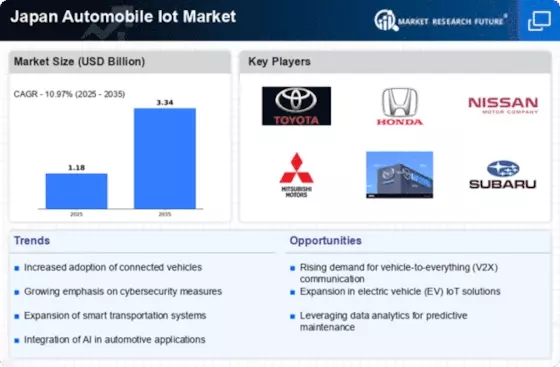
As per MRFR analysis, The Japan Automobile Iot Market is projected to grow from USD 1.19 Billion in 2025 to USD 3.34 Billion by 2035, exhibiting a compound annual growth rate (CAGR) of 10.97% during the forecast period (2025 - 2035).

Key Market Trends & Highlights

The Japan Automobile IoT Market is poised for substantial growth driven by technological advancements and increasing consumer demand.

  • The market is witnessing a surge in connectivity solutions, enhancing vehicle communication and data exchange.
  • Autonomous driving technology is gaining traction, indicating a shift towards more intelligent transportation systems.
  • Fleet management remains the largest segment, while vehicle tracking is emerging as the fastest-growing segment in the market.
  • Government support for IoT integration and rising consumer demand for connected vehicles are key drivers propelling market expansion.

Market Size & Forecast

2024 Market Size 1.06 (USD Billion)
2035 Market Size 3.34 (USD Billion)
CAGR (2025 - 2035) 10.97%

Major Players

Toyota Motor Corporation (JP), Honda Motor Co., Ltd. (JP), Nissan Motor Co., Ltd. (JP), Mitsubishi Motors Corporation (JP), Mazda Motor Corporation (JP), Subaru Corporation (JP), Denso Corporation (JP), Hitachi, Ltd. (JP), Panasonic Corporation (JP)

Our Impact
Enabled $4.3B Revenue Impact for Fortune 500 and Leading Multinationals
Partnering with 2000+ Global Organizations Each Year
30K+ Citations by Top-Tier Firms in the Industry

Japan Automobile Iot Market Trends

The Japan Automobile IoT Market is currently experiencing a transformative phase, driven by advancements in connectivity and automation technologies. The integration of Internet of Things (IoT) solutions into vehicles is enhancing safety, efficiency, and user experience. Japanese manufacturers are increasingly adopting smart technologies, which facilitate real-time data exchange between vehicles and infrastructure. This trend is not only improving traffic management but also contributing to the development of autonomous driving capabilities. Furthermore, the government is actively promoting initiatives to support the adoption of IoT in the automotive sector, indicating a strong commitment to innovation and sustainability. In addition to technological advancements, consumer preferences in Japan are shifting towards more connected and intelligent vehicles. The demand for features such as remote diagnostics, predictive maintenance, and enhanced infotainment systems is on the rise. This shift is likely to encourage manufacturers to invest in research and development, ensuring that their offerings align with evolving consumer expectations. As the market continues to mature, collaboration between automotive companies and technology firms is expected to intensify, fostering an ecosystem that supports the growth of the Japan Automobile IoT Market.

Increased Connectivity Solutions

The Japan Automobile IoT Market is witnessing a surge in connectivity solutions, enabling vehicles to communicate with each other and surrounding infrastructure. This trend enhances safety and efficiency, as real-time data sharing can help prevent accidents and optimize traffic flow.

Focus on Autonomous Driving

There is a growing emphasis on autonomous driving technologies within the Japan Automobile IoT Market. Manufacturers are investing in advanced sensors and AI-driven systems to develop vehicles capable of navigating without human intervention, aligning with national goals for safer transportation.

Sustainability Initiatives

Sustainability is becoming a central theme in the Japan Automobile IoT Market. The government is promoting eco-friendly technologies, encouraging the integration of IoT solutions that reduce emissions and improve energy efficiency in vehicles, reflecting a commitment to environmental stewardship.

Japan Automobile Iot Market Drivers

Advancements in Automotive Technology

Technological advancements play a pivotal role in shaping the Japan Automobile IoT Market. Innovations in artificial intelligence, machine learning, and big data analytics are enabling automakers to develop smarter vehicles that can communicate with their environment. For example, Japanese manufacturers are increasingly utilizing IoT sensors to enhance vehicle performance and safety features. The integration of these technologies is expected to reduce accident rates by up to 30% in urban areas, thereby attracting more consumers to IoT-enabled vehicles. As these advancements continue to evolve, they are likely to create new revenue streams and business models within the Japan Automobile IoT Market.

Focus on Environmental Sustainability

Environmental sustainability is becoming a central theme in the Japan Automobile IoT Market. With increasing awareness of climate change, consumers and manufacturers alike are prioritizing eco-friendly solutions. The Japanese government has set ambitious targets for reducing carbon emissions, which has led to a rise in the development of electric and hybrid vehicles equipped with IoT technologies. These vehicles not only contribute to sustainability goals but also enhance operational efficiency through real-time monitoring and data analytics. The market for sustainable vehicles is projected to grow by 25% in the next five years, reflecting a significant shift towards greener alternatives in the Japan Automobile IoT Market.

Government Support for IoT Integration

The Japan Automobile IoT Market benefits significantly from robust government support aimed at integrating IoT technologies into the automotive sector. The Japanese government has implemented various initiatives, including funding for research and development, to promote smart mobility solutions. For instance, the Ministry of Land, Infrastructure, Transport and Tourism has established a framework to encourage the adoption of connected vehicles. This support is crucial as it aligns with Japan's vision of becoming a leader in smart transportation, potentially increasing the market size by 15% over the next five years. Furthermore, policies that incentivize manufacturers to adopt IoT technologies are likely to enhance the competitiveness of the Japan Automobile IoT Market.

Rising Consumer Demand for Connected Vehicles

Consumer preferences in Japan are shifting towards connected vehicles, driving growth in the Japan Automobile IoT Market. Recent surveys indicate that approximately 70% of Japanese consumers express a strong interest in vehicles equipped with advanced connectivity features. This demand is fueled by the desire for enhanced safety, convenience, and entertainment options. As automakers respond to this trend, they are increasingly incorporating IoT technologies such as real-time traffic updates, remote diagnostics, and vehicle-to-everything (V2X) communication. The market for connected vehicles in Japan is projected to grow at a compound annual growth rate (CAGR) of 12% through 2028, indicating a substantial opportunity for IoT integration within the automotive sector.

Collaboration Between Automakers and Tech Companies

The Japan Automobile IoT Market is witnessing a surge in collaborations between traditional automakers and technology firms. This trend is driven by the need for expertise in IoT solutions and software development. Partnerships, such as those between Toyota and tech giants like Panasonic, aim to create innovative connected vehicle solutions. These collaborations are essential for accelerating the development of smart mobility services, including autonomous driving and vehicle connectivity. As a result, the market is expected to see a 20% increase in IoT-related investments by 2027, indicating a strong commitment to enhancing the capabilities of the Japan Automobile IoT Market.


Market Segment Insights

By Application: Fleet Management (Largest) vs. Vehicle Tracking (Fastest-Growing)

In the Japan Automobile IoT market, the application segment showcases a diverse range of functionalities tailored for enhancing vehicle management. Fleet management dominates this segment, contributing significantly to market share owing to its comprehensive approach in optimizing operations, improving efficiency, and reducing costs for businesses. Meanwhile, vehicle tracking is rapidly gaining traction, reflecting an increasing demand for real-time monitoring and enhanced asset management processes across various industries. The growth trends within this segment are largely driven by the surge in digital transformation initiatives within the automotive industry. As businesses increasingly focus on improving operational efficiency, the demand for advanced solutions like remote diagnostics and predictive maintenance is expected to grow significantly. Additionally, driver behavior monitoring emerges as an essential factor in enhancing safety and compliance, further propelling growth in this segment as manufacturers emphasize feature-rich IoT applications.

Fleet Management (Dominant) vs. Remote Diagnostics (Emerging)

Fleet management plays a dominant role in the Japan Automobile IoT market, as it encompasses various functionalities that streamline operations and enhance efficiency for businesses managing numerous vehicles. This segment offers accurate tracking, route optimization, and comprehensive data analytics, thus reducing operational costs and improving decision-making. In contrast, remote diagnostics is an emerging segment that provides real-time vehicle health monitoring and predictive maintenance alerts. As vehicles become more sophisticated, remote diagnostics is gaining momentum, appealing to fleet operators who seek to minimize downtime and enhance vehicle reliability. Both segments address critical operational needs, with fleet management currently leading in market presence, while remote diagnostics continues to grow in relevance and technological advancement.

By Connectivity Technology: Cellular (Largest) vs. Wi-Fi (Fastest-Growing)

In the Japan Automobile IoT market, Cellular technology holds the largest market share, driven by its extensive coverage and reliability. Various automotive manufacturers are adopting Cellular technology to enable real-time communication between vehicles and infrastructure, enhancing safety and efficiency. In contrast, Wi-Fi, while smaller in share, is rapidly gaining traction, particularly in urban areas where connectivity demands are high. Its advantages include high-speed data transfer and cost-effectiveness, appealing to customers looking for in-car connectivity solutions. The growth trends in this segment are heavily influenced by the increasing demand for connected cars and smart transportation solutions in Japan. Cellular technology's widespread use is encouraged by advancements in 4G and emerging 5G networks, which facilitate faster and more efficient vehicle-to-everything (V2X) communication. Meanwhile, Wi-Fi's growth is propelled by the rising number of devices in vehicles and consumer expectations for robust in-car wireless networks. Factors such as government initiatives promoting smart mobility and the evolution of automotive safety regulations also play a significant role in shaping this market.

Cellular (Dominant) vs. Bluetooth (Emerging)

Cellular connectivity remains the dominant force in the Japan Automobile IoT market, providing robust solutions for real-time data transmission essential for safe and efficient driving experiences. Its comprehensive network coverage and dependability make it the preferred choice for automakers integrating advanced infrastructure and services like telematics. On the other hand, Bluetooth is emerging as a significant player, appealing to consumers for its ease of use in connecting with personal devices. It fosters hands-free communication and media streaming, enhancing the overall driving experience. The growing proliferation of IoT devices in vehicles creates opportunities for Bluetooth technology, enabling seamless interactions and integrations with other systems. As consumer expectations continue to evolve towards convenience and connectivity, both technologies play critical roles in shaping the future of the automobile landscape.

By Vehicle Type: Passenger Vehicle (Largest) vs. Electric Vehicle (Fastest-Growing)

In the Japan Automobile IoT Market, the distribution among vehicle types shows passenger vehicles holding the largest market share due to their popularity and widespread use for personal transportation. The adoption of smart technologies in passenger vehicles enhances safety, convenience, and connectivity for users, solidifying their dominance in the market. Meanwhile, electric vehicles are quickly catching up as a significant sub-segment, driven by government initiatives aimed at promoting eco-friendly transportation solutions and increasing environmental awareness among consumers.

Electric Vehicle (Emerging) vs. Hybrid Vehicle (Dominant)

The electric vehicle segment in Japan is rapidly emerging as a key player in the automotive market, fueled by advancements in battery technology and a shift towards sustainable mobility solutions. With growing consumer demand for environmentally friendly options, electric vehicles are gaining significant traction. On the other hand, hybrid vehicles represent a more established segment of the market, combining traditional internal combustion engines with electric propulsion. This dual approach appeals to those seeking fuel efficiency without compromising on range, making hybrid vehicles a dominant force. The success of both segments relies heavily on continuous technological innovations and supportive government policies.

By Data Type: Telematics Data (Largest) vs. Sensor Data (Fastest-Growing)

In the Japan Automobile IoT Market, Telematics Data dominates the data type segment, capturing a significant share due to its critical role in fleet management and vehicle diagnostics. Other data types such as Sensor Data, Vehicle Performance Data, Driver Behavior Data, and Location Data are experiencing varying degrees of adoption, with Sensor Data showing an impressive growth trajectory as vehicles become increasingly equipped with advanced sensors for safety and efficiency. Growth trends in this segment are driven by advancements in technology and increasing regulatory requirements for vehicle safety. The demand for real-time data analytics and connected vehicle solutions is enhancing the prominence of Telematics Data while driving rapid innovation in Sensor Data applications. The insight derived from these data types is essential for manufacturers and service providers aiming to enhance vehicle performance and passenger safety in Japan’s evolving automotive landscape.

Telematics Data (Dominant) vs. Sensor Data (Emerging)

Telematics Data is firmly established as the dominant force in the Japan Automobile IoT Market, underpinning various applications, including navigation, fleet management, and predictive maintenance. Its extensive use across industries reflects an overarching trend towards smarter, data-driven vehicles. On the other hand, Sensor Data is emerging as a pivotal aspect of vehicle intelligence, enabling the development of innovative features like adaptive cruise control and collision avoidance systems. The rapid integration of smart sensors fosters a connected environment that empowers real-time decision-making in vehicles. This trend is expected to continue as manufacturers prioritize safety and efficiency, marking Sensor Data not just as an additional feature but as a core component of future automobile designs.

Get more detailed insights about Japan Automobile Iot Market

Key Players and Competitive Insights

The Automobile IoT Market in Japan is characterized by a dynamic competitive landscape, driven by rapid technological advancements and increasing consumer demand for connected vehicles. Major players such as Toyota Motor Corporation (Japan), Honda Motor Co., Ltd. (Japan), and Denso Corporation (Japan) are at the forefront, focusing on innovation and strategic partnerships to enhance their market positions. Toyota, for instance, emphasizes its commitment to sustainability and digital transformation, while Honda is actively pursuing advancements in autonomous driving technologies. Denso, a key supplier, is leveraging its expertise in electronics to develop IoT solutions that integrate seamlessly with automotive systems. Collectively, these strategies contribute to a competitive environment that is increasingly focused on technological differentiation and customer-centric solutions.

In terms of business tactics, companies are localizing manufacturing and optimizing supply chains to enhance efficiency and responsiveness to market demands. The competitive structure of the market appears moderately fragmented, with several key players exerting influence over various segments. This fragmentation allows for a diverse range of offerings, yet the collective strength of major companies like Toyota and Honda shapes the overall market dynamics, pushing smaller players to innovate or collaborate to remain relevant.

In December 2025, Toyota Motor Corporation (Japan) announced a partnership with a leading tech firm to develop advanced AI-driven vehicle systems. This strategic move is likely to enhance Toyota's capabilities in autonomous driving and connected vehicle technologies, positioning the company to better compete in an increasingly digital marketplace. The collaboration underscores Toyota's commitment to integrating cutting-edge technology into its vehicles, which may significantly influence consumer preferences and market trends.

In November 2025, Honda Motor Co., Ltd. (Japan) unveiled its latest electric vehicle model equipped with IoT features that allow for real-time data sharing and vehicle-to-everything (V2X) communication. This launch not only highlights Honda's focus on sustainability but also its strategic intent to lead in the electric vehicle segment. By incorporating IoT capabilities, Honda aims to enhance user experience and safety, potentially attracting a broader customer base in the competitive landscape.

In October 2025, Denso Corporation (Japan) expanded its IoT product line by introducing a new suite of connected vehicle solutions designed to improve fleet management and vehicle diagnostics. This expansion reflects Denso's strategic focus on leveraging IoT technology to provide value-added services to automotive manufacturers and fleet operators. By enhancing operational efficiency and reducing downtime, Denso positions itself as a critical player in the evolving automotive ecosystem.

As of January 2026, current trends in the Automobile IoT Market are heavily influenced by digitalization, sustainability, and the integration of AI technologies. Strategic alliances among key players are shaping the competitive landscape, fostering innovation and collaboration. The shift from price-based competition to a focus on technological advancement and supply chain reliability is evident, suggesting that future competitive differentiation will hinge on the ability to innovate and adapt to changing consumer expectations.

Key Companies in the Japan Automobile Iot Market include

Industry Developments

Toyota and NTT unveiled a daring proposal in October 2024 to invest 500 billion yen by 2030 to construct an AI-enabled mobility infrastructure that will use sophisticated driver assistance technology and intelligent data processing to reduce traffic accidents. Related technologies will begin early testing in 2025, with deployment goals established for 2028 and wider industrial use by 2030.

Prior to that, Hitachi Astemo showcased its next-generation connected vehicle technologies at the Japan Mobility Show in late 2023 (October–November). These technologies included steer-by-wire, smart braking, cooperative autonomous navigation, 360° environmental sensing, and advanced IoT integration for EV charging optimization.

Hitachi also unveiled high-speed, edge-computing cybersecurity capabilities in automobiles in April 2023. To improve safety and threat response, the company integrated cyberattack detection technologies into in-car ECUs.

Concurrently, Nissan started testing autonomous vehicles with several LIDARs, cameras, and radar sensors on Yokohama's busy streets in March 2025, with the goal of achieving complete autonomy by 2029.

These advancements—from Nissan's self-driving tests to Hitachi's sensory and security technology and Toyota's AI platform—showcase Japan's growing strength in automotive IoT, including safety, automation, and connectivity through mid-2025.

Future Outlook

Japan Automobile Iot Market Future Outlook

The Japan Automobile IoT Market is projected to grow at a 10.97% CAGR from 2025 to 2035, driven by advancements in connectivity, automation, and consumer demand for smart vehicles.

New opportunities lie in:

  • Development of integrated vehicle-to-everything (V2X) communication systems.
  • Expansion of predictive maintenance solutions leveraging real-time data analytics.
  • Creation of subscription-based services for enhanced in-car experiences.

By 2035, the market is expected to be robust, driven by innovation and consumer adoption.

Market Segmentation

Japan Automobile Iot Market Data Type Outlook

  • Telematics Data
  • Sensor Data
  • Vehicle Performance Data
  • Driver Behavior Data
  • Location Data

Japan Automobile Iot Market Application Outlook

  • Fleet Management
  • Vehicle Tracking
  • Remote Diagnostics
  • Predictive Maintenance
  • Driver Behavior Monitoring

Japan Automobile Iot Market Vehicle Type Outlook

  • Passenger Vehicle
  • Commercial Vehicle
  • Electric Vehicle
  • Hybrid Vehicle
  • Luxury Vehicle

Japan Automobile Iot Market Connectivity Technology Outlook

  • Cellular
  • Satellite
  • Wi-Fi
  • Bluetooth
  • Near Field Communication

Report Scope

MARKET SIZE 20241.06(USD Billion)
MARKET SIZE 20251.19(USD Billion)
MARKET SIZE 20353.34(USD Billion)
COMPOUND ANNUAL GROWTH RATE (CAGR)10.97% (2024 - 2035)
REPORT COVERAGERevenue Forecast, Competitive Landscape, Growth Factors, and Trends
BASE YEAR2024
Market Forecast Period2025 - 2035
Historical Data2019 - 2024
Market Forecast UnitsUSD Billion
Key Companies ProfiledToyota Motor Corporation (JP), Honda Motor Co., Ltd. (JP), Nissan Motor Co., Ltd. (JP), Mitsubishi Motors Corporation (JP), Mazda Motor Corporation (JP), Subaru Corporation (JP), Denso Corporation (JP), Hitachi, Ltd. (JP), Panasonic Corporation (JP)
Segments CoveredApplication, Connectivity Technology, Vehicle Type, Data Type
Key Market OpportunitiesIntegration of advanced connectivity solutions in electric vehicles enhances Japan Automobile IoT Market potential.
Key Market DynamicsRising demand for connected vehicles drives innovation in Japan's Automobile Internet of Things market.
Countries CoveredJapan
Leave a Comment

FAQs

What is the projected market valuation of the Japan Automobile IoT Market by 2035?

The projected market valuation for the Japan Automobile IoT Market is expected to reach 3.34 USD Billion by 2035.

What was the market valuation of the Japan Automobile IoT Market in 2024?

The overall market valuation was 1.06 USD Billion in 2024.

What is the expected CAGR for the Japan Automobile IoT Market during the forecast period 2025 - 2035?

The expected CAGR for the Japan Automobile IoT Market during the forecast period 2025 - 2035 is 10.97%.

Which companies are considered key players in the Japan Automobile IoT Market?

Key players in the market include Toyota Motor Corporation, Honda Motor Co., Ltd., Nissan Motor Co., Ltd., and others.

What are the main applications driving the Japan Automobile IoT Market?

Main applications include Fleet Management, Vehicle Tracking, Remote Diagnostics, and Predictive Maintenance.

How does the market for Vehicle Tracking compare to Fleet Management in terms of valuation?

In 2024, the valuation for Vehicle Tracking was 0.2 USD Billion, while Fleet Management was valued at 0.25 USD Billion.

What connectivity technologies are utilized in the Japan Automobile IoT Market?

Connectivity technologies include Cellular, Satellite, Wi-Fi, Bluetooth, and Near Field Communication.

What is the valuation range for Electric Vehicles in the Japan Automobile IoT Market?

The valuation range for Electric Vehicles is projected between 0.18 USD Billion and 0.56 USD Billion.

What types of data are collected in the Japan Automobile IoT Market?

Data types collected include Telematics Data, Sensor Data, Vehicle Performance Data, and Driver Behavior Data.

How does the market for Commercial Vehicles compare to Luxury Vehicles in terms of valuation?

In 2024, the valuation for Commercial Vehicles was 0.24 USD Billion, whereas Luxury Vehicles were valued at 0.1 USD Billion.

Download Free Sample

Kindly complete the form below to receive a free sample of this Report

Compare Licence

×
Features License Type
Single User Multiuser License Enterprise User
Price $4,950 $5,950 $7,250
Maximum User Access Limit 1 User Upto 10 Users Unrestricted Access Throughout the Organization
Free Customization
Direct Access to Analyst
Deliverable Format
Platform Access
Discount on Next Purchase 10% 15% 15%
Printable Versions