×
Request Free Sample ×

Kindly complete the form below to receive a free sample of this Report

* Please use a valid business email

Leading companies partner with us for data-driven Insights

clients tt-cursor
Hero Background
English
Chinese
French
Japanese
Korean
German
Spanish

Non Alcoholic Beverages Market Share

ID: MRFR/FnB/2277-HCR
128 Pages
Snehal Singh
February 2026

Non-Alcoholic Beverages Market Size, Share, Industry Trend & Analysis Research Report By Product Type (Carbonated Beverages, Juices, Functional Drinks, Dairy-based Drinks, Water), By Distribution Channel (Supermarkets, Convenience Stores, Online Retail, Specialty Stores, Food Service), By Consumer Type (Adults, Children, Teenagers, Health-conscious Consumers, Athletes), By Packaging Type (Bottles, Cans, Pouches, Tetra Packs) and By Regional (North America, Europe, South America, Asia Pacific, Middle East and Africa) - Forecast to 2035

Share:
Download PDF ×

We do not share your information with anyone. However, we may send you emails based on your report interest from time to time. You may contact us at any time to opt-out.

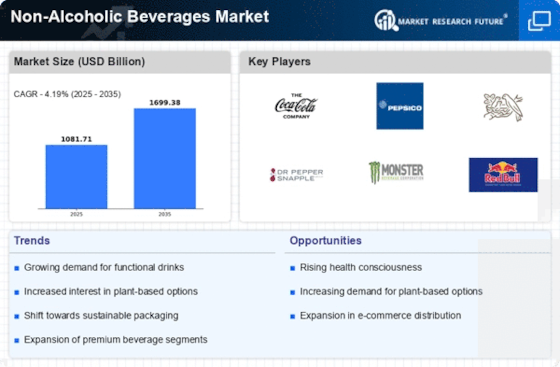
Non Alcoholic Beverages Market Infographic
Purchase Options

Market Share

Non Alcoholic Beverages Market Share Analysis

Acquiring and expanding piece of the pie in the profoundly aggressive non-alcoholic beverages industry is dependent upon the execution of vital situating procedures by organizations. These procedures focus on separation, development, customer commitment, and brand engaging quality with an end goal to lay out an unmistakable character in the midst of the huge swath of drink choices accessible to buyers. Brand separation and novel worth plans are key procedures utilized in the market to stand out for customers and separate oneself from contenders. Instances of such plans might highlight selective incentives that underline regular fixings or useful benefits. Item portfolio expansion and development are basic elements in deciding business sector situating techniques inside the non-alcoholic beverages area. Makers reliably present novel flavours, recipes, and bundling to oblige the developing inclinations of shoppers. By broadening their item contributions to incorporate utilitarian beverages, uncommon flavour mixes, and specialty refreshments, brands can speak to a more extensive scope of customers and get an upper hand on the lookout. Wellbeing and Health Arrangement: Organizations working in the industry decisively position their items as better other options, profiting by the developing interest of wellbeing cognizant shoppers and giving practical advantages, regular fixings, and decreased sugar content. In the domain of non-alcoholic beverages, brands utilize different methodologies like trial marking, online entertainment, and intuitive advertising to encourage customer commitment, develop brand devotion, and empower repeating buys. The idea of moral marking is being assessed for its likely effect on the industry. It includes upholding for maintainability using eco-accommodating bundling, capable obtainment rehearses, and the decrease of natural effect. The extension of piece of the pie is impacted by essential retail and dispersion plans in the industry, which incorporate the execution of differed designs, the fortifying of organizations, and the development of circulation channels. Showcasing Efforts and Brand Noticeable quality: To increment memorability, shopper review, and piece of the pie development, brands in the non-cocktails industry impact viable promoting efforts, powerhouse organizations, supports, and publicizing. Basic achievement factors in industry incorporate brand separation, advancement, wellbeing and health situating, retail and circulation procedures, client commitment, manageability drives, and compelling promoting effort.
Author
Snehal Singh
Assistant Manager - Research

High acumen in analyzing complex macro & micro markets with more than 6 years of work experience in the field of market research. By implementing her analytical skills in forecasting and estimation into market research reports, she has expertise in Packaging, Construction, and Equipment domains. She handles a team size of 20-25 resources and ensures smooth running of the projects, associated marketing activities, and client servicing.

Leave a Comment

FAQs

What is the current valuation of the Non-Alcoholic Beverages Market in 2025?

<p>The Non-Alcoholic Beverages Market is valued at approximately 1081.71 USD Billion in 2024.</p>

What is the projected market size for the Non-Alcoholic Beverages Market by 2035?

The market is expected to reach a valuation of 1699.38 USD Billion by 2035.

What is the expected CAGR for the Non-Alcoholic Beverages Market during the forecast period 2025 - 2035?

The expected CAGR for the Non-Alcoholic Beverages Market during 2025 - 2035 is 4.19%.

Which segment of the Non-Alcoholic Beverages Market had the highest valuation in 2024?

In 2024, Carbonated Beverages had the highest valuation at 300.0 USD Billion.

What are the key distribution channels for Non-Alcoholic Beverages?

Key distribution channels include Supermarkets, Convenience Stores, and Online Retail, with Supermarkets valued at 432.51 USD Billion in 2024.

Who are the leading players in the Non-Alcoholic Beverages Market?

Leading players include Coca-Cola, PepsiCo, and Nestle, among others.

What is the projected growth for the Water segment in the Non-Alcoholic Beverages Market?

The Water segment is projected to grow from 281.71 USD Billion in 2024 to 499.38 USD Billion by 2035.

How does the market for Functional Drinks compare to Juices in 2024?

In 2024, the Functional Drinks segment was valued at 150.0 USD Billion, while Juices were valued at 200.0 USD Billion.

What consumer types are driving the Non-Alcoholic Beverages Market?

Consumer types driving the market include Adults, Health-conscious Consumers, and Athletes, with Adults valued at 432.68 USD Billion in 2024.

What packaging types are prevalent in the Non-Alcoholic Beverages Market?

Prevalent packaging types include Bottles, Cans, and Tetra Packs, with Bottles valued at 400.0 USD Billion in 2024.

Market Summary

As per Market Research Future analysis, the Non-Alcoholic Beverages Market Size was estimated at 1379.76 USD Billion in 2024. The Non-Alcoholic Beverages industry is projected to grow from 1,455.7 USD Billion in 2025 to 2,488.0 USD Billion by 2035, exhibiting a compound annual growth rate (CAGR) of 5.51% during the forecast period 2025 - 2035, strengthening the Non-alcoholic Beverage Industry market share globally.

Key Market Trends & Highlights

The Non-Alcoholic Beverages Market is experiencing a dynamic shift towards health-conscious and sustainable options.

  • The market is increasingly driven by a focus on health and wellness, with consumers seeking beverages that offer functional benefits. Sustainability and ethical sourcing are becoming paramount, influencing product development and consumer choices in North America and Asia-Pacific. Innovation in product offerings, particularly in the carbonated beverages segment, is essential to capture the evolving tastes of consumers. Health consciousness and convenience are major drivers, as seen in the growth of functional drinks and the rise of online retail channels.

Market Size & Forecast

2024 Market Size 1379.76 (USD Billion)
2035 Market Size 1699.38 (USD Billion)
CAGR (2025 - 2035) 5.51%
Largest Regional Market Share in 2024 North America

Major Players

Coca-Cola (US), <a href="https://www.pepsico.com/brands">PepsiCo (US)</a>, Nestle (CH), Dr Pepper Snapple Group (US), Monster Beverage Corporation (US), Red Bull GmbH (AT), Unilever (GB), Kraft Heinz (US), Danone (FR)

Market Trends

The Non-Alcoholic Beverages Market is currently experiencing a dynamic evolution, driven by shifting consumer preferences and an increasing focus on health and wellness, shaping long-term non-alcoholic rtd beverages market trends. As individuals become more health-conscious, there is a noticeable shift towards beverages that offer functional benefits, such as enhanced hydration, vitamins, and minerals. This trend is further supported by a growing demand for natural ingredients, as consumers seek products that align with their lifestyle choices. Additionally, the rise of plant-based and organic options is reshaping the landscape, appealing to a broader audience that values sustainability and ethical sourcing.

Moreover, the Non-Alcoholic Beverages Market is witnessing innovation in product offerings, with brands exploring ready-to-drink formats, reinforcing growth in the non alcoholic rtd beverages market. The emergence of ready-to-drink options and convenient packaging solutions caters to the on-the-go lifestyle prevalent among modern consumers. This adaptability indicates a market that is not only responsive to current trends but also anticipates future demands. As the market continues to evolve, it appears poised for further growth, driven by a combination of health trends, innovative products, and changing consumer behaviors.

Health and Wellness Focus

There is a growing emphasis on health and wellness within the Non-Alcoholic Beverages Market. Consumers increasingly prefer drinks that provide functional benefits, such as hydration, vitamins, and minerals, reflecting a broader trend towards healthier lifestyles.

Sustainability and Ethical Sourcing

Sustainability is becoming a key consideration for consumers in the Non-Alcoholic Beverages Market. The demand for organic and plant-based options is rising, as individuals seek products that align with their values regarding environmental impact and ethical sourcing.

Innovation in Product Offerings

Innovation plays a crucial role in the Non-Alcoholic Beverages Market, with brands introducing unique flavors and convenient formats, including developments within the non-alcoholic beverage packaging market.

Non Alcoholic Beverages Market Market Drivers

Health Consciousness

The increasing awareness of health and wellness among consumers appears to be a primary driver of the Non-alcoholic beverages Market. As individuals become more health-conscious, they tend to seek alternatives to sugary and alcoholic drinks. This shift is reflected in the rising demand for beverages that are low in sugar, organic, and fortified with vitamins and minerals. According to recent data, the market for health-oriented non-alcoholic beverages is projected to grow significantly, with a compound annual growth rate (CAGR) of approximately 8% over the next five years. This trend suggests that manufacturers are likely to innovate and expand their product lines to cater to this growing segment, thereby enhancing their market presence.

Diverse Flavor Profiles

The demand for diverse and unique flavor profiles is reshaping the Non-Alcoholic Beverages Market. Consumers are increasingly seeking novel taste experiences, prompting manufacturers to experiment with exotic ingredients and innovative flavor combinations. This trend is particularly evident in the rise of craft sodas, flavored waters, and herbal teas, which cater to adventurous palates. Market data indicates that beverages featuring unique flavors are gaining traction, with sales in this category expected to rise by over 10% in the coming years. This suggests that companies focusing on flavor innovation may capture a larger share of the market, appealing to consumers looking for alternatives to traditional offerings.

Sustainability Initiatives

Sustainability has emerged as a crucial factor influencing consumer choices in the Non-Alcoholic Beverages Market. As environmental concerns gain traction, consumers increasingly prefer brands that demonstrate a commitment to sustainable practices. This includes the use of eco-friendly packaging, responsible sourcing of ingredients, and transparent supply chains. Companies that adopt sustainable practices not only appeal to environmentally conscious consumers but also position themselves favorably in a competitive market. Recent statistics indicate that brands emphasizing sustainability have seen a notable increase in sales, suggesting that this trend is likely to continue shaping the industry landscape. The integration of sustainability into business models may also lead to long-term cost savings and enhanced brand loyalty.

Convenience and On-the-Go Consumption

The fast-paced lifestyle of modern consumers is driving the demand for convenience in the Non-Alcoholic Beverages Market. As individuals seek quick and easy options, ready-to-drink beverages are becoming increasingly popular. This trend is reflected in the growth of single-serve packaging and portable formats, which cater to on-the-go consumption. Recent market analysis shows that the ready-to-drink segment is expected to witness a CAGR of around 7% over the next few years. This indicates that companies focusing on convenience-oriented products may find substantial opportunities for growth, as they align with the evolving preferences of busy consumers.

Digital Marketing and E-commerce Growth

The rise of digital marketing and e-commerce platforms is transforming the Non-Alcoholic Beverages Market. As consumers increasingly turn to online shopping, brands are leveraging digital channels to reach their target audiences more effectively. This shift has led to a surge in direct-to-consumer sales, allowing companies to build stronger relationships with their customers. Data suggests that e-commerce sales in the non-alcoholic beverage sector are projected to grow by over 15% annually, indicating a significant shift in purchasing behavior. This trend suggests that businesses that invest in digital marketing strategies and enhance their online presence may gain a competitive edge in the market.

Market Segment Insights

By Type: Carbonated Beverages (Largest) vs. Functional Drinks (Fastest-Growing)

In the Non-Alcoholic Beverages Market, the distribution of market share among different types reveals carbonated beverages as the largest segment, reflecting their longstanding popularity among consumers. Juices and dairy-based drinks also hold substantial shares, but the dynamic landscape is increasingly influenced by the rise of functional drinks, which cater to health-conscious consumers. Water remains a significant staple, buoyed by the demand for hydration solutions in various forms.<br>Looking at growth trends, functional drinks and ready-to-drink formats are rapidly gaining traction, highlighting opportunities across the non-alcoholic rtd beverages market. Innovations in flavors and formulations, such as enhanced vitamins and herbal ingredients, are fueling this surge. Conversely, carbonated beverages, while still dominant, face challenges from changing consumer preferences, leading to an overall shift towards more functional and health-oriented drink options.

Carbonated Beverages: Dominant vs. Functional Drinks: Emerging

Carbonated beverages have long dominated the Non-Alcoholic Beverages Market, characterized by their wide appeal and diverse flavor offerings, appealing to various demographics. Brands within this segment invest heavily in marketing and flavor innovation to retain consumer interest. In contrast, functional drinks have emerged as a significant player, targeting health-conscious consumers with products that provide additional health benefits, such as energy boosts, digestive aids, and hydration solutions. As awareness of health and wellness increases, functional drinks are positioned to capture a growing segment of the market, reflecting changing consumer demands toward more purposeful choices.

By Distribution Channel: Supermarkets (Largest) vs. Online Retail (Fastest-Growing)

In the Non-Alcoholic Beverages Market, supermarkets dominate the distribution channel landscape, capturing a significant share of consumer purchases. Their widespread presence and comprehensive product range make them a primary shopping destination for non-alcoholic beverages. In contrast, online retail has gained remarkable traction, increasingly appealing to tech-savvy consumers who value convenience and accessibility. This shift is reshaping consumer behavior and patterns in the beverage purchase process.<br>The growth trends in this sector are underscored by the rising preference for online shopping and convenient formats, strengthening the non-alcoholic beverage industry market share across channels. Additionally, product variety and competitive pricing strategies in online retail are fuelling its expansion. Meanwhile, supermarkets continue to leverage their physical presence and promotional strategies to maintain their dominant position while gradually enhancing their capabilities in the online realm.

Supermarkets (Dominant) vs. Convenience Stores (Emerging)

Supermarkets are recognized as the dominant force within the Non-Alcoholic Beverages Market distribution channels, offering a vast array of products that cater to diverse consumer preferences. Their ability to negotiate favorable supplier terms and provide discounts enhances their attractiveness to price-sensitive consumers. On the other hand, convenience stores are emerging as an essential segment, capitalizing on the increasing trend of on-the-go consumption. Located strategically for ready access, they are well-positioned to capture impulse purchases. While convenience stores may not match supermarkets in assortment, their focus on quick service and specialized offerings allows them to carve a niche catering to busy consumers seeking immediate refreshment.

By Consumer Type: Adults (Largest) vs. Health-conscious Consumers (Fastest-Growing)

In the Non-Alcoholic Beverages Market, adults represent the largest consumer segment, driven by their diverse preferences ranging from soft drinks to premium juices. This demographic shows a strong inclination towards convenience and brand loyalty, significantly influencing market trends. Children and teenagers follow behind, collectively making up a robust market share as they are also major consumers of flavored and sugary beverages, although their segment growth is comparatively stable.

Adults: Dominant vs. Health-conscious Consumers: Emerging

Adults in the Non-Alcoholic Beverages Market dominate consumption trends with their preference for a wide variety of beverages, including sodas, juices, and flavored waters. Their purchasing power and brand loyalty play crucial roles in shaping product offerings and marketing strategies. In contrast, health-conscious consumers are emerging as a significant segment, prioritizing functional and low-calorie beverages. This group is increasingly drawn to organic and natural options, reflecting a broader shift towards healthier lifestyles. Brands are rapidly innovating to cater to this trend, offering enhanced beverages that support wellness, ultimately reshaping the market landscape.

By Packaging Type: Bottles (Largest) vs. Cans (Fastest-Growing)

In the Non-Alcoholic Beverages Market, packaging types are crucial in shaping consumer preferences and distribution efficiency. Bottles hold the largest market share, leveraging their versatility and appeal in various beverage categories, especially in premium segments. Cans, while smaller in share compared to bottles, are rapidly gaining traction due to their convenience and eco-friendly recycling capabilities. The growth trends in this segment are driven by changing consumer habits, with a noticeable shift towards on-the-go options, increasing the popularity of cans. Additionally, the environmental concerns surrounding plastic waste are propelling manufacturers to innovate with sustainable materials, enhancing the attractiveness of cans. This evolution highlights a dynamic competitive landscape as brands seek to balance consumer preferences with sustainability initiatives.

Bottles (Dominant) vs. Pouches (Emerging)

Bottles are currently the dominant packaging type in the Non-Alcoholic Beverages Market, celebrated for their ability to maintain product integrity and facilitate branding through distinctive shapes and labels. They are particularly favored in categories like juices and smoothies, where visual appeal is paramount. On the other hand, pouches are an emerging trend, especially in the children’s beverage segment, where portability and ease of use are essential. Pouches offer a lightweight and space-efficient alternative, capturing the attention of manufacturers aiming to target younger audiences. The increasing focus on convenience and reduced environmental impact is prompting brands to explore pouches as a viable option, indicating strong potential for growth in this category.

Get more detailed insights about Non Alcoholic Beverages Market Research Report-Forecast to 2035

Regional Insights

The Non-Alcoholic Beverages Market showcases a diverse range of regional dynamics, with North America holding a dominant position, reinforcing the US non-alcoholic beverage market. In 2024, North America, supporting the market share non-alcoholic beverage industry is valued at 350.0 USD billion, making it a dominant player due to its advanced retail infrastructure and high consumer demand for health-oriented beverages.

Europe follows closely, with strong demand from countries such as the United Kingdom, supporting the united kingdom non-alcoholic beverages market.

Meanwhile, Asia Pacific is witnessing rapid growth propelled by changing lifestyle trends and an expanding middle class, including rising demand in the non-alcoholic beverages market in India. 

South America, with a market value of 100.0 USD billion, is significant for its unique flavors and local beverages, while the Middle East and Africa, valued at 72.89 USD billion, are experiencing growth due to increasing urbanization and rising disposable incomes.

Each region presents distinct opportunities, from the health-conscious consumers in North America to the emerging markets in Asia Pacific, emphasizing the diverse landscape within the Non-Alcoholic Beverages Market revenue.

With rising awareness about health and wellness globally, coupled with innovative product offerings, the market is poised for steady growth in various segments.

Key Players and Competitive Insights

This sector encompasses a wide range of products, all competing for non-alcoholic beverage market share in an increasingly competitive global environment. Major players continue to invest in innovation and distribution to strengthen their non-alcoholic beverage industry market share. This sector encompasses a wide range of products, including soft drinks, bottled waters, juices, teas, and energy drinks, all competing for market share. Growing health awareness and shifts towards healthier beverage options are reshaping the landscape, prompting companies to innovate and diversify their offerings.The market is influenced by numerous factors, including shifting demographics, changing lifestyles, and increasing demand for convenient and on-the-go options. As the competition heats up, brand loyalty and effective marketing strategies become pivotal for companies striving to maintain or grow their presence in this global marketplace.

Britvic has established itself as a key player within the Non-Alcoholic Beverages Market by focusing on innovation, sustainability, and premiumization strategies.The company is particularly recognized for its wide array of products that cater to health-conscious consumers, including low-sugar and no-sugar beverages.Britvic's ability to adapt to changing market trends and consumer preferences serves as one of its notable strengths, along with a strong emphasis on marketing and promotional strategies that resonate with target demographics.The company effectively utilizes consumer insights to enhance product development, ensuring that its offerings remain relevant in a competitive landscape. Additionally, Britvic's commitment to sustainability and environmental responsibility bolsters its brand reputation and appeal in a market increasingly driven by eco-conscious choices.

PepsiCo stands out in the Non-Alcoholic Beverages Market with its expansive portfolio of well-known brands and innovative product offerings.The company is renowned for key products such as carbonated soft drinks, juices, bottled water, and energy beverages, which cater to diverse consumer preferences across various demographics.PepsiCo's strengths lie in its extensive distribution network and strong global presence, enabling it to reach consumers worldwide effectively.The company's commitment to innovation is reflected in its continuous investment in research and development, resulting in the introduction of new flavors and health-focused beverage options.Furthermore, PepsiCo has made significant strides in strategic mergers and acquisitions, enhancing its market position and expanding its product range.This adaptability and forward-thinking approach have solidified PepsiCo's status as a leader in the global non-alcoholic beverage segment, allowing it to respond robustly to market changes and consumer demands.

Key Companies in the Non Alcoholic Beverages Market include

Industry Developments

The continued rise in functional and ready-to-drink beverages highlights strategic expansion across the non-alcoholic rtd beverages market globally. There have been big changes in the Non-Alcoholic Beverages Market lately, especially among major players like PepsiCo, Coca-Cola, and Unilever. PepsiCo said in September 2023 that it had bought a startup that makes health-focused drinks.

This added to the company's wellness product line. At the same time, Coca-Cola kept up its plan to offer more drinks with little or no sugar, like new flavors of Coke Zero Sugar and Vitaminwater. This is because more and more people are looking for healthier options.

In August 2023, Unilever teamed up with a plant-based drink company to offer more non-alcoholic drinks in Europe.

As part of their larger ESG efforts, Nestlé and Kraft Heinz also said that more people were paying attention to sustainable packaging and new organic products through the end of 2023. In the last two years, the market has seen a huge increase in demand for functional drinks like kombucha, probiotic drinks, and ready-to-drink wellness teas.

Brands like KeVita (a PepsiCo brand) and Vitaminwater (a Coca-Cola brand) have come up with new products that focus on immunity, hydration, and energy. These products have become popular in small groups of health-conscious people.

These changes show that the industry is clearly moving toward health, sustainability, and new products. To stay competitive in a constantly changing global market, companies are putting a lot of money into research and development and adapting their supply chains.

Future Outlook

Non Alcoholic Beverages Market Future Outlook

The Non-Alcoholic Beverages Market is projected to grow at a 5.51% CAGR from 2025 to 2035, driven by health trends, innovation, and sustainability initiatives, contributing to rising non-alcoholic beverage market share worldwide.

New opportunities lie in:

  • <p>Expansion of plant-based beverage lines Development of personalized nutrition drinks Investment in eco-friendly packaging solutions</p>

By 2035, the market is expected to be robust, reflecting evolving consumer preferences and sustainable practices.

Market Segmentation

Non Alcoholic Beverages Market Type Outlook

  • Carbonated Beverages
  • Juices
  • Functional Drinks
  • Dairy-based Drinks
  • Water

Non Alcoholic Beverages Market Consumer Type Outlook

  • Adults
  • Children
  • Teenagers
  • Health-conscious Consumers
  • Athletes

Non Alcoholic Beverages Market Packaging Type Outlook

  • Bottles
  • Cans
  • Pouches
  • Tetra Packs

Non Alcoholic Beverages Market Distribution Channel Outlook

  • Supermarkets
  • Convenience Stores
  • Online Retail
  • Specialty Stores
  • Food Service

Report Scope

MARKET SIZE 2024 1379.76(USD Billion)
MARKET SIZE 2025 1,455.7(USD Billion)
MARKET SIZE 2035 2,488.0(USD Billion)
COMPOUND ANNUAL GROWTH RATE (CAGR)  5.51% (2025 - 2035)
REPORT COVERAGE Revenue Forecast, Competitive Landscape, Growth Factors, and Trends
BASE YEAR 2024
Market Forecast Period 2025 - 2035
Historical Data 2019 - 2024
Market Forecast Units USD Billion
Key Companies Profiled Coca-Cola (US), PepsiCo (US), Nestle (CH), Dr Pepper Snapple Group (US), Monster Beverage Corporation (US), Red Bull GmbH (AT), Unilever (GB), Kraft Heinz (US), Danone (FR)
Segments Covered Product Type, Distribution Channel, Consumer Type, Packaging Type, Regional
Key Market Opportunities Growing demand for health-conscious, functional beverages presents opportunities in the Non-Alcoholic Beverages Market.
Key Market Dynamics Shifting consumer preferences towards healthier options drive innovation and competition in the global non-alcoholic beverage market size.
Countries Covered North America, Europe, APAC, South America, MEA

FAQs

What is the current valuation of the Non-Alcoholic Beverages Market in 2025?

<p>The Non-Alcoholic Beverages Market is valued at approximately 1081.71 USD Billion in 2024.</p>

What is the projected market size for the Non-Alcoholic Beverages Market by 2035?

The market is expected to reach a valuation of 1699.38 USD Billion by 2035.

What is the expected CAGR for the Non-Alcoholic Beverages Market during the forecast period 2025 - 2035?

The expected CAGR for the Non-Alcoholic Beverages Market during 2025 - 2035 is 4.19%.

Which segment of the Non-Alcoholic Beverages Market had the highest valuation in 2024?

In 2024, Carbonated Beverages had the highest valuation at 300.0 USD Billion.

What are the key distribution channels for Non-Alcoholic Beverages?

Key distribution channels include Supermarkets, Convenience Stores, and Online Retail, with Supermarkets valued at 432.51 USD Billion in 2024.

Who are the leading players in the Non-Alcoholic Beverages Market?

Leading players include Coca-Cola, PepsiCo, and Nestle, among others.

What is the projected growth for the Water segment in the Non-Alcoholic Beverages Market?

The Water segment is projected to grow from 281.71 USD Billion in 2024 to 499.38 USD Billion by 2035.

How does the market for Functional Drinks compare to Juices in 2024?

In 2024, the Functional Drinks segment was valued at 150.0 USD Billion, while Juices were valued at 200.0 USD Billion.

What consumer types are driving the Non-Alcoholic Beverages Market?

Consumer types driving the market include Adults, Health-conscious Consumers, and Athletes, with Adults valued at 432.68 USD Billion in 2024.

What packaging types are prevalent in the Non-Alcoholic Beverages Market?

Prevalent packaging types include Bottles, Cans, and Tetra Packs, with Bottles valued at 400.0 USD Billion in 2024.

  1. SECTION I: EXECUTIVE SUMMARY AND KEY HIGHLIGHTS
    1. | 1.1 EXECUTIVE SUMMARY
    2. | | 1.1.1 Market Overview
    3. | | 1.1.2 Key Findings
    4. | | 1.1.3 Market Segmentation
    5. | | 1.1.4 Competitive Landscape
    6. | | 1.1.5 Challenges and Opportunities
    7. | | 1.1.6 Future Outlook
  2. SECTION II: SCOPING, METHODOLOGY AND MARKET STRUCTURE
    1. | 2.1 MARKET INTRODUCTION
    2. | | 2.1.1 Definition
    3. | | 2.1.2 Scope of the study
    4. | | | 2.1.2.1 Research Objective
    5. | | | 2.1.2.2 Assumption
    6. | | | 2.1.2.3 Limitations
    7. | 2.2 RESEARCH METHODOLOGY
    8. | | 2.2.1 Overview
    9. | | 2.2.2 Data Mining
    10. | | 2.2.3 Secondary Research
    11. | | 2.2.4 Primary Research
    12. | | | 2.2.4.1 Primary Interviews and Information Gathering Process
    13. | | | 2.2.4.2 Breakdown of Primary Respondents
    14. | | 2.2.5 Forecasting Model
    15. | | 2.2.6 Market Size Estimation
    16. | | | 2.2.6.1 Bottom-Up Approach
    17. | | | 2.2.6.2 Top-Down Approach
    18. | | 2.2.7 Data Triangulation
    19. | | 2.2.8 Validation
  3. SECTION III: QUALITATIVE ANALYSIS
    1. | 3.1 MARKET DYNAMICS
    2. | | 3.1.1 Overview
    3. | | 3.1.2 Drivers
    4. | | 3.1.3 Restraints
    5. | | 3.1.4 Opportunities
    6. | 3.2 MARKET FACTOR ANALYSIS
    7. | | 3.2.1 Value chain Analysis
    8. | | 3.2.2 Porter's Five Forces Analysis
    9. | | | 3.2.2.1 Bargaining Power of Suppliers
    10. | | | 3.2.2.2 Bargaining Power of Buyers
    11. | | | 3.2.2.3 Threat of New Entrants
    12. | | | 3.2.2.4 Threat of Substitutes
    13. | | | 3.2.2.5 Intensity of Rivalry
    14. | | 3.2.3 COVID-19 Impact Analysis
    15. | | | 3.2.3.1 Market Impact Analysis
    16. | | | 3.2.3.2 Regional Impact
    17. | | | 3.2.3.3 Opportunity and Threat Analysis
  4. SECTION IV: QUANTITATIVE ANALYSIS
    1. | 4.1 Food, Beverages & Nutrition, BY Type (USD Billion)
    2. | | 4.1.1 Carbonated Beverages
    3. | | 4.1.2 Juices
    4. | | 4.1.3 Functional Drinks
    5. | | 4.1.4 Dairy-based Drinks
    6. | | 4.1.5 Water
    7. | 4.2 Food, Beverages & Nutrition, BY Distribution Channel (USD Billion)
    8. | | 4.2.1 Supermarkets
    9. | | 4.2.2 Convenience Stores
    10. | | 4.2.3 Online Retail
    11. | | 4.2.4 Specialty Stores
    12. | | 4.2.5 Food Service
    13. | 4.3 Food, Beverages & Nutrition, BY Consumer Type (USD Billion)
    14. | | 4.3.1 Adults
    15. | | 4.3.2 Children
    16. | | 4.3.3 Teenagers
    17. | | 4.3.4 Health-conscious Consumers
    18. | | 4.3.5 Athletes
    19. | 4.4 Food, Beverages & Nutrition, BY Packaging Type (USD Billion)
    20. | | 4.4.1 Bottles
    21. | | 4.4.2 Cans
    22. | | 4.4.3 Pouches
    23. | | 4.4.4 Tetra Packs
    24. | 4.5 Food, Beverages & Nutrition, BY Region (USD Billion)
    25. | | 4.5.1 North America
    26. | | | 4.5.1.1 US
    27. | | | 4.5.1.2 Canada
    28. | | 4.5.2 Europe
    29. | | | 4.5.2.1 Germany
    30. | | | 4.5.2.2 UK
    31. | | | 4.5.2.3 France
    32. | | | 4.5.2.4 Russia
    33. | | | 4.5.2.5 Italy
    34. | | | 4.5.2.6 Spain
    35. | | | 4.5.2.7 Rest of Europe
    36. | | 4.5.3 APAC
    37. | | | 4.5.3.1 China
    38. | | | 4.5.3.2 India
    39. | | | 4.5.3.3 Japan
    40. | | | 4.5.3.4 South Korea
    41. | | | 4.5.3.5 Malaysia
    42. | | | 4.5.3.6 Thailand
    43. | | | 4.5.3.7 Indonesia
    44. | | | 4.5.3.8 Rest of APAC
    45. | | 4.5.4 South America
    46. | | | 4.5.4.1 Brazil
    47. | | | 4.5.4.2 Mexico
    48. | | | 4.5.4.3 Argentina
    49. | | | 4.5.4.4 Rest of South America
    50. | | 4.5.5 MEA
    51. | | | 4.5.5.1 GCC Countries
    52. | | | 4.5.5.2 South Africa
    53. | | | 4.5.5.3 Rest of MEA
  5. SECTION V: COMPETITIVE ANALYSIS
    1. | 5.1 Competitive Landscape
    2. | | 5.1.1 Overview
    3. | | 5.1.2 Competitive Analysis
    4. | | 5.1.3 Market share Analysis
    5. | | 5.1.4 Major Growth Strategy in the Food, Beverages & Nutrition
    6. | | 5.1.5 Competitive Benchmarking
    7. | | 5.1.6 Leading Players in Terms of Number of Developments in the Food, Beverages & Nutrition
    8. | | 5.1.7 Key developments and growth strategies
    9. | | | 5.1.7.1 New Product Launch/Service Deployment
    10. | | | 5.1.7.2 Merger & Acquisitions
    11. | | | 5.1.7.3 Joint Ventures
    12. | | 5.1.8 Major Players Financial Matrix
    13. | | | 5.1.8.1 Sales and Operating Income
    14. | | | 5.1.8.2 Major Players R&D Expenditure. 2023
    15. | 5.2 Company Profiles
    16. | | 5.2.1 Coca-Cola (US)
    17. | | | 5.2.1.1 Financial Overview
    18. | | | 5.2.1.2 Products Offered
    19. | | | 5.2.1.3 Key Developments
    20. | | | 5.2.1.4 SWOT Analysis
    21. | | | 5.2.1.5 Key Strategies
    22. | | 5.2.2 PepsiCo (US)
    23. | | | 5.2.2.1 Financial Overview
    24. | | | 5.2.2.2 Products Offered
    25. | | | 5.2.2.3 Key Developments
    26. | | | 5.2.2.4 SWOT Analysis
    27. | | | 5.2.2.5 Key Strategies
    28. | | 5.2.3 Nestle (CH)
    29. | | | 5.2.3.1 Financial Overview
    30. | | | 5.2.3.2 Products Offered
    31. | | | 5.2.3.3 Key Developments
    32. | | | 5.2.3.4 SWOT Analysis
    33. | | | 5.2.3.5 Key Strategies
    34. | | 5.2.4 Dr Pepper Snapple Group (US)
    35. | | | 5.2.4.1 Financial Overview
    36. | | | 5.2.4.2 Products Offered
    37. | | | 5.2.4.3 Key Developments
    38. | | | 5.2.4.4 SWOT Analysis
    39. | | | 5.2.4.5 Key Strategies
    40. | | 5.2.5 Monster Beverage Corporation (US)
    41. | | | 5.2.5.1 Financial Overview
    42. | | | 5.2.5.2 Products Offered
    43. | | | 5.2.5.3 Key Developments
    44. | | | 5.2.5.4 SWOT Analysis
    45. | | | 5.2.5.5 Key Strategies
    46. | | 5.2.6 Red Bull GmbH (AT)
    47. | | | 5.2.6.1 Financial Overview
    48. | | | 5.2.6.2 Products Offered
    49. | | | 5.2.6.3 Key Developments
    50. | | | 5.2.6.4 SWOT Analysis
    51. | | | 5.2.6.5 Key Strategies
    52. | | 5.2.7 Unilever (GB)
    53. | | | 5.2.7.1 Financial Overview
    54. | | | 5.2.7.2 Products Offered
    55. | | | 5.2.7.3 Key Developments
    56. | | | 5.2.7.4 SWOT Analysis
    57. | | | 5.2.7.5 Key Strategies
    58. | | 5.2.8 Kraft Heinz (US)
    59. | | | 5.2.8.1 Financial Overview
    60. | | | 5.2.8.2 Products Offered
    61. | | | 5.2.8.3 Key Developments
    62. | | | 5.2.8.4 SWOT Analysis
    63. | | | 5.2.8.5 Key Strategies
    64. | | 5.2.9 Danone (FR)
    65. | | | 5.2.9.1 Financial Overview
    66. | | | 5.2.9.2 Products Offered
    67. | | | 5.2.9.3 Key Developments
    68. | | | 5.2.9.4 SWOT Analysis
    69. | | | 5.2.9.5 Key Strategies
    70. | 5.3 Appendix
    71. | | 5.3.1 References
    72. | | 5.3.2 Related Reports
  6. LIST OF FIGURES
    1. | 6.1 MARKET SYNOPSIS
    2. | 6.2 NORTH AMERICA MARKET ANALYSIS
    3. | 6.3 US MARKET ANALYSIS BY TYPE
    4. | 6.4 US MARKET ANALYSIS BY DISTRIBUTION CHANNEL
    5. | 6.5 US MARKET ANALYSIS BY CONSUMER TYPE
    6. | 6.6 US MARKET ANALYSIS BY PACKAGING TYPE
    7. | 6.7 CANADA MARKET ANALYSIS BY TYPE
    8. | 6.8 CANADA MARKET ANALYSIS BY DISTRIBUTION CHANNEL
    9. | 6.9 CANADA MARKET ANALYSIS BY CONSUMER TYPE
    10. | 6.10 CANADA MARKET ANALYSIS BY PACKAGING TYPE
    11. | 6.11 EUROPE MARKET ANALYSIS
    12. | 6.12 GERMANY MARKET ANALYSIS BY TYPE
    13. | 6.13 GERMANY MARKET ANALYSIS BY DISTRIBUTION CHANNEL
    14. | 6.14 GERMANY MARKET ANALYSIS BY CONSUMER TYPE
    15. | 6.15 GERMANY MARKET ANALYSIS BY PACKAGING TYPE
    16. | 6.16 UK MARKET ANALYSIS BY TYPE
    17. | 6.17 UK MARKET ANALYSIS BY DISTRIBUTION CHANNEL
    18. | 6.18 UK MARKET ANALYSIS BY CONSUMER TYPE
    19. | 6.19 UK MARKET ANALYSIS BY PACKAGING TYPE
    20. | 6.20 FRANCE MARKET ANALYSIS BY TYPE
    21. | 6.21 FRANCE MARKET ANALYSIS BY DISTRIBUTION CHANNEL
    22. | 6.22 FRANCE MARKET ANALYSIS BY CONSUMER TYPE
    23. | 6.23 FRANCE MARKET ANALYSIS BY PACKAGING TYPE
    24. | 6.24 RUSSIA MARKET ANALYSIS BY TYPE
    25. | 6.25 RUSSIA MARKET ANALYSIS BY DISTRIBUTION CHANNEL
    26. | 6.26 RUSSIA MARKET ANALYSIS BY CONSUMER TYPE
    27. | 6.27 RUSSIA MARKET ANALYSIS BY PACKAGING TYPE
    28. | 6.28 ITALY MARKET ANALYSIS BY TYPE
    29. | 6.29 ITALY MARKET ANALYSIS BY DISTRIBUTION CHANNEL
    30. | 6.30 ITALY MARKET ANALYSIS BY CONSUMER TYPE
    31. | 6.31 ITALY MARKET ANALYSIS BY PACKAGING TYPE
    32. | 6.32 SPAIN MARKET ANALYSIS BY TYPE
    33. | 6.33 SPAIN MARKET ANALYSIS BY DISTRIBUTION CHANNEL
    34. | 6.34 SPAIN MARKET ANALYSIS BY CONSUMER TYPE
    35. | 6.35 SPAIN MARKET ANALYSIS BY PACKAGING TYPE
    36. | 6.36 REST OF EUROPE MARKET ANALYSIS BY TYPE
    37. | 6.37 REST OF EUROPE MARKET ANALYSIS BY DISTRIBUTION CHANNEL
    38. | 6.38 REST OF EUROPE MARKET ANALYSIS BY CONSUMER TYPE
    39. | 6.39 REST OF EUROPE MARKET ANALYSIS BY PACKAGING TYPE
    40. | 6.40 APAC MARKET ANALYSIS
    41. | 6.41 CHINA MARKET ANALYSIS BY TYPE
    42. | 6.42 CHINA MARKET ANALYSIS BY DISTRIBUTION CHANNEL
    43. | 6.43 CHINA MARKET ANALYSIS BY CONSUMER TYPE
    44. | 6.44 CHINA MARKET ANALYSIS BY PACKAGING TYPE
    45. | 6.45 INDIA MARKET ANALYSIS BY TYPE
    46. | 6.46 INDIA MARKET ANALYSIS BY DISTRIBUTION CHANNEL
    47. | 6.47 INDIA MARKET ANALYSIS BY CONSUMER TYPE
    48. | 6.48 INDIA MARKET ANALYSIS BY PACKAGING TYPE
    49. | 6.49 JAPAN MARKET ANALYSIS BY TYPE
    50. | 6.50 JAPAN MARKET ANALYSIS BY DISTRIBUTION CHANNEL
    51. | 6.51 JAPAN MARKET ANALYSIS BY CONSUMER TYPE
    52. | 6.52 JAPAN MARKET ANALYSIS BY PACKAGING TYPE
    53. | 6.53 SOUTH KOREA MARKET ANALYSIS BY TYPE
    54. | 6.54 SOUTH KOREA MARKET ANALYSIS BY DISTRIBUTION CHANNEL
    55. | 6.55 SOUTH KOREA MARKET ANALYSIS BY CONSUMER TYPE
    56. | 6.56 SOUTH KOREA MARKET ANALYSIS BY PACKAGING TYPE
    57. | 6.57 MALAYSIA MARKET ANALYSIS BY TYPE
    58. | 6.58 MALAYSIA MARKET ANALYSIS BY DISTRIBUTION CHANNEL
    59. | 6.59 MALAYSIA MARKET ANALYSIS BY CONSUMER TYPE
    60. | 6.60 MALAYSIA MARKET ANALYSIS BY PACKAGING TYPE
    61. | 6.61 THAILAND MARKET ANALYSIS BY TYPE
    62. | 6.62 THAILAND MARKET ANALYSIS BY DISTRIBUTION CHANNEL
    63. | 6.63 THAILAND MARKET ANALYSIS BY CONSUMER TYPE
    64. | 6.64 THAILAND MARKET ANALYSIS BY PACKAGING TYPE
    65. | 6.65 INDONESIA MARKET ANALYSIS BY TYPE
    66. | 6.66 INDONESIA MARKET ANALYSIS BY DISTRIBUTION CHANNEL
    67. | 6.67 INDONESIA MARKET ANALYSIS BY CONSUMER TYPE
    68. | 6.68 INDONESIA MARKET ANALYSIS BY PACKAGING TYPE
    69. | 6.69 REST OF APAC MARKET ANALYSIS BY TYPE
    70. | 6.70 REST OF APAC MARKET ANALYSIS BY DISTRIBUTION CHANNEL
    71. | 6.71 REST OF APAC MARKET ANALYSIS BY CONSUMER TYPE
    72. | 6.72 REST OF APAC MARKET ANALYSIS BY PACKAGING TYPE
    73. | 6.73 SOUTH AMERICA MARKET ANALYSIS
    74. | 6.74 BRAZIL MARKET ANALYSIS BY TYPE
    75. | 6.75 BRAZIL MARKET ANALYSIS BY DISTRIBUTION CHANNEL
    76. | 6.76 BRAZIL MARKET ANALYSIS BY CONSUMER TYPE
    77. | 6.77 BRAZIL MARKET ANALYSIS BY PACKAGING TYPE
    78. | 6.78 MEXICO MARKET ANALYSIS BY TYPE
    79. | 6.79 MEXICO MARKET ANALYSIS BY DISTRIBUTION CHANNEL
    80. | 6.80 MEXICO MARKET ANALYSIS BY CONSUMER TYPE
    81. | 6.81 MEXICO MARKET ANALYSIS BY PACKAGING TYPE
    82. | 6.82 ARGENTINA MARKET ANALYSIS BY TYPE
    83. | 6.83 ARGENTINA MARKET ANALYSIS BY DISTRIBUTION CHANNEL
    84. | 6.84 ARGENTINA MARKET ANALYSIS BY CONSUMER TYPE
    85. | 6.85 ARGENTINA MARKET ANALYSIS BY PACKAGING TYPE
    86. | 6.86 REST OF SOUTH AMERICA MARKET ANALYSIS BY TYPE
    87. | 6.87 REST OF SOUTH AMERICA MARKET ANALYSIS BY DISTRIBUTION CHANNEL
    88. | 6.88 REST OF SOUTH AMERICA MARKET ANALYSIS BY CONSUMER TYPE
    89. | 6.89 REST OF SOUTH AMERICA MARKET ANALYSIS BY PACKAGING TYPE
    90. | 6.90 MEA MARKET ANALYSIS
    91. | 6.91 GCC COUNTRIES MARKET ANALYSIS BY TYPE
    92. | 6.92 GCC COUNTRIES MARKET ANALYSIS BY DISTRIBUTION CHANNEL
    93. | 6.93 GCC COUNTRIES MARKET ANALYSIS BY CONSUMER TYPE
    94. | 6.94 GCC COUNTRIES MARKET ANALYSIS BY PACKAGING TYPE
    95. | 6.95 SOUTH AFRICA MARKET ANALYSIS BY TYPE
    96. | 6.96 SOUTH AFRICA MARKET ANALYSIS BY DISTRIBUTION CHANNEL
    97. | 6.97 SOUTH AFRICA MARKET ANALYSIS BY CONSUMER TYPE
    98. | 6.98 SOUTH AFRICA MARKET ANALYSIS BY PACKAGING TYPE
    99. | 6.99 REST OF MEA MARKET ANALYSIS BY TYPE
    100. | 6.100 REST OF MEA MARKET ANALYSIS BY DISTRIBUTION CHANNEL
    101. | 6.101 REST OF MEA MARKET ANALYSIS BY CONSUMER TYPE
    102. | 6.102 REST OF MEA MARKET ANALYSIS BY PACKAGING TYPE
    103. | 6.103 KEY BUYING CRITERIA OF FOOD, BEVERAGES & NUTRITION
    104. | 6.104 RESEARCH PROCESS OF MRFR
    105. | 6.105 DRO ANALYSIS OF FOOD, BEVERAGES & NUTRITION
    106. | 6.106 DRIVERS IMPACT ANALYSIS: FOOD, BEVERAGES & NUTRITION
    107. | 6.107 RESTRAINTS IMPACT ANALYSIS: FOOD, BEVERAGES & NUTRITION
    108. | 6.108 SUPPLY / VALUE CHAIN: FOOD, BEVERAGES & NUTRITION
    109. | 6.109 FOOD, BEVERAGES & NUTRITION, BY TYPE, 2024 (% SHARE)
    110. | 6.110 FOOD, BEVERAGES & NUTRITION, BY TYPE, 2024 TO 2035 (USD Billion)
    111. | 6.111 FOOD, BEVERAGES & NUTRITION, BY DISTRIBUTION CHANNEL, 2024 (% SHARE)
    112. | 6.112 FOOD, BEVERAGES & NUTRITION, BY DISTRIBUTION CHANNEL, 2024 TO 2035 (USD Billion)
    113. | 6.113 FOOD, BEVERAGES & NUTRITION, BY CONSUMER TYPE, 2024 (% SHARE)
    114. | 6.114 FOOD, BEVERAGES & NUTRITION, BY CONSUMER TYPE, 2024 TO 2035 (USD Billion)
    115. | 6.115 FOOD, BEVERAGES & NUTRITION, BY PACKAGING TYPE, 2024 (% SHARE)
    116. | 6.116 FOOD, BEVERAGES & NUTRITION, BY PACKAGING TYPE, 2024 TO 2035 (USD Billion)
    117. | 6.117 BENCHMARKING OF MAJOR COMPETITORS
  7. LIST OF TABLES
    1. | 7.1 LIST OF ASSUMPTIONS
    2. | | 7.1.1
    3. | 7.2 North America MARKET SIZE ESTIMATES; FORECAST
    4. | | 7.2.1 BY TYPE, 2025-2035 (USD Billion)
    5. | | 7.2.2 BY DISTRIBUTION CHANNEL, 2025-2035 (USD Billion)
    6. | | 7.2.3 BY CONSUMER TYPE, 2025-2035 (USD Billion)
    7. | | 7.2.4 BY PACKAGING TYPE, 2025-2035 (USD Billion)
    8. | 7.3 US MARKET SIZE ESTIMATES; FORECAST
    9. | | 7.3.1 BY TYPE, 2025-2035 (USD Billion)
    10. | | 7.3.2 BY DISTRIBUTION CHANNEL, 2025-2035 (USD Billion)
    11. | | 7.3.3 BY CONSUMER TYPE, 2025-2035 (USD Billion)
    12. | | 7.3.4 BY PACKAGING TYPE, 2025-2035 (USD Billion)
    13. | 7.4 Canada MARKET SIZE ESTIMATES; FORECAST
    14. | | 7.4.1 BY TYPE, 2025-2035 (USD Billion)
    15. | | 7.4.2 BY DISTRIBUTION CHANNEL, 2025-2035 (USD Billion)
    16. | | 7.4.3 BY CONSUMER TYPE, 2025-2035 (USD Billion)
    17. | | 7.4.4 BY PACKAGING TYPE, 2025-2035 (USD Billion)
    18. | 7.5 Europe MARKET SIZE ESTIMATES; FORECAST
    19. | | 7.5.1 BY TYPE, 2025-2035 (USD Billion)
    20. | | 7.5.2 BY DISTRIBUTION CHANNEL, 2025-2035 (USD Billion)
    21. | | 7.5.3 BY CONSUMER TYPE, 2025-2035 (USD Billion)
    22. | | 7.5.4 BY PACKAGING TYPE, 2025-2035 (USD Billion)
    23. | 7.6 Germany MARKET SIZE ESTIMATES; FORECAST
    24. | | 7.6.1 BY TYPE, 2025-2035 (USD Billion)
    25. | | 7.6.2 BY DISTRIBUTION CHANNEL, 2025-2035 (USD Billion)
    26. | | 7.6.3 BY CONSUMER TYPE, 2025-2035 (USD Billion)
    27. | | 7.6.4 BY PACKAGING TYPE, 2025-2035 (USD Billion)
    28. | 7.7 UK MARKET SIZE ESTIMATES; FORECAST
    29. | | 7.7.1 BY TYPE, 2025-2035 (USD Billion)
    30. | | 7.7.2 BY DISTRIBUTION CHANNEL, 2025-2035 (USD Billion)
    31. | | 7.7.3 BY CONSUMER TYPE, 2025-2035 (USD Billion)
    32. | | 7.7.4 BY PACKAGING TYPE, 2025-2035 (USD Billion)
    33. | 7.8 France MARKET SIZE ESTIMATES; FORECAST
    34. | | 7.8.1 BY TYPE, 2025-2035 (USD Billion)
    35. | | 7.8.2 BY DISTRIBUTION CHANNEL, 2025-2035 (USD Billion)
    36. | | 7.8.3 BY CONSUMER TYPE, 2025-2035 (USD Billion)
    37. | | 7.8.4 BY PACKAGING TYPE, 2025-2035 (USD Billion)
    38. | 7.9 Russia MARKET SIZE ESTIMATES; FORECAST
    39. | | 7.9.1 BY TYPE, 2025-2035 (USD Billion)
    40. | | 7.9.2 BY DISTRIBUTION CHANNEL, 2025-2035 (USD Billion)
    41. | | 7.9.3 BY CONSUMER TYPE, 2025-2035 (USD Billion)
    42. | | 7.9.4 BY PACKAGING TYPE, 2025-2035 (USD Billion)
    43. | 7.10 Italy MARKET SIZE ESTIMATES; FORECAST
    44. | | 7.10.1 BY TYPE, 2025-2035 (USD Billion)
    45. | | 7.10.2 BY DISTRIBUTION CHANNEL, 2025-2035 (USD Billion)
    46. | | 7.10.3 BY CONSUMER TYPE, 2025-2035 (USD Billion)
    47. | | 7.10.4 BY PACKAGING TYPE, 2025-2035 (USD Billion)
    48. | 7.11 Spain MARKET SIZE ESTIMATES; FORECAST
    49. | | 7.11.1 BY TYPE, 2025-2035 (USD Billion)
    50. | | 7.11.2 BY DISTRIBUTION CHANNEL, 2025-2035 (USD Billion)
    51. | | 7.11.3 BY CONSUMER TYPE, 2025-2035 (USD Billion)
    52. | | 7.11.4 BY PACKAGING TYPE, 2025-2035 (USD Billion)
    53. | 7.12 Rest of Europe MARKET SIZE ESTIMATES; FORECAST
    54. | | 7.12.1 BY TYPE, 2025-2035 (USD Billion)
    55. | | 7.12.2 BY DISTRIBUTION CHANNEL, 2025-2035 (USD Billion)
    56. | | 7.12.3 BY CONSUMER TYPE, 2025-2035 (USD Billion)
    57. | | 7.12.4 BY PACKAGING TYPE, 2025-2035 (USD Billion)
    58. | 7.13 APAC MARKET SIZE ESTIMATES; FORECAST
    59. | | 7.13.1 BY TYPE, 2025-2035 (USD Billion)
    60. | | 7.13.2 BY DISTRIBUTION CHANNEL, 2025-2035 (USD Billion)
    61. | | 7.13.3 BY CONSUMER TYPE, 2025-2035 (USD Billion)
    62. | | 7.13.4 BY PACKAGING TYPE, 2025-2035 (USD Billion)
    63. | 7.14 China MARKET SIZE ESTIMATES; FORECAST
    64. | | 7.14.1 BY TYPE, 2025-2035 (USD Billion)
    65. | | 7.14.2 BY DISTRIBUTION CHANNEL, 2025-2035 (USD Billion)
    66. | | 7.14.3 BY CONSUMER TYPE, 2025-2035 (USD Billion)
    67. | | 7.14.4 BY PACKAGING TYPE, 2025-2035 (USD Billion)
    68. | 7.15 India MARKET SIZE ESTIMATES; FORECAST
    69. | | 7.15.1 BY TYPE, 2025-2035 (USD Billion)
    70. | | 7.15.2 BY DISTRIBUTION CHANNEL, 2025-2035 (USD Billion)
    71. | | 7.15.3 BY CONSUMER TYPE, 2025-2035 (USD Billion)
    72. | | 7.15.4 BY PACKAGING TYPE, 2025-2035 (USD Billion)
    73. | 7.16 Japan MARKET SIZE ESTIMATES; FORECAST
    74. | | 7.16.1 BY TYPE, 2025-2035 (USD Billion)
    75. | | 7.16.2 BY DISTRIBUTION CHANNEL, 2025-2035 (USD Billion)
    76. | | 7.16.3 BY CONSUMER TYPE, 2025-2035 (USD Billion)
    77. | | 7.16.4 BY PACKAGING TYPE, 2025-2035 (USD Billion)
    78. | 7.17 South Korea MARKET SIZE ESTIMATES; FORECAST
    79. | | 7.17.1 BY TYPE, 2025-2035 (USD Billion)
    80. | | 7.17.2 BY DISTRIBUTION CHANNEL, 2025-2035 (USD Billion)
    81. | | 7.17.3 BY CONSUMER TYPE, 2025-2035 (USD Billion)
    82. | | 7.17.4 BY PACKAGING TYPE, 2025-2035 (USD Billion)
    83. | 7.18 Malaysia MARKET SIZE ESTIMATES; FORECAST
    84. | | 7.18.1 BY TYPE, 2025-2035 (USD Billion)
    85. | | 7.18.2 BY DISTRIBUTION CHANNEL, 2025-2035 (USD Billion)
    86. | | 7.18.3 BY CONSUMER TYPE, 2025-2035 (USD Billion)
    87. | | 7.18.4 BY PACKAGING TYPE, 2025-2035 (USD Billion)
    88. | 7.19 Thailand MARKET SIZE ESTIMATES; FORECAST
    89. | | 7.19.1 BY TYPE, 2025-2035 (USD Billion)
    90. | | 7.19.2 BY DISTRIBUTION CHANNEL, 2025-2035 (USD Billion)
    91. | | 7.19.3 BY CONSUMER TYPE, 2025-2035 (USD Billion)
    92. | | 7.19.4 BY PACKAGING TYPE, 2025-2035 (USD Billion)
    93. | 7.20 Indonesia MARKET SIZE ESTIMATES; FORECAST
    94. | | 7.20.1 BY TYPE, 2025-2035 (USD Billion)
    95. | | 7.20.2 BY DISTRIBUTION CHANNEL, 2025-2035 (USD Billion)
    96. | | 7.20.3 BY CONSUMER TYPE, 2025-2035 (USD Billion)
    97. | | 7.20.4 BY PACKAGING TYPE, 2025-2035 (USD Billion)
    98. | 7.21 Rest of APAC MARKET SIZE ESTIMATES; FORECAST
    99. | | 7.21.1 BY TYPE, 2025-2035 (USD Billion)
    100. | | 7.21.2 BY DISTRIBUTION CHANNEL, 2025-2035 (USD Billion)
    101. | | 7.21.3 BY CONSUMER TYPE, 2025-2035 (USD Billion)
    102. | | 7.21.4 BY PACKAGING TYPE, 2025-2035 (USD Billion)
    103. | 7.22 South America MARKET SIZE ESTIMATES; FORECAST
    104. | | 7.22.1 BY TYPE, 2025-2035 (USD Billion)
    105. | | 7.22.2 BY DISTRIBUTION CHANNEL, 2025-2035 (USD Billion)
    106. | | 7.22.3 BY CONSUMER TYPE, 2025-2035 (USD Billion)
    107. | | 7.22.4 BY PACKAGING TYPE, 2025-2035 (USD Billion)
    108. | 7.23 Brazil MARKET SIZE ESTIMATES; FORECAST
    109. | | 7.23.1 BY TYPE, 2025-2035 (USD Billion)
    110. | | 7.23.2 BY DISTRIBUTION CHANNEL, 2025-2035 (USD Billion)
    111. | | 7.23.3 BY CONSUMER TYPE, 2025-2035 (USD Billion)
    112. | | 7.23.4 BY PACKAGING TYPE, 2025-2035 (USD Billion)
    113. | 7.24 Mexico MARKET SIZE ESTIMATES; FORECAST
    114. | | 7.24.1 BY TYPE, 2025-2035 (USD Billion)
    115. | | 7.24.2 BY DISTRIBUTION CHANNEL, 2025-2035 (USD Billion)
    116. | | 7.24.3 BY CONSUMER TYPE, 2025-2035 (USD Billion)
    117. | | 7.24.4 BY PACKAGING TYPE, 2025-2035 (USD Billion)
    118. | 7.25 Argentina MARKET SIZE ESTIMATES; FORECAST
    119. | | 7.25.1 BY TYPE, 2025-2035 (USD Billion)
    120. | | 7.25.2 BY DISTRIBUTION CHANNEL, 2025-2035 (USD Billion)
    121. | | 7.25.3 BY CONSUMER TYPE, 2025-2035 (USD Billion)
    122. | | 7.25.4 BY PACKAGING TYPE, 2025-2035 (USD Billion)
    123. | 7.26 Rest of South America MARKET SIZE ESTIMATES; FORECAST
    124. | | 7.26.1 BY TYPE, 2025-2035 (USD Billion)
    125. | | 7.26.2 BY DISTRIBUTION CHANNEL, 2025-2035 (USD Billion)
    126. | | 7.26.3 BY CONSUMER TYPE, 2025-2035 (USD Billion)
    127. | | 7.26.4 BY PACKAGING TYPE, 2025-2035 (USD Billion)
    128. | 7.27 MEA MARKET SIZE ESTIMATES; FORECAST
    129. | | 7.27.1 BY TYPE, 2025-2035 (USD Billion)
    130. | | 7.27.2 BY DISTRIBUTION CHANNEL, 2025-2035 (USD Billion)
    131. | | 7.27.3 BY CONSUMER TYPE, 2025-2035 (USD Billion)
    132. | | 7.27.4 BY PACKAGING TYPE, 2025-2035 (USD Billion)
    133. | 7.28 GCC Countries MARKET SIZE ESTIMATES; FORECAST
    134. | | 7.28.1 BY TYPE, 2025-2035 (USD Billion)
    135. | | 7.28.2 BY DISTRIBUTION CHANNEL, 2025-2035 (USD Billion)
    136. | | 7.28.3 BY CONSUMER TYPE, 2025-2035 (USD Billion)
    137. | | 7.28.4 BY PACKAGING TYPE, 2025-2035 (USD Billion)
    138. | 7.29 South Africa MARKET SIZE ESTIMATES; FORECAST
    139. | | 7.29.1 BY TYPE, 2025-2035 (USD Billion)
    140. | | 7.29.2 BY DISTRIBUTION CHANNEL, 2025-2035 (USD Billion)
    141. | | 7.29.3 BY CONSUMER TYPE, 2025-2035 (USD Billion)
    142. | | 7.29.4 BY PACKAGING TYPE, 2025-2035 (USD Billion)
    143. | 7.30 Rest of MEA MARKET SIZE ESTIMATES; FORECAST
    144. | | 7.30.1 BY TYPE, 2025-2035 (USD Billion)
    145. | | 7.30.2 BY DISTRIBUTION CHANNEL, 2025-2035 (USD Billion)
    146. | | 7.30.3 BY CONSUMER TYPE, 2025-2035 (USD Billion)
    147. | | 7.30.4 BY PACKAGING TYPE, 2025-2035 (USD Billion)
    148. | 7.31 PRODUCT LAUNCH/PRODUCT DEVELOPMENT/APPROVAL
    149. | | 7.31.1
    150. | 7.32 ACQUISITION/PARTNERSHIP
    151. | | 7.32.1

Food, Beverages & Nutrition Market Segmentation

Food, Beverages & Nutrition By Type (USD Billion, 2025-2035)

  • Carbonated Beverages
  • Juices
  • Functional Drinks
  • Dairy-based Drinks
  • Water

Food, Beverages & Nutrition By Distribution Channel (USD Billion, 2025-2035)

  • Supermarkets
  • Convenience Stores
  • Online Retail
  • Specialty Stores
  • Food Service

Food, Beverages & Nutrition By Consumer Type (USD Billion, 2025-2035)

  • Adults
  • Children
  • Teenagers
  • Health-conscious Consumers
  • Athletes

Food, Beverages & Nutrition By Packaging Type (USD Billion, 2025-2035)

  • Bottles
  • Cans
  • Pouches
  • Tetra Packs
Infographic

Free Sample Request

Kindly complete the form below to receive a free sample of this Report

Get Free Sample

Customer Strories

Compare Licence

×
Features License Type
Single User Multiuser License Enterprise User
Price $4,950 $5,950 $7,250
Maximum User Access Limit 1 User Upto 10 Users Unrestricted Access Throughout the Organization
Free Customization
Direct Access to Analyst
Deliverable Format
Platform Access
Discount on Next Purchase 10% 15% 15%
Printable Versions