×
Request Free Sample ×

Kindly complete the form below to receive a free sample of this Report

* Please use a valid business email

Leading companies partner with us for data-driven Insights

clients tt-cursor
Hero Background

Nephrology Stents Catheters Market

ID: MRFR/HC/40901-HCR
100 Pages
Rahul Gotadki
February 2026

Nephrology Stents and Catheters Market Research Report: Size, Share, Trend Analysis By Product Type (Nephrology Stents, Nephrology Catheters, Dialysis Catheters, Ureteral Stents), By Material (Silicone, Polyurethane, Metal, Biodegradable Polymers), By Applications (Hemodialysis, Peritoneal Dialysis, Kidney Transplantation), By End Use (Hospitals, Dialysis Centers, Home Care Settings) and By Regional (North America, Europe, South America, Asia Pacific, Middle East and Africa) - Growth Outlook & Industry Forecast 2025 To 2035

Share:
Download PDF ×

We do not share your information with anyone. However, we may send you emails based on your report interest from time to time. You may contact us at any time to opt-out.

Nephrology Stents Catheters Market Infographic
Purchase Options

Nephrology Stents Catheters Market Summary

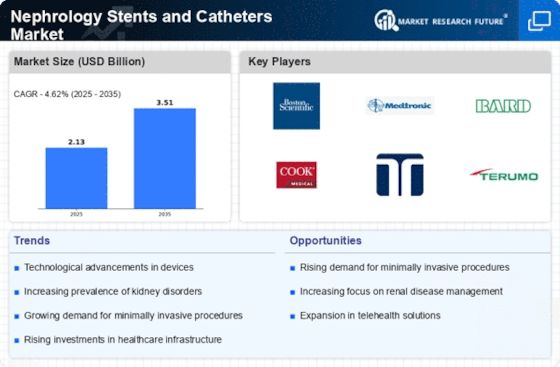
As per Market Research Future analysis, the Nephrology Stents and Catheters Market Size was estimated at 2.134 USD Billion in 2024. The Nephrology Stents and Catheters industry is projected to grow from 2.233 USD Billion in 2025 to 3.508 USD Billion by 2035, exhibiting a compound annual growth rate (CAGR) of 4.62% during the forecast period 2025 - 2035

Key Market Trends & Highlights

The Nephrology Stents and Catheters Market is poised for growth driven by technological advancements and increasing awareness of kidney health.

  • Technological advancements are reshaping the Nephrology Stents and Catheters Market, particularly in North America, which remains the largest market.
  • The rising prevalence of kidney disorders is propelling demand for nephrology stents, with silicone stents being the largest segment.
  • Asia-Pacific is emerging as the fastest-growing region, driven by increasing healthcare investments and awareness.
  • Key market drivers include technological innovations in nephrology stents and catheters and the rising incidence of chronic kidney disease.

Market Size & Forecast

2024 Market Size 2.134 (USD Billion)
2035 Market Size 3.508 (USD Billion)
CAGR (2025 - 2035) 4.62%

Major Players

Boston Scientific (US), Medtronic (US), Bard Medical (US), Cook Medical (US), Teleflex (US), Terumo Corporation (JP), AngioDynamics (US), C. R. Bard (US), B. Braun Melsungen AG (DE)

Our Impact
Enabled $4.3B Revenue Impact for Fortune 500 and Leading Multinationals
Partnering with 2000+ Global Organizations Each Year
30K+ Citations by Top-Tier Firms in the Industry

Nephrology Stents Catheters Market Trends

The Nephrology Stents and Catheters Market is currently experiencing notable growth, driven by advancements in medical technology and an increasing prevalence of kidney-related disorders. Innovations in stent and catheter design are enhancing patient outcomes, as these devices become more effective and easier to use. Furthermore, the rising awareness of chronic kidney disease is prompting healthcare providers to adopt these solutions more widely. As a result, the market is evolving to meet the demands of both patients and healthcare professionals, indicating a shift towards more patient-centered care. In addition, the Nephrology Stents and Catheters Market is likely to benefit from ongoing research and development efforts aimed at improving device performance and safety. Regulatory bodies are also playing a crucial role in ensuring that new products meet stringent safety standards, which may further bolster market confidence. The integration of digital health technologies, such as telemedicine and remote monitoring, could also enhance the management of kidney diseases, potentially leading to increased demand for nephrology devices. Overall, the market appears poised for continued expansion as it adapts to the evolving landscape of healthcare needs and technological advancements.

Technological Advancements

Recent innovations in stent and catheter technology are enhancing their effectiveness and usability. New materials and designs are being developed to improve patient comfort and reduce complications, which may lead to higher adoption rates among healthcare providers.

Rising Prevalence of Kidney Disorders

The increasing incidence of chronic kidney diseases is driving demand for nephrology devices. As more individuals are diagnosed, healthcare systems are likely to prioritize the availability and accessibility of stents and catheters to manage these conditions effectively.

Regulatory Developments

Ongoing changes in regulatory frameworks are influencing the Nephrology Stents and Catheters Market. Stricter safety and efficacy standards may encourage manufacturers to innovate, ensuring that new products meet the necessary requirements for patient care.

Nephrology Stents Catheters Market Drivers

Advancements in Regulatory Frameworks

The Nephrology Stents and Catheters Market is influenced by advancements in regulatory frameworks that aim to ensure the safety and efficacy of medical devices. Regulatory bodies are increasingly adopting streamlined processes for the approval of innovative nephrology products, which can facilitate faster market entry. This is particularly relevant as manufacturers strive to introduce cutting-edge technologies that address unmet clinical needs. Additionally, the establishment of clear guidelines for the use of nephrology stents and catheters can enhance clinician confidence in these devices, potentially leading to increased adoption rates. As regulations evolve to support innovation while maintaining patient safety, the market is likely to experience sustained growth.

Increasing Incidence of Chronic Kidney Disease

The rising incidence of chronic kidney disease (CKD) is a pivotal driver for the Nephrology Stents and Catheters Market. According to recent estimates, CKD affects approximately 10% of the population, leading to a growing need for effective treatment options. As the prevalence of risk factors such as diabetes and hypertension continues to escalate, the demand for nephrology stents and catheters is likely to increase. This trend is further compounded by an aging population, which is more susceptible to kidney-related ailments. Consequently, healthcare systems are compelled to invest in advanced nephrology solutions to manage the increasing patient load, thereby propelling market growth and innovation in this sector.

Growing Investment in Healthcare Infrastructure

The Nephrology Stents and Catheters Market is poised for growth due to increasing investments in healthcare infrastructure. Governments and private entities are recognizing the need to enhance healthcare facilities, particularly in regions with high incidences of kidney diseases. This investment is directed towards upgrading medical equipment, expanding healthcare access, and improving patient care services. As healthcare systems evolve, there is a corresponding demand for advanced nephrology solutions, including stents and catheters. Enhanced infrastructure not only facilitates better patient management but also encourages the adoption of innovative technologies, thereby driving the overall growth of the nephrology market.

Rising Awareness and Education on Kidney Health

The Nephrology Stents and Catheters Market is benefiting from heightened awareness and education regarding kidney health. Public health campaigns and initiatives aimed at educating individuals about the importance of kidney function and the risks associated with kidney diseases are gaining traction. This increased awareness is likely to lead to earlier diagnosis and treatment of kidney disorders, thereby driving demand for nephrology stents and catheters. Moreover, healthcare professionals are increasingly emphasizing preventive measures and regular screenings, which could further contribute to market growth. As patients become more informed about their health, the likelihood of seeking advanced nephrology interventions increases, creating a favorable environment for market expansion.

Technological Innovations in Nephrology Stents and Catheters

The Nephrology Stents and Catheters Market is experiencing a surge in technological innovations that enhance the efficacy and safety of renal interventions. Advanced materials and designs, such as biocompatible coatings and drug-eluting stents, are being developed to minimize complications and improve patient outcomes. For instance, the introduction of minimally invasive techniques has led to shorter recovery times and reduced hospital stays. Furthermore, the integration of digital technologies, including telemedicine and remote monitoring, is transforming patient management and follow-up care. These innovations not only improve the quality of care but also drive market growth, as healthcare providers increasingly adopt these advanced solutions to meet the rising demand for effective renal therapies.


Market Segment Insights

By Type: Nephrology Stents (Largest) vs. Dialysis Catheters (Fastest-Growing)

The Nephrology Stents and Catheters market is characterized by a diverse range of products including Nephrology Stents, Nephrology Catheters, Dialysis Catheters, and Ureteral Stents. Among these, Nephrology Stents hold the largest market share due to their critical role in managing kidney-related ailments, significantly influencing the treatment landscape. In contrast, Dialysis Catheters are emerging rapidly, driven by the increasing prevalence of chronic kidney disease and the growing demand for renal replacement therapy, which further shapes the market dynamics.

Nephrology Stents (Dominant) vs. Dialysis Catheters (Emerging)

Nephrology Stents are widely recognized for their essential role in facilitating urine flow while addressing obstructions, marking their dominance in the Nephrology Stents and Catheters Market. Their established use in clinical settings and strong adoption rates contribute to their leading position. Conversely, Dialysis Catheters are gaining traction as an emerging segment, spurred by rising patient numbers requiring dialysis and advancements in catheter technology. Their ability to enhance patient comfort and reduce complications positions them competitively in the market, appealing to both healthcare providers and patients alike. This contrast between established dominance and emerging significance highlights the evolving landscape of nephrology interventions.

By Material: Silicone (Largest) vs. Polyurethane (Fastest-Growing)

The Nephrology Stents and Catheters Market exhibits a diverse material composition, with Silicone holding the largest market share due to its excellent biocompatibility and flexibility. This material has been a favored choice among healthcare providers, leading to its dominance in stent and catheter manufacturing. However, Polyurethane is emerging swiftly, capturing significant attention for its strength and durability, positioning itself as a competitive alternative to Silicone in specific applications.

Material: Silicone (Dominant) vs. Polyurethane (Emerging)

Silicone-based stents and catheters are recognized for their superior elasticity and soft texture, minimizing irritation and enhancing patient comfort. Their long-standing reputation, combined with proven efficacy in various nephrology procedures, ensures Silicone maintains a dominant presence in the market. Conversely, Polyurethane represents an emerging material that is gaining fast traction, celebrated for its robustness and resistance to kinking. This growing popularity can be attributed to clinical successes highlighting its performance in high-pressure environments, making it a viable option for innovative catheter designs.

By Application: Hemodialysis (Largest) vs. Peritoneal Dialysis (Fastest-Growing)

The Nephrology Stents and Catheters Market is significantly influenced by three main applications: Hemodialysis, Peritoneal Dialysis, and Kidney Transplantation. Among these, Hemodialysis holds the largest market share due to its widespread adoption and established efficacy in treating end-stage renal disease. Peritoneal Dialysis, while smaller in market size, is becoming increasingly prominent as patient preference shifts toward home-based care options, supporting its rapid growth. In contrast, Kidney Transplantation serves a crucial need but is limited by donor availability, thereby restraining its market share compared to the other two methods.

Hemodialysis (Dominant) vs. Peritoneal Dialysis (Emerging)

Hemodialysis stands as the dominant application in the Nephrology Stents and Catheters Market, frequently utilized in clinical settings due to its reliability and proven success rates. It requires specialized machinery and skilled personnel, contributing to its growth as a highly regulated and pivotal procedure. Conversely, Peritoneal Dialysis is emerging as a popular alternative, largely due to its minimal need for healthcare facility visits and empowered patient management. This method has been gaining traction among patients seeking a more independent and flexible approach, thus showcasing significant growth potential in recent years. As awareness increases, both segments will continue to play vital roles in nephrology treatment options.

By End Use: Hospitals (Largest) vs. Dialysis Centers (Fastest-Growing)

The Nephrology Stents and Catheters Market exhibits a significant distribution in its end use segment, with hospitals holding the largest share. This dominance can be attributed to the high volume of nephrology-related procedures performed in hospitals, driving demand for specialized stents and catheters. Dialysis centers, on the other hand, are gaining traction as healthcare systems focus on outpatient care, reflecting a shift towards more specialized facilities catering specifically to renal treatments.

End Use: Hospitals (Dominant) vs. Dialysis Centers (Emerging)

Hospitals remain the dominant end-use segment in the Nephrology Stents and Catheters Market due to their extensive infrastructure and capacity to perform complex renal procedures. They provide a wide range of nephrology-related services, ensuring continuous demand for advanced stenting and catheterization solutions. Conversely, dialysis centers are emerging as a rapidly growing segment, driven by the rising incidence of end-stage renal disease and a shift towards outpatient care models. These centers focus specifically on dialysis procedures, providing tailored services and demonstrating substantial growth potential as they become increasingly integrated into the renal care pathway.

Get more detailed insights about Nephrology Stents Catheters Market

Regional Insights

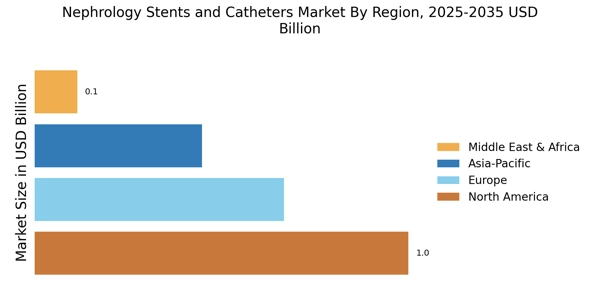
The Nephrology Stents and Catheters Market reflects a robust growth trajectory in the Regional segment, with North America leading the valuation at 0.9 USD Billion in 2024, increasing to 1.5 USD Billion by 2035. This region holds a majority share, driven by advanced healthcare infrastructure and high adoption rates of nephrology devices.

Europe follows, with a market valuation of 0.55 USD Billion in 2024, projected to reach 0.9 USD Billion in 2035, indicating a significant demand due to increasing cases of kidney disorders. The APAC region holds a valuation of 0.45 USD Billion in 2024 and is expected to grow to 0.75 USD Billion, showcasing its emerging importance as a major market driven by rising awareness and healthcare advancements.

South America and MEA present smaller markets, with valuations of 0.1 USD Billion and 0.13 USD Billion in 2024, respectively; however, they are expected to see gradual growth, highlighting untapped opportunities in these regions. The Nephrology Stents and Catheters Market statistics reveal a diverse landscape, emphasizing both growth potential and existing challenges across different regions, particularly concerning accessibility and affordability of treatment.

Nephrology Stents Catheters Market Regional Image

Key Players and Competitive Insights

The Nephrology Stents and Catheters Market has experienced significant growth, driven by increasing incidences of kidney diseases, aging populations, and advancements in medical technology. As healthcare systems around the world prioritize efficient renal treatments, the competitive landscape within this market is becoming increasingly diverse and dynamic. Key players in the industry are investing heavily in research and development to innovate new products that enhance patient outcomes and procedural effectiveness. Additionally, strategic partnerships, mergers, and acquisitions are common strategies employed by these companies to expand their market reach, enhance product offerings, and improve their competitive positioning. This market is characterized by an array of established players and emerging organizations, all striving to capitalize on the expanding demand for high-quality nephrology stents and catheters. Abbott Laboratories has established a strong presence within the Nephrology Stents and Catheters Market and is renowned for its commitment to innovation and quality. The company's portfolio includes advanced catheter technologies that are designed to enhance the delivery and performance of therapies related to kidney function. Abbott Laboratories invests extensively in research to develop cutting-edge medical devices that meet rigorous safety and efficacy standards. The firm’s strong emphasis on clinical support and education further enhances its credibility among healthcare professionals. Their ability to leverage a robust supply chain alongside a global distribution network enables Abbott Laboratories to position itself effectively and reach a wide variety of healthcare providers. Baxter International plays a pivotal role in the Nephrology Stents and Catheters Market by focusing on solutions that address the needs of patients with renal conditions. With a legacy of over 80 years in medical innovation, Baxter has built a reputation for delivering high-quality products that improve patient care. The company is known for its consistent advancements in dialysis technologies, including catheter systems that facilitate effective renal replacement therapies. Baxter International’s extensive clinical experience and strong partnerships with healthcare institutions support its product development efforts and ensure its solutions are tailored to meet the demands of the market. Additionally, the company's commitment to global health initiatives illustrates its dedication to enhancing healthcare access, particularly in underserved regions.

Key Companies in the Nephrology Stents Catheters Market include

Industry Developments

Recent developments in the Nephrology Stents and Catheters Market have shown significant activities among leading companies. Abbott Laboratories and Baxter International are advancing their innovative product lines, focusing on enhancing patient outcomes through advanced stent designs and catheter technologies.

Terumo and AngioDynamics have launched new solutions aimed at improving procedural efficiency in clinical settings. Concurrently, Teleflex and Fresenius Medical Care are expanding their market reach through strategic partnerships.

Noteworthy is the ongoing trend of mergers and acquisitions, where Cook Medical has recently made headway in acquiring smaller biotech firms to strengthen its portfolio. Stryker continues to explore potential acquisitions that align with its growth strategy, aiming to enhance its offerings in the nephrology space.

Additionally, Boston Scientific and Medtronic are engaged in expanding their product ranges to cater to evolving market needs. As these companies aspire to capture greater market share, the competitive landscape reflects a dynamic growth trajectory driven by innovation and strategic alignments, thereby reshaping the Nephrology Stents and Catheters Market.

The increasing emphasis on technological advancements and patient-centric solutions is propelling market valuation upward, influencing stakeholders' strategies across the sector.

Future Outlook

Nephrology Stents Catheters Market Future Outlook

The Nephrology Stents and Catheters Market is projected to grow at a 4.62% CAGR from 2025 to 2035, driven by technological advancements, increasing prevalence of kidney diseases, and rising healthcare expenditures.

New opportunities lie in:

  • Development of biodegradable stents for enhanced patient outcomes. Expansion into emerging markets with tailored product offerings. Integration of telemedicine solutions for remote patient monitoring.

By 2035, the market is expected to achieve robust growth, positioning itself as a leader in nephrology solutions.

Market Segmentation

Nephrology Stents Catheters Market Type Outlook

  • Nephrology Stents
  • Nephrology Catheters
  • Dialysis Catheters
  • Ureteral Stents

Nephrology Stents Catheters Market End Use Outlook

  • Hospitals
  • Dialysis Centers
  • Home Care Settings

Nephrology Stents Catheters Market Material Outlook

  • Silicone
  • Polyurethane
  • Metal
  • Biodegradable Polymers

Nephrology Stents Catheters Market Application Outlook

  • Hemodialysis
  • Peritoneal Dialysis
  • Kidney Transplantation

Report Scope

MARKET SIZE 2024 2.134(USD Billion)
MARKET SIZE 2025 2.233(USD Billion)
MARKET SIZE 2035 3.508(USD Billion)
COMPOUND ANNUAL GROWTH RATE (CAGR) 4.62% (2025 - 2035)
REPORT COVERAGE Revenue Forecast, Competitive Landscape, Growth Factors, and Trends
BASE YEAR 2024
Market Forecast Period 2025 - 2035
Historical Data 2019 - 2024
Market Forecast Units USD Billion
Key Companies Profiled Boston Scientific (US), Medtronic (US), Bard Medical (US), Cook Medical (US), Teleflex (US), Terumo Corporation (JP), AngioDynamics (US), C. R. Bard (US), B. Braun Melsungen AG (DE)
Segments Covered Product Type, Material, Applications, End Use, Regional
Key Market Opportunities Advancements in biocompatible materials enhance performance in the Nephrology Stents and Catheters Market.
Key Market Dynamics Technological advancements and regulatory changes drive innovation and competition in the nephrology stents and catheters market.
Countries Covered North America, Europe, APAC, South America, MEA
Leave a Comment

FAQs

What is the projected market valuation of the Nephrology Stents and Catheters Market by 2035?

The Nephrology Stents and Catheters Market is projected to reach a valuation of 3.508 USD Billion by 2035.

What was the market valuation of the Nephrology Stents and Catheters Market in 2024?

In 2024, the market valuation of the Nephrology Stents and Catheters Market was 2.134 USD Billion.

What is the expected CAGR for the Nephrology Stents and Catheters Market during the forecast period 2025 - 2035?

The expected CAGR for the Nephrology Stents and Catheters Market during the forecast period 2025 - 2035 is 4.62%.

Which companies are considered key players in the Nephrology Stents and Catheters Market?

Key players in the market include Boston Scientific, Medtronic, Bard Medical, Cook Medical, Teleflex, Terumo Corporation, AngioDynamics, C. R. Bard, and B. Braun Melsungen AG.

What are the projected revenues for Nephrology Stents by 2035?

The projected revenue for Nephrology Stents is expected to reach 1.415 USD Billion by 2035.

How do the revenues of Ureteral Stents compare between 2024 and 2035?

Ureteral Stents revenues were 0.427 USD Billion in 2024 and are projected to increase to 0.673 USD Billion by 2035.

What is the expected market size for Dialysis Catheters in 2035?

The expected market size for Dialysis Catheters is projected to be 0.71 USD Billion by 2035.

Which material segment is anticipated to have the highest revenue by 2035?

The Silicone material segment is anticipated to have the highest revenue, projected at 1.02 USD Billion by 2035.

What is the projected revenue for Home Care Settings in the Nephrology Stents and Catheters Market by 2035?

The projected revenue for Home Care Settings is expected to reach 1.035 USD Billion by 2035.

What application segment is expected to show significant growth in the Nephrology Stents and Catheters Market?

The Kidney Transplantation application segment is expected to show significant growth, with projected revenues of 1.413 USD Billion by 2035.

Download Free Sample

Kindly complete the form below to receive a free sample of this Report

Compare Licence

×
Features License Type
Single User Multiuser License Enterprise User
Price $4,950 $5,950 $7,250
Maximum User Access Limit 1 User Upto 10 Users Unrestricted Access Throughout the Organization
Free Customization
Direct Access to Analyst
Deliverable Format
Platform Access
Discount on Next Purchase 10% 15% 15%
Printable Versions