×
Request Free Sample ×

Kindly complete the form below to receive a free sample of this Report

* Please use a valid business email

Leading companies partner with us for data-driven Insights

clients tt-cursor
Hero Background

Microbial Fermentation Technology Market

ID: MRFR/HC/20277-CR
237 Pages
Rahul Gotadki
July 2025

Microbial Fermentation Technology Market Research Report: Size, Share, Trend Analysis By Class (Antibiotics (Penicillin, Streptomycin, Tetracycline, Others), Hormones and Growth Factors (Insulin, Human Growth Hormone (HGH), Erythropoietin (EPO), Anticancer Agents (Doxorubicin, Daunorubicin, Others), Immunosuppressants, Others), by End-User (Pharmaceutical Companies, Contract Research Organizations (CROs) and CDMOs, Research Organizations) and Region (North America, Europe, Asia-Pacific, South America, Middle East & Africa)) - Growth Outlook & Industry Forecast 2025 To 2035

Share:
Download PDF ×

We do not share your information with anyone. However, we may send you emails based on your report interest from time to time. You may contact us at any time to opt-out.

Microbial Fermentation Technology Market Infographic
Purchase Options

Microbial Fermentation Technology Market Summary

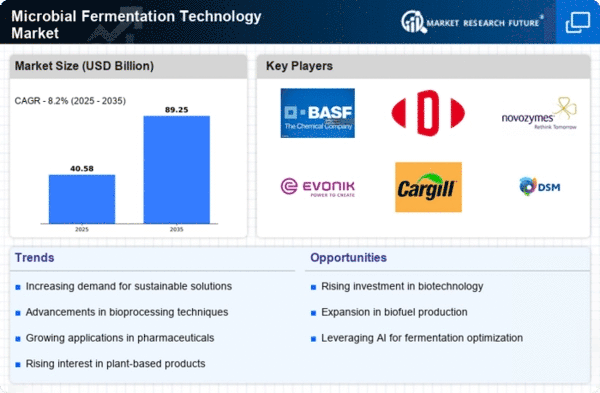
As per MRFR analysis, the Microbial Fermentation Technology Market was estimated at 37.5 USD Billion in 2024. The microbial fermentation technology industry is projected to grow from 40.57 USD Billion in 2025 to 89.25 USD Billion by 2035, exhibiting a compound annual growth rate (CAGR) of 8.2 during the forecast period 2025 - 2035.

Key Market Trends & Highlights

The Microbial Fermentation Technology Market is poised for robust growth driven by sustainability and technological advancements.

  • North America remains the largest market for microbial fermentation technology, reflecting a strong demand for bioproducts.
  • Asia-Pacific is emerging as the fastest-growing region, fueled by increasing investments in biotechnology and fermentation processes.
  • The Food and Beverage segment dominates the market, while the Pharmaceuticals segment is experiencing rapid growth due to innovative applications.
  • Key market drivers include rising demand for bioproducts and advancements in fermentation technology, which are shaping industry dynamics.

Market Size & Forecast

2024 Market Size 37.5 (USD Billion)
2035 Market Size 89.25 (USD Billion)
CAGR (2025 - 2035) 8.2%

Major Players

BASF SE (DE), DuPont de Nemours Inc (US), Novozymes A/S (DK), Evonik Industries AG (DE), Cargill Inc (US), DSM Nutritional Products (CH), Fermicute (US), Genomatica Inc (US), Kraft Heinz Company (US)

Our Impact
Enabled $4.3B Revenue Impact for Fortune 500 and Leading Multinationals
Partnering with 2000+ Global Organizations Each Year
30K+ Citations by Top-Tier Firms in the Industry

Microbial Fermentation Technology Market Trends

The Microbial Fermentation Technology Market is currently experiencing a notable evolution, driven by advancements in biotechnology and increasing demand for sustainable production methods. This market encompasses a wide array of applications, including pharmaceuticals, food and beverages, and biofuels, reflecting its versatility and importance in various sectors. As industries seek to reduce their environmental footprint, microbial fermentation emerges as a viable solution, offering efficient pathways for producing essential compounds. The integration of innovative techniques, such as synthetic biology and metabolic engineering, further enhances the capabilities of microbial fermentation, allowing for the development of novel products and processes. In December 2025, the Microbial Fermentation Technology Market appears poised for continued growth, as stakeholders increasingly recognize the potential of fermentation processes in addressing global challenges. The shift towards renewable resources and the circular economy is likely to bolster investments in this field. Moreover, collaborations between academia and industry are fostering research and development initiatives, which may lead to breakthroughs in fermentation technology. Overall, the market's trajectory suggests a promising future, characterized by ongoing innovation and a commitment to sustainability across various applications.

Sustainability Focus

The Microbial Fermentation Technology Market is witnessing a pronounced emphasis on sustainability. As environmental concerns escalate, industries are increasingly adopting fermentation processes that utilize renewable resources. This shift not only reduces reliance on fossil fuels but also minimizes waste, aligning with global sustainability goals.

Technological Advancements

Recent advancements in biotechnology are significantly influencing the Microbial Fermentation Technology Market. Innovations such as synthetic biology and advanced metabolic engineering are enhancing the efficiency and productivity of fermentation processes. These technologies enable the development of new products and improve existing processes, driving market growth.

Diverse Applications

The versatility of microbial fermentation is evident in its wide-ranging applications across various sectors. From pharmaceuticals to food production, the technology is being utilized to create essential compounds. This diversity not only broadens the market's scope but also attracts investments from different industries seeking to leverage fermentation technology.

Microbial Fermentation Technology Market Drivers

Market Growth Projections

The Global Microbial Fermentation Technology Market Industry is projected to experience substantial growth, with estimates indicating a market value of 156.8 USD Billion by 2035. This growth trajectory suggests a compound annual growth rate (CAGR) of 6.1% from 2025 to 2035, reflecting the increasing adoption of microbial fermentation across various sectors. The anticipated expansion is driven by factors such as rising consumer demand for natural products, advancements in fermentation technology, and the growing emphasis on sustainability. These projections underscore the market's potential and the critical role of microbial fermentation in shaping future industrial practices.

Rising Demand for Biopharmaceuticals

The Global Microbial Fermentation Technology Market Industry experiences a notable surge in demand for biopharmaceuticals, driven by the increasing prevalence of chronic diseases and the need for innovative therapies. Microbial fermentation serves as a critical process in the production of antibiotics, vaccines, and monoclonal antibodies. For instance, the global biopharmaceutical market is projected to reach 81.7 USD Billion in 2024, highlighting the essential role of microbial fermentation in meeting healthcare needs. This trend suggests that as the biopharmaceutical sector expands, the reliance on microbial fermentation technology will likely increase, thereby propelling market growth.

Expanding Applications Across Industries

The Global Microbial Fermentation Technology Market Industry is characterized by expanding applications across diverse sectors, including food and beverage, pharmaceuticals, and agriculture. In the food industry, fermentation is utilized for producing probiotics, fermented dairy products, and plant-based alternatives, catering to the growing consumer preference for health-oriented products. Similarly, in agriculture, microbial fermentation plays a crucial role in developing biofertilizers and biopesticides, promoting sustainable farming practices. This diversification of applications not only broadens the market's scope but also indicates a robust growth potential, as industries increasingly recognize the benefits of microbial fermentation.

Sustainability and Eco-Friendly Practices

Sustainability emerges as a pivotal driver within the Global Microbial Fermentation Technology Market Industry, as industries seek eco-friendly alternatives to traditional chemical processes. Microbial fermentation offers a sustainable method for producing various chemicals, biofuels, and food ingredients, which aligns with global efforts to reduce carbon footprints. The shift towards greener production methods is evident in sectors such as food and beverage, where fermentation processes are utilized to create natural flavors and preservatives. This growing emphasis on sustainability not only enhances the market's appeal but also positions microbial fermentation as a key player in the transition towards environmentally responsible manufacturing.

Regulatory Support and Funding Initiatives

Regulatory support and funding initiatives significantly bolster the Global Microbial Fermentation Technology Market Industry, as governments and organizations promote research and development in fermentation technologies. Various funding programs aim to encourage innovation and commercialization of microbial fermentation processes, particularly in biopharmaceuticals and sustainable agriculture. This support is crucial for fostering advancements that enhance product quality and safety. As regulatory frameworks evolve to accommodate new fermentation technologies, the market is likely to benefit from increased investment and collaboration between public and private sectors, further driving growth.

Technological Advancements in Fermentation Processes

Technological advancements significantly influence the Global Microbial Fermentation Technology Market Industry, enhancing efficiency and productivity in fermentation processes. Innovations such as automated fermentation systems, advanced bioreactor designs, and improved strain development techniques contribute to higher yields and reduced production costs. For example, the integration of artificial intelligence and machine learning in fermentation monitoring allows for real-time adjustments, optimizing conditions for microbial growth. These advancements are expected to drive the market's growth trajectory, as companies increasingly adopt cutting-edge technologies to remain competitive and meet the rising demand for fermented products.


Market Segment Insights

By Application: Food and Beverage (Largest) vs. Pharmaceuticals (Fastest-Growing)

The Microbial Fermentation Technology Market displays a varied distribution of market share across multiple applications. Food and Beverage leads the segment, capturing the largest portion due to the rising demand for fermented products, which have gained popularity for their health benefits. This dominance is complemented by the Pharmaceuticals segment, which is experiencing rapid growth, driven by the increasing need for biopharmaceuticals and innovative drug production processes that utilize microbial fermentation techniques.

Food and Beverage (Dominant) vs. Pharmaceuticals (Emerging)

The Food and Beverage sector stands as the dominant force in the Microbial Fermentation Technology Market, primarily due to its established processes for producing fermented goods like yogurt, cheese, and probiotics. This segment is characterized by well-established methodologies and a steady consumer base looking for natural and health-oriented food products. Conversely, the Pharmaceuticals segment is marked as the emerging player, experiencing significant growth fueled by advancements in biopharmaceuticals and personalized medicine. The integration of microbial fermentation in drug development is propelling this segment forward, attracting investments and fostering research, contributing to its rapid evolution in the market.

By Microorganism Type: Bacteria (Largest) vs. Yeast (Fastest-Growing)

In the Microbial Fermentation Technology Market, Bacteria hold the largest market share among microorganism types, significantly influencing production techniques across various industries. This dominance is attributed to their versatility and ability to produce a wide range of bio-products, from pharmaceuticals to biofuels. Yeast, on the other hand, has emerged as the fastest-growing segment owing to its crucial role in food and beverage fermentation, along with rising utilization in bioethanol production and other biotechnological applications.

Bacteria (Dominant) vs. Yeast (Emerging)

Bacteria are the dominant players in the microbial fermentation technology, thanks to their adaptability and efficiency in fermenting diverse substrates. They are widely employed in industries such as agriculture, pharmaceuticals, and food processing. Yeast, particularly Saccharomyces cerevisiae, is recognized as an emerging segment, driven by increasing demand for fermented products and sustainable practices. While bacteria have established their foothold, yeast is quickly gaining traction due to innovations in fermentation technology, including genetic engineering, enhancing its market position as a key contributor to fermentation processes.

By Process Type: Batch Fermentation (Largest) vs. Continuous Fermentation (Fastest-Growing)

In the Microbial Fermentation Technology Market, Batch Fermentation holds the largest share compared to other process types. Its traditional application in various industries, including pharmaceuticals and food, underpins its dominance. Meanwhile, Continuous Fermentation, though smaller in market share, rapidly gains traction due to its efficiency and scalability, appealing to manufacturers seeking to enhance productivity. Emerging trends in sustainability also favor this process, as it reduces waste and optimizes resource use.

Batch Fermentation (Dominant) vs. Continuous Fermentation (Emerging)

Batch Fermentation, characterized by its cyclical operation where all ingredients are added at once and then fermented until the process is complete, is the dominant method in microbial fermentation. It is particularly favored in smaller scale applications due to its simplicity and flexibility. On the other hand, Continuous Fermentation operates on a constant input and output basis, making it an emerging technique in high-volume production environments. This method is gaining momentum as it allows for more efficient substrate utilization and lower operational costs, thus appealing to industries focused on large-scale fermentation.

Get more detailed insights about Microbial Fermentation Technology Market

Regional Insights

North America : Innovation and Market Leadership

North America dominates the microbial fermentation technology market, holding a significant share of 18.75% in 2024. The region's growth is driven by increasing demand for sustainable and eco-friendly production methods, alongside supportive regulatory frameworks that encourage innovation. The presence of advanced research institutions and a robust biotechnology sector further catalyze market expansion, making it a hub for technological advancements in fermentation processes. The United States stands out as a key player, hosting major companies like DuPont and Cargill, which are at the forefront of microbial fermentation innovations. Canada also contributes to the market with its growing biotechnology sector. The competitive landscape is characterized by strategic partnerships and collaborations among leading firms, enhancing product offerings and market reach. This dynamic environment positions North America as a leader in microbial fermentation technology.

Europe : Sustainable Practices and Innovation

Europe's microbial fermentation technology market is valued at €10.5 million, reflecting a growing trend towards sustainable practices and innovation. The region benefits from stringent regulations that promote environmentally friendly production methods, driving demand for microbial fermentation solutions. The European Union's Green Deal and various sustainability initiatives are key catalysts for market growth, encouraging investments in green technologies and bioprocessing. Germany, France, and the UK are leading countries in this sector, with significant contributions from companies like BASF and Novozymes. The competitive landscape is marked by a focus on research and development, with many firms investing heavily in innovative fermentation technologies. This commitment to sustainability and innovation positions Europe as a vital player in The Microbial Fermentation Technology.

Asia-Pacific : Rapid Growth and Adoption

The Asia-Pacific region is witnessing rapid growth in the microbial fermentation technology market, valued at $6.0 million. This growth is fueled by increasing consumer demand for natural and organic products, alongside rising investments in biotechnology. Countries like China and India are leading the charge, supported by government initiatives aimed at enhancing agricultural productivity and food security through advanced fermentation technologies. China is particularly notable for its significant investments in biotechnology, with numerous startups and established companies focusing on microbial fermentation. The competitive landscape is evolving, with both local and international players vying for market share. This dynamic environment, characterized by innovation and collaboration, positions Asia-Pacific as an emerging powerhouse in the microbial fermentation sector.

Middle East and Africa : Emerging Market Potential

The Middle East and Africa (MEA) region, with a market size of $2.25 million, presents significant growth opportunities in microbial fermentation technology. The region is increasingly recognizing the importance of sustainable agricultural practices and food production methods, driven by a growing population and food security concerns. Government initiatives aimed at enhancing agricultural productivity are key drivers of market growth in this area. Countries like South Africa and the UAE are leading the way in adopting microbial fermentation technologies, with investments in research and development. The competitive landscape is characterized by a mix of local and international players, focusing on innovative solutions to meet regional demands. This emerging market potential positions MEA as a region to watch in the microbial fermentation technology space.

Key Players and Competitive Insights

The Microbial Fermentation Technology Market is currently characterized by a dynamic competitive landscape, driven by increasing demand for sustainable production methods and innovative bioprocessing solutions. Key players such as BASF SE (DE), DuPont de Nemours Inc (US), and Novozymes A/S (DK) are strategically positioned to leverage their extensive research and development capabilities. These companies are focusing on innovation and partnerships to enhance their product offerings and market reach, thereby shaping a competitive environment that emphasizes technological advancement and sustainability.
In terms of business tactics, companies are increasingly localizing manufacturing to reduce supply chain vulnerabilities and optimize operational efficiency. The market appears moderately fragmented, with several key players exerting considerable influence. This structure allows for a diverse range of products and services, fostering competition that encourages continuous improvement and innovation among market participants.
In November 2025, DuPont de Nemours Inc (US) announced a strategic partnership with a leading agricultural technology firm to develop bio-based fertilizers through microbial fermentation. This collaboration is expected to enhance DuPont's portfolio in sustainable agriculture, aligning with global trends towards eco-friendly farming practices. The strategic importance of this partnership lies in its potential to address the growing demand for sustainable agricultural solutions, thereby positioning DuPont as a leader in this niche market.
In October 2025, Novozymes A/S (DK) launched a new enzyme product designed to optimize fermentation processes in the food industry. This innovation is particularly significant as it aims to improve efficiency and reduce waste in production, reflecting Novozymes' commitment to sustainability. The introduction of this product not only strengthens Novozymes' competitive edge but also responds to the increasing consumer demand for environmentally friendly food production methods.
In September 2025, BASF SE (DE) expanded its fermentation technology capabilities by acquiring a biotechnology startup specializing in microbial production systems. This acquisition is likely to enhance BASF's technological expertise and broaden its product offerings in the microbial fermentation space. The strategic move underscores BASF's focus on innovation and its commitment to maintaining a competitive advantage through technological advancements.
As of December 2025, current trends in the Microbial Fermentation Technology Market indicate a strong emphasis on digitalization, sustainability, and the integration of artificial intelligence in production processes. Strategic alliances are increasingly shaping the competitive landscape, allowing companies to pool resources and expertise. Looking ahead, it appears that competitive differentiation will evolve from traditional price-based competition to a focus on innovation, technological advancements, and supply chain reliability, reflecting the industry's shift towards more sustainable and efficient production methods.

Key Companies in the Microbial Fermentation Technology Market include

Industry Developments

January 2025: Biocon Pharma Limited received approval from China’s National Medical Products Administration (NMPA) for its Tacrolimus Capsules. Tacrolimus was used as an immunosuppressant to reduce the body's ability to reject transplanted organs in patients who had undergone organ transplants.

April 2024: Biocon Limited received approval from the South African Health Products Regulatory Authority (SAHPRA) for its vertically integrated, complex drug product Tacrolimus Capsules in 0.5mg, 1mg, and 5mg strengths. This marked the company’s first product approval in South Africa.

February 2021: Sandoz, a Novartis division, has acquired GSK's cephalosporin antibiotics business, strengthening the company's global leadership in antibiotics. The transaction grants global rights to three established brands (Zinnat, Zinacef, and Fortum) in over 100 markets. It excludes rights in the United States, Australia, and Germany to some brands that GSK previously divested, as well as rights in India, Pakistan, Egypt, Japan (to select products), and China, which GSK will retain.

May 2021: India-based generics manufacturers Biocon and Lupin both launched their generic versions of tacrolimus capsules in the US market. Biocon announced the launch of its generic tacrolimus capsules on December 28, 2020, following FDA approval received in November 2020.

Future Outlook

Microbial Fermentation Technology Market Future Outlook

The Microbial Fermentation Technology Market is projected to grow at an 8.2% CAGR from 2025 to 2035, driven by increasing demand for sustainable production methods and bioprocess innovations.

New opportunities lie in:

  • Development of bioreactor systems for enhanced yield efficiency.
  • Expansion into emerging markets with tailored fermentation solutions.
  • Partnerships with food and beverage companies for probiotic product lines.

By 2035, the market is expected to solidify its position as a leader in sustainable biotechnological solutions.

Market Segmentation

Microbial Fermentation Technology Market Application Outlook

  • Food and Beverage
  • Pharmaceuticals
  • Biofuels
  • Agriculture
  • Bioplastics

Microbial Fermentation Technology Market Process Type Outlook

  • Batch Fermentation
  • Continuous Fermentation
  • Fed-Batch Fermentation
  • Solid-State Fermentation
  • Submerged Fermentation

Microbial Fermentation Technology Market Microorganism Type Outlook

  • Bacteria
  • Yeast
  • Fungi
  • Algae
  • Actinomycetes

Report Scope

MARKET SIZE 2024 37.5(USD Billion)
MARKET SIZE 2025 40.57(USD Billion)
MARKET SIZE 2035 89.25(USD Billion)
COMPOUND ANNUAL GROWTH RATE (CAGR) 8.2% (2025 - 2035)
REPORT COVERAGE Revenue Forecast, Competitive Landscape, Growth Factors, and Trends
BASE YEAR 2024
Market Forecast Period 2025 - 2035
Historical Data 2019 - 2024
Market Forecast Units USD Billion
Key Companies Profiled BASF SE (DE), DuPont de Nemours Inc (US), Novozymes A/S (DK), Evonik Industries AG (DE), Cargill Inc (US), DSM Nutritional Products (CH), Fermicute (US), Genomatica Inc (US), Kraft Heinz Company (US)
Segments Covered Application, Microorganism Type, Process Type
Key Market Opportunities Advancements in microbial strains enhance production efficiency in the Microbial Fermentation Technology Market.
Key Market Dynamics Rising demand for sustainable products drives innovation in microbial fermentation technology across various industries.
Countries Covered North America, Europe, APAC, South America, MEA
Leave a Comment

FAQs

What is the projected growth of the Microbial Fermentation Technology market?

The Microbial Fermentation Technology market is the expected increase in total market value of 89.25 USD billion over a defined forecast period 2025–2035. It is driven by factors such as demand trends, technological advances, regulatory changes, and geographic expansion.

What is the size of the Microbial Fermentation Technology market?

Microbial Fermentation Technology market size was valued at approximately 37.5 billion USD in 2024. This figure will reach 89.25 billion USD covering all regions (America, Europe, Asia, MEA and ROW), focusing its segments / services / distribution channels till 2035.

What is the CAGR of the Microbial Fermentation Technology market?

Microbial Fermentation Technology market is expected to grow at a CAGR of 8.2% between 2025 and 2035.

How much will the Microbial Fermentation Technology market be worth by 2035?

Microbial Fermentation Technology market is expected to be worth of 89.25 billion USD, reflecting growth driven by usage, technology and global demands by the end of 2035.

How will the Microbial Fermentation Technology market perform over the next 10 years?

Over the next 10 years the Microbial Fermentation Technology market is expected to shift from usd billion 37.5 to 89.25 billion USD, led by adoption of advanced tech, demographic trends, regulatory approvals, with potential headwinds from 2025 to 2035.

Download Free Sample

Kindly complete the form below to receive a free sample of this Report

Compare Licence

×
Features License Type
Single User Multiuser License Enterprise User
Price $4,950 $5,950 $7,250
Maximum User Access Limit 1 User Upto 10 Users Unrestricted Access Throughout the Organization
Free Customization
Direct Access to Analyst
Deliverable Format
Platform Access
Discount on Next Purchase 10% 15% 15%
Printable Versions