×
Request Free Sample ×

Kindly complete the form below to receive a free sample of this Report

* Please use a valid business email

Leading companies partner with us for data-driven Insights

clients tt-cursor
Hero Background

MFGM Ingredient Market

ID: MRFR/FnB/36357-HCR
100 Pages
Harshita Gorade
February 2026

MFGM Ingredient Market Size, Share, Industry Trend & Analysis Research Report: By Application (Infant Formula, Dairy Products, Bakery Products, Nutritional Supplements), By Source (Milk, Cream, Whey, Concentrate), By Form (Powder, Liquid, Granular), By End User (Food Industry, Dietary Supplements, Pharmaceuticals) and By Regional (North America, Europe, South America, Asia Pacific, Middle East and Africa) - Forecast to 2035

Share:
Download PDF ×

We do not share your information with anyone. However, we may send you emails based on your report interest from time to time. You may contact us at any time to opt-out.

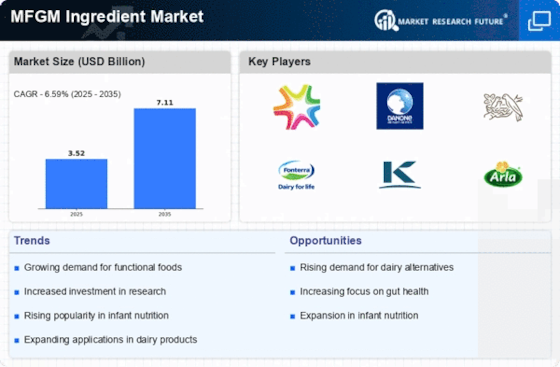
MFGM Ingredient Market Infographic
Purchase Options

MFGM Ingredient Market Summary

As per Market Research Future analysis, the MFGM Ingredient Market Size was estimated at 3.524 USD Billion in 2024. The MFGM industry is projected to grow from 3.757 USD Billion in 2025 to 7.113 USD Billion by 2035, exhibiting a compound annual growth rate (CAGR) of 6.59% during the forecast period 2025 - 2035

Key Market Trends & Highlights

The MFGM Ingredient Market is experiencing robust growth driven by health trends and technological advancements.

  • Rising health consciousness among consumers is propelling the demand for MFGM ingredients in various food products.
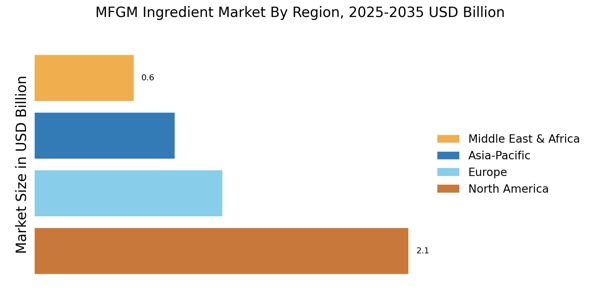
  • North America remains the largest market for MFGM ingredients, while the Asia-Pacific region is emerging as the fastest-growing market.
  • The infant formula segment continues to dominate the market, whereas the dairy products segment is witnessing rapid growth.
  • Key market drivers include the increasing demand for dairy alternatives and the rising interest in functional foods.

Market Size & Forecast

2024 Market Size 3.524 (USD Billion)
2035 Market Size 7.113 (USD Billion)
CAGR (2025 - 2035) 6.59%

Major Players

FrieslandCampina (NL), Danone (FR), Nestle (CH), Fonterra (NZ), Kerry Group (IE), Arla Foods (DK), Glanbia (IE), Synlogic (US), BASF (DE)

Our Impact
Enabled $4.3B Revenue Impact for Fortune 500 and Leading Multinationals
Partnering with 2000+ Global Organizations Each Year
30K+ Citations by Top-Tier Firms in the Industry

MFGM Ingredient Market Trends

The MFGM Ingredient Market is currently experiencing a notable evolution, driven by increasing consumer awareness regarding health and nutrition. This market encompasses a variety of applications, including infant formula, dairy products, and functional foods. The growing inclination towards natural and clean-label products appears to be influencing manufacturers to incorporate MFGM ingredients, which are recognized for their potential health benefits. As consumers seek products that support cognitive development and immune function, the demand for MFGM ingredients is likely to rise. Furthermore, the trend towards personalized nutrition may also play a role in shaping the future landscape of this market, as consumers increasingly desire tailored solutions that meet their specific dietary needs. In addition, the MFGM Ingredient Market seems to be benefiting from advancements in processing technologies, which enhance the extraction and stabilization of these ingredients. This could lead to improved product formulations and expanded applications across various sectors. The market's growth trajectory may also be supported by ongoing research that continues to unveil the functional properties of MFGM, thereby attracting interest from both manufacturers and consumers alike. Overall, the MFGM Ingredient Market is poised for growth, driven by a combination of health trends, technological innovations, and evolving consumer preferences.

Rising Health Consciousness

There is a growing trend among consumers towards health and wellness, which is influencing their purchasing decisions. This shift is prompting manufacturers to explore MFGM ingredients due to their perceived health benefits, such as supporting cognitive function and enhancing immune health.

Technological Advancements in Processing

Innovations in processing technologies are facilitating the extraction and stabilization of MFGM ingredients. These advancements may lead to improved product formulations, allowing for broader applications in various food and beverage sectors.

Personalized Nutrition Trends

The increasing demand for personalized nutrition is shaping the MFGM Ingredient Market. Consumers are seeking tailored dietary solutions that cater to their individual health needs, which could drive the incorporation of MFGM ingredients into customized products.

MFGM Ingredient Market Drivers

Growing Awareness of Gut Health

The MFGM Ingredient Market is benefiting from the increasing awareness surrounding gut health and its impact on overall well-being. Consumers are becoming more informed about the role of gut microbiota in health, leading to a surge in demand for products that promote digestive health. MFGM is recognized for its prebiotic properties, which can support a healthy gut microbiome. Market analysis indicates that the gut health market is expected to exceed 70 billion in the next few years, driven by consumer interest in probiotics and prebiotics. This trend presents a compelling opportunity for the MFGM Ingredient Market to position its products as essential components of gut health solutions, thereby tapping into a rapidly growing segment.

Rising Interest in Functional Foods

The MFGM Ingredient Market is witnessing a surge in interest surrounding functional foods, which are perceived to offer health benefits beyond basic nutrition. Consumers are increasingly seeking products that support immune health, cognitive function, and digestive wellness. MFGM, known for its bioactive compounds, is being recognized for its potential health benefits, including its role in enhancing gut health and cognitive development. Market data suggests that the functional foods sector is expected to reach a valuation of over 300 billion in the coming years. This growth presents a significant opportunity for the MFGM Ingredient Market to innovate and develop products that cater to this demand, thereby enhancing their market presence and consumer appeal.

Expansion of Infant Nutrition Products

The MFGM Ingredient Market is significantly influenced by the expansion of infant nutrition products, as MFGM is increasingly recognized for its beneficial properties in early childhood development. Research indicates that MFGM can support cognitive development and immune function in infants, making it a valuable ingredient in infant formula. The infant nutrition market is projected to grow at a rate of 8% annually, driven by rising birth rates and increasing awareness among parents regarding nutrition. This trend presents a lucrative opportunity for the MFGM Ingredient Market to collaborate with infant formula manufacturers, thereby enhancing product offerings and meeting the growing demand for high-quality nutrition for infants.

Increasing Demand for Dairy Alternatives

The MFGM Ingredient Market is experiencing a notable shift towards dairy alternatives, driven by changing consumer preferences and dietary restrictions. As more individuals adopt plant-based diets, the demand for MFGM ingredients derived from non-dairy sources is likely to rise. This trend is supported by a report indicating that the dairy alternatives market is projected to grow at a compound annual growth rate of 10% over the next five years. Consequently, manufacturers are exploring innovative ways to incorporate MFGM into these alternatives, enhancing their nutritional profiles. This shift not only caters to lactose-intolerant consumers but also aligns with the growing trend of health-conscious eating. The MFGM Ingredient Market must adapt to these evolving consumer needs to remain competitive.

Innovations in Food Processing Technologies

The MFGM Ingredient Market is poised for growth due to innovations in food processing technologies that enhance the extraction and application of MFGM. Advances in processing techniques, such as membrane filtration and enzymatic hydrolysis, are enabling manufacturers to obtain MFGM with improved functionality and bioavailability. These technological advancements not only improve the efficiency of MFGM extraction but also expand its application across various food products, including dairy, beverages, and snacks. The food processing industry is projected to grow at a rate of 5% annually, indicating a favorable environment for the MFGM Ingredient Market to leverage these innovations. By adopting cutting-edge technologies, the industry can enhance product quality and meet the evolving demands of consumers.


Market Segment Insights

By Application: Infant Formula (Largest) vs. Dairy Products (Fastest-Growing)

The MFGM Ingredient Market is characterized by significant application areas, with the largest share held by Infant Formula, which utilizes MFGM for its nutritional benefits critical to early development. Following closely are Dairy Products, which have gained substantial traction for their value in enhancing taste and texture. bakery products and Nutritional Supplements exhibit smaller market shares yet present unique opportunities due to rising health-conscious consumer trends, indicating a diverse range of applications driven by specific dietary needs.

Infant Formula (Dominant) vs. Nutritional Supplements (Emerging)

Infant Formula remains the dominant application in the MFGM Ingredient Market due to the increasing demand for enhanced infant nutrition, leveraging MFGM's functional properties to support cognitive and immune development. On the other hand, Nutritional Supplements emerge as a rapidly growing segment, driven by rising consumer awareness of health and wellness. These supplements utilize MFGM to offer benefits beyond basic nutrition, appealing to a broader audience seeking functional and fortified food options. As globally shopping habits shift towards health-oriented choices, both segments are poised for continuous innovation and growth.

By Source: Milk (Largest) vs. Cream (Fastest-Growing)

In the MFGM Ingredient Market, the division by source illustrates the varying contributions of each segment. Milk holds the largest share, leading in both production volume and consumer preference due to its versatility and nutritional profile. Meanwhile, cream, with its rich texture and flavor, is emerging rapidly as a preferred source for MFGM due to the growing demand for premium dairy products.

Milk: Dominant vs. Cream: Emerging

Milk remains the dominant source in the MFGM Ingredient Market thanks to its wide availability and established application in dairy products. As a source of essential nutrients and bioactive compounds, it caters to a broad consumer base, making it irreplaceable in this market. Cream, on the other hand, is recognized for its potential growth driven by changing consumer preferences towards indulgent products. Its rich flavor and creamy texture have made it the go-to ingredient in various applications, especially in high-end products which see a rising trend in demand.

By Form: Powder (Largest) vs. Liquid (Fastest-Growing)

In the MFGM Ingredient Market, the segment distribution reveals that the Powder form holds the largest market share, making it a preferred choice among manufacturers due to its ease of handling and application versatility. Liquid form, while comprising a smaller portion, is positioned as the fastest-growing segment, driven by increasing demands in the food and beverage sector for liquid-based applications that enhance product texture and flavor profiles. As health awareness continues to rise, manufacturers and consumers alike are gravitating towards products that offer convenience and nutritional benefits. This trend is further supported by innovations in extraction and processing techniques that enhance the quality of liquid MFGM, propelling its growth trajectory in various applications, including infant formula and dairy products.

Powder (Dominant) vs. Liquid (Emerging)

The Powder form of MFGM ingredients stands as the dominant player in the market, widely recognized for its advantages in stability and ease of integration into dry formulations. Powdered MFGM is extensively utilized in various applications, spanning from nutrition supplements to confectionery products, owing to its high stability and extended shelf life. In contrast, Liquid MFGM is emerging as a significant player, especially in sectors that prioritize sensory attributes and enhanced nutritional profiles. This form is reshaping the market dynamics, appealing to manufacturers looking to develop innovative food products that meet consumer preferences for liquid dietary options. As the demand for natural and clean-label ingredients rises, Liquid MFGM is likely to see accelerated adoption in both industrial and retail segments.

By End User: Food Industry (Largest) vs. Dietary Supplements (Fastest-Growing)

In the MFGM ingredient market, the food industry represents the largest share of end users, significantly dominated by dairy products, infant formulas, and bakery goods. The segment leverages MFGM ingredients to enhance nutritional value and improve product quality, catering to health-conscious consumers. On the other hand, dietary supplements are rapidly gaining traction due to increasing health awareness and the growing trend of preventive healthcare. This sector adapts MFGM for its functional benefits, appealing particularly to fitness enthusiasts and those seeking overall wellness. Growth in the MFGM ingredient market is influenced by rising consumer demand for natural and nutritious food options. The food industry's stronghold is reinforced by innovation in product formulations and a growing preference for premium offerings. Conversely, the dietary supplements segment is driven by a surge in popularity for functional foods and supplements that support health claims, leading to increased investments and R&D in MFGM applications. This duality not only boosts overall market dynamics but also presents opportunities across various consumer demographics.

Food Industry (Dominant) vs. Dietary Supplements (Emerging)

The food industry dominates the MFGM ingredient market due to its broad application in enhancing the quality and nutritional profile of various products. This segment is characterized by established supply chains, significant product innovation, and a comprehensive understanding of consumer preferences. Conversely, dietary supplements represent an emerging segment, gaining momentum as more consumers prioritize health and wellness. This growth is stimulated by increased accessibility to information regarding health benefits and the rise of e-commerce platforms. Dietary supplements utilizing MFGM ingredients are particularly appealing to consumers looking for natural, functional products. As both segments evolve, their interaction shapes market trends, making MFGM a pivotal ingredient across diverse consumer offerings.

Get more detailed insights about MFGM Ingredient Market

Regional Insights

North America : Innovation and Demand Surge

The North American MFGM ingredient market is driven by increasing consumer awareness of health benefits associated with dairy ingredients, particularly in infant nutrition and functional foods. The U.S. holds the largest market share at approximately 60%, followed by Canada at around 25%. Regulatory support for dairy product innovation further fuels growth, with initiatives promoting the nutritional value of dairy ingredients. Leading the market, the U.S. is home to key players like Synlogic and BASF, which are investing in research and development to enhance MFGM applications. Canada also shows a growing presence of companies like Dairy Farmers of Canada, focusing on sustainable practices. The competitive landscape is characterized by strategic partnerships and product diversification, ensuring a robust supply chain for MFGM ingredients.

Europe : Regulatory Support and Growth

The European MFGM ingredient market is experiencing significant growth, driven by rising demand for dairy-based nutritional products and increasing health consciousness among consumers. Germany and France are the largest markets, holding approximately 35% and 30% market shares, respectively. Regulatory frameworks, such as the EU's Common Agricultural Policy, support dairy innovation and sustainability, enhancing market dynamics. Key players like Danone and FrieslandCampina are leading the charge in Europe, focusing on product innovation and sustainability. The competitive landscape is marked by collaborations between dairy producers and research institutions, fostering advancements in MFGM applications. Countries like the Netherlands and Denmark are also emerging as significant contributors, enhancing the region's overall market potential.

Asia-Pacific : Emerging Market Potential

The Asia-Pacific MFGM ingredient market is on the rise, driven by increasing urbanization, changing dietary habits, and a growing middle class. China and India are the largest markets, accounting for approximately 40% and 25% of the regional share, respectively. The demand for infant formula and functional foods is a key growth driver, supported by favorable government policies promoting dairy consumption. China's market is characterized by a strong presence of international players like Nestle and Fonterra, who are investing heavily in local production facilities. India is witnessing a surge in domestic companies focusing on MFGM applications in various food products. The competitive landscape is evolving, with both multinational and local players vying for market share, ensuring a dynamic environment for MFGM ingredients.

Middle East and Africa : Untapped Market Opportunities

The Middle East and Africa (MEA) MFGM ingredient market is gradually expanding, driven by increasing awareness of health benefits and rising demand for dairy products. South Africa and the UAE are the largest markets, holding approximately 30% and 20% market shares, respectively. The region's growth is supported by government initiatives aimed at improving nutrition and food security, which are crucial for market development. In South Africa, local players are focusing on enhancing dairy production capabilities, while the UAE is witnessing an influx of international brands. The competitive landscape is characterized by a mix of established companies and emerging startups, all aiming to capitalize on the growing demand for MFGM ingredients. This dynamic environment presents significant opportunities for innovation and market penetration.

MFGM Ingredient Market Regional Image

Key Players and Competitive Insights

The MFGM Ingredient Market is characterized by a diverse competitive landscape, driven by the rising demand for dairy-based and nutritional products enriched with bioactive components. As functional dairy ingredients gain traction for their health benefits, numerous companies are vying for market share and striving to differentiate their offerings to cater to consumer preferences. The interplay among regional players, large-scale manufacturers, and niche producers fosters a dynamic environment where innovation, quality, and sustainability play crucial roles in establishing a competitive advantage.
Companies are increasingly focusing on research and development to pioneer new product formulations while leveraging strategic partnerships to enhance their market presence and navigate regulatory complexities.Fonterra stands as a formidable player within the MFGM Ingredient Market, recognized for its extensive expertise in dairy production and its strong commitment to quality. The company's investment in advanced technologies has enabled it to produce high-quality milk fat globule membrane ingredients that cater to various applications, from infant formula to nutrition supplements.
Furthermore, Fonterra's robust global distribution network ensures that its MFGM ingredients are accessible across multiple markets, enabling it to respond promptly to customer demands. The company's emphasis on sustainability and ethical sourcing also resonates well with consumers, fostering brand loyalty and reinforcing its market position. Fonterra’s continuous RD efforts underline its intention to lead in this competitive arena, allowing it to provide products that deliver both functional benefits and nutritional value.Ingredion’s presence in the MFGM Ingredient Market is marked by its dedication to innovation and consumer-centric product development.
With a strong emphasis on leveraging scientific insights, Ingredion has positioned itself to unlock the potential of milk fat globule membrane ingredients. The company's multifunctional ingredients find applications in several segments, particularly within the growing sectors of health and wellness foods. Ingredion benefits from its extensive research capabilities and application expertise that allow for tailored solutions to meet specific customer needs. Additionally, the firm’s global footprint and established relationships with food manufacturers facilitate the effective distribution of its MFGM offerings, further strengthening its presence in the market.
Ingredion’s focus on enhancing product performance while addressing the evolving consumer landscape highlights its proactive approach in the competitive MFGM Ingredient Market.

Key Companies in the MFGM Ingredient Market include

Industry Developments

Recent developments in the MFGM Ingredient Market have showcased the continuous growth and innovation in this sector. Companies like Fonterra and FrieslandCampina are actively expanding their offerings, emphasizing the nutritional benefits of MFGM in infant formulas and dairy products. Similarly, Givaudan and Kerry Group are focusing on enhancing flavor profiles while integrating MFGM into their ingredient blends, aligning with consumer demand for functional and health-oriented products. There have also been notable mergers and acquisitions within this market, including GlaxoSmithKline's strategic partnership with Synlogic to develop advanced nutritional solutions using MFGM components, reinforcing its significance in the health and wellness segment.

Furthermore, Ingredion and BASF have been reported to strengthen their market position through various collaborative initiatives focused on incorporating MFGM into diverse applications, enhancing their product portfolio. As companies like DMV and Omega Protein pursue innovations, they contribute to a dynamic shift that reflects increased investment and growing valuation in MFGM ingredients, positively impacting market trends and consumer preferences. The overall market is poised for growth as stakeholders continue to leverage the health benefits associated with MFGM, driving competitiveness and expanding its applications across various segments.

Future Outlook

MFGM Ingredient Market Future Outlook

The MFGM Ingredient Market is projected to grow at a 6.59% CAGR from 2025 to 2035, driven by rising health awareness, demand for functional foods, and innovations in dairy processing.

New opportunities lie in:

  • Development of MFGM-enriched infant formulas targeting premium segments.
  • Expansion into plant-based alternatives incorporating MFGM for enhanced nutrition.
  • Strategic partnerships with food manufacturers for co-branded MFGM products.

By 2035, the MFGM Ingredient Market is expected to achieve robust growth, solidifying its position in the global food industry.

Market Segmentation

MFGM Ingredient Market Form Outlook

  • Powder
  • Liquid
  • Granular

MFGM Ingredient Market Source Outlook

  • Milk
  • Cream
  • Whey
  • Concentrate

MFGM Ingredient Market End User Outlook

  • Food Industry
  • Dietary Supplements
  • Pharmaceuticals

MFGM Ingredient Market Application Outlook

  • Infant Formula
  • Dairy Products
  • Bakery Products
  • Nutritional Supplements

Report Scope

MARKET SIZE 20243.524(USD Billion)
MARKET SIZE 20253.757(USD Billion)
MARKET SIZE 20357.113(USD Billion)
COMPOUND ANNUAL GROWTH RATE (CAGR)6.59% (2025 - 2035)
REPORT COVERAGERevenue Forecast, Competitive Landscape, Growth Factors, and Trends
BASE YEAR2024
Market Forecast Period2025 - 2035
Historical Data2019 - 2024
Market Forecast UnitsUSD Billion
Key Companies ProfiledFrieslandCampina (NL), Danone (FR), Nestle (CH), Fonterra (NZ), Kerry Group (IE), Arla Foods (DK), Glanbia (IE), Synlogic (US), BASF (DE)
Segments CoveredApplication, Source, Form, End User, Regional
Key Market OpportunitiesGrowing consumer demand for natural and functional ingredients in the MFGM Ingredient Market.
Key Market DynamicsRising consumer demand for functional foods drives innovation and competition in the MFGM ingredient market.
Countries CoveredNorth America, Europe, APAC, South America, MEA
Leave a Comment

FAQs

What is the projected market valuation of the MFGM Ingredient Market by 2035?

The MFGM Ingredient Market is projected to reach a valuation of 7.113 USD Billion by 2035.

What was the market valuation of the MFGM Ingredient Market in 2024?

In 2024, the MFGM Ingredient Market had a valuation of 3.524 USD Billion.

What is the expected CAGR for the MFGM Ingredient Market during the forecast period 2025 - 2035?

The expected CAGR for the MFGM Ingredient Market during the forecast period 2025 - 2035 is 6.59%.

Which companies are considered key players in the MFGM Ingredient Market?

Key players in the MFGM Ingredient Market include FrieslandCampina, Danone, Nestle, Fonterra, Kerry Group, Arla Foods, Glanbia, Synlogic, and BASF.

What are the main application segments of the MFGM Ingredient Market?

The main application segments include Infant Formula, Dairy Products, Bakery Products, and Nutritional Supplements.

How much is the Infant Formula segment projected to grow by 2035?

The Infant Formula segment is projected to grow from 1.2 USD Billion in 2024 to 2.4 USD Billion by 2035.

What is the projected growth for the Dairy Products segment by 2035?

The Dairy Products segment is expected to increase from 1.0 USD Billion in 2024 to 2.0 USD Billion by 2035.

What are the different forms of MFGM ingredients available in the market?

The different forms of MFGM ingredients include Powder, Liquid, and Granular.

What is the projected market size for the Food Industry end user segment by 2035?

The Food Industry end user segment is projected to grow from 1.5 USD Billion in 2024 to 3.0 USD Billion by 2035.

How does the MFGM Ingredient Market's growth compare across different sources?

The Milk source segment is projected to grow from 1.5 USD Billion in 2024 to 3.0 USD Billion by 2035, indicating robust growth compared to other sources.

Download Free Sample

Kindly complete the form below to receive a free sample of this Report

Compare Licence

×
Features License Type
Single User Multiuser License Enterprise User
Price $4,950 $5,950 $7,250
Maximum User Access Limit 1 User Upto 10 Users Unrestricted Access Throughout the Organization
Free Customization
Direct Access to Analyst
Deliverable Format
Platform Access
Discount on Next Purchase 10% 15% 15%
Printable Versions