×
Request Free Sample ×

Kindly complete the form below to receive a free sample of this Report

* Please use a valid business email

Leading companies partner with us for data-driven Insights

clients tt-cursor
Hero Background

Mexico Palm Recognition Market

ID: MRFR/ICT/59657-HCR
200 Pages
Aarti Dhapte
February 2026

Mexico Palm Recognition Market Size, Share and Trends Analysis Report By Offering (Hardware, Software & Services), By Product (Finger Vein Biometrics, Palm Vein Biometrics), By Authentication (Unimodal Biometric System, Multimodal Biometric System), By Functionality (Physical Access Control & Biometric Identification, Logical Access Control & Biometric Identification, Embedded System), By Vertical (BFSI, Commercial, Industrial, Others) and By Application (Access Control & Biometric Identification, OEM Terminal Devices, User Authentication, Others) - Forecast to 2035

Share:
Download PDF ×

We do not share your information with anyone. However, we may send you emails based on your report interest from time to time. You may contact us at any time to opt-out.

Mexico Palm Recognition Market  Infographic
Purchase Options

Mexico Palm Recognition Market Summary

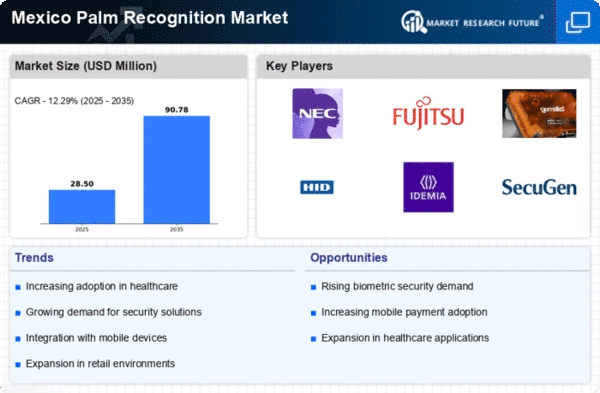
As per Market Research Future analysis, the Mexico Palm Recognition Market size was estimated at 25.38 USD Million in 2024. The Palm Recognition market is projected to grow from 28.5 USD Million in 2025 to 90.78 USD Million by 2035, exhibiting a compound annual growth rate (CAGR) of 12.2% during the forecast period 2025 - 2035

Key Market Trends & Highlights

The Mexico palm recognition market is poised for substantial growth driven by technological advancements and increasing security demands.

  • Technological advancements in biometric solutions are enhancing the efficiency of palm recognition systems.
  • The largest segment in the Mexico palm recognition market is the security sector, while the fastest-growing segment is likely the consumer electronics sector.
  • Regulatory support is fostering a conducive environment for the adoption of palm recognition technologies.
  • Key market drivers include rising security concerns and increasing adoption of biometric solutions, which are shaping market dynamics.

Market Size & Forecast

2024 Market Size 25.38 (USD Million)
2035 Market Size 90.78 (USD Million)
CAGR (2025 - 2035) 12.29%

Major Players

NEC Corporation (JP), Fujitsu Limited (JP), Gemalto NV (NL), HID Global Corporation (US), IDEMIA (FR), SecuGen Corporation (US), Crossmatch Technologies (US), Innovatrics (SK)

Our Impact
Enabled $4.3B Revenue Impact for Fortune 500 and Leading Multinationals
Partnering with 2000+ Global Organizations Each Year
30K+ Citations by Top-Tier Firms in the Industry

Mexico Palm Recognition Market Trends

the Mexico Palm Recognition Market is experiencing notable growth, driven by advancements in biometric technology and increasing demand for secure authentication methods.. In Mexico, the adoption of palm recognition systems is gaining traction across various sectors, including banking, healthcare, and security. This trend is largely attributed to the need for enhanced security measures and the convenience offered by contactless biometric solutions. As organizations seek to improve user experience while ensuring data protection, palm recognition technology appears to be a viable option. Furthermore, the integration of artificial intelligence and machine learning into palm recognition systems is likely to enhance accuracy and efficiency, making these solutions more appealing to businesses. In addition, the regulatory environment in Mexico is evolving to support the implementation of biometric technologies. Government initiatives aimed at promoting digital transformation and cybersecurity are likely to foster a favorable landscape for the palm recognition market. As more companies recognize the benefits of adopting biometric solutions, the market is expected to expand further. The increasing awareness of privacy concerns among consumers may also drive demand for secure authentication methods, positioning palm recognition as a preferred choice for identity verification. Overall, the palm recognition market in Mexico is poised for growth, with technological advancements and regulatory support playing crucial roles in its development.

Technological Advancements

Recent innovations in biometric technology are enhancing the capabilities of palm recognition systems. These advancements include improved algorithms and sensors that increase accuracy and speed, making the technology more reliable for various applications.

Regulatory Support

The Mexican government is actively promoting the use of biometric technologies through policies aimed at enhancing cybersecurity. This regulatory support is likely to encourage businesses to adopt palm recognition systems as part of their security measures.

Growing Demand for Security

As security concerns rise across multiple sectors, there is an increasing demand for effective authentication methods. Palm recognition offers a contactless solution that meets the needs of organizations seeking to protect sensitive information.

Mexico Palm Recognition Market Drivers

Rising Security Concerns

In Mexico, the escalating concerns regarding security and personal safety are significantly influencing the palm recognition market. With increasing incidents of crime and identity fraud, both public and private sectors are prioritizing the implementation of robust security measures. the palm recognition market is positioned to benefit from this heightened awareness, as it provides a reliable and efficient means of verifying identities.. Government initiatives aimed at enhancing public safety are likely to drive investments in biometric technologies, including palm recognition systems. As organizations seek to protect sensitive information and ensure secure access to facilities, the demand for palm recognition solutions is expected to rise. This trend may lead to a market growth rate of around 12% annually, reflecting the urgent need for advanced security solutions in various industries.

Consumer Awareness and Acceptance

The growing awareness and acceptance of biometric technologies among consumers are contributing to the expansion of the palm recognition market in Mexico. As individuals become more informed about the benefits of biometric solutions, including enhanced security and convenience, the demand for palm recognition systems is likely to increase. Educational campaigns and demonstrations by technology providers are helping to dispel misconceptions and promote the advantages of using palm recognition for identity verification. This shift in consumer perception is crucial, as it encourages businesses to adopt these technologies to meet customer expectations. Market analysts suggest that as consumer acceptance rises, the palm recognition market could witness a growth rate of approximately 10% annually, reflecting the increasing integration of biometric solutions in everyday life.

Government Initiatives and Funding

Government initiatives aimed at promoting technological innovation and security are playing a crucial role in the palm recognition market in Mexico. Various programs and funding opportunities are being introduced to support the development and implementation of biometric technologies. These initiatives are designed to enhance public safety and streamline administrative processes, thereby creating a favorable environment for the palm recognition market. For instance, the Mexican government has allocated significant resources to improve security infrastructure, which includes the adoption of biometric systems. This support is expected to drive market growth, as public institutions and private enterprises increasingly turn to palm recognition solutions to meet regulatory requirements and enhance operational efficiency. The potential for government contracts in this sector may further stimulate investment in palm recognition technologies.

Increasing Adoption of Biometric Solutions

the palm recognition market in Mexico is experiencing a notable surge in the adoption of biometric solutions, across various sectors.. Organizations are increasingly recognizing the need for secure and efficient identification methods, particularly in banking, healthcare, and government services. This trend is driven by the growing concerns over identity theft and fraud, prompting businesses to invest in advanced biometric technologies. According to recent data, the biometric market in Mexico is projected to grow at a CAGR of approximately 15% over the next five years. This growth is likely to bolster the palm recognition market, as companies seek to enhance security measures and streamline user authentication processes. The integration of palm recognition technology into existing systems is becoming a priority, as it offers a non-intrusive and user-friendly alternative to traditional methods.

Technological Integration in Smart Devices

The integration of palm recognition technology into smart devices is emerging as a key driver for the palm recognition market in Mexico. As consumers increasingly demand seamless and secure access to their devices, manufacturers are incorporating biometric solutions to enhance user experience. This trend is particularly evident in smartphones and tablets, where palm recognition offers a convenient alternative to passwords and PINs. The market for smart devices in Mexico is projected to reach $10 billion by 2026, with a significant portion attributed to the adoption of biometric technologies. This shift towards biometric-enabled devices is likely to propel the palm recognition market, as consumers seek innovative solutions that combine security with convenience. The growing trend of smart home devices also presents opportunities for palm recognition technology to be integrated into everyday applications.


Market Segment Insights

By Offering: Hardware (Largest) vs. Software & Services (Fastest-Growing)

In the Mexico palm recognition market, the hardware segment holds the largest share, driven by the increasing demand for advanced imaging technologies and user-friendly devices. This segment comprises various components such as cameras, sensors, and recognition systems that together form a robust solution for palm recognition applications. On the other hand, the software and services segment is rapidly gaining traction, with significant growth attributed to the rise in demand for integrated solutions and analytics that enhance the overall user experience. The growth trends indicate a dynamic shift towards innovative software solutions, reflecting an increased emphasis on security and efficiency within diverse industries such as banking and healthcare. The driver behind this expansion is the rising need for biometric authentication methods, leading companies to invest in more effective software and service options. Additionally, partnerships between hardware producers and software developers are poised to accelerate this segment’s growth, enabling the delivery of comprehensive and smart recognition solutions.

Hardware (Dominant) vs. Software & Services (Emerging)

The hardware segment is characterized by its established presence and reliability in the market. With substantial investments in sophisticated imaging technologies, companies are focusing on enhancing the performance and accuracy of palm recognition systems. These systems are crucial in applications that require high-level security and verification. In contrast, the software and services segment represents an emerging force, offering analytics and integration capabilities that complement hardware solutions. This dual approach not only optimizes performance but also provides users with comprehensive security management solutions. As the demand for biometric recognition continues to grow, both segments are poised to evolve, with hardware maintaining its dominance and software services rapidly adapting to meet emerging security challenges.

By Product: Finger Vein Biometrics (Largest) vs. Palm Vein Biometrics (Fastest-Growing)

In the Mexico palm recognition market, Finger Vein Biometrics holds the largest share, driven by its proven reliability and accuracy in identification processes. This segment's established presence makes it a preferred choice across various sectors, including banking and security, where high security is paramount. On the other hand, Palm Vein Biometrics, while currently smaller in market share, is rapidly gaining traction due to advancements in technology and increasing adoption rates in access control applications. The growth trends within the segment reveal a significant shift towards the adoption of Palm Vein Biometrics. Factors contributing to this include heightened awareness of biometric security measures and a growing preference for contactless solutions. These drivers indicate that while Finger Vein Biometrics remains dominant, the emerging trends suggest a promising future for Palm Vein technologies, potentially reshaping competitive dynamics within the sector.

Biometric Solutions: Finger Vein (Dominant) vs. Palm Vein (Emerging)

Finger Vein Biometrics is characterized by its high security and accuracy, making it an essential solution for organizations needing reliable identification methods. Its dominance in the market stems from extensive application across various industries like finance and healthcare. Conversely, Palm Vein Biometrics, as an emerging solution, is being adopted for its benefits such as reduced contact needs and enhanced user convenience. As enterprises increasingly prioritize user-friendly and hygienic solutions, Palm Vein technology is expected to penetrate the market further, appealing to a broader range of applications. The growing integration of these biometric solutions into various systems marks a significant trend shaping the future of biometrics in Mexico.

By Authentication: Unimodal Biometric System (Largest) vs. Multimodal Biometric System (Fastest-Growing)

In the Mexico palm recognition market, Unimodal Biometric Systems hold the largest share, driven by their simplicity and effectiveness in various applications. This segment benefits from widespread acceptance in security and access control sectors. Meanwhile, Multimodal Biometric Systems, which combine multiple biometric inputs for enhanced accuracy, are gaining traction and are positioned as the fastest-growing segment due to increasing demand for security and user authentication improvements. The growth of Multimodal Biometric Systems is attributed to technological advancements and the rising need for secure authentication methods across various industries in Mexico. Organizations are investing in integrated security solutions that offer greater reliability and ease of use. This trend indicates a shift towards more sophisticated authentication mechanisms, encouraging further innovations within the sector, and highlighting the importance of biometric technologies in addressing security challenges.

Authentication: Unimodal Biometric System (Dominant) vs. Multimodal Biometric System (Emerging)

Unimodal Biometric Systems are characterized by their reliance on a single biometric trait, such as palm prints. This dominant approach offers a reliable and straightforward solution for various authentication scenarios, making it a preferred choice for many applications in the Mexico palm recognition market. On the other hand, Multimodal Biometric Systems are emerging as a significant alternative, leveraging multiple biometric indicators to enhance accuracy and minimize false acceptance rates. As organizations seek to bolster security measures, this segment is increasingly recognized for its potential in high-stakes environments. The growth of both segments reflects the evolving landscape of biometric technology, with each offering unique advantages tailored to specific security needs.

By Functionality: Physical Access Control & Biometric Identification (Largest) vs. Embedded System (Fastest-Growing)

In the Mexico palm recognition market, Physical Access Control & Biometric Identification occupies the largest share of the segment, demonstrating its crucial role in enhancing security measures across various sectors. This segment continues to dominate due to increasing security concerns and the need for reliable identification methods. Meanwhile, Logical Access Control & Biometric Identification represents a significant portion of the market, catering to the growing demand for secure digital access mechanisms. The growth trends within the Mexico palm recognition market indicate a robust surge in the adoption of Embedded Systems, which are recognized as the fastest-growing segment. Factors driving this trend include technological advancements, the integration of biometric systems into everyday applications, and the rising need for efficient and secure authentication methods. As more businesses and institutions look to modernize their access control systems, the shift toward more sophisticated embedded solutions is expected to accelerate.

Physical Access Control & Biometric Identification (Dominant) vs. Embedded System (Emerging)

Physical Access Control & Biometric Identification is currently the dominant player in the Mexico palm recognition market, recognized for its effectiveness in fulfilling physical security requirements in a variety of industries including government, corporate, and educational sectors. This segment is characterized by robust biometric features that ensure accurate and swift identity verification. In contrast, the Embedded System segment is emerging rapidly, driven by innovations that allow for seamless integration of biometric recognition into devices. This adaptability is appealing to a wide range of applications, from consumer electronics to automated banking systems, signaling a shift towards personalized and efficient user experiences. The evolution of both segments highlights a dynamic landscape influenced by security necessities and technological advancements.

By Vertical: BFSI (Largest) vs. Commercial (Fastest-Growing)

In the Mexico palm recognition market, the BFSI sector dominates the vertical segment, capturing a significant share of the overall market. This large share is driven by the increasing adoption of biometric authentication solutions for secure transactions and customer verification. The commercial sector, while smaller, is rapidly gaining traction due to the growing need for enhanced security measures in retail and service industries, enabling businesses to improve customer experiences and reduce fraud. The growth trends in this segment highlight a strong upward trajectory, particularly for the commercial sector, which is evolving as the fastest-growing vertical. Factors such as the rising awareness of security threats, advancements in palm recognition technology, and increasing investment in biometric systems are propelling this growth. Furthermore, regulatory requirements in various industries are driving the adoption of these solutions, ensuring sustained demand across all verticals.

BFSI (Dominant) vs. Commercial (Emerging)

The BFSI segment is characterized by its robust demand for identity verification systems, benefiting from stringent security standards and an established infrastructure that supports biometric technologies. This vertical is integral to maintaining customer trust and compliance in financial operations. On the other hand, the commercial segment is emerging with its unique needs for enhanced security and user-friendly solutions. This vertical is capturing the attention of retail and hospitality sectors, focusing on seamless customer experiences. With innovation in palm recognition technology, the commercial sector is positioned for substantial growth, leveraging biometric solutions to mitigate security risks and streamline operations, ultimately aiming to match the advanced offerings of the BFSI segment.

By Application: Access Control & Biometric Identification (Largest) vs. User Authentication (Fastest-Growing)

In the Mexico palm recognition market, the application segment is predominantly led by Access Control & Biometric Identification, which holds the largest share due to its widespread adoption in security systems across various sectors. OEM Terminal Devices also contribute significantly, but their share tends to be overshadowed by the more established Access Control applications. User Authentication represents a smaller segment currently, yet its importance is rapidly increasing as digital identification solutions gain traction. The growth trends within this segment highlight a strong inclination towards User Authentication as organizations recognize the need for enhanced security measures in digital transactions. Factors driving this growth include technological advancements, increasing awareness about identity theft, and regulatory compliance requirements. As these trends continue, User Authentication is expected to emerge as a pivotal player in the Mexico palm recognition market, reflecting changing consumer preferences and adoption of biometric solutions.

Access Control & Biometric Identification (Dominant) vs. User Authentication (Emerging)

Access Control & Biometric Identification is characterized by its integral role in security and surveillance, with applications in various industries such as banking, transportation, and public facilities. This segment has established itself as the dominant force in the Mexico palm recognition market, driven by the necessity for robust identity verification systems. On the other hand, User Authentication is an emerging segment focused on securing digital identities and transactions, which is gaining momentum due to the increasing prevalence of online services. As consumers and businesses seek reliable ways to authenticate identities, User Authentication is becoming increasingly relevant, presenting exciting opportunities for growth and innovation in the biometric landscape.

Get more detailed insights about Mexico Palm Recognition Market

Key Players and Competitive Insights

The palm recognition market in Mexico is characterized by a dynamic competitive landscape, driven by technological advancements and increasing demand for secure identification solutions. Key players such as NEC Corporation (Japan), Fujitsu Limited (Japan), and IDEMIA (France) are at the forefront, each adopting distinct strategies to enhance their market presence. NEC Corporation (Japan) focuses on innovation through the development of advanced biometric systems, while Fujitsu Limited (Japan) emphasizes partnerships with local firms to expand its reach. IDEMIA (France) is leveraging its expertise in digital identity solutions to cater to the growing need for secure authentication in various sectors, including finance and government. Collectively, these strategies contribute to a competitive environment that is increasingly oriented towards technological sophistication and customer-centric solutions.In terms of business tactics, companies are localizing manufacturing and optimizing supply chains to enhance operational efficiency. The market structure appears moderately fragmented, with several players vying for market share. However, the influence of major companies is significant, as they set benchmarks for innovation and service quality. This competitive structure fosters an environment where smaller firms may struggle to keep pace with the technological advancements and customer expectations established by the leading players.

In October NEC Corporation (Japan) announced a strategic partnership with a leading Mexican technology firm to co-develop a new palm recognition system tailored for the financial sector. This collaboration is expected to enhance the security of financial transactions, reflecting NEC's commitment to innovation and local market adaptation. Such partnerships are crucial as they allow for the integration of local insights into product development, thereby increasing the relevance of solutions offered.

In September Fujitsu Limited (Japan) launched a new palm recognition technology that integrates AI capabilities to improve accuracy and speed. This development is particularly significant as it positions Fujitsu to meet the rising demand for efficient biometric solutions in various applications, from access control to payment systems. The incorporation of AI not only enhances performance but also aligns with broader trends towards digital transformation in the identification sector.

In August IDEMIA (France) expanded its operations in Mexico by opening a new research and development center focused on biometric technologies. This move underscores IDEMIA's long-term commitment to the region and its strategy to innovate locally. By investing in R&D, IDEMIA aims to tailor its offerings to meet the specific needs of the Mexican market, thereby strengthening its competitive position.

As of November current trends in the palm recognition market are heavily influenced by digitalization, sustainability, and the integration of AI technologies. Strategic alliances are increasingly shaping the competitive landscape, enabling companies to pool resources and expertise. Looking ahead, it is likely that competitive differentiation will evolve, with a shift from price-based competition to a focus on innovation, technological advancement, and supply chain reliability. This transition suggests that companies that prioritize these aspects will be better positioned to thrive in an increasingly complex market.

Key Companies in the Mexico Palm Recognition Market include

Industry Developments

Recent developments in the Mexico Palm Recognition Market indicate robust growth driven by advancements in biometric technology and a rising emphasis on security solutions. Companies such as idemia, Crossmatch, and SecuGen have been expanding their product offerings, focusing on improving the accuracy and speed of palm recognition systems. In terms of current affairs, a significant partnership was established in March 2023 between M2SYS Technology and a leading Mexican security firm to enhance biometric solutions for governmental institutions, providing increased funding and research opportunities. 

Over the past couple of years, companies have experienced notable growth; for instance, Fingerprint Cards AB reported an increase in market valuation due to rising demand for palm biometrics in various sectors, including finance and healthcare. Noteworthy happenings include Gemalto launching a new series of biometric devices in January 2022 aimed at the retail market in Mexico, showcasing how retail security is becoming a priority. 

Regarding mergers and acquisitions, no recent public reports were available pertaining to the companies of interest in this sector within Mexico. The overall trend indicates that the palm recognition technology market is poised for further expansion, driven by both innovative developments and increasing investments in biometric systems.

Future Outlook

Mexico Palm Recognition Market Future Outlook

the Palm Recognition Market is projected to grow at a 12.29% CAGR from 2025 to 2035, driven by advancements in biometric technology and increasing security demands..

New opportunities lie in:

  • Integration of palm recognition in mobile payment systems
  • Development of palm-based access control solutions for enterprises
  • Partnerships with healthcare providers for patient identification systems

By 2035, the palm recognition market is expected to achieve substantial growth and widespread adoption.

Market Segmentation

Mexico Palm Recognition Market Product Outlook

  • Finger Vein Biometrics
  • Palm Vein Biometrics

Mexico Palm Recognition Market Offering Outlook

  • Hardware
  • Software & Services

Mexico Palm Recognition Market Vertical Outlook

  • BFSI
  • Commercial
  • Industrial
  • Others

Mexico Palm Recognition Market Application Outlook

  • Access Control & Biometric Identification
  • OEM Terminal Devices
  • User Authentication
  • Others

Mexico Palm Recognition Market Functionality Outlook

  • Physical Access Control & Biometric Identification
  • Logical Access Control & Biometric Identification
  • Embedded System

Mexico Palm Recognition Market Authentication Outlook

  • Unimodal Biometric System
  • Multimodal Biometric System

Report Scope

MARKET SIZE 2024 25.38(USD Million)
MARKET SIZE 2025 28.5(USD Million)
MARKET SIZE 2035 90.78(USD Million)
COMPOUND ANNUAL GROWTH RATE (CAGR) 12.29% (2025 - 2035)
REPORT COVERAGE Revenue Forecast, Competitive Landscape, Growth Factors, and Trends
BASE YEAR 2024
Market Forecast Period 2025 - 2035
Historical Data 2019 - 2024
Market Forecast Units USD Million
Key Companies Profiled NEC Corporation (JP), Fujitsu Limited (JP), Gemalto NV (NL), HID Global Corporation (US), IDEMIA (FR), SecuGen Corporation (US), Crossmatch Technologies (US), Innovatrics (SK)
Segments Covered Offering, Product, Authentication, Functionality, Vertical, Application
Key Market Opportunities Integration of palm recognition technology in security systems enhances user authentication and access control.
Key Market Dynamics Rising demand for secure authentication drives innovation in palm recognition technology across various sectors in Mexico.
Countries Covered Mexico
Leave a Comment

FAQs

What was the projected market size of the Mexico Palm Recognition Market in 2024?

The Mexico Palm Recognition Market was valued at 23.31 million USD in 2024.

What will be the market size of the Mexico Palm Recognition Market by 2035?

By 2035, the Mexico Palm Recognition Market is projected to reach 90.36 million USD.

What is the expected compound annual growth rate (CAGR) for the Mexico Palm Recognition Market between 2025 and 2035?

The expected CAGR for the Mexico Palm Recognition Market from 2025 to 2035 is 13.11%.

How is the Mexico Palm Recognition Market segmented by offering?

The Mexico Palm Recognition Market is segmented into hardware, software, and services offerings.

What was the estimated value of hardware offerings in the Mexico Palm Recognition Market for 2024?

In 2024, the hardware offerings in the Mexico Palm Recognition Market are valued valued at 9.33 million USD.

What is the expected value of software and services in the Mexico Palm Recognition Market by 2035?

By 2035, the software and services segment in the Mexico Palm Recognition Market is expected to reach 53.46 million USD.

Who are the major players in the Mexico Palm Recognition Market?

Key players in the Mexico Palm Recognition Market include Cognitive Security, SecuGen, M2SYS Technology, and Idemia, among others.

What are the applications driving growth in the Mexico Palm Recognition Market?

Applications in security, access control, and identity verification are key drivers of growth in the Mexico Palm Recognition Market.

What will be the estimated value of hardware offerings in the Mexico Palm Recognition Market by 2035?

The estimated value of hardware offerings in the Mexico Palm Recognition Market is projected to reach 36.9 million USD by 2035.

What challenges does the Mexico Palm Recognition Market face in the coming years?

Challenges in the Mexico Palm Recognition Market include competition from alternative biometric technologies and data privacy concerns.

Download Free Sample

Kindly complete the form below to receive a free sample of this Report

Compare Licence

×
Features License Type
Single User Multiuser License Enterprise User
Price $4,950 $5,950 $7,250
Maximum User Access Limit 1 User Upto 10 Users Unrestricted Access Throughout the Organization
Free Customization
Direct Access to Analyst
Deliverable Format
Platform Access
Discount on Next Purchase 10% 15% 15%
Printable Versions