×
Request Free Sample ×

Kindly complete the form below to receive a free sample of this Report

* Please use a valid business email

Leading companies partner with us for data-driven Insights

clients tt-cursor
Hero Background

Canada Palm Recognition Market

ID: MRFR/ICT/59501-HCR
200 Pages
Aarti Dhapte
February 2026

Canada Palm Recognition Market Size, Share and Trends Analysis Report By Offering (Hardware, Software & Services), By Product (Finger Vein Biometrics, Palm Vein Biometrics), By Authentication (Unimodal Biometric System, Multimodal Biometric System), By Functionality (Physical Access Control & Biometric Identification, Logical Access Control & Biometric Identification, Embedded System), By Vertical (BFSI, Commercial, Industrial, Others) and By Application (Access Control & Biometric Identification, OEM Terminal Devices, User Authentication, Others)-Forecast to 2035

Share:
Download PDF ×

We do not share your information with anyone. However, we may send you emails based on your report interest from time to time. You may contact us at any time to opt-out.

Canada Palm Recognition Market Infographic
Purchase Options

Canada Palm Recognition Market Summary

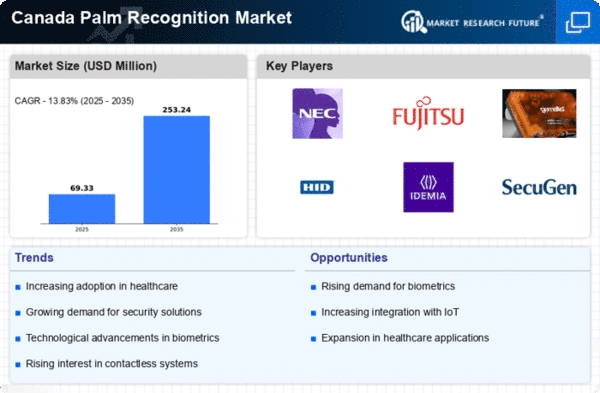
As per Market Research Future analysis, the Canada Palm Recognition Market Size was estimated at 60.91 USD Million in 2024. The Canada palm recognition market is projected to grow from 69.33 USD Million in 2025 to 253.24 USD Million by 2035, exhibiting a compound annual growth rate (CAGR) of 13.8% during the forecast period 2025 - 2035

Key Market Trends & Highlights

The Canada palm recognition market is experiencing robust growth driven by technological advancements and increasing demand for contactless solutions.

  • Technological advancements are enhancing the accuracy and efficiency of palm recognition systems.
  • The healthcare segment is the largest, driven by the need for secure patient identification and access control.
  • Regulatory support is fostering the adoption of palm recognition technologies across various sectors.
  • Increased security concerns and integration with smart technologies are major drivers propelling market growth.

Market Size & Forecast

2024 Market Size 60.91 (USD Million)
2035 Market Size 253.24 (USD Million)
CAGR (2025 - 2035) 13.83%

Major Players

NEC Corporation (JP), Fujitsu Limited (JP), Gemalto NV (NL), HID Global Corporation (US), IDEMIA (FR), SecuGen Corporation (US), Crossmatch Technologies (US), M2SYS Technology (US)

Our Impact
Enabled $4.3B Revenue Impact for Fortune 500 and Leading Multinationals
Partnering with 2000+ Global Organizations Each Year
30K+ Citations by Top-Tier Firms in the Industry

Canada Palm Recognition Market Trends

The palm recognition market is experiencing notable growth. This growth is driven by advancements in biometric technology and an increasing demand for secure authentication methods. As organizations seek to enhance security measures, the adoption of palm recognition systems is becoming more prevalent across various sectors, including finance, healthcare, and government. This trend is further supported by the rising awareness of identity theft and the need for reliable identification solutions. Moreover, the integration of artificial intelligence and machine learning into palm recognition systems is likely to improve accuracy and efficiency, making these technologies more appealing to businesses and consumers alike. In addition, the regulatory landscape in Canada is evolving to accommodate the growing use of biometric technologies. Government initiatives aimed at promoting digital security and privacy are influencing the adoption of palm recognition systems. As organizations comply with these regulations, the market is expected to expand further. The increasing focus on contactless solutions, particularly in public spaces, is also contributing to the market's growth. Overall, the palm recognition market appears poised for continued expansion, driven by technological advancements and a heightened emphasis on security and privacy.

Technological Advancements

Recent innovations in biometric technology are enhancing the capabilities of palm recognition systems. These advancements include improved imaging techniques and algorithms that increase accuracy and speed. As a result, businesses are more inclined to adopt these systems for secure access and identification.

Regulatory Support

The evolving regulatory framework in Canada is fostering the adoption of biometric solutions. Government policies aimed at enhancing digital security and privacy are encouraging organizations to implement palm recognition systems, thereby driving market growth.

Rising Demand for Contactless Solutions

The growing preference for contactless technologies is influencing the palm recognition market. As consumers and businesses seek safer methods of identification, palm recognition systems are becoming increasingly attractive due to their non-invasive nature.

Canada Palm Recognition Market Drivers

Rising Consumer Awareness

Consumer awareness regarding the benefits of biometric authentication is on the rise in Canada, positively impacting the palm recognition market. As individuals become more informed about the advantages of secure and convenient access methods, the demand for palm recognition solutions is expected to increase. This awareness is fueled by educational campaigns and the visibility of biometric technologies in everyday applications, such as mobile payments and secure access to personal devices. The palm recognition market may see a notable uptick in adoption rates as consumers prioritize security and convenience in their interactions with technology.

Increased Security Concerns

The palm recognition market in Canada is experiencing growth due to heightened security concerns across various sectors. Organizations are increasingly adopting biometric solutions to enhance security measures, particularly in sensitive environments such as financial institutions and government facilities. The need for robust authentication methods is underscored by rising incidents of identity theft and fraud. As a result, the palm recognition market is projected to expand, with estimates suggesting a compound annual growth rate (CAGR) of approximately 15% over the next five years. This trend indicates a strong demand for advanced biometric systems that can provide secure access while ensuring user convenience.

Growing Adoption in Healthcare

The healthcare sector in Canada is increasingly adopting palm recognition technology to streamline patient identification and enhance security protocols. Hospitals and clinics are recognizing the potential of biometric systems to reduce errors associated with patient misidentification, which can lead to serious consequences. The palm recognition market is poised to grow. This growth is due to healthcare facilities investing in these systems to improve operational efficiency and patient safety. With healthcare expenditures in Canada projected to reach $300 billion by 2026, the demand for reliable identification methods is likely to drive the adoption of palm recognition solutions in this sector.

Supportive Government Initiatives

Government initiatives aimed at promoting biometric technologies are contributing to the growth of the palm recognition market in Canada. Various programs and funding opportunities are being introduced to encourage the development and implementation of advanced security solutions. These initiatives are designed to enhance national security and improve public safety, thereby creating a favorable environment for the adoption of palm recognition systems. As the government invests in technology infrastructure, the palm recognition market is likely to benefit from increased funding and support, fostering innovation and expansion within the industry.

Integration with Smart Technologies

The integration of palm recognition technology with smart devices is driving innovation within the industry. As smart home and IoT devices proliferate, the demand for seamless and secure user authentication methods is increasing. This integration allows for enhanced user experiences, as palm recognition can facilitate quick access to devices and services. In Canada, the market for smart devices is expected to reach $10 billion by 2026, indicating a significant opportunity for palm recognition solutions to be embedded in these technologies. This trend suggests that the palm recognition market will likely benefit from the growing interconnectedness of devices.


Market Segment Insights

By Offering: Hardware (Largest) vs. Software & Services (Fastest-Growing)

In the Canada palm recognition market, Hardware holds the largest share of the offering segment, driven by its essential role in the effectiveness of palm recognition systems. This segment benefits from a consistent demand for advanced hardware solutions that enhance recognition accuracy and speed. As businesses and institutions increasingly implement these systems, Hardware continues to dominate the market, positioning itself as a foundation for other offerings. Conversely, Software & Services is the fastest-growing segment, driven by the growing need for integration and continual support. As technology evolves, software solutions are being developed to offer improved functionalities, leading to a rising adoption rate. Factors such as enhanced security protocols and the need for user-friendly interfaces are fueling growth in this area, making it a pivotal part of the overall offering.

Hardware (Dominant) vs. Software & Services (Emerging)

The Hardware segment in the Canada palm recognition market is marked by robust performance and dominance, primarily due to the necessity of high-quality equipment for successful palm recognition implementations. This segment includes biometric scanners, processing units, and supportive infrastructure, which are integral to delivering reliable and efficient recognition services. In comparison, the Software & Services segment, while emerging, showcases significant potential for growth. It encompasses the development of sophisticated algorithms, application interfaces, and service provision for system maintenance. This sector is becoming increasingly important as organizations seek to enhance the functionality of their hardware investments, leading to a synergistic relationship between both segments.

By Product: Finger Vein Biometrics (Largest) vs. Palm Vein Biometrics (Fastest-Growing)

In the Canada palm recognition market, Finger Vein Biometrics holds the largest market share, primarily due to its established presence and reliability in security applications. Its adoption across various sectors such as banking, healthcare, and government has strengthened its market position, making it a preferred choice among organizations that require high security levels. On the other hand, Palm Vein Biometrics is recognized as the fastest-growing segment. This surge is driven by advancements in technology and increasing consumer awareness about biometric solutions. As organizations seek more efficient and contactless authentication methods, palm vein recognition is gaining traction, positioning itself as a strong competitor in the market.

Fingerprint Biometrics (Dominant) vs. Palm Vein Biometrics (Emerging)

Fingerprint Biometrics is characterized by its deep integration into existing security frameworks and widespread consumer acceptance, making it a dominant force in the Canada palm recognition market. Its reliability and efficiency in identification processes have resulted in significant usage across various industries. In contrast, Palm Vein Biometrics, while currently labeled as an emerging segment, is rapidly innovating with new technology that enhances accuracy and user convenience. Its unique advantages, such as reduced fraud risk and improved hygiene, are attracting attention from organizations looking to modernize their security systems, suggesting a promising future for this segment.

By Authentication: Unimodal Biometric System (Largest) vs. Multimodal Biometric System (Fastest-Growing)

In the Canada palm recognition market, the Unimodal Biometric System currently holds the largest market share. This segment benefits from its straightforward implementation and robust performance, making it a preferred choice among various sectors requiring identity verification. While this system stands strong, the Multimodal Biometric System is gaining traction due to its enhanced security features and ability to combine multiple biometric inputs, providing a more reliable solution for authentication. The growth trends in this segment are primarily driven by increased demand for high-security measures across various industries such as banking, healthcare, and government services. Additionally, advancements in technology are facilitating the development of more sophisticated biometric solutions. The awareness regarding the limitations of unimodal systems has propelled organizations to adopt multimodal systems, thus accelerating their growth in the market, marking them as the fastest-growing option in the authentication category.

Authentication: Unimodal Biometric System (Dominant) vs. Multimodal Biometric System (Emerging)

The Unimodal Biometric System stands out as the dominant force in the Canada palm recognition market, characterized by its reliance on a single biometric trait for authentication. This simplicity often translates to quicker user adoption, especially in scenarios where cost and ease of deployment are paramount. However, this system has faced challenges due to vulnerabilities in accuracy and security. In contrast, the emerging Multimodal Biometric System integrates various biometric modalities, enhancing security through multiple authentication factors. Its ability to mitigate the weaknesses of unimodal systems by combining different biometric characteristics distinguishes it as a forward-looking solution for industries seeking cutting-edge security measures. As organizations increasingly prioritize robust authentication methods, the multimodal approach is likely to garner significant market interest.

By Functionality: Physical Access Control & Biometric Identification (Largest) vs. Logical Access Control & Biometric Identification (Fastest-Growing)

In the Canada palm recognition market, the distribution of market share among various functionalities highlights Physical Access Control & Biometric Identification as the largest segment. This segment continues to dominate due to its extensive applications in securing physical spaces and entry points. In contrast, Logical Access Control & Biometric Identification is emerging rapidly, driven by the necessity for secure data access and cyber protection solutions across various industries. Growth trends indicate that the demand for advanced biometric solutions is increasing, primarily due to rising concerns over security and identity verification. The shift towards digital solutions and the implementation of stricter security regulations are propelling the Logical Access Control segment, making it the fastest-growing area in this market. Additionally, advancements in technology, such as AI and machine learning, are enhancing the capabilities and efficiency of biometric systems, further driving growth across all functionality segments.

Physical Access Control & Biometric Identification (Dominant) vs. Logical Access Control & Biometric Identification (Emerging)

Physical Access Control & Biometric Identification represents the dominant segment in the Canada palm recognition market. It is characterized by its robust applications in safeguarding infrastructures, offices, and restricted areas through physical authentication methods. This segment is fortified by various technologies including fingerprint and facial recognition systems that provide both security and convenience. On the other hand, Logical Access Control & Biometric Identification is emerging as a significant player, emphasizing digital security in online environments. This segment is increasingly critical as businesses transition to remote operations and require secure access to sensitive data. Both segments reflect a growing integration of technology and user-friendly features, addressing the evolving demands for security in both physical and digital landscapes.

By Vertical: BFSI (Largest) vs. Commercial (Fastest-Growing)

The Canada palm recognition market showcases a diverse distribution among its vertical segments, with BFSI capturing the largest share due to its extensive adoption of biometric technologies for secure transactions and identity verification. Commercial applications are gaining traction, but currently hold a smaller market share as businesses increasingly recognize the benefits of palm recognition for customer engagement and security enhancements. Growth trends indicate that the BFSI sector will continue to dominate due to regulatory pressures and security needs, whereas the commercial sector is rapidly evolving, driven by technological advancements and the increasing emphasis on contactless payment systems. Emerging applications in retail and hospitality are expected to unlock new opportunities, making commercial the fastest-growing segment in the process.

BFSI (Dominant) vs. Commercial (Emerging)

BFSI stands as the dominant vertical in the Canada palm recognition market, heavily relying on palm recognition for secure banking and financial transactions. Institutions in this sector prioritize user authentication and anti-fraud measures, leading to significant investment in biometric solutions. In contrast, the commercial segment is emerging, characterized by a rapid adoption of palm recognition in retail settings for customer identification, access control, and personalized services. This growth is fueled by the demand for efficient, seamless customer experiences. As companies increasingly adopt innovative technologies to enhance security and service delivery, commercial applications are expected to expand significantly, positioning them as a key area of growth in the market.

By Application: Access Control & Biometric Identification (Largest) vs. User Authentication (Fastest-Growing)

In the Canada palm recognition market, market share distribution among various application segments indicates that Access Control & Biometric Identification dominates significantly, capturing a major portion of the market. The OEM Terminal Devices and Others segments hold moderate shares while User Authentication is rapidly emerging as a pivotal area of growth. This distribution reflects a strong emphasis on security and identification applications, catering to rising demands across both commercial and personal sectors. The growth trends within the market are primarily driven by advancements in biometric technology and increasing concerns over security and privacy. User Authentication is expected to witness the fastest growth as organizations seek more secure methods of confirming user identities. Technology integration across various sectors further fuels demand, highlighting the increasing reliance on biometric systems in everyday applications.

Access Control & Biometric Identification (Dominant) vs. User Authentication (Emerging)

Access Control & Biometric Identification serves as the dominant segment in the Canada palm recognition market, primarily due to heightened security demands across various industries including finance and healthcare. This segment employs advanced biometric solutions to enhance safety and streamline identification processes, making it a cornerstone for organizations aiming to protect sensitive data. In contrast, User Authentication represents an emerging segment characterized by rapid adoption as more businesses implement biometric systems to secure user access. The increasing prevalence of cybersecurity threats and the necessity for robust identification mechanisms make this segment vital. User Authentication not only complements established systems but also addresses specific needs in digital security, positioning it for significant expansion in the foreseeable future.

Get more detailed insights about Canada Palm Recognition Market

Key Players and Competitive Insights

The palm recognition market exhibits a dynamic competitive landscape, characterized by rapid technological advancements and increasing demand for biometric solutions across various sectors. Key growth drivers include the rising need for secure authentication methods and the integration of biometric systems in both public and private sectors. Major players such as NEC Corporation (Japan), Fujitsu Limited (Japan), and IDEMIA (France) are strategically positioned to leverage innovation and partnerships to enhance their market presence. Their operational focus on developing advanced palm recognition technologies and expanding their service offerings contributes to a competitive environment that is both collaborative and competitive.In terms of business tactics, companies are increasingly localizing manufacturing and optimizing supply chains to enhance efficiency and reduce costs. The market structure appears moderately fragmented, with several key players exerting influence over market dynamics. This fragmentation allows for a diverse range of solutions, catering to various customer needs while fostering competition among established and emerging firms.

In October Fujitsu Limited (Japan) announced a partnership with a leading Canadian financial institution to implement its palm recognition technology for secure banking transactions. This strategic move not only enhances the security of financial services but also positions Fujitsu as a frontrunner in the biometric authentication space, potentially increasing its market share in Canada. The collaboration underscores the growing trend of integrating biometric solutions into everyday financial operations, reflecting a shift towards more secure and user-friendly banking experiences.

In September IDEMIA (France) launched a new palm recognition system designed for high-security environments, such as government facilities and data centers. This innovation is significant as it addresses the increasing demand for robust security measures in sensitive areas. By focusing on high-security applications, IDEMIA aims to differentiate itself from competitors and capture a larger segment of the market that prioritizes advanced security solutions.

In August NEC Corporation (Japan) expanded its operations in Canada by establishing a new research and development center dedicated to biometric technologies, including palm recognition. This expansion reflects NEC's commitment to innovation and its strategy to enhance local capabilities. By investing in R&D, NEC is likely to accelerate the development of cutting-edge solutions tailored to the Canadian market, thereby strengthening its competitive position.

As of November current trends in the palm recognition market indicate a strong emphasis on digitalization, sustainability, and the integration of artificial intelligence (AI) into biometric systems. Strategic alliances among key players are shaping the landscape, fostering innovation and enhancing product offerings. The competitive differentiation is expected to evolve, with a notable shift from price-based competition towards a focus on technological advancements, reliability of supply chains, and the ability to deliver innovative solutions that meet the evolving needs of consumers and businesses alike.

Key Companies in the Canada Palm Recognition Market include

Industry Developments

The Canada Palm Recognition Market has seen notable advancements recently, particularly as organizations increasingly adopt biometric technologies to enhance security measures. In March 2023, Aware announced a significant partnership with a Canadian government agency to provide advanced biometric solutions, including palm recognition, improving identity verification processes. In July 2023, Innovatrics expanded its presence in Canada by setting up a new office focused on biometric research and development, signaling growth potential in the market.

Moreover, a robust collaboration emerged between HID Global and local authorities to integrate palm-based authentication in critical infrastructures. M2SYS Technology announced in August 2023 a strategic partnership with a prominent Canadian healthcare provider to deploy palm recognition systems for patient identification, showcasing the technology's application in health services.

While the market has largely thrived, the valuation of major players like NEC Corporation and IDEMIA has experienced enhancements, indicating increased interest and investment in biometric technologies. The Canadian government has also been actively promoting biometric systems for border security, thus augmenting the relevance and expansion opportunities for palm recognition technology in the region.

Future Outlook

Canada Palm Recognition Market Future Outlook

The Palm Recognition Market is projected to grow at a 13.83% CAGR from 2025 to 2035, driven by advancements in biometric technology and increasing security demands.

New opportunities lie in:

  • Integration of palm recognition in mobile payment systems
  • Development of palm-based access control solutions for enterprises
  • Partnerships with healthcare providers for patient identification systems

By 2035, the palm recognition market is expected to achieve substantial growth and widespread adoption.

Market Segmentation

Canada Palm Recognition Market Product Outlook

  • Finger Vein Biometrics
  • Palm Vein Biometrics

Canada Palm Recognition Market Offering Outlook

  • Hardware
  • Software & Services

Canada Palm Recognition Market Vertical Outlook

  • BFSI
  • Commercial
  • Industrial
  • Others

Canada Palm Recognition Market Application Outlook

  • Access Control & Biometric Identification
  • OEM Terminal Devices
  • User Authentication
  • Others

Canada Palm Recognition Market Functionality Outlook

  • Physical Access Control & Biometric Identification
  • Logical Access Control & Biometric Identification
  • Embedded System

Canada Palm Recognition Market Authentication Outlook

  • Unimodal Biometric System
  • Multimodal Biometric System

Report Scope

MARKET SIZE 2024 60.91(USD Million)
MARKET SIZE 2025 69.33(USD Million)
MARKET SIZE 2035 253.24(USD Million)
COMPOUND ANNUAL GROWTH RATE (CAGR) 13.83% (2025 - 2035)
REPORT COVERAGE Revenue Forecast, Competitive Landscape, Growth Factors, and Trends
BASE YEAR 2024
Market Forecast Period 2025 - 2035
Historical Data 2019 - 2024
Market Forecast Units USD Million
Key Companies Profiled NEC Corporation (JP), Fujitsu Limited (JP), Gemalto NV (NL), HID Global Corporation (US), IDEMIA (FR), SecuGen Corporation (US), Crossmatch Technologies (US), M2SYS Technology (US)
Segments Covered Offering, Product, Authentication, Functionality, Vertical, Application
Key Market Opportunities Integration of palm recognition technology in secure payment systems enhances user convenience and security.
Key Market Dynamics Rising demand for secure authentication drives innovation in palm recognition technology across various sectors in Canada.
Countries Covered Canada
Leave a Comment

FAQs

What is the expected market size of the Canada Palm Recognition Market in 2024?

The Canada Palm Recognition Market is expected to be valued at 41.95 million USD in 2024.

What will be the estimated market value of the Canada Palm Recognition Market by 2035?

By 2035, the Canada Palm Recognition Market is projected to reach a valuation of 211.37 million USD.

What is the expected compound annual growth rate (CAGR) for the Canada Palm Recognition Market from 2025 to 2035?

The market is expected to grow at a CAGR of 15.837 percent during the forecast period from 2025 to 2035.

What are the key players in the Canada Palm Recognition Market?

Major players include Aware, SecuGen, M2SYS Technology, SRI International, and IDEMIA among others.

What is the market size for hardware offerings in the Canada Palm Recognition Market by 2035?

The market size for hardware offerings is anticipated to be 76.0 million USD by 2035.

What is the expected market value for software and services in the Canada Palm Recognition Market by 2035?

The software and services segment is projected to reach 135.37 million USD by 2035.

How does the Canada Palm Recognition Market growth rate compare between hardware and software & services?

Both segments are experiencing significant growth, with hardware growing to 76.0 million USD and software & services reaching 135.37 million USD by 2035.

What are the emerging trends in the Canada Palm Recognition Market?

Emerging trends include increased biometric security adoption and advancements in technology enhancing recognition accuracy.

What challenges does the Canada Palm Recognition Market face?

Challenges include the need for high initial investment and concerns regarding data privacy and security.

What impact does the current global scenario have on the Canada Palm Recognition Market?

Current global trends may amplify the demand for biometric security solutions, thereby positively impacting market growth.

Download Free Sample

Kindly complete the form below to receive a free sample of this Report

Compare Licence

×
Features License Type
Single User Multiuser License Enterprise User
Price $4,950 $5,950 $7,250
Maximum User Access Limit 1 User Upto 10 Users Unrestricted Access Throughout the Organization
Free Customization
Direct Access to Analyst
Deliverable Format
Platform Access
Discount on Next Purchase 10% 15% 15%
Printable Versions