×
Request Free Sample ×

Kindly complete the form below to receive a free sample of this Report

* Please use a valid business email

Leading companies partner with us for data-driven Insights

clients tt-cursor
Hero Background

Mexico Dietary Supplements Market

ID: MRFR/FnB/44714-HCR
128 Pages
Varsha More
February 2026

Mexico Dietary Supplements Market Size, Share, Industry Trend & Analysis Research Report By Type (Vitamins, Minerals, Amino Acids Proteins, Probiotics, Blends), By form (Tablets, Capsules Softgels, Powders, Gummies) and By Distribution channel (Store, Non-store)- Forecast to 2035

Share:
Download PDF ×

We do not share your information with anyone. However, we may send you emails based on your report interest from time to time. You may contact us at any time to opt-out.

Mexico Dietary Supplements Market Infographic
Purchase Options

Mexico Dietary Supplements Market Summary

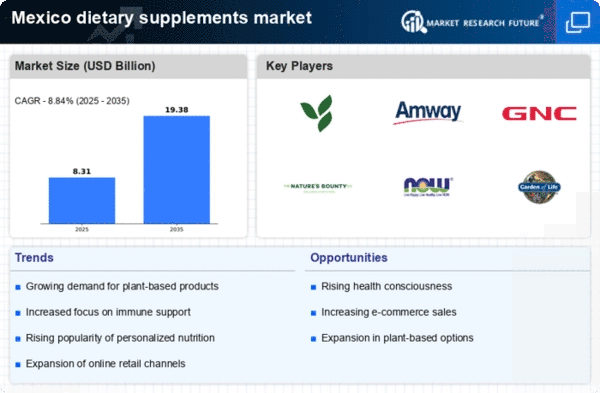
As per Market Research Future analysis, the Mexico dietary supplements market size was estimated at 7.63 USD Billion in 2024. The Mexico dietary supplements market is projected to grow from 8.31 USD Billion in 2025 to 19.38 USD Billion by 2035, exhibiting a compound annual growth rate (CAGR) of 8.8% during the forecast period 2025 - 2035

Key Market Trends & Highlights

The Mexico dietary supplements market is experiencing a notable shift towards natural ingredients and personalized nutrition.

  • The largest segment in the Mexico dietary supplements market is vitamins and minerals, while the fastest-growing segment is protein supplements.
  • There is a marked increase in demand for natural ingredients, reflecting a broader consumer trend towards health and wellness.
  • Online retail channels are expanding rapidly, providing consumers with greater access to a variety of dietary supplements.
  • Key market drivers include growing health consciousness and rising interest in preventive healthcare, which are shaping consumer preferences.

Market Size & Forecast

2024 Market Size 7.63 (USD Billion)
2035 Market Size 19.38 (USD Billion)
CAGR (2025 - 2035) 8.84%

Major Players

Herbalife (US), Amway (US), GNC Holdings (US), Nature's Bounty (US), NOW Foods (US), Garden of Life (US), NutraBio Labs (US), Optimum Nutrition (US), USANA Health Sciences (US)

Our Impact
Enabled $4.3B Revenue Impact for Fortune 500 and Leading Multinationals
Partnering with 2000+ Global Organizations Each Year
30K+ Citations by Top-Tier Firms in the Industry

Mexico Dietary Supplements Market Trends

The dietary supplements market in Mexico is currently experiencing notable growth, driven by increasing health awareness among consumers. This trend appears to be influenced by a shift towards preventive healthcare, where individuals are more inclined to invest in their well-being through nutritional products. The rising prevalence of lifestyle-related health issues, such as obesity and diabetes, has further propelled the demand for dietary supplements. Consumers are increasingly seeking products that support their health goals, including weight management, immune support, and overall wellness. This evolving landscape suggests a potential for innovation and diversification within the market, as companies strive to meet the changing preferences of health-conscious individuals. Moreover, the regulatory environment in Mexico is adapting to accommodate the growing dietary supplements market. Authorities are implementing stricter guidelines to ensure product safety and efficacy, which may enhance consumer trust. The rise of e-commerce platforms has also transformed the way consumers access these products, making them more readily available. As a result, the dietary supplements market is likely to continue expanding, with a focus on quality, transparency, and consumer education. This dynamic environment presents opportunities for both established brands and new entrants to capture market share by aligning their offerings with consumer demands and regulatory standards.

Increased Demand for Natural Ingredients

There is a growing preference for dietary supplements that contain natural and organic ingredients. Consumers are becoming more discerning, often seeking products that are free from artificial additives and preservatives. This trend indicates a shift towards holistic health approaches, where individuals prioritize clean and sustainable sourcing of their supplements.

Rise of Personalized Nutrition

The concept of personalized nutrition is gaining traction within the dietary supplements market. Consumers are increasingly interested in products tailored to their specific health needs and goals. This trend suggests a move towards customization, where brands may offer solutions based on individual health assessments or genetic profiles.

Expansion of Online Retail Channels

The dietary supplements market is witnessing a significant shift towards online retail. E-commerce platforms are becoming the preferred shopping method for many consumers, providing convenience and a wider selection of products. This trend highlights the importance of digital marketing strategies for brands aiming to reach a broader audience.

Mexico Dietary Supplements Market Drivers

Aging Population

Mexico's demographic shift towards an aging population is significantly influencing the dietary supplements market. With a growing number of individuals aged 60 and above, there is an increasing need for products that cater to age-related health concerns. This demographic is often more susceptible to chronic diseases and nutritional deficiencies, leading to a heightened interest in dietary supplements that support joint health, cognitive function, and cardiovascular health. It is estimated that by 2030, the elderly population in Mexico will account for over 20% of the total population, thereby expanding the market for dietary supplements tailored to this age group. The dietary supplements market is thus poised for growth as manufacturers develop targeted products to meet the specific needs of older consumers.

Growing Health Consciousness

The increasing awareness of health and wellness among the Mexican population appears to be a primary driver for the dietary supplements market. As individuals become more informed about nutrition and its impact on overall health, the demand for dietary supplements is likely to rise. Reports indicate that approximately 60% of Mexicans actively seek ways to improve their health, which includes the consumption of vitamins, minerals, and herbal supplements. This trend is further supported by a shift towards preventive healthcare, where consumers prefer to invest in supplements to avoid potential health issues. The dietary supplements market is thus experiencing a surge in demand, particularly for products that promote immunity, energy, and overall well-being.

Regulatory Support and Quality Assurance

The Mexican government has been actively promoting the dietary supplements market through regulatory frameworks that ensure product safety and efficacy. The establishment of guidelines by the Federal Commission for the Protection against Sanitary Risk (COFEPRIS) has fostered consumer trust in dietary supplements. This regulatory support is crucial as it encourages manufacturers to adhere to quality standards, thereby enhancing the credibility of the dietary supplements market. As consumers become more discerning about product quality, the presence of stringent regulations is likely to drive growth in the market. Furthermore, the emphasis on quality assurance may lead to increased investment in research and development, resulting in innovative products that cater to evolving consumer preferences.

Rising Interest in Preventive Healthcare

The growing trend towards preventive healthcare is significantly impacting the dietary supplements market in Mexico. Consumers are increasingly recognizing the importance of maintaining health and preventing illness rather than solely treating conditions as they arise. This shift in mindset is driving demand for dietary supplements that support immune function, digestive health, and overall vitality. Market data indicates that the preventive healthcare segment is expected to grow by approximately 15% annually, reflecting a broader societal trend towards proactive health management. The dietary supplements market is thus benefiting from this paradigm shift, as consumers seek out products that align with their health goals and lifestyle choices.

Influence of Social Media and Digital Marketing

The rise of social media and digital marketing strategies is reshaping the dietary supplements market in Mexico. Brands are increasingly leveraging platforms like Instagram and Facebook to reach health-conscious consumers, particularly millennials and Generation Z. This demographic is known for its reliance on online information and peer recommendations when making purchasing decisions. As a result, the dietary supplements market is witnessing a shift towards more engaging and informative marketing campaigns that highlight product benefits and user testimonials. Data suggests that nearly 70% of young consumers in Mexico are influenced by social media when considering dietary supplements, indicating a potential for brands to expand their reach and enhance consumer engagement through digital channels.


Market Segment Insights

By Form: Tablets (Largest) vs. Powders (Fastest-Growing)

In the Mexico dietary supplements market, the segment values for form, including Tablets, Capsules, Powders, Liquids, and Soft gels, demonstrate a diverse distribution. Tablets hold the largest share, driven by consumer familiarity and convenience, while Powders are gaining traction, appealing to health-conscious individuals seeking quick and efficient intake options. Liquids and Soft gels, while smaller, offer unique benefits that cater to niche markets. Growth trends in the segment reveal a shift towards more personalized nutrition, with consumers increasingly favoring forms that align with their lifestyles. The rise of fitness culture and awareness around health has fueled the growth of Powders, which are perceived as versatile and easy to incorporate into daily routines. Meanwhile, Tablets continue to dominate due to their established presence and trust among users.

Tablets (Dominant) vs. Powders (Emerging)

Tablets are the dominant form in the Mexico dietary supplements market, valued for their portability, long shelf life, and user familiarity, making them a preferred choice for many consumers. They account for a significant portion of market sales, appealing to a broad demographic. In contrast, Powders represent an emerging segment, capitalizing on trends towards health and wellness. Their versatility allows for easy mixing with beverages or foods, attracting fitness enthusiasts and those looking for customizable nutritional solutions. The convenience of Powders, combined with their increasingly popular flavors and formulations, positions them as a compelling alternative for consumers seeking both efficacy and variety in their dietary supplements.

By Ingredients: Vitamins (Largest) vs. Herbs (Fastest-Growing)

In the Mexico dietary supplements market, the ingredients segment is primarily dominated by vitamins, which command the largest market share due to their essential role in overall health and wellness. This is closely followed by minerals, which also hold a substantial portion of the market. Herbs are emerging as a significant part of this landscape, appealing to consumers who favor natural solutions for health enhancement. Amino acids and enzymes, while important, lag behind the other categories in terms of share, often serving niche markets.

Vitamins (Dominant) vs. Herbs (Emerging)

Vitamins are the cornerstone of the ingredients segment in the Mexico dietary supplements market, known for their crucial health benefits and widespread consumer recognition. They are extensively marketed and recommended by health professionals, bolstering their position as the dominant choice among health-conscious individuals. In contrast, herbs are rapidly gaining traction, appealing particularly to younger demographics that are increasingly interested in natural and holistic health options. This emerging category capitalizes on trends towards plant-based products and sustainability, creating a robust market presence that complements the established sales of vitamins.

By Distribution Channel: Online (Largest) vs. Pharmacies (Fastest-Growing)

In the Mexico dietary supplements market, the distribution of share among distribution channels reveals that online sales dominate, capturing the largest portion of consumer engagement. Following online platforms, supermarkets hold a significant share, catering to a broad audience seeking convenience. Health food stores and pharmacies also play crucial roles but with lesser shares, indicating diverse consumer preferences for purchasing dietary supplements. Growth trends in the distribution channel segment are driven predominantly by the rise of e-commerce and digital engagement. Online channels are thriving due to increased internet penetration and changing consumer behaviors, while pharmacies are emerging as the fastest-growing avenue, driven by their role as trusted health sources. This dual trend showcases shifting preferences toward both convenience and reliability in supplement purchasing.

Online (Dominant) vs. Pharmacies (Emerging)

Online distribution channels in the Mexico dietary supplements market have positioned themselves as the dominant force due to their convenience and broad selection. They attract a tech-savvy demographic looking for easy access to products, often accompanied by detailed information and customer reviews. On the other hand, pharmacies are emerging as a key player in this space, gaining traction as consumers seek trusted locations for dietary supplements. They provide expert advice and cater to health-conscious individuals, thus enhancing consumer trust. As both segments evolve, their contrasting attributes highlight a dynamic market landscape, where online convenience meets traditional trust.

By End-user: Adults (Largest) vs. Children (Fastest-Growing)

In the Mexico dietary supplements market, the distribution of market share among different end-user segments illustrates significant preferences. Adults hold the largest share, reflecting their increased awareness and consumption of dietary supplements for health optimization. This segment is driven by various factors, including aging populations and lifestyle-related health concerns, pushing the demand for vitamins, minerals, and herbal products tailored for adult needs. Conversely, the children's segment is the fastest-growing due to rising health consciousness among parents and an emphasis on nutritional supplements for developmental support. This growth is fueled by marketing strategies targeting parents, along with an increased focus on preventive healthcare for children, leading to a heightened demand for naturally derived and safe supplements for young consumers.

Adults: Dominant vs. Children: Emerging

The adults segment in the Mexico dietary supplements market stands out as the dominant force, characterized by a robust market presence. Adults prioritize their health, driving demand for a range of supplements, including multivitamins, omega-3 fatty acids, and specialized products for specific health concerns like heart health and immunity. This segment benefits from extensive marketing and product variety, allowing for tailored solutions. In contrast, the children’s segment represents an emerging market with rapid growth, as parents increasingly seek supplements that promote healthy development. Emphasizing safety and natural ingredients, products designed for children are experiencing innovation, with a focus on flavors and formats appealing to younger audiences. The synergy of parents' health awareness and targeted marketing strategies positions this segment for sustained growth.

Get more detailed insights about Mexico Dietary Supplements Market

Key Players and Competitive Insights

The dietary supplements market in Mexico is characterized by a dynamic competitive landscape, driven by increasing health consciousness among consumers and a growing demand for natural products. Key players such as Herbalife (US), Amway (US), and GNC Holdings (US) are strategically positioned to capitalize on these trends. Herbalife (US) focuses on innovation in product formulations, emphasizing plant-based ingredients, while Amway (US) leverages its extensive distribution network to enhance market penetration. GNC Holdings (US) is concentrating on digital transformation, enhancing its e-commerce capabilities to meet the rising demand for online shopping. Collectively, these strategies contribute to a competitive environment that is increasingly focused on consumer preferences and technological advancements.In terms of business tactics, companies are localizing manufacturing to reduce costs and improve supply chain efficiency. The market structure appears moderately fragmented, with several players vying for market share. However, the influence of major companies is significant, as they set trends and standards that smaller firms often follow. This competitive structure fosters innovation and encourages new entrants to explore niche segments within the market.

In October Herbalife (US) announced a partnership with a local Mexican health and wellness influencer to promote its new line of plant-based protein supplements. This strategic move not only enhances brand visibility but also aligns with the growing consumer preference for natural and sustainable products. By leveraging local influencers, Herbalife (US) aims to strengthen its connection with the Mexican market, potentially increasing its market share in a competitive landscape.

In September GNC Holdings (US) launched a new mobile app designed to enhance customer engagement and streamline the shopping experience. This app features personalized recommendations based on user preferences and purchase history, reflecting the company's commitment to digital transformation. By investing in technology, GNC Holdings (US) positions itself to better meet the evolving needs of consumers, particularly younger demographics who favor digital interactions.

In August Amway (US) expanded its product line to include a range of organic dietary supplements, responding to the increasing demand for clean-label products. This expansion not only diversifies Amway's offerings but also reinforces its commitment to sustainability and health. By tapping into the organic trend, Amway (US) is likely to attract health-conscious consumers, thereby enhancing its competitive edge in the market.

As of November current trends in the dietary supplements market include a strong emphasis on digitalization, sustainability, and the integration of artificial intelligence in product development and marketing strategies. Strategic alliances are increasingly shaping the competitive landscape, enabling companies to pool resources and expertise. Looking ahead, competitive differentiation is expected to evolve, with a shift from price-based competition to a focus on innovation, technology, and supply chain reliability. Companies that can effectively leverage these trends are likely to secure a more prominent position in the market.

Key Companies in the Mexico Dietary Supplements Market include

Industry Developments

In recent months, the Mexico Dietary Supplements Market has experienced notable developments, particularly with increased consumer awareness regarding health and wellness leading to a surge in demand for dietary products. Companies like Herbalife and GNC have expanded their product lines, tapping into the growing trend of natural and organic supplements. Additionally, there has been a noteworthy focus on clean label products as consumers demand transparency in ingredient sourcing. In September 2023, a strong acquisition in this market was noted when Amway announced its acquisition of a local nutrition brand, aiming to enhance its market penetration in Mexico.

The market valuation of the dietary supplements sector in Mexico has also risen significantly, with estimates showing an increase in overall sales, attributed to the rising health consciousness of the population and the growing interest in preventive healthcare solutions. Additionally, in 2021, Jamieson expanded its operations in Mexico, which demonstrated its commitment to the region amid a competitive landscape. Overall, the trends in Mexico reflect an evolving landscape where health-oriented products are increasingly becoming a priority for consumers.

Future Outlook

Mexico Dietary Supplements Market Future Outlook

The Dietary Supplements Market in Mexico is projected to grow at an 8.84% CAGR from 2025 to 2035, driven by increasing health awareness and demand for preventive healthcare.

New opportunities lie in:

  • Expansion of e-commerce platforms for direct-to-consumer sales.
  • Development of personalized supplement formulations based on genetic testing.
  • Partnerships with fitness centers for exclusive product offerings.

By 2035, the market is expected to achieve substantial growth, reflecting evolving consumer preferences and innovative product strategies.

Market Segmentation

Mexico Dietary Supplements Market Form Outlook

  • Tablets
  • Capsules
  • Powders
  • Liquids
  • Soft gels

Mexico Dietary Supplements Market End-user Outlook

  • Adults
  • Children
  • Pregnant Women
  • Elderly

Mexico Dietary Supplements Market Ingredients Outlook

  • Vitamins
  • Minerals
  • Herbs
  • Amino Acids
  • Enzymes

Mexico Dietary Supplements Market Distribution Channel Outlook

  • Online
  • Supermarkets
  • Health Food Stores
  • Pharmacies
  • Direct Sales

Report Scope

MARKET SIZE 2024 7.63(USD Billion)
MARKET SIZE 2025 8.31(USD Billion)
MARKET SIZE 2035 19.38(USD Billion)
COMPOUND ANNUAL GROWTH RATE (CAGR) 8.84% (2025 - 2035)
REPORT COVERAGE Revenue Forecast, Competitive Landscape, Growth Factors, and Trends
BASE YEAR 2024
Market Forecast Period 2025 - 2035
Historical Data 2019 - 2024
Market Forecast Units USD Billion
Key Companies Profiled Herbalife (US), Amway (US), GNC Holdings (US), Nature's Bounty (US), NOW Foods (US), Garden of Life (US), NutraBio Labs (US), Optimum Nutrition (US), USANA Health Sciences (US)
Segments Covered Form, Ingredients, Distribution Channel, End-user
Key Market Opportunities Growing consumer interest in personalized nutrition drives innovation in the dietary supplements market.
Key Market Dynamics Rising consumer demand for natural ingredients drives innovation and competition in the dietary supplements market.
Countries Covered Mexico
Leave a Comment

FAQs

What is the projected market size of the Mexico Dietary Supplements Market in 2024?

The Mexico Dietary Supplements Market is expected to be valued at 3.5 USD Billion in 2024.

What is the expected market size of the Mexico Dietary Supplements Market by 2035?

By 2035, the Mexico Dietary Supplements Market is anticipated to reach a value of 8.0 USD Billion.

What is the projected CAGR for the Mexico Dietary Supplements Market from 2025 to 2035?

The expected CAGR for the Mexico Dietary Supplements Market from 2025 to 2035 is 7.805%.

Which segment holds the largest market share in the Mexico Dietary Supplements Market?

The Vitamins segment is projected to be valued at 1.2 USD Billion in 2024, leading the market.

What will be the value of the Minerals segment in the Mexico Dietary Supplements Market by 2035?

The Minerals segment is expected to reach a valuation of 2.0 USD Billion by 2035.

Who are some of the key players in the Mexico Dietary Supplements Market?

Major players include Jamieson, Nature's Bounty, NOW Foods, USANA, and Herbalife.

What is the expected market value of the Amino Acids & Proteins segment in 2035?

The Amino Acids & Proteins segment is anticipated to be valued at 1.8 USD Billion in 2035.

What challenges might the Mexico Dietary Supplements Market face in the future?

Challenges may include regulatory changes, competition, and changing consumer preferences.

What is the projected market size for Probiotics in 2024?

The Probiotics segment is expected to be valued at 0.4 USD Billion in 2024.

What will be the value of the Blends segment in the Mexico Dietary Supplements Market by 2035?

The Blends segment is expected to reach a valuation of 0.5 USD Billion by 2035.

Download Free Sample

Kindly complete the form below to receive a free sample of this Report

Compare Licence

×
Features License Type
Single User Multiuser License Enterprise User
Price $4,950 $5,950 $7,250
Maximum User Access Limit 1 User Upto 10 Users Unrestricted Access Throughout the Organization
Free Customization
Direct Access to Analyst
Deliverable Format
Platform Access
Discount on Next Purchase 10% 15% 15%
Printable Versions