×
Request Free Sample ×

Kindly complete the form below to receive a free sample of this Report

* Please use a valid business email

Leading companies partner with us for data-driven Insights

clients tt-cursor
Hero Background

Malaysia Combat Helmet Market

ID: MRFR/AD/56338-HCR
128 Pages
Sejal Akre
February 2026

Malaysia Combat Helmet Market Size, Share, Industry Trend & Analysis Research Report: By Material (Polycarbonate, Aramid Fiber, Carbon Fiber, Metal), By Product Type (Ballistic Helmets, Bump Helmets, Flight Helmets, Modular Helmets), By Application (Military, Law Enforcement, Civilians) andBy End Use (Combat, Training, Rescue Operations)- Forecast to 2035

Share:
Download PDF ×

We do not share your information with anyone. However, we may send you emails based on your report interest from time to time. You may contact us at any time to opt-out.

Malaysia Combat Helmet Market Infographic
Purchase Options

Malaysia Combat Helmet Market Summary

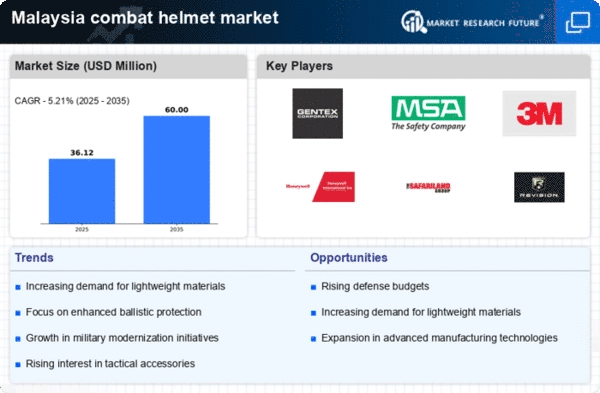
As per Market Research Future analysis, the Malaysia combat helmet market Size was estimated at 34.33 $ Million in 2024. The Malaysia combat helmet market is projected to grow from 36.12 $ Million in 2025 to 60.0 $ Million by 2035, exhibiting a compound annual growth rate (CAGR) of 5.2% during the forecast period 2025 - 2035

Key Market Trends & Highlights

The Malaysia combat helmet market is experiencing a dynamic shift driven by technological advancements and increased government investment.

  • Technological advancements are enhancing the performance and safety features of combat helmets.
  • The military segment remains the largest, while the law enforcement segment is the fastest-growing in the Malaysia combat helmet market.
  • There is a notable focus on ergonomics and comfort, catering to the needs of users in various operational environments.
  • Rising security concerns and increased military modernization are key drivers propelling market growth.

Market Size & Forecast

2024 Market Size 34.33 (USD Million)
2035 Market Size 60.0 (USD Million)
CAGR (2025 - 2035) 5.21%

Major Players

Gentex Corporation (US), MSA Safety Incorporated (US), 3M Company (US), Honeywell International Inc. (US), Safariland Group (US), Revision Military Ltd. (CA), Bae Systems (GB), Elbit Systems Ltd. (IL), Zentiva (CZ)

Our Impact
Enabled $4.3B Revenue Impact for Fortune 500 and Leading Multinationals
Partnering with 2000+ Global Organizations Each Year
30K+ Citations by Top-Tier Firms in the Industry

Malaysia Combat Helmet Market Trends

The combat helmet market in Malaysia is currently experiencing a notable evolution, driven by advancements in technology and increasing demand for enhanced safety features. The government has been actively investing in defense and security, which has led to a rise in procurement of modern combat helmets. These helmets are designed to provide superior protection while ensuring comfort and usability for military personnel. Furthermore, the emphasis on lightweight materials and ergonomic designs is becoming more pronounced, as these factors contribute to the overall effectiveness of soldiers in the field. In addition to technological advancements, the combat helmet market is also influenced by the growing awareness of personal safety among law enforcement and security agencies. As threats evolve, the need for reliable protective gear becomes paramount. This has prompted manufacturers to innovate and adapt their products to meet the specific requirements of various users. The collaboration between local manufacturers and international suppliers is fostering a competitive landscape, which may lead to improved product offerings and pricing strategies. Overall, the combat helmet market appears poised for growth, reflecting the broader trends in defense and security sectors.

Technological Advancements

The combat helmet market is witnessing rapid technological advancements, particularly in materials and design. Innovations such as the integration of communication systems and enhanced ballistic protection are becoming standard features. This trend is likely to improve operational efficiency and safety for users.

Increased Government Investment

Government investment in defense and security is significantly impacting the combat helmet market. Enhanced funding for military and law enforcement agencies is driving demand for modern protective gear, including advanced helmets that meet contemporary safety standards.

Focus on Ergonomics and Comfort

There is a growing emphasis on ergonomics and comfort within the combat helmet market. Manufacturers are prioritizing lightweight materials and adjustable designs to ensure that helmets can be worn for extended periods without compromising user performance or safety.

Malaysia Combat Helmet Market Drivers

Innovation in Materials

The combat helmet market in Malaysia is significantly influenced by innovations in materials used for helmet production. The introduction of lightweight, high-strength materials such as aramid fibers and polyethylene composites has revolutionized helmet design. These materials not only enhance protection but also improve comfort and usability for the wearer. The combat helmet market is witnessing a shift towards helmets that offer better ballistic protection while being lighter, which is crucial for operational efficiency. As manufacturers invest in research and development, the market is expected to see a rise in products that meet stringent safety standards. This trend is likely to attract both military and civilian customers, further expanding the market's reach.

Rising Security Concerns

The combat helmet market in Malaysia is experiencing growth due to escalating security concerns. The government and military organizations are increasingly prioritizing the safety of personnel in various operations. This heightened focus on security is reflected in the allocation of budgets, with defense spending projected to rise by approximately 5% annually. As threats evolve, the demand for advanced protective gear, including combat helmets, is likely to increase. The combat helmet market is thus positioned to benefit from these trends, as both public and private sectors seek to enhance their protective measures. Furthermore, the emphasis on personal safety in urban areas has led to a broader acceptance of advanced combat helmets, which are now seen as essential equipment for law enforcement and military personnel alike.

Increased Military Modernization

The combat helmet market in Malaysia is benefiting from the ongoing military modernization initiatives. The Malaysian Armed Forces are actively upgrading their equipment to meet contemporary warfare demands. This modernization includes the procurement of advanced combat helmets that provide enhanced protection and functionality. Reports indicate that military expenditure in Malaysia is expected to reach approximately $4 billion by 2026, with a significant portion allocated to personal protective equipment. The combat helmet market is thus poised for growth as the military seeks to equip its personnel with state-of-the-art gear. This trend not only enhances the safety of soldiers but also boosts the overall capabilities of the armed forces.

Growing Demand from Law Enforcement

The combat helmet market in Malaysia is experiencing a surge in demand from law enforcement agencies. As public safety concerns rise, police and security forces are increasingly adopting advanced protective gear, including combat helmets. The combat helmet market is likely to see a substantial increase in orders from these agencies, driven by the need for enhanced protection during operations. Furthermore, the government is investing in training and equipping law enforcement personnel, which is expected to further stimulate market growth. The trend towards adopting military-grade helmets for police use reflects a broader recognition of the importance of personal safety in maintaining public order.

Focus on Customization and Personalization

The combat helmet market in Malaysia is witnessing a trend towards customization and personalization of helmets. As users seek gear that meets their specific needs, manufacturers are responding by offering tailored solutions. This includes adjustable features, modular designs, and options for integrating communication systems. The combat helmet market is adapting to these demands, with companies investing in technologies that allow for greater customization. This trend is particularly relevant for military and law enforcement agencies, where individual preferences can significantly impact operational effectiveness. As the market evolves, the ability to provide personalized helmets may become a key differentiator for manufacturers, potentially leading to increased market share.

Market Segment Insights

By Material: Polycarbonate (Largest) vs. Aramid Fiber (Fastest-Growing)

The Malaysia combat helmet market is witnessing a substantial distribution among key materials, with polycarbonate holding the largest share. This material is favored for its balance of strength and weight, making it a preferred choice for various military applications. Following polycarbonate, aramid fiber is gathering momentum, gaining a notable share as its properties of high strength and low weight become more recognized. The competitive landscape shows that while polycarbonate remains dominant, aramid fiber is rapidly closing the gap. In terms of growth trends, aramid fiber is emerging as the fastest-growing segment within this market. The increasing adoption of newer materials driven by advancements in technology and the emphasis on lightweight yet durable helmets are key factors affecting this growth. Additionally, environmental considerations are pushing manufacturers to innovate with materials like aramid fiber, allowing for improved protection while meeting regulatory standards. Such trends indicate a shift towards more sophisticated materials in the Malaysia combat helmet market.

Polycarbonate (Dominant) vs. Carbon Fiber (Emerging)

Polycarbonate is currently the dominant material in the Malaysia combat helmet market, prized for its durability, lightweight nature, and impact resistance. This makes it suitable for intense combat situations and various military applications. In contrast, carbon fiber, while emerging, is gaining interest for its unique benefits such as high strength-to-weight ratio and enhanced ballistic protection. Although carbon fiber is not as widely adopted yet, its growing usage hints at a future shift as manufacturers begin to recognize its performance advantages. The versatility of carbon fiber coupled with ongoing technological developments may enable it to become a more common choice in the combat helmet segment, appealing to both military and law enforcement sectors.

By Product Type: Ballistic Helmets (Largest) vs. Bump Helmets (Fastest-Growing)

The Malaysia combat helmet market is characterized by several segments, with ballistic helmets holding the largest share due to their critical applications in providing enhanced protection during combat scenarios. Bump helmets, while not primarily designed for ballistic threats, have gained popularity for their lightweight structure and versatility, thus occupying a significant portion of the market as well. Flight helmets and modular helmets also contribute to the market share, but to a lesser extent compared to the dominant ballistic and emerging bump varieties. Growth trends in this segment are primarily driven by increasing defense budget allocations and a rising focus on enhancing the safety protocols for military and law enforcement personnel. The advancement of materials technology has resulted in lighter and more effective designs, further propelling the demand for ballistic helmets. Concurrently, the surge in tactical operations and training exercises has contributed to the rising adoption of bump helmets, making them one of the fastest-growing segments in this market.

Ballistic Helmets (Dominant) vs. Bump Helmets (Emerging)

Ballistic helmets are designed to offer maximum protection against ballistic threats, adhering to strict military standards and utilizing cutting-edge materials for durability. These helmets typically include features such as enhanced impact resistance and noise reduction capabilities, positioning them as the dominant choice for military applications. In contrast, bump helmets, although primarily focused on protecting against non-ballistic impacts, have quickly become an emerging favorite among various tactical units. Their modular designs often enable the attachment of communication systems and accessories, catering to the growing demand for versatile headgear in operational environments. This adaptability and lower weight profile make bump helmets increasingly popular, particularly in training and special operations, ensuring they capture a significant market share.

By Application: Military (Largest) vs. Law Enforcement (Fastest-Growing)

In the Malaysia combat helmet market, the military segment commands the largest share, reflecting the heightened focus on defense and security amid regional tensions. This segment not only has a robust demand but also benefits from government contracts that ensure a steady supply of advanced helmet technologies to armed forces. Conversely, the law enforcement segment is rapidly gaining traction, driven by increasing investments in public safety and crime prevention initiatives. As agencies modernize their equipment, the demand for high-quality helmets for law enforcement personnel is expected to surge. Growth trends in this segment are influenced by various factors, including rising security concerns and evolving threats in urban environments. The military segment is propelled by technological advancements in materials and design, enhancing protection and comfort for soldiers. Meanwhile, the law enforcement sector is adopting innovative helmet designs that improve functionality, such as integration with communication systems. Civilian applications remain niche but are slowly growing, focusing on recreational use and safety during events.

Military (Dominant) vs. Law Enforcement (Emerging)

The military segment of the Malaysia combat helmet market is characterized by its dominance, driven by ongoing defense expenditure and a focus on enhancing soldier safety through superior headgear technology. Military helmets are designed to withstand ballistic impacts while offering comfort and adaptability, crucial for tactical operations. In contrast, the law enforcement segment is emerging, reflecting a trend towards modernizing police equipment to meet contemporary challenges. These helmets incorporate features like communication systems and enhanced visibility, catering to the specific needs of law enforcement personnel in urban settings. With a growing emphasis on public safety, the law enforcement segment is poised for significant expansion, attracting investments and innovations.

By End Use: Combat (Largest) vs. Training (Fastest-Growing)

In the Malaysia combat helmet market, the distribution of market share among the end use segments reveals that the Combat segment takes the largest share, driven by the increasing defense budgets and enhanced focus on military preparedness. The Training segment, while currently smaller in share, is rapidly gaining traction as training activities for defense forces intensify due to the importance of preparedness in emergency scenarios. The growth trends for these segments are significantly influenced by rising security concerns and evolving operational requirements. The Combat segment's dominance is bolstered by regular modernization efforts within the military, while the Training segment is supported by advancements in training technologies, emphasizing realistic simulations that require specialized helmets, thus fostering a growing market demand.

Combat (Dominant) vs. Training (Emerging)

The Combat segment is characterized by a strong demand for high-performance helmets that ensure safety and operational efficiency for military personnel in the field. These helmets are designed to meet rigorous standards and provide crucial features such as ballistic protection and integration with communication systems. In contrast, the Training segment is emerging as a significant player, with helmets tailored for safety during training exercises, focusing on comfort and functionality. As training becomes more advanced and realistic, the requirements for specialized helmets are increasing. The dual focus on safety and performance in both segments shapes the competitive landscape, catering to various needs within the Malaysia combat helmet market.

Get more detailed insights about Malaysia Combat Helmet Market

Key Players and Competitive Insights

The combat helmet market is currently characterized by a dynamic competitive landscape, driven by technological advancements and increasing defense budgets across various nations. Key players such as Gentex Corporation (US), MSA Safety Incorporated (US), and Revision Military Ltd. (CA) are at the forefront, focusing on innovation and strategic partnerships to enhance their market positions. Gentex Corporation (US) has been particularly active in developing advanced helmet systems that integrate communication technologies, which appears to be a response to the growing demand for multifunctional protective gear. MSA Safety Incorporated (US) emphasizes safety and reliability, leveraging its extensive experience in personal protective equipment to cater to military and law enforcement sectors. Meanwhile, Revision Military Ltd. (CA) is known for its commitment to research and development, which seems to position it well in a market that increasingly values cutting-edge technology and performance.In terms of business tactics, companies are increasingly localizing manufacturing to reduce costs and improve supply chain efficiency. This trend is particularly evident in Malaysia, where firms are establishing production facilities to cater to regional demands. The market structure appears moderately fragmented, with several players competing for market share, yet the influence of major companies remains substantial. Their collective strategies, including mergers and acquisitions, are likely to shape the competitive dynamics significantly.

In October Gentex Corporation (US) announced a partnership with a leading technology firm to develop next-generation helmet systems that incorporate augmented reality features. This strategic move is indicative of the company's commitment to innovation and could potentially redefine user experience in combat scenarios. The integration of augmented reality may enhance situational awareness for soldiers, thereby improving operational effectiveness.

In September MSA Safety Incorporated (US) launched a new line of lightweight helmets designed specifically for urban warfare. This product line aims to address the unique challenges faced by military personnel in urban environments, suggesting a strategic pivot towards specialized solutions. The lightweight design is likely to enhance mobility and comfort, which are critical factors in modern combat situations.

In August Revision Military Ltd. (CA) secured a contract with the Malaysian government to supply advanced combat helmets for its armed forces. This contract not only underscores the company's reputation for quality but also highlights the growing defense spending in Malaysia. Such strategic contracts are essential for establishing long-term relationships with government entities and ensuring a steady revenue stream.

As of November the combat helmet market is witnessing trends such as digitalization and sustainability, with companies increasingly focusing on integrating AI technologies into their products. Strategic alliances are becoming more prevalent, as firms recognize the need to collaborate to enhance innovation and market reach. The competitive landscape is likely to evolve, shifting from price-based competition to a focus on technological advancements and supply chain reliability. This transition may redefine how companies differentiate themselves, emphasizing the importance of innovation and adaptability in a rapidly changing market.

Key Companies in the Malaysia Combat Helmet Market include

Industry Developments

Companies such as Tactical Response Gear and Gentex Corporation are focusing on innovative designs and materials to meet these demands.

Furthermore, the Malaysian government is committed to strengthening its defense procurement processes, evidenced by plans revealed in August 2023 to invest in local manufacturing of military equipment, which could benefit companies like Bae Systems and Honeywell International.In terms of mergers and acquisitions, although there haven't been any prominent news announcements regarding this specific segment in the last year, the competitive landscape continues to evolve as companies like MSA Safety and Safariland Group seek to expand their market presence through collaborative efforts.

Over the past couple of years, major incidents, such as the joint military exercises in November 2022, have highlighted the necessity for advanced combat helmets and further driving demand. The growth in defense spending and regional security concerns continues to shape the market dynamics significantly.

Future Outlook

Malaysia Combat Helmet Market Future Outlook

The Combat Helmet Market is projected to grow at 5.21% CAGR from 2025 to 2035, driven by advancements in materials, increasing defense budgets, and rising demand for personal protective equipment.

New opportunities lie in:

  • Development of lightweight composite materials for enhanced comfort and protection.
  • Integration of smart technology for real-time data collection and communication.
  • Expansion into civilian markets for sports and recreational safety helmets.

By 2035, the combat helmet market is expected to achieve substantial growth and innovation.

Market Segmentation

Malaysia Combat Helmet Market End Use Outlook

  • Combat
  • Training
  • Rescue Operations

Malaysia Combat Helmet Market Material Outlook

  • Polycarbonate
  • Aramid Fiber
  • Carbon Fiber
  • Metal

Malaysia Combat Helmet Market Application Outlook

  • Military
  • Law Enforcement
  • Civilians

Malaysia Combat Helmet Market Product Type Outlook

  • Ballistic Helmets
  • Bump Helmets
  • Flight Helmets
  • Modular Helmets

Report Scope

MARKET SIZE 2024 34.33(USD Million)
MARKET SIZE 2025 36.12(USD Million)
MARKET SIZE 2035 60.0(USD Million)
COMPOUND ANNUAL GROWTH RATE (CAGR) 5.21% (2025 - 2035)
REPORT COVERAGE Revenue Forecast, Competitive Landscape, Growth Factors, and Trends
BASE YEAR 2024
Market Forecast Period 2025 - 2035
Historical Data 2019 - 2024
Market Forecast Units USD Million
Key Companies Profiled Gentex Corporation (US), MSA Safety Incorporated (US), 3M Company (US), Honeywell International Inc. (US), Safariland Group (US), Revision Military Ltd. (CA), Bae Systems (GB), Elbit Systems Ltd. (IL), Zentiva (CZ)
Segments Covered Material, Product Type, Application, End Use
Key Market Opportunities Integration of advanced materials and smart technologies enhances safety and performance in the combat helmet market.
Key Market Dynamics Rising demand for advanced ballistic protection drives innovation in combat helmet designs and materials in Malaysia.
Countries Covered Malaysia
Leave a Comment

FAQs

What is the market size of the Malaysia Combat Helmet Market in 2024?

The Malaysia Combat Helmet Market is expected to be valued at 28.5 million USD in 2024.

What is the projected market value of the Malaysia Combat Helmet Market by 2035?

By 2035, the market is anticipated to grow to 42.0 million USD.

What is the expected CAGR for the Malaysia Combat Helmet Market from 2025 to 2035?

The market is expected to grow at a CAGR of 3.588 percent during the period from 2025 to 2035.

Which material segment holds the largest share in the Malaysia Combat Helmet Market?

The Aramid Fiber segment is expected to have the largest share, valued at 9.0 million USD in 2024.

What will be the market value of Polycarbonate helmets by 2035?

The market value for Polycarbonate helmets is projected to reach 12.0 million USD by 2035.

Who are the key players in the Malaysia Combat Helmet Market?

Major players in the market include Tactical Response Gear, Gentex Corporation, and Honeywell International.

What is the projected market size for Carbon Fiber helmets by 2035?

Carbon Fiber helmets are expected to reach a market value of 9.5 million USD by 2035.

What challenges and opportunities exist in the Malaysia Combat Helmet Market?

Challenges include evolving threat scenarios, while opportunities lie in advancements in helmet technology.

How is the Metal helmet segment expected to perform between 2024 and 2035?

The Metal helmet segment is expected to increase from 5.0 million USD in 2024 to 6.5 million USD by 2035.

What trends are influencing the growth of the Malaysia Combat Helmet Market?

Growing defense budgets and rising safety awareness are key trends driving market growth.

Download Free Sample

Kindly complete the form below to receive a free sample of this Report

Compare Licence

×
Features License Type
Single User Multiuser License Enterprise User
Price $4,950 $5,950 $7,250
Maximum User Access Limit 1 User Upto 10 Users Unrestricted Access Throughout the Organization
Free Customization
Direct Access to Analyst
Deliverable Format
Platform Access
Discount on Next Purchase 10% 15% 15%
Printable Versions