×
Request Free Sample ×

Kindly complete the form below to receive a free sample of this Report

* Please use a valid business email

Leading companies partner with us for data-driven Insights

clients tt-cursor
Hero Background

Germany Combat Helmet Market

ID: MRFR/AD/56337-HCR
128 Pages
Swapnil Palwe
February 2026

Germany Combat Helmet Market Size, Share, Industry Trend & Analysis Research Report By Material (Polycarbonate, Aramid Fiber, Carbon Fiber, Metal), By Product Type (Ballistic Helmets, Bump Helmets, Flight Helmets, Modular Helmets), By Application (Military, Law Enforcement, Civilians) and By End Use (Combat, Training, Rescue Operations)- Forecast to 2035

Share:
Download PDF ×

We do not share your information with anyone. However, we may send you emails based on your report interest from time to time. You may contact us at any time to opt-out.

Germany Combat Helmet Market Infographic
Purchase Options

Germany Combat Helmet Market Summary

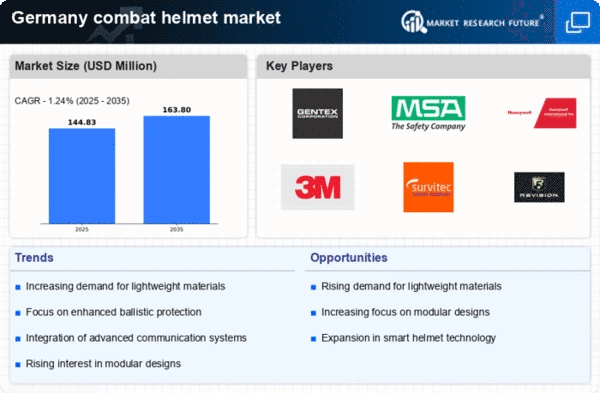
As per Market Research Future analysis, the Germany combat helmet market size was estimated at 143.06 USD Million in 2024. The Germany combat helmet market is projected to grow from 144.83 USD Million in 2025 to 163.8 USD Million by 2035, exhibiting a compound annual growth rate (CAGR) of 1.2% during the forecast period 2025 - 2035

Key Market Trends & Highlights

The Germany combat helmet market is experiencing a robust growth trajectory driven by technological advancements and increased defense spending.

  • Technological advancements are enhancing helmet performance and safety features, making them more effective in combat situations.
  • Customization and modularity are becoming increasingly important, allowing for tailored solutions to meet specific operational needs.
  • Regulatory compliance and safety standards are driving manufacturers to innovate and improve product offerings to meet stringent requirements.
  • Increased defense spending and rising threat levels are key drivers propelling the demand for advanced combat helmets in Germany.

Market Size & Forecast

2024 Market Size 143.06 (USD Million)
2035 Market Size 163.8 (USD Million)
CAGR (2025 - 2035) 1.24%

Major Players

Gentex Corporation (US), MSA Safety Incorporated (US), Honeywell International Inc. (US), 3M Company (US), Survitec Group Limited (GB), Revision Military Inc. (CA), Safariland LLC (US), Bae Systems plc (GB), Elbit Systems Ltd. (IL)

Our Impact
Enabled $4.3B Revenue Impact for Fortune 500 and Leading Multinationals
Partnering with 2000+ Global Organizations Each Year
30K+ Citations by Top-Tier Firms in the Industry

Germany Combat Helmet Market Trends

The combat helmet market in Germany is currently experiencing notable evolution. This is driven by advancements in technology and increasing demand for enhanced protection among military and law enforcement personnel. The integration of lightweight materials and innovative designs appears to be a focal point, as manufacturers strive to improve comfort without compromising safety. Additionally, the emphasis on modular systems that allow for customization is gaining traction, reflecting a shift towards personalized equipment that meets specific operational needs. This trend may be influenced by the growing recognition of the importance of head protection in various combat scenarios. This recognition is leading to a more competitive landscape among suppliers. Furthermore, the regulatory environment in Germany is evolving, with government initiatives aimed at enhancing the safety standards for personal protective equipment. This regulatory push could potentially stimulate innovation within the combat helmet market, as companies are encouraged to develop products that comply with stringent safety requirements. The collaboration between manufacturers and defense agencies is likely to foster a culture of continuous improvement, ensuring that the helmets not only meet current demands but also anticipate future challenges. As the market progresses, it seems poised for growth, driven by both technological advancements and a commitment to safety.

Technological Advancements

The combat helmet market is witnessing a surge in technological innovations, particularly in materials and design. Lightweight composites and advanced ballistic materials are being utilized to enhance protection while reducing fatigue for users. This trend indicates a shift towards helmets that offer superior performance without compromising comfort.

Customization and Modularity

There is a growing trend towards modular helmet systems that allow for customization based on specific mission requirements. This flexibility enables users to adapt their helmets with various accessories, such as communication devices and night vision equipment, enhancing operational effectiveness.

Regulatory Compliance and Safety Standards

The evolving regulatory landscape in Germany is pushing manufacturers to adhere to stricter safety standards. This focus on compliance is likely to drive innovation, as companies strive to develop helmets that not only meet but exceed these requirements, ensuring maximum protection for users.

Germany Combat Helmet Market Drivers

Rising Threat Levels

The combat helmet market in Germany is influenced by rising threat levels, both domestically and internationally. The geopolitical landscape has become increasingly complex, with heightened concerns regarding terrorism and regional conflicts. This situation has prompted the German military to prioritize the safety of its personnel, leading to a surge in demand for advanced combat helmets. According to recent assessments, the need for improved protective gear is expected to grow by approximately 15% over the next five years. Consequently, manufacturers in the combat helmet market are focusing on developing helmets that offer enhanced ballistic protection and comfort. This ensures that soldiers are adequately equipped to face evolving threats.

Technological Integration

The integration of advanced technologies into the combat helmet market is a key driver of growth in Germany. Innovations such as augmented reality (AR) and communication systems are being incorporated into helmet designs, enhancing situational awareness for soldiers. This trend is evident in the development of helmets equipped with integrated communication devices, which facilitate real-time information sharing among troops. As the German military seeks to modernize its forces, the demand for technologically advanced helmets is expected to increase significantly. Market analysts project that the segment of helmets featuring integrated technology could account for up to 30% of total sales in the combat helmet market by 2027, reflecting a shift towards multifunctional protective gear.

Increased Defense Spending

Increased defense spending by the government is driving growth in the combat helmet market in Germany. In recent years, the German government has committed to enhancing its military capabilities, which includes investing in advanced personal protective equipment. This trend is reflected in the 2025 defense budget, which allocates approximately €53 billion for military expenditures. As a result, the demand for high-quality combat helmets is likely to rise, as military forces seek to equip personnel with the latest protective gear. This increased funding not only supports the procurement of helmets but also encourages research and development in the combat helmet market, leading to innovations that enhance safety and performance.

Focus on Soldier Well-being

The combat helmet market in Germany is increasingly prioritizing the well-being of soldiers, driving demand for helmets that emphasize comfort and ergonomics. Recognizing that prolonged use of heavy helmets can lead to fatigue and discomfort, manufacturers are investing in lightweight materials and improved designs. This emphasis on soldier well-being is supported by studies indicating that comfortable helmets can enhance performance and reduce the risk of injuries. As a result, the market is witnessing a shift towards helmets that not only provide protection but also ensure that soldiers can operate effectively in various environments. This trend is likely to contribute to a projected growth rate of 10% in the combat helmet market over the next few years.

Increased Collaboration with NATO

The combat helmet market in Germany is benefiting from increased collaboration with NATO forces, which is fostering standardization and interoperability among member nations. As Germany participates in joint military exercises and operations, the need for compatible equipment, including helmets, becomes paramount. This collaboration encourages the adoption of similar standards and technologies across NATO countries, which can lead to bulk procurement and shared research initiatives. Consequently, the combat helmet market is likely to see a rise in demand for helmets that meet NATO specifications, potentially increasing market size by 20% in the coming years. This alignment not only enhances operational efficiency but also drives innovation within the combat helmet market.

Market Segment Insights

By Material: Polycarbonate (Largest) vs. Aramid Fiber (Fastest-Growing)

In the Germany combat helmet market, Polycarbonate leads with the largest market share due to its excellent durability, lightweight characteristics, and cost-effectiveness. This material has gained widespread acceptance among military and defense sectors, making it a top choice for manufacturers aiming to satisfy operational requirements. Aramid Fiber, on the other hand, has been capturing market attention as the fastest-growing segment. Its high-strength properties and impact resistance make it an ideal choice for modern combat scenarios, with increasing adoption in advanced helmet designs. The growth of the Aramid Fiber segment is driven by rising demand for helmets that offer enhanced protection while maintaining comfort and mobility. As soldiers face evolving threats on the battlefield, manufacturers are focusing on integrating innovative materials like Aramid Fiber to improve safety and performance. This trend is further supported by technological advancements in material science, enabling the production of lighter and more resilient helmets that cater to the dynamic needs of military personnel.

Polycarbonate (Dominant) vs. Carbon Fiber (Emerging)

Polycarbonate holds a dominant position in the Germany combat helmet market, favored for its balance of strength and weight. It provides reliable protection while ensuring ease of wear during extended missions. This material's lower production costs contribute to its widespread use, making it a staple among various defense organizations. In contrast, Carbon Fiber is emerging as a notable segment in the market, appreciated for its superior strength-to-weight ratio and cutting-edge applications in helmet design. While Carbon Fiber helmets tend to be more expensive, their advanced protective features are gaining traction, particularly in specialized units where every ounce of weight savings is critical. As technology progresses, Carbon Fiber's role in the market is expected to expand.

By Product Type: Ballistic Helmets (Largest) vs. Bump Helmets (Fastest-Growing)

The Germany combat helmet market showcases a diverse range of product types, with ballistic helmets commanding the largest market share due to their critical role in military applications. These helmets are designed to offer maximum protection against ballistic threats and are widely utilized by military personnel. Conversely, bump helmets are gaining traction as the fastest-growing segment, appealing to law enforcement and tactical teams for their lightweight design and effective protection against blunt force impacts. Growth in the Germany combat helmet market is being driven by increasing defense budgets and rising security concerns, which are pushing organizations to acquire advanced protective gear. The trend towards modular helmets is also contributing significantly, as they offer customizable features that cater to a variety of operational needs. This adaptability is appealing to users who require helmets for different scenarios, thus enhancing the market for both ballistic and bump helmets.

Ballistic Helmets (Dominant) vs. Bump Helmets (Emerging)

Ballistic helmets remain the dominant force in the Germany combat helmet market due to their robust design and ability to protect against high-velocity projectiles. They are typically made from advanced materials such as Kevlar and aramid fibers, ensuring a balance of weight and performance. Bump helmets, while emerging, are making significant inroads thanks to their versatility and lighter weight, making them suitable for various non-ballistic scenarios. They often include mounts for accessories such as night vision goggles and communication systems, making them highly adaptable for tactical operations. This combination of protection and usability is propelling the demand for bump helmets, especially among special forces and police units.

By Application: Military (Largest) vs. Law Enforcement (Fastest-Growing)

In the Germany combat helmet market, the Military segment dominates the landscape, holding the largest market share. This segment is primarily driven by ongoing defense budgets and modernization initiatives, which prioritize effective protective gear for troops. Simultaneously, the Law Enforcement segment showcases rapid growth as police and security forces increasingly recognize the importance of enhanced head protection during operations. The growth of the Law Enforcement segment is fueled by rising concerns over personal safety and security in urban environments. Additionally, advancements in helmet technology have led to the development of lighter and more effective models, making them attractive for law enforcement applications. As societal demands for public safety increase, the market for civilian helmets is also witnessing gradual growth, further diversifying the application landscape.

Military: Dominant vs. Law Enforcement: Emerging

The Military segment stands as the dominant player in the Germany combat helmet market, characterized by robust investments and a strong emphasis on superior protective capabilities. These helmets are designed to withstand extreme conditions and provide comfort and functionality for soldiers in the field. In contrast, the Law Enforcement sector, while still emerging, is rapidly gaining traction due to the heightened emphasis on safety among police forces. This segment often integrates advanced features like communication systems and night vision capabilities, making these helmets vital for contemporary policing. The distinct needs of military and law enforcement applications drive differentiated development in technology, materials, and design, resulting in a competitive yet focused market.

By End Use: Combat (Largest) vs. Training (Fastest-Growing)

The Germany combat helmet market exhibits a structured segmentation with Combat applications holding a significant share, primarily driven by defense procurement and military modernization. Training applications, while currently smaller, are becoming a focal point due to increased expenditures on training programs for military personnel, thereby enhancing overall readiness. In recent years, growth trends in the segment have been influenced by technological advancements and the integration of enhanced safety features. Training is emerging as a fast-growing sector fueled by rising awareness of the importance of realistic training conditions in preparing soldiers for combat scenarios. Additionally, the rising emphasis on rescue operations adds a supplementary layer of demand, underlining the versatility of combat helmets across various applications.

Combat (Dominant) vs. Training (Emerging)

The Combat segment is characterized by its robust market position, largely influenced by government contracts and the need for high-performance protective gear in active conflict zones. Combat helmets are designed to meet rigorous safety standards while integrating advanced technologies for communication and situational awareness. In contrast, the Training segment is emerging as a critical area, catering to the growing demand for specialized training equipment that simulates real-world scenarios. Training helmets are often designed with lightweight materials to ensure comfort during extended wear. As defense forces in Germany prioritize realistic training environments, the Training segment's focus shifts towards innovation and enhanced functionality to better prepare personnel for combat situations.

Get more detailed insights about Germany Combat Helmet Market

Key Players and Competitive Insights

The combat helmet market is currently characterized by a dynamic competitive landscape. This landscape is driven by technological advancements and increasing defense budgets across various nations. Key players such as Gentex Corporation (US), MSA Safety Incorporated (US), and Bae Systems plc (GB) are at the forefront, each adopting distinct strategies to enhance their market positioning. Gentex Corporation (US) focuses on innovation, particularly in developing advanced materials that improve helmet performance and safety. MSA Safety Incorporated (US) emphasizes regional expansion, aiming to penetrate emerging markets with tailored solutions. Bae Systems plc (GB) is actively pursuing partnerships with defense agencies to align its product offerings with evolving military requirements, thereby shaping a competitive environment that prioritizes adaptability and responsiveness.In terms of business tactics, companies are increasingly localizing manufacturing to reduce lead times and enhance supply chain efficiency. The market appears moderately fragmented, with several players vying for market share while also collaborating on joint ventures and technology sharing. This collective influence of key players fosters a competitive structure that encourages innovation and responsiveness to market demands.

In October Gentex Corporation (US) announced a strategic partnership with a leading technology firm to develop next-generation smart helmets equipped with integrated communication systems. This move is likely to enhance their product offerings, positioning them as a leader in the smart helmet segment, which is gaining traction among military and law enforcement agencies.

In September MSA Safety Incorporated (US) launched a new line of lightweight helmets designed for enhanced comfort and protection. This product introduction reflects the company's commitment to innovation and addresses the growing demand for ergonomic solutions in the combat helmet market. The lightweight design is expected to appeal to military personnel who require mobility without compromising safety.

In August Bae Systems plc (GB) secured a contract with the German military to supply advanced combat helmets featuring enhanced ballistic protection. This contract not only solidifies Bae Systems' presence in the German market but also underscores the increasing focus on high-performance protective gear in military applications. Such strategic actions indicate a trend towards prioritizing quality and performance over cost in procurement decisions.

As of November current trends in the combat helmet market include a strong emphasis on digitalization, sustainability, and the integration of artificial intelligence (AI) into product development. Strategic alliances are becoming increasingly important, as companies collaborate to leverage technological advancements and enhance product capabilities. The competitive differentiation is likely to evolve, shifting from price-based competition to a focus on innovation, technology integration, and supply chain reliability. This transition suggests that companies that prioritize R&D and strategic partnerships will be better positioned to thrive in the evolving landscape.

Key Companies in the Germany Combat Helmet Market include

Industry Developments

In September 2023, BulletSafe announced a strategic partnership with Team Wendy to combine innovative helmet technologies and improve their product offerings. The German government has also prioritized the upgrade of military gear, with plans to procure next-generation combat helmets that provide improved ballistic capabilities.

Notable trends include a significant surge in the market valuation of key players like Revision Military and Gentex, reflecting the growing emphasis on enhanced safety features. In terms of mergers and acquisitions, no recent high-profile activities have been reported among the listed companies, suggesting a stable competitive landscape.

Over the past few years, from 2021 to 2023, the market has seen consistent growth driven by technological advancements and heightened security concerns across Europe, particularly in light of geopolitical tensions. This evolution is expected to shape the future of the combat helmet sector in Germany significantly.

Future Outlook

Germany Combat Helmet Market Future Outlook

The Combat Helmet Market in Germany is projected to grow at a 1.24% CAGR from 2025 to 2035, driven by technological advancements and increasing defense budgets.

New opportunities lie in:

  • Development of lightweight, ballistic-resistant materials for enhanced protection.
  • Integration of smart technology for real-time data analytics in helmets.
  • Expansion into civilian markets for safety helmets in high-risk industries.

By 2035, the market is expected to maintain steady growth, driven by innovation and diversification.

Market Segmentation

Germany Combat Helmet Market End Use Outlook

  • Combat
  • Training
  • Rescue Operations

Germany Combat Helmet Market Material Outlook

  • Polycarbonate
  • Aramid Fiber
  • Carbon Fiber
  • Metal

Germany Combat Helmet Market Application Outlook

  • Military
  • Law Enforcement
  • Civilians

Germany Combat Helmet Market Product Type Outlook

  • Ballistic Helmets
  • Bump Helmets
  • Flight Helmets
  • Modular Helmets

Report Scope

MARKET SIZE 2024 143.06(USD Million)
MARKET SIZE 2025 144.83(USD Million)
MARKET SIZE 2035 163.8(USD Million)
COMPOUND ANNUAL GROWTH RATE (CAGR) 1.24% (2025 - 2035)
REPORT COVERAGE Revenue Forecast, Competitive Landscape, Growth Factors, and Trends
BASE YEAR 2024
Market Forecast Period 2025 - 2035
Historical Data 2019 - 2024
Market Forecast Units USD Million
Key Companies Profiled Gentex Corporation (US), MSA Safety Incorporated (US), Honeywell International Inc. (US), 3M Company (US), Survitec Group Limited (GB), Revision Military Inc. (CA), Safariland LLC (US), Bae Systems plc (GB), Elbit Systems Ltd. (IL)
Segments Covered Material, Product Type, Application, End Use
Key Market Opportunities Integration of advanced materials and smart technologies enhances performance in the combat helmet market.
Key Market Dynamics Technological advancements drive innovation in combat helmet designs, enhancing protection and comfort for military personnel.
Countries Covered Germany
Leave a Comment

FAQs

What is the expected market size of the Germany Combat Helmet Market in 2024?

The Germany Combat Helmet Market is expected to be valued at 85.5 million USD in 2024.

What is the projected market size for the Germany Combat Helmet Market by 2035?

By 2035, the Germany Combat Helmet Market is projected to reach a value of 145.0 million USD.

What is the expected CAGR for the Germany Combat Helmet Market from 2025 to 2035?

The expected CAGR for the Germany Combat Helmet Market from 2025 to 2035 is 4.919 percent.

Which material segment holds the largest market share in the Germany Combat Helmet Market?

The polycarbonate segment is expected to hold the largest market share in the Germany Combat Helmet Market.

What is the value of the polycarbonate segment in the Germany Combat Helmet Market for 2024?

The polycarbonate segment is valued at 30.0 million USD in 2024.

How much is the aramid fiber segment expected to be valued at in 2035?

The aramid fiber segment is expected to be valued at 40.0 million USD in 2035.

Who are the major players in the Germany Combat Helmet Market?

Major players include Militech, HNI Corporation, CAE, and Rheinmetall among others.

What is the market value for the carbon fiber segment in 2024?

The carbon fiber segment is valued at 15.5 million USD in 2024.

What is the expected market size for the metal segment in 2035?

The metal segment is expected to reach 30.0 million USD in 2035.

What trends are influencing the growth of the Germany Combat Helmet Market?

Emerging trends include advancements in materials and increasing defense spending driving market growth.

Download Free Sample

Kindly complete the form below to receive a free sample of this Report

Compare Licence

×
Features License Type
Single User Multiuser License Enterprise User
Price $4,950 $5,950 $7,250
Maximum User Access Limit 1 User Upto 10 Users Unrestricted Access Throughout the Organization
Free Customization
Direct Access to Analyst
Deliverable Format
Platform Access
Discount on Next Purchase 10% 15% 15%
Printable Versions