×
Request Free Sample ×

Kindly complete the form below to receive a free sample of this Report

* Please use a valid business email

Leading companies partner with us for data-driven Insights

clients tt-cursor
Hero Background

China Wholesale Telecom Carrier Market

ID: MRFR/ICT/55989-HCR
200 Pages
Aarti Dhapte
February 2026

China Wholesale Telecom Carrier Market Research Report By Solutions (Voice Termination, SMS Messaging Services, VoIP Solutions, Data Roaming Services, International Call Services, SIP Trunking, Mobile Number Portability, Cloud Communication Services, Network Security Solutions), By Organization Size (SMEs, Large Enterprises) and By Passive Device Type (Internet Service Providers (ISPS), Mobile Network Operators (MNOs), VoIP Service Providers, Cable TV Operators, Government Agencies, Educational Institutes, Content Providers, Others)-Forecast to 2035

Share:
Download PDF ×

We do not share your information with anyone. However, we may send you emails based on your report interest from time to time. You may contact us at any time to opt-out.

China Wholesale Telecom Carrier Market Infographic
Purchase Options

China Wholesale Telecom Carrier Market Summary

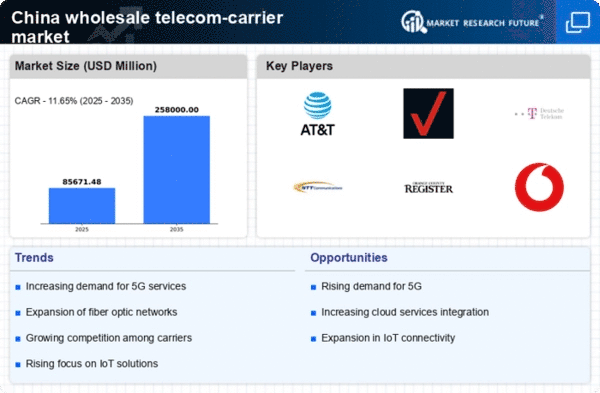
As per Market Research Future analysis, the China wholesale telecom-carrier market size was estimated at 76732.18 USD Million in 2024. The China wholesale telecom-carrier market is projected to grow from 85671.48 USD Million in 2025 to 258000.0 USD Million by 2035, exhibiting a compound annual growth rate (CAGR) of 11.6% during the forecast period 2025 - 2035

Key Market Trends & Highlights

The China wholesale telecom-carrier market is experiencing robust growth driven by technological advancements and increasing demand for data services.

  • The demand for data services continues to rise, reflecting a shift towards digital consumption patterns.
  • Infrastructure investment remains a focal point, as telecom providers enhance their network capabilities to meet growing user needs.
  • Regulatory changes are shaping the market landscape, necessitating compliance and adaptation among telecom operators.
  • Technological advancements in network infrastructure and rising demand for cloud services are key drivers propelling market expansion.

Market Size & Forecast

2024 Market Size 76732.18 (USD Million)
2035 Market Size 258000.0 (USD Million)
CAGR (2025 - 2035) 11.65%

Major Players

AT&T (US), Verizon (US), Deutsche Telekom (DE), NTT Communications (JP), Orange (FR), Vodafone (GB), Telefónica (ES), China Telecom (CN)

Our Impact
Enabled $4.3B Revenue Impact for Fortune 500 and Leading Multinationals
Partnering with 2000+ Global Organizations Each Year
30K+ Citations by Top-Tier Firms in the Industry

China Wholesale Telecom Carrier Market Trends

The wholesale telecom-carrier market in China is currently experiencing a dynamic transformation, driven by advancements in technology and increasing demand for high-speed connectivity. The proliferation of mobile devices and the rise of data-intensive applications have led to a surge in bandwidth requirements. Consequently, telecom carriers are investing heavily in infrastructure upgrades to enhance their service offerings. This shift not only reflects the growing consumer appetite for seamless communication but also indicates a competitive landscape where efficiency and innovation are paramount. As the market evolves, regulatory frameworks are adapting to ensure fair competition and consumer protection, which may further influence market dynamics. In addition, the wholesale telecom-carrier market is witnessing a trend towards consolidation among service providers. Mergers and acquisitions are becoming more prevalent as companies seek to expand their market share and optimize operational efficiencies. This consolidation could lead to a more streamlined service delivery model, potentially benefiting end-users through improved service quality and reduced costs. The interplay between technological advancements, regulatory changes, and market consolidation is likely to shape the future of the wholesale telecom-carrier market in China, presenting both challenges and opportunities for stakeholders.

Increased Demand for Data Services

The wholesale telecom-carrier market is seeing a notable rise in demand for data services. This trend is largely driven by the growing number of internet users and the increasing reliance on digital platforms for communication and business operations. As consumers and enterprises seek faster and more reliable connectivity, telecom carriers are compelled to enhance their data offerings, which may lead to innovative service packages.

Focus on Infrastructure Investment

Investment in infrastructure is a critical trend within the wholesale telecom-carrier market. Carriers are prioritizing the development of advanced networks, including fiber-optic and 5G technologies, to meet the escalating demand for high-speed internet. This focus on infrastructure not only aims to improve service quality but also positions carriers to better compete in a rapidly evolving market.

Regulatory Changes and Compliance

Regulatory changes are influencing the wholesale telecom-carrier market significantly. The government is implementing new policies aimed at fostering competition and ensuring consumer protection. These regulations may require carriers to adapt their business strategies, potentially leading to enhanced transparency and improved service standards across the market.

China Wholesale Telecom Carrier Market Drivers

Regulatory Support for Telecom Expansion

The regulatory environment in China is playing a crucial role in shaping the wholesale telecom-carrier market. The government has implemented policies aimed at promoting the expansion of telecom infrastructure, particularly in underserved regions. As of 2025, initiatives such as the 'Broadband China' strategy are facilitating investments in rural areas, thereby increasing access to telecom services. This regulatory support is likely to stimulate growth in the wholesale telecom-carrier market by encouraging carriers to expand their networks. Furthermore, the government is actively working to streamline licensing processes, making it easier for new entrants to join the market. This supportive regulatory framework is expected to enhance competition and drive innovation, ultimately benefiting consumers through improved service availability and quality.

Growing Internet Penetration and Mobile Usage

China's wholesale telecom-carrier market is significantly influenced by the increasing internet penetration and mobile device usage. As of late 2025, approximately 1.2 billion people in China are estimated to be internet users, representing a penetration rate of around 85%. This widespread access to the internet is driving demand for data services, particularly among mobile users. The wholesale telecom-carrier market is adapting to this trend by expanding their service offerings to cater to the growing number of mobile subscribers. Additionally, the rise of mobile applications and digital services is creating new revenue streams for carriers. This trend suggests that the market will continue to evolve, with carriers focusing on enhancing mobile data plans and services to meet the needs of an increasingly connected population.

Increased Competition Among Telecom Providers

The competitive landscape of the wholesale telecom-carrier market in China is intensifying as new players enter the market. Established carriers are facing pressure from emerging companies that offer innovative solutions and competitive pricing. This competition is likely to drive down prices, benefiting consumers and businesses alike. As of 2025, the market is characterized by a diverse range of service providers, each vying for market share. The wholesale telecom-carrier market is witnessing a shift towards customer-centric services, with providers focusing on personalized offerings and enhanced customer support. This competitive environment may lead to strategic partnerships and mergers as companies seek to consolidate their positions. Overall, the increased competition is expected to foster innovation and improve service quality across the market.

Rising Demand for Cloud Services and IoT Solutions

The wholesale telecom-carrier market in China is witnessing a surge in demand for cloud services and Internet of Things (IoT) solutions. As businesses increasingly adopt digital transformation strategies, the need for reliable connectivity and data management solutions is growing. By 2025, the market for IoT devices is projected to reach over 1 billion units, creating substantial opportunities for telecom carriers. The wholesale telecom-carrier market is responding by developing tailored solutions that cater to the specific needs of businesses, such as enhanced data security and low-latency connectivity. This trend indicates a shift towards more integrated service offerings, where carriers not only provide connectivity but also value-added services that support the digital ecosystem. As a result, the market is likely to evolve, with carriers positioning themselves as key enablers of digital transformation.

Technological Advancements in Network Infrastructure

The wholesale telecom-carrier market in China is experiencing a notable transformation due to rapid technological advancements. Innovations such as 5G technology and fiber-optic networks are enhancing the capacity and speed of data transmission. As of 2025, the deployment of 5G networks is projected to cover over 80% of urban areas, significantly increasing the demand for data services. This shift is compelling carriers to invest in modern infrastructure to remain competitive. The wholesale telecom-carrier market is thus witnessing a surge in partnerships and collaborations aimed at upgrading existing networks. These advancements not only improve service quality but also reduce operational costs, allowing carriers to offer more competitive pricing. Consequently, the market is likely to see an influx of new entrants, further intensifying competition and driving innovation.


Market Segment Insights

By Solution: Voice Termination (Largest) vs. IoT Connectivity Solutions (Fastest-Growing)

In the China wholesale telecom-carrier market, the distribution of market share among segment values reveals some noteworthy trends. Voice Termination dominates with a significant share, as it remains a core service essential for traditional telecom infrastructures. Meanwhile, services such as SMS Messaging and VoIP Solutions continue to hold substantial segments as well. The emergence of Data Roaming and International Call Services also contributes to the dynamic landscape, highlighting the robustness of voice-centric offerings. Growth trends indicate a shift towards more integrated solutions as customers demand robust services that include mobile and cloud solutions. The rise of IoT Connectivity Solutions is spearheading innovation within the market, making it the fastest-growing segment, driven by increasing adoption of IoT devices and applications. The demand for enhanced network security solutions is also shaping growth, particularly as businesses seek to protect vast amounts of data being transmitted across networks.

Voice Termination (Dominant) vs. IoT Connectivity Solutions (Emerging)

Voice Termination services remain dominant in the market due to their foundational importance for voice communication in telecom networks. This segment benefits from established customer bases and high usage rates, making it essential for carriers. In contrast, IoT Connectivity Solutions represent an emerging trend driven by the rapid expansion of IoT applications and devices. This segment is characterized by a growing service demand for connectivity that supports smart devices and applications, making it an attractive offering for telecom carriers looking to innovate. While Voice Termination serves established market needs, IoT Connectivity Solutions signify a shift towards future-oriented services, indicating a diverse and competitive landscape in the telecom sector.

By Organization Size: Large Enterprises (Largest) vs. SMEs (Fastest-Growing)

In the China wholesale telecom-carrier market, the distribution of market share between SMEs and Large Enterprises reveals an interesting landscape. Large Enterprises hold the dominant share, benefiting from their extensive infrastructure and resources, allowing them to command a significant portion of the market. Conversely, SMEs, though smaller in market share, are rapidly gaining traction as they adapt to service demands with agility and innovation, carving out their own niches. The growth trends within this segment indicate a shift towards digital transformation, with SMEs capitalizing on their flexibility to swiftly embrace new technologies. As Large Enterprises continue to optimize their operations and scale their offerings, SMEs are emerging as vital players driving industry dynamism. Factors such as increasing internet penetration and a growing focus on tailored telecom solutions propel SMEs into the spotlight, making them the fastest-growing segment in this market.

Large Enterprises (Dominant) vs. SMEs (Emerging)

Large Enterprises are characterized by their substantial operational capacity and resources, allowing them to invest heavily in infrastructure and technology. This segment typically benefits from established relationships with major telecom providers, ensuring reliable service and support for extensive networks. On the other hand, SMEs represent an emerging segment that is rapidly evolving. These organizations leverage their agility and innovative approaches to capture specific market demands. They often focus on niche solutions and personalized customer service, which appeal to a growing base of customers seeking tailored offerings. The contrast between these segments highlights the enduring strength of Large Enterprises while showcasing the potential of SMEs to disrupt traditional market dynamics with their fresh perspectives.

By End User: ISPs (Largest) vs. MNOs (Fastest-Growing)

The market landscape reveals that Internet Service Providers (ISPs) hold the largest share in the China wholesale telecom-carrier market, dominating the end user segment due to their extensive infrastructure and established customer base. In contrast, Mobile Network Operators (MNOs) are witnessing rapid growth, driven by the increasing demand for mobile data and innovative telecom solutions that cater to consumers' evolving needs. The growth trends within this segment are significantly influenced by technological advancements and consumer behavior shifts. MNOs are particularly benefiting from the surge in mobile internet usage and the rise of 5G technology, which is promising higher speeds and more reliable connections. Meanwhile, ISPs continue to expand their offerings, enhancing service quality and customer engagement to maintain their leading position in this competitive market.

ISPs (Dominant) vs. MNOs (Emerging)

Internet Service Providers (ISPs) are characterized by their extensive network capabilities, providing high-speed internet access to a wide range of consumers and businesses. Their established presence ensures reliability and customer trust, making them the dominant player in the China wholesale telecom-carrier market. In contrast, Mobile Network Operators (MNOs), while currently positioned as an emerging segment, are rapidly innovating and adapting to market demands. The growth of 5G technology and the increasing reliance on mobile connectivity place MNOs in a favorable position for future expansion, allowing them to capture a larger share of the market.

Get more detailed insights about China Wholesale Telecom Carrier Market

Key Players and Competitive Insights

The wholesale telecom-carrier market in China is characterized by a dynamic competitive landscape, driven by rapid technological advancements and increasing demand for high-capacity data services. Key players such as China Telecom (CN), AT&T (US), and Deutsche Telekom (DE) are actively shaping the market through strategic initiatives focused on innovation, partnerships, and regional expansion. China Telecom (CN) continues to leverage its extensive infrastructure to enhance service offerings, while AT&T (US) emphasizes its global reach and digital transformation efforts. Deutsche Telekom (DE) is also investing in network modernization and strategic alliances to bolster its competitive positioning, collectively influencing the market's evolution.
In terms of business tactics, companies are increasingly localizing operations and optimizing supply chains to enhance efficiency and responsiveness. The market structure appears moderately fragmented, with several key players exerting substantial influence. This fragmentation allows for a variety of service offerings, yet the collective strategies of major companies create a competitive environment that fosters innovation and service differentiation.
In October 2025, China Telecom (CN) announced a partnership with a leading cloud service provider to enhance its cloud-based solutions for enterprise customers. This strategic move is likely to strengthen its position in the growing cloud services market, enabling it to offer more comprehensive solutions that meet the evolving needs of businesses in China. The partnership underscores the importance of integrating cloud capabilities into telecom services, reflecting a broader trend towards digital transformation.
In September 2025, AT&T (US) launched a new initiative aimed at expanding its 5G network coverage across urban and rural areas in China. This expansion is significant as it not only enhances connectivity but also positions AT&T as a key player in the 5G space, potentially attracting new customers and partnerships. The initiative aligns with global trends towards increased mobile data consumption and the demand for faster, more reliable network services.
In August 2025, Deutsche Telekom (DE) entered into a strategic alliance with a major technology firm to co-develop next-generation telecommunications solutions. This collaboration is expected to drive innovation in areas such as AI and IoT, positioning Deutsche Telekom at the forefront of technological advancements in the telecom sector. The alliance reflects a growing trend among telecom companies to partner with tech firms to enhance service offerings and operational capabilities.
As of November 2025, the competitive trends in the wholesale telecom-carrier market are increasingly defined by digitalization, sustainability, and the integration of AI technologies. Strategic alliances are becoming pivotal in shaping the current landscape, allowing companies to pool resources and expertise. Looking ahead, competitive differentiation is likely to evolve from traditional price-based competition towards a focus on innovation, technology integration, and supply chain reliability. This shift suggests that companies that prioritize these aspects will be better positioned to thrive in an increasingly complex market.

Key Companies in the China Wholesale Telecom Carrier Market include

Industry Developments

Recent developments in the China Wholesale Telecom Carrier Market indicate a surge in market activity, particularly with major players like China Mobile, China Unicom, and Huawei. In October 2023, China Mobile announced an expansion of its 5G network, aiming to enhance its capabilities and drive growth within the industry. Similarly, China Telecom has pursued network upgrades to support increased data demands, reinforcing its position in the competitive landscape. In September 2023, China Unicom launched a collaborative initiative with ZTE to develop next-generation network infrastructure, further demonstrating the trend towards technological advancement.

The market has also seen consolidation efforts; in July 2023, China Broadcasting Network and China United Network Communications Group explored potential synergies, reflecting a strategic focus on maximizing resources and enhancing service delivery. Moreover, the ongoing digitization and the transition to 5G technology have fueled investment in Research and Development by companies like Sichuan Mobile and China Satcom, leading to significant market growth. The competitive environment is witnessing shifts due to evolving consumer preferences and regulatory changes, compelling stakeholders to innovate continuously in their service offerings.

Future Outlook

China Wholesale Telecom Carrier Market Future Outlook

The wholesale telecom-carrier market in China is projected to grow at 11.65% CAGR from 2025 to 2035, driven by increased demand for data services and technological advancements.

New opportunities lie in:

  • Expansion of 5G infrastructure to enhance service offerings.
  • Development of IoT connectivity solutions for smart cities.
  • Partnerships with cloud service providers to create bundled services.

By 2035, the market is expected to achieve robust growth, positioning itself as a leader in telecommunications.

Market Segmentation

China Wholesale Telecom Carrier Market End User Outlook

  • Internet Service Providers (ISPS)
  • Mobile Network Operators (MNOs)
  • VoIP Service Providers
  • Cable TV Operators
  • Government Agencies
  • Educational Institutes
  • Content Providers
  • Others

China Wholesale Telecom Carrier Market Solution Outlook

  • Voice Termination
  • SMS Messaging Services
  • VoIP Solutions
  • Data Roaming Services
  • International Call Services
  • SIP Trunking
  • Mobile Number Portability
  • Cloud Communication Services
  • Network Security Solutions
  • Interconnection Services
  • MPLS (Multiprotocol Label Switching) Solutions
  • Bandwidth on Demand
  • Colocation Services
  • Hosted PBX Services
  • Virtual Private Network (VPN) Services
  • Data Center Services
  • Ethernet Services
  • Content Delivery Network (CDN) Services
  • Mobile Virtual Network Enabler (MVNE) Services
  • International Data Services
  • Dark Fiber Services
  • Internet Exchange Point (IXP) Services
  • Satellite Communication Services
  • IoT Connectivity Solutions
  • Cloud Connectivity Services
  • Voice over LTE (VoLTE) Services
  • 5G Network Services
  • Network Monitoring and Management Services
  • Disaster Recovery Services
  • Network Consulting Services
  • Managed Network Services
  • Mobile Device Management (MDM) Solutions
  • Network Virtualization Services
  • DDoS Protection Services
  • Internet Transit Services
  • Mobile Advertising Solutions
  • Mobile Payment Solutions
  • Network Equipment Sales and Leasing
  • Video Conferencing Services
  • Unified Communications Solutions
  • Network Traffic Optimization
  • Fraud Management Solutions
  • Network Performance Monitoring
  • Software-Defined Networking (SDN) Solutions
  • Business Continuity Services
  • Blockchain-based Telecom Solutions
  • Wholesale Voice Trading Platforms
  • Network Capacity Planning
  • Over-the-Top (OTT) Service Solutions
  • Network Infrastructure Management Services
  • Multi-Cloud Connectivity Services
  • Others

China Wholesale Telecom Carrier Market Organization Size Outlook

  • SMEs
  • Large Enterprises

Report Scope

MARKET SIZE 2024 76732.18(USD Million)
MARKET SIZE 2025 85671.48(USD Million)
MARKET SIZE 2035 258000.0(USD Million)
COMPOUND ANNUAL GROWTH RATE (CAGR) 11.65% (2025 - 2035)
REPORT COVERAGE Revenue Forecast, Competitive Landscape, Growth Factors, and Trends
BASE YEAR 2024
Market Forecast Period 2025 - 2035
Historical Data 2019 - 2024
Market Forecast Units USD Million
Key Companies Profiled AT&T (US), Verizon (US), Deutsche Telekom (DE), NTT Communications (JP), Orange (FR), Vodafone (GB), Telefónica (ES), China Telecom (CN)
Segments Covered Solution, Organization Size, End User
Key Market Opportunities Expansion of 5G infrastructure and services in the wholesale telecom-carrier market.
Key Market Dynamics Intensifying competition among carriers drives innovation and pricing strategies in the wholesale telecom-carrier market.
Countries Covered China
Leave a Comment

FAQs

What is the projected market size of the China Wholesale Telecom Carrier Market in 2024?

The China Wholesale Telecom Carrier Market is expected to be valued at 66.26 USD Billion in 2024.

What is the estimated market value of the China Wholesale Telecom Carrier Market by 2035?

By 2035, the China Wholesale Telecom Carrier Market is projected to reach a value of 257.36 USD Billion.

What is the expected compound annual growth rate (CAGR) for the China Wholesale Telecom Carrier Market from 2025 to 2035?

The market is expected to grow at a CAGR of 13.128% from 2025 to 2035.

Which solution segment is expected to dominate the China Wholesale Telecom Carrier Market in 2024?

The Voice Termination segment is anticipated to dominate the market with a value of 15.0 USD Billion in 2024.

What will the market value for SMS Messaging Services reach by 2035?

The SMS Messaging Services segment is forecasted to grow to 48.0 USD Billion by 2035.

Who are the key players in the China Wholesale Telecom Carrier Market?

Major players in the market include China Unicom, China Mobile, Huawei, and China Telecom among others.

What is the expected market size for VoIP Solutions in 2024?

The VoIP Solutions segment is expected to be valued at 10.0 USD Billion in 2024.

How much is the Data Roaming Services segment projected to grow by 2035?

The Data Roaming Services segment is anticipated to grow to 25.0 USD Billion by 2035.

What is the projected market size for International Call Services in 2024?

The International Call Services segment is projected to reach 23.0 USD Billion in market size in 2024.

How does the China Wholesale Telecom Carrier Market contribute to the economy?

The market plays a crucial role in telecommunications infrastructure development and connectivity improvements, enhancing overall economic growth.

Download Free Sample

Kindly complete the form below to receive a free sample of this Report

Compare Licence

×
Features License Type
Single User Multiuser License Enterprise User
Price $4,950 $5,950 $7,250
Maximum User Access Limit 1 User Upto 10 Users Unrestricted Access Throughout the Organization
Free Customization
Direct Access to Analyst
Deliverable Format
Platform Access
Discount on Next Purchase 10% 15% 15%
Printable Versions