×
Request Free Sample ×

Kindly complete the form below to receive a free sample of this Report

* Please use a valid business email

Leading companies partner with us for data-driven Insights

clients tt-cursor
Hero Background

Japan Social Emotional Learning Market

ID: MRFR/ICT/61299-HCR
200 Pages
Aarti Dhapte
February 2026

Japan Social and Emotional Learning SEL Market Size, Share and Research Report: By Component (Solution, Services), By Type (Web-Based, Apps), By Core Competencies (Self-Awareness, Self-Management, Social Awareness, Relationship Skills, Responsible Decision-Making), and By End-User (Pre-K, Elementary Schools, Middle and High Schools, Others)-Forecast to 2035

Share:
Download PDF ×

We do not share your information with anyone. However, we may send you emails based on your report interest from time to time. You may contact us at any time to opt-out.

Japan Social Emotional Learning Market Infographic
Purchase Options

Japan Social Emotional Learning Market Summary

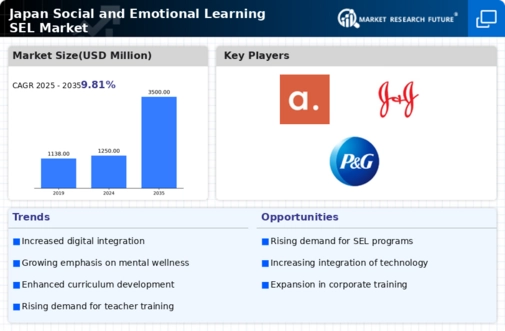
As per analysis, the Japan social emotional learning market is projected to grow from USD 70.06 Million in 2024 to USD 331.05 Million by 2035, exhibiting a compound annual growth rate (CAGR) of 15.16% during the forecast period (2025 - 2035).

Key Market Trends & Highlights

The Japan social emotional learning market is experiencing a robust expansion driven by increasing awareness and integration into educational frameworks.

  • The integration of social emotional learning (SEL) into school programs is currently the largest segment, reflecting a growing commitment to holistic education.
  • Online learning platforms are emerging as the fastest-growing segment, catering to the rising demand for flexible and accessible SEL resources.
  • Educational institutions are leading the market, while corporate training is rapidly gaining traction as organizations recognize the value of SEL in the workplace.
  • Key market drivers include government policies supporting SEL initiatives and rising parental demand for comprehensive SEL programs.

Market Size & Forecast

2024 Market Size 70.06 (USD Million)
2035 Market Size 331.05 (USD Million)
CAGR (2025 - 2035) 15.16%

Major Players

Benesse Corporation (JP), Gakken Holdings Co Ltd (JP), Shogakukan Inc (JP), Sofmap Co Ltd (JP), Kumon Institute of Education Co Ltd (JP), Z-kai Co Ltd (JP), Coco Juku Co Ltd (JP), Mitsubishi Research Institute Inc (JP)

Our Impact
Enabled $4.3B Revenue Impact for Fortune 500 and Leading Multinationals
Partnering with 2000+ Global Organizations Each Year
30K+ Citations by Top-Tier Firms in the Industry

Japan Social Emotional Learning Market Trends

The japan social emotional learning market is currently experiencing a notable evolution, driven by a growing recognition of the importance of emotional intelligence in educational settings. Recent initiatives by the Japanese government emphasize the integration of social emotional learning (SEL) into school curricula, reflecting a shift towards holistic education that nurtures both cognitive and emotional development. This trend appears to be supported by various educational policies aimed at fostering resilience, empathy, and interpersonal skills among students. As educational institutions increasingly adopt SEL frameworks, the demand for resources, training, and assessment tools tailored to this approach is likely to rise. Moreover, the increasing awareness of mental health issues among youth in Japan has prompted educators and policymakers to prioritize emotional well-being. Schools are beginning to implement programs that not only address academic performance but also focus on students' emotional and social needs. This dual approach may lead to a more balanced educational experience, potentially enhancing students' overall well-being and academic success. As the japan social emotional learning market continues to develop, collaboration between educational institutions, mental health professionals, and community organizations may play a crucial role in shaping effective SEL initiatives.

Integration of SEL in Curriculum

Educational institutions are increasingly incorporating social emotional learning into their curricula. This integration aims to enhance students' emotional intelligence and interpersonal skills, aligning with government policies that promote holistic education.

Focus on Mental Health Awareness

There is a growing emphasis on mental health within schools, leading to the implementation of programs that address emotional well-being. This focus may contribute to improved academic performance and overall student satisfaction.

Collaboration with Community Organizations

Partnerships between schools and community organizations are becoming more common. These collaborations aim to provide comprehensive support for students, enhancing the effectiveness of social emotional learning initiatives.

Japan Social Emotional Learning Market Drivers

Focus on Mental Health Awareness

The increasing focus on mental health awareness in Japan is significantly influencing the japan social emotional learning market. Recent surveys indicate that nearly 40% of Japanese youth report experiencing mental health challenges, prompting a societal shift towards prioritizing mental well-being. This heightened awareness has led to the implementation of various initiatives aimed at promoting mental health education within schools. The government has allocated funding to support mental health programs, which often incorporate SEL components. As a result, the demand for SEL resources that address mental health issues is likely to surge. The japan social emotional learning market may see a rise in partnerships between educational institutions and mental health organizations, fostering a collaborative approach to student well-being. This trend suggests a potential for growth in the development of SEL curricula that specifically target mental health education.

Integration of SEL in Curriculum

The integration of social emotional learning (SEL) into the educational curriculum in Japan appears to be a pivotal driver for the japan social emotional learning market. The Ministry of Education, Culture, Sports, Science and Technology (MEXT) has been advocating for the incorporation of SEL principles in schools, aiming to foster emotional intelligence and interpersonal skills among students. This initiative aligns with the broader educational reforms that emphasize holistic development. As of 2025, approximately 70% of schools in Japan have begun implementing SEL programs, indicating a growing recognition of its importance. The japan social emotional learning market is likely to benefit from this trend, as educational institutions seek resources and training to effectively deliver SEL content. Furthermore, the demand for SEL-related materials and professional development for educators is expected to rise, potentially expanding market opportunities.

Government Policies Supporting SEL

Government policies that support the implementation of social emotional learning (SEL) in Japan are likely to play a significant role in shaping the japan social emotional learning market. The Japanese government has recognized the importance of SEL in fostering a well-rounded education, leading to the establishment of guidelines that encourage schools to adopt SEL practices. Recent policy initiatives have included the introduction of training programs for teachers and the development of SEL-focused educational materials. As of 2025, approximately 60% of schools have reported aligning their curricula with these government guidelines, indicating a strong commitment to SEL. This supportive policy environment is expected to drive growth in the japan social emotional learning market, as educational institutions seek to comply with regulations and enhance their offerings. The potential for increased funding and resources from the government further underscores the positive outlook for SEL initiatives.

Rising Parental Demand for SEL Programs

The rising demand from parents for social emotional learning (SEL) programs in Japan is emerging as a significant driver in the japan social emotional learning market. Parents are increasingly aware of the importance of emotional intelligence and social skills in their children's development, leading to a growing expectation for schools to provide SEL education. Surveys indicate that over 75% of parents support the inclusion of SEL in school curricula, reflecting a cultural shift towards valuing emotional well-being alongside academic achievement. This demand is prompting educational institutions to seek out effective SEL programs and resources, thereby expanding the market for SEL-related products and services. The japan social emotional learning market may witness an influx of new offerings tailored to meet parental expectations, including workshops, online resources, and community engagement initiatives. This trend suggests a promising future for SEL as a fundamental component of education in Japan.

Collaboration with Community Organizations

Collaboration between schools and community organizations is emerging as a crucial driver in the japan social emotional learning market. Many educational institutions are recognizing the value of partnerships with local organizations to enhance SEL initiatives. These collaborations often provide students with access to additional resources, mentorship programs, and extracurricular activities that promote social and emotional development. For instance, community-based organizations are increasingly offering workshops and training sessions for educators, equipping them with the necessary skills to implement effective SEL strategies. This synergy not only enriches the educational experience but also fosters a supportive environment for students. As the japan social emotional learning market evolves, such collaborations are likely to become more prevalent, potentially leading to innovative SEL programs that cater to the diverse needs of students across various regions.

Market Segment Insights

By Application: School Programs (Largest) vs. Online Learning Platforms (Fastest-Growing)

In the Japan social emotional learning market, school programs currently dominate, capturing the largest market share. These programs are widely implemented across public and private educational institutions, focusing on curriculum integration and teacher training. Online learning platforms are rapidly gaining traction, showcasing significant growth potential as more educators and parents value flexible, accessible options for social emotional learning.

School Programs: Dominant vs. Online Learning Platforms: Emerging

School programs remain the cornerstone of social emotional learning in Japan, characterized by their structured approach and broad acceptance in the educational framework. They encompass comprehensive curricula designed to enhance students' emotional intelligence, resilience, and interpersonal skills. On the other hand, online learning platforms are emerging as a significant alternative, offering innovative, tech-driven solutions tailored for diverse learning environments. These platforms provide greater accessibility and personalization, appealing particularly to tech-savvy learners and busy parents, indicating a shift in how social emotional learning can be delivered and accessed.

By End Use: Educational Institutions (Largest) vs. Corporate Training (Fastest-Growing)

In the Japan social emotional learning market, Educational Institutions dominate the sector, capturing a significant share due to the increasing integration of SEL into curricula. Schools and universities are increasingly adopting social emotional learning programs, recognizing the importance of emotional intelligence and interpersonal skills in student development. Conversely, Corporate Training is emerging rapidly, reflecting a growing acknowledgment among businesses of the value of social emotional learning in enhancing employee engagement and teamwork.

Educational Institutions: Dominant vs. Corporate Training: Emerging

Educational Institutions hold a dominant position in the Japan social emotional learning market due to their extensive reach and the foundational role they play in childhood education. These institutions have been pivotal in developing emotional skills among students, which is essential for academic success and personal development. On the other hand, Corporate Training represents an emerging segment, driven by a newfound focus on the psychological well-being of employees and team dynamics. Organizations are increasingly investing in SEL programs to foster better workplace environments, improve employee relationships, and enhance overall productivity, showcasing the significant shift towards holistic employee development.

By Target Audience: Children (Largest) vs. Adolescents (Fastest-Growing)

In the Japan social emotional learning market, children represent the largest target audience segment, as early intervention has gained significant focus from educational institutions and parents. This is driven by a growing awareness of mental health in younger populations, leading schools to implement programs that enhance social-emotional skills among children. Conversely, adolescents have emerged as the fastest-growing segment, with increased investment in their emotional intelligence development as they face unique challenges during their developmental years. The growth in the adolescent segment is largely attributed to rising incidences of anxiety and depression among teenagers, prompting schools and mental health professionals to prioritize emotional learning strategies. Additionally, peer pressure, social media influences, and academic stress contribute to the need for more comprehensive social emotional learning frameworks tailored for adolescents. This heightened emphasis on supporting adolescent mental well-being signifies a robust growth trajectory for targeted learning initiatives in this demographic.

Children (Dominant) vs. Adolescents (Emerging)

Children constitute the dominant segment in the Japan social emotional learning market, largely due to proactive measures taken by schools and parents to instill foundational social and emotional skills at an early age. Programs tailored for children are often integrated into early childhood education and primary schooling, focusing on building empathy, communication skills, and problem-solving abilities. On the other hand, adolescents, while currently in the emerging phase, are gaining traction rapidly as educational systems adapt to the complexities of teenage emotional health. The high competition and academic pressures faced by adolescents create a pressing need for effective social emotional learning solutions that equip them with vital coping mechanisms. Schools are increasingly recognizing this demand and are crafting specialized programs aimed at enhancing emotional resilience and interpersonal skills within this group.

By Delivery Method: In-Person Training (Largest) vs. Virtual Training (Fastest-Growing)

In the Japan social emotional learning market, the delivery method segment showcases a diverse range of options, with In-Person Training leading the market share among other delivery methods. This segment is favored for its interactive nature and effective face-to-face engagement with learners, which is particularly appealing in culturally rich and relationship-oriented settings like Japan. Virtual Training also holds a significant share, increasingly capturing interest due to its flexibility and accessibility, especially among institutions looking to adapt to modern learning environments. Growth trends reveal a strong inclination towards Virtual Training as the fastest-growing method in the segment. As the demand for remote learning options rises, fueled by technological advances and the necessity for continuous education during periods of disruption, Virtual Training is expected to evolve. This growth is further driven by the ability of online platforms to reach wider audiences and provide tailored learning experiences, positioning Virtual Training as a key player in the future of social emotional learning in Japan.

In-Person Training (Dominant) vs. Mobile Applications (Emerging)

In-Person Training remains a dominant force in the Japan social emotional learning market, characterized by its immersive and interactive approach, providing significant advantages in fostering genuine social skills and emotional competencies in learners. This method thrives on the personal touch, allowing trainers to engage directly with participants, adjusting their tactics based on real-time feedback. On the other hand, Mobile Applications represent an emerging force, catering to a tech-savvy audience that prefers flexible learning environments. These applications offer an innovative approach, enabling users to engage with social emotional learning material anytime and anywhere, promoting self-paced learning opportunities. As both methods cater to distinct demographics, their coexistence continues to shape a diversified learning landscape.

By Content Type: Curriculum-Based Content (Largest) vs. Interactive Activities (Fastest-Growing)

In the Japan social emotional learning market, the segment distribution shows a clear dominance of curriculum-based content, which is recognized as the primary resource utilized by educators. Its structured approach allows for comprehensive coverage of social emotional competencies, making it a preferred choice in schools and institutions. Meanwhile, interactive activities are rapidly gaining traction, appealing to educators looking for innovative ways to engage students and enhance learning through participation and creativity. The growth trends indicate that while curriculum-based content remains essential, the emphasis on interactive activities reflects a shift towards more hands-on learning experiences. This pivot is driven by an increasing recognition of the importance of student engagement in emotional learning, leading to greater investment in interactive resources that facilitate collaboration and peer-to-peer interactions in educational settings.

Curriculum-Based Content: Dominant vs. Interactive Activities: Emerging

Curriculum-based content is a dominant force in the Japan social emotional learning market, characterized by its comprehensive framework that systematically addresses emotional and social skills development. It provides structured lessons that educators can easily implement, ensuring that essential skills are taught consistently across various educational environments. In contrast, interactive activities are emerging as a favored choice for their ability to captivate students through engaging formats that promote active participation. These activities often incorporate games, role-playing, and collaborative projects, which not only enhance learning but also encourage socialization among peers. Together, these segments highlight the evolving landscape of educational content, as providers seek to blend traditional and modern methodologies to foster emotional intelligence among students.

Get more detailed insights about Japan Social Emotional Learning Market

Key Players and Competitive Insights

The social emotional learning market in Japan is characterized by a dynamic competitive landscape, driven by increasing awareness of the importance of emotional intelligence in education. Key players such as Benesse Corporation (Japan), Gakken Holdings Co Ltd (Japan), and Kumon Institute of Education Co Ltd (Japan) are at the forefront, each adopting distinct strategies to enhance their market presence. Benesse Corporation (Japan) focuses on digital transformation, integrating technology into its educational offerings to foster emotional and social skills among students. Gakken Holdings Co Ltd (Japan) emphasizes partnerships with educational institutions to expand its reach, while Kumon Institute of Education Co Ltd (Japan) leverages its extensive network of learning centers to implement tailored social emotional learning programs. Collectively, these strategies contribute to a moderately fragmented market, where innovation and collaboration are pivotal for competitive advantage.

In terms of business tactics, companies are increasingly localizing their offerings to cater to the unique cultural and educational needs of Japanese students. This localization, coupled with supply chain optimization, allows for more effective delivery of educational content. The market structure remains moderately fragmented, with several key players influencing the overall dynamics. The collective efforts of these companies not only enhance their individual market positions but also drive the overall growth of the social emotional learning sector in Japan.

In December 2025, Benesse Corporation (Japan) launched a new digital platform aimed at enhancing emotional intelligence among students through interactive learning modules. This strategic move is significant as it aligns with the growing trend of digitalization in education, allowing for personalized learning experiences that cater to individual emotional needs. The platform's success could potentially set a new standard for educational technology in the region.

In November 2025, Gakken Holdings Co Ltd (Japan) announced a partnership with local schools to implement a comprehensive social emotional learning curriculum. This collaboration is crucial as it not only expands Gakken's market reach but also reinforces the importance of emotional learning in traditional educational settings. By integrating their curriculum with existing school programs, Gakken positions itself as a leader in educational innovation.

In October 2025, Kumon Institute of Education Co Ltd (Japan) introduced a new training program for instructors focused on social emotional learning techniques. This initiative is particularly noteworthy as it enhances the skill set of educators, ensuring that they are well-equipped to support students' emotional development. By investing in instructor training, Kumon strengthens its brand reputation and commitment to holistic education.

As of January 2026, current trends in the social emotional learning market include a pronounced shift towards digitalization, sustainability, and the integration of artificial intelligence in educational tools. Strategic alliances among key players are increasingly shaping the competitive landscape, fostering innovation and collaboration. Looking ahead, it appears that competitive differentiation will evolve, with a greater emphasis on technology and supply chain reliability rather than solely on price. This shift suggests a future where innovation and adaptability are paramount for success in the social emotional learning market.

Key Companies in the Japan Social Emotional Learning Market include

Industry Developments

Benesse Corporation introduced a SEL-focused digital campaign in April 2024 that included daily goal-setting and mood-reflection tools for elementary school students on their Shinkenzemi platform. Pilot schools in Tokyo and Osaka implemented Mindset Works' Japanese-language version of their brain science-based SEL program by October 2024.

"SEL Playbox," a modular SEL activity kit used in preschools to teach empathy and self-awareness through guided activities, was introduced by Gakken Holdings in January 2025. In July 2024, Hitachi announced a partnership with Fukuoka's urban schools to install classroom sensors that track stress markers and give teachers access to anonymized SEL statistics.

Lastly, in March 2025, Cerego released an adaptive SEL app that was adapted for Japan. The app offers scenario-based lessons that assess and strengthen students' ability to control their emotions and make decisions.

These focused initiatives show how localized curricula, early childhood resources, multilingual digital platforms, and wellness analytics are improving Japan's SEL landscape and reaffirming emotional learning as a crucial component of holistic education.

Future Outlook

Japan Social Emotional Learning Market Future Outlook

The Japan social emotional learning market is projected to grow at a 15.16% CAGR from 2025 to 2035, driven by increasing educational reforms and heightened awareness of mental health.

New opportunities lie in:

  • Development of digital SEL platforms for remote learning environments.
  • Integration of SEL curricula in corporate training programs.
  • Partnerships with educational institutions for tailored SEL workshops.

By 2035, the market is expected to be robust, reflecting a strong commitment to emotional intelligence in education.

Market Segmentation

Japan Social Emotional Learning Market End Use Outlook

  • Educational Institutions
  • Non-Profit Organizations
  • Government Agencies
  • Corporate Training
  • Parents and Guardians

Japan Social Emotional Learning Market Application Outlook

  • School Programs
  • After-School Programs
  • Online Learning Platforms
  • Workshops
  • Community Initiatives

Japan Social Emotional Learning Market Content Type Outlook

  • Curriculum-Based Content
  • Interactive Activities
  • Assessment Tools
  • Resource Guides
  • Multimedia Materials

Japan Social Emotional Learning Market Delivery Method Outlook

  • In-Person Training
  • Virtual Training
  • Hybrid Learning
  • Self-Paced Learning
  • Mobile Applications

Japan Social Emotional Learning Market Target Audience Outlook

  • Children
  • Adolescents
  • Educators
  • Parents
  • Mental Health Professionals

Report Scope

MARKET SIZE 202470.06(USD Million)
MARKET SIZE 202581.83(USD Million)
MARKET SIZE 2035331.05(USD Million)
COMPOUND ANNUAL GROWTH RATE (CAGR)15.16% (2024 - 2035)
REPORT COVERAGERevenue Forecast, Competitive Landscape, Growth Factors, and Trends
BASE YEAR2024
Market Forecast Period2025 - 2035
Historical Data2019 - 2024
Market Forecast UnitsUSD Million
Key Companies ProfiledBenesse Corporation (JP), Gakken Holdings Co Ltd (JP), Shogakukan Inc (JP), Sofmap Co Ltd (JP), Kumon Institute of Education Co Ltd (JP), Z-kai Co Ltd (JP), Coco Juku Co Ltd (JP), Mitsubishi Research Institute Inc (JP)
Segments CoveredApplication, End Use, Target Audience, Delivery Method, Content Type
Key Market OpportunitiesIntegration of digital platforms enhances accessibility and engagement in the japan social emotional learning market.
Key Market DynamicsGrowing emphasis on emotional intelligence in education drives demand for social emotional learning programs in Japan.
Countries CoveredJapan
Leave a Comment

FAQs

What is the current valuation of the Japan social emotional learning market?

As of 2024, the Japan social emotional learning market was valued at 70.06 USD Million.

What is the projected market size for the Japan social emotional learning market by 2035?

The market is projected to reach a valuation of 331.05 USD Million by 2035.

What is the expected CAGR for the Japan social emotional learning market during the forecast period?

The expected CAGR for the Japan social emotional learning market from 2025 to 2035 is 15.16%.

Who are the key players in the Japan social emotional learning market?

Key players include Benesse Corporation, Gakken Holdings Co Ltd, Shogakukan Inc, and Kumon Institute of Education Co Ltd.

What are the main segments of the Japan social emotional learning market?

The main segments include School Programs, After-School Programs, Online Learning Platforms, Workshops, and Community Initiatives.

How did the School Programs segment perform in terms of valuation?

The School Programs segment had a valuation range from 20.0 to 90.0 USD Million.

What is the valuation range for the Online Learning Platforms segment?

The Online Learning Platforms segment is valued between 10.0 and 50.0 USD Million.

Which target audience segments are included in the Japan social emotional learning market?

Target audience segments include Children, Adolescents, Educators, Parents, and Mental Health Professionals.

What delivery methods are utilized in the Japan social emotional learning market?

Delivery methods include In-Person Training, Virtual Training, Hybrid Learning, Self-Paced Learning, and Mobile Applications.

What types of content are offered in the Japan social emotional learning market?

Content types include Curriculum-Based Content, Interactive Activities, Assessment Tools, Resource Guides, and Multimedia Materials.

Download Free Sample

Kindly complete the form below to receive a free sample of this Report

Compare Licence

×
Features License Type
Single User Multiuser License Enterprise User
Price $4,950 $5,950 $7,250
Maximum User Access Limit 1 User Upto 10 Users Unrestricted Access Throughout the Organization
Free Customization
Direct Access to Analyst
Deliverable Format
Platform Access
Discount on Next Purchase 10% 15% 15%
Printable Versions