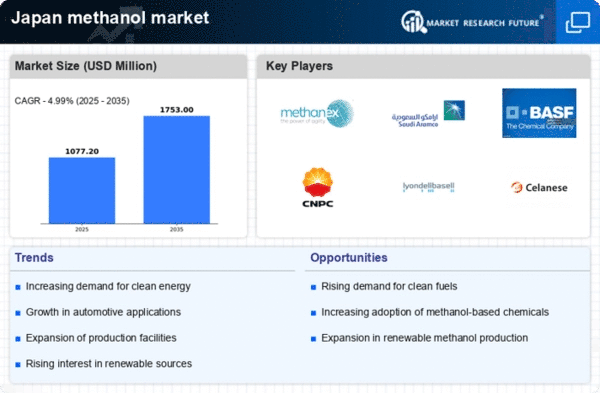
The methanol market in Japan is characterized by a competitive landscape that is increasingly shaped by innovation, sustainability initiatives, and strategic partnerships. Key players such as Methanex Corporation (CA), Saudi Methanol Company (SA), and BASF SE (DE) are actively pursuing strategies that emphasize operational efficiency and market expansion. Methanex Corporation (CA) has positioned itself as a leader in sustainable methanol production, focusing on reducing carbon emissions through innovative technologies. Meanwhile, Saudi Methanol Company (SA) is enhancing its production capabilities to meet rising domestic and international demand, indicating a robust operational focus on capacity expansion. BASF SE (DE) is leveraging its extensive research and development capabilities to innovate in methanol applications, thereby strengthening its competitive edge in the market.The business tactics employed by these companies reflect a moderately fragmented market structure, where localized manufacturing and supply chain optimization are pivotal. Companies are increasingly localizing their production to mitigate risks associated with global supply chain disruptions. This strategy not only enhances operational efficiency but also allows for quicker response times to market demands. The collective influence of these key players is significant, as they drive competition through technological advancements and strategic collaborations.
In October Methanex Corporation (CA) announced a partnership with a leading renewable energy firm to develop a new facility aimed at producing methanol from renewable sources. This strategic move underscores Methanex's commitment to sustainability and positions the company to capitalize on the growing demand for green methanol. The collaboration is expected to enhance Methanex's market share while aligning with global sustainability goals.
In September Saudi Methanol Company (SA) unveiled plans to expand its production capacity by 20% over the next two years. This expansion is strategically important as it aims to meet the increasing demand for methanol in both domestic and international markets. By enhancing its production capabilities, Saudi Methanol Company (SA) is likely to solidify its position as a key supplier in the region, thereby influencing pricing dynamics and competitive strategies.
In August BASF SE (DE) launched a new line of methanol-based products designed for the automotive industry, focusing on reducing emissions and improving fuel efficiency. This initiative not only reflects BASF's innovative approach but also highlights the growing trend towards sustainable solutions in the automotive sector. The introduction of these products is expected to enhance BASF's competitive positioning and attract new customers seeking environmentally friendly alternatives.
As of November the competitive trends in the methanol market are increasingly defined by digitalization, sustainability, and the integration of advanced technologies such as AI. Strategic alliances are becoming more prevalent, as companies recognize the need to collaborate in order to innovate and meet evolving market demands. The shift from price-based competition to a focus on innovation, technology, and supply chain reliability is evident, suggesting that future competitive differentiation will hinge on these factors.