×
Request Free Sample ×

Kindly complete the form below to receive a free sample of this Report

* Please use a valid business email

Leading companies partner with us for data-driven Insights

clients tt-cursor
Hero Background

Japan Hyperscale Data Center Market

ID: MRFR/ICT/59004-HCR
200 Pages
Aarti Dhapte
February 2026

Japan Hyperscale Data Center Market Research Report By Type (Colocation Data Centers, Cloud Data Centers, Enterprise Data Centers, Managed Data Centers), By Service Type (Infrastructure as a Service, Platform as a Service, Software as a Service), By End User (IT Services, Telecommunications, Web Services, Financial Services, Healthcare) and By Cooling Technology (Air-based Cooling, Liquid Cooling, Evaporative Cooling)- Forecast to 2035

Share:
Download PDF ×

We do not share your information with anyone. However, we may send you emails based on your report interest from time to time. You may contact us at any time to opt-out.

Japan Hyperscale Data Center Market Infographic
Purchase Options

Japan Hyperscale Data Center Market Summary

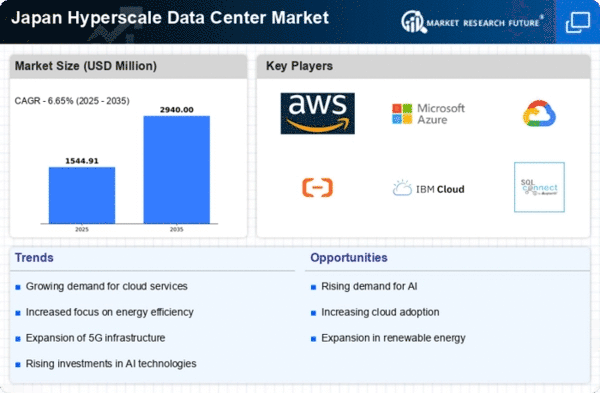
As per Market Research Future analysis, the Japan hyperscale data-center market size was estimated at 1448.58 USD Million in 2024.. The Japan hyperscale data-center market is projected to grow from 1544.91 USD Million in 2025 to 2940.0 USD Million by 2035, exhibiting a compound annual growth rate (CAGR) of 6.6% during the forecast period 2025 - 2035

Key Market Trends & Highlights

The Japan hyperscale data-center market is experiencing robust growth driven by technological advancements and sustainability initiatives.

  • Cloud adoption continues to rise, indicating a shift towards more scalable and flexible data solutions.
  • Energy efficiency remains a focal point, as operators seek to reduce operational costs and environmental impact.
  • Integration of advanced technologies, such as AI and machine learning, is enhancing data processing capabilities.
  • Rising demand for data processing and government support for green technologies are key drivers of market expansion.

Market Size & Forecast

2024 Market Size 1448.58 (USD Million)
2035 Market Size 2940.0 (USD Million)
CAGR (2025 - 2035) 6.65%

Major Players

Amazon Web Services (US), Microsoft Azure (US), Google Cloud (US), Alibaba Cloud (CN), IBM Cloud (US), Oracle Cloud (US), Tencent Cloud (CN), DigitalOcean (US), Equinix (US)

Our Impact
Enabled $4.3B Revenue Impact for Fortune 500 and Leading Multinationals
Partnering with 2000+ Global Organizations Each Year
30K+ Citations by Top-Tier Firms in the Industry

Japan Hyperscale Data Center Market Trends

The hyperscale data-center market in Japan is currently experiencing notable growth, driven by increasing demand for cloud services and data storage solutions. As businesses continue to digitize their operations, the need for scalable and efficient data management systems has become paramount. This trend is further supported by advancements in technology, which enable data centers to operate with greater energy efficiency and lower operational costs. Additionally, the Japanese government has been actively promoting initiatives to enhance digital infrastructure, which may contribute to the expansion of this market. Moreover, the hyperscale data-center market is likely to benefit from the rising adoption of artificial intelligence and machine learning technologies. These innovations require substantial computational power and storage capabilities, which hyperscale facilities are well-equipped to provide. The focus on sustainability is also becoming increasingly relevant, as operators seek to minimize their environmental impact through renewable energy sources and efficient cooling systems. Overall, The outlook for the hyperscale data-center market in Japan is promising, with various factors indicating robust future growth..

Increased Cloud Adoption

The demand for cloud services is rising, leading to a greater need for hyperscale data centers. Businesses are migrating to cloud-based solutions for enhanced flexibility and scalability, which drives the expansion of this market.

Focus on Energy Efficiency

Operators are prioritizing energy-efficient technologies to reduce operational costs and environmental impact. This trend is likely to influence the design and operation of hyperscale facilities, promoting sustainable practices.

Integration of Advanced Technologies

The incorporation of artificial intelligence and machine learning is transforming data management. Hyperscale data centers are adapting to support these technologies, which require significant computational resources.

Japan Hyperscale Data Center Market Drivers

Rising Demand for Data Processing

The hyperscale data-center market in Japan experiences a notable surge in demand for data processing capabilities. As businesses increasingly rely on data analytics and real-time processing, the need for robust data infrastructure intensifies. In 2025, the market is projected to grow by approximately 15%, driven by sectors such as finance, healthcare, and e-commerce. These industries require substantial computational power to manage vast amounts of data, thereby propelling investments in hyperscale facilities. Furthermore, the proliferation of IoT devices contributes to this demand, as they generate significant data traffic that necessitates efficient processing and storage solutions. Consequently, the hyperscale data-center market is positioned to expand, catering to the evolving needs of enterprises seeking to harness data for strategic decision-making.

Government Initiatives and Support

The Japanese government plays a pivotal role in fostering the hyperscale data-center market through various initiatives and support mechanisms. Policies aimed at enhancing digital infrastructure and promoting technological innovation are increasingly prevalent. For instance, the government has allocated substantial funding to improve connectivity and energy efficiency in data centers. In 2025, it is estimated that public investments in digital infrastructure will reach ¥500 billion, significantly benefiting the hyperscale data-center market. Additionally, regulatory frameworks are being established to streamline the development of data centers, ensuring compliance with environmental standards. This supportive environment encourages both domestic and foreign investments, thereby stimulating growth in the hyperscale data-center market.

Shift Towards Hybrid Cloud Solutions

The hyperscale data-center market in Japan is witnessing a shift towards hybrid cloud solutions, which combine on-premises infrastructure with cloud services. This trend is driven by organizations seeking flexibility and scalability in their IT operations. In 2025, it is anticipated that hybrid cloud adoption will increase by 20%, as businesses recognize the advantages of leveraging both private and public cloud resources. This approach allows for optimized workloads, enhanced security, and cost efficiency. As a result, hyperscale data centers are adapting their offerings to support hybrid environments, thereby expanding their service portfolios. This evolution not only meets the diverse needs of clients but also positions the hyperscale data-center market for sustained growth in a competitive landscape.

Technological Advancements in Infrastructure

Technological advancements are significantly shaping the hyperscale data-center market in Japan. Innovations in hardware, software, and networking are enhancing the efficiency and performance of data centers. In 2025, it is expected that investments in AI-driven management systems will increase by 25%, enabling operators to optimize resource allocation and reduce operational costs. Additionally, the integration of edge computing technologies is facilitating faster data processing and lower latency, which are crucial for applications such as autonomous vehicles and smart cities. As these technologies continue to evolve, they are likely to drive further growth in the hyperscale data-center market, positioning it as a leader in the digital transformation landscape.

Focus on Sustainability and Green Technologies

Sustainability has emerged as a critical focus within the hyperscale data-center market in Japan. As environmental concerns gain prominence, data center operators are increasingly adopting green technologies to minimize their carbon footprint. In 2025, it is projected that 30% of new data centers will incorporate renewable energy sources, such as solar and wind power. This shift not only aligns with global sustainability goals but also appeals to environmentally conscious consumers and businesses. Furthermore, energy-efficient cooling systems and advanced power management solutions are being implemented to optimize resource usage. Consequently, the hyperscale data-center market is likely to benefit from this trend, as companies prioritize sustainable practices in their operations.


Market Segment Insights

By Type: Cloud Data Centers (Largest) vs. Colocation Data Centers (Fastest-Growing)

In the Japan hyperscale data-center market, the market share distribution among major segments reveals Cloud Data Centers as the largest segment, driven by the increasing adoption of digital solutions and cloud-based services. Colocation Data Centers are emerging as a strong contender, appealing to businesses due to their scalability and cost-efficiency. Consequently, these segments showcase a dynamic landscape where cloud solutions dominate the market share while colocation services gain traction. Growth trends in the Japan hyperscale data-center market are significantly influenced by digital transformation initiatives and the demand for efficient IT infrastructures. Cloud Data Centers benefit from evolving enterprise needs for robust data management, whereas Colocation Data Centers attract businesses looking for flexibility and reduced capital expenditure. As businesses continue to migrate to cloud platforms, the colocation segment is projected to grow at a rapid pace, signifying a shift in how organizations manage their data resources.

Cloud Data Centers (Dominant) vs. Colocation Data Centers (Emerging)

Cloud Data Centers serve as the backbone of digital infrastructure, offering extensive resources and scalability that meet the growing demands of enterprises in Japan. They provide on-demand services tailored for various applications, ranging from storage solutions to advanced computing power. In contrast, Colocation Data Centers present an emerging solution for businesses seeking reliable and cost-effective infrastructures without investing heavily in their own hardware. These facilities allow organizations to house their servers and other hardware while benefiting from high security, advanced cooling solutions, and resilient backup power systems. The synergy between these segments not only enhances operational efficiency but also fosters innovation as businesses navigate their digital transformation journeys.

By Service Type: Infrastructure as a Service (Largest) vs. Software as a Service (Fastest-Growing)

In the Japan hyperscale data-center market, the service type segment is significantly characterized by Infrastructure as a Service (IaaS) maintaining a dominant market share compared to others. Within this segment, IaaS has established itself as a foundational service, appealing to enterprises seeking flexibility and scalability in their operations. Conversely, Software as a Service (SaaS) has emerged as a vital player, capturing a growing share as businesses increasingly adopt cloud-based applications to enhance productivity and reduce costs. The growth trends in this segment are primarily driven by the digital transformation initiatives undertaken by organizations across various industries in Japan. IaaS continues to benefit from the rising demand for high-capacity storage solutions and computing power. Meanwhile, SaaS is recognized as the fastest-growing service type due to its convenience and affordability, making it an attractive option for businesses that prioritize agility and innovation in their operations.

Infrastructure as a Service: IaaS (Dominant) vs. Software as a Service: SaaS (Emerging)

Infrastructure as a Service (IaaS) is the dominant force in the Japan hyperscale data-center market, providing essential IT infrastructure solutions that enable businesses to efficiently manage their workloads. With its robust scalability and cost-effectiveness, IaaS allows organizations to customize their resources according to specific project needs. In contrast, Software as a Service (SaaS) represents an emerging trend, thriving on the widespread adoption of cloud technologies. SaaS offers user-friendly software applications accessible via the internet, thus facilitating collaboration and operational efficiency. As more organizations recognize the benefits of SaaS, its growth trajectory is poised to accelerate, further enhancing its presence as a significant contender in this market.

By End User: IT Services (Largest) vs. Telecommunications (Fastest-Growing)

In the Japan hyperscale data-center market, the distribution of market share among end users is diverse, with IT Services holding the largest share. This segment benefits from increasing demand for cloud-based solutions and data processing capabilities. Telecommunications follows closely, experiencing rapid growth as 5G technology and mobile data consumption rise, driving the need for robust data infrastructure. The demand for enhanced connectivity solutions further boosts this segment's position. The growth trends in the Japan hyperscale data-center market are influenced by factors such as the digital transformation of industries, increased reliance on cloud services, and the proliferation of IoT devices. IT Services remains a dominant player by adapting to evolving customer needs. Conversely, Telecommunications is emerging as a fast-growing segment due to the expansion of 5G networks and the need for improved communication services, suggesting a promising future for both segments as they evolve with technological advancements.

IT Services: Dominant vs. Telecommunications: Emerging

IT Services is characterized by its critical role in facilitating technological advancements and businesses' digital transformation efforts. This segment remains dominant in the Japan hyperscale data-center market due to its extensive requirement for data storage, processing power, and cloud-based services. Organizations in this space prioritize data security, reliability, and scalability, making IT Services a cornerstone for enterprise-level solutions. On the other hand, Telecommunications is an emerging segment driven by the rapid deployment of 5G infrastructure and escalating mobile data needs. As communication requirements evolve, this sector is rapidly adopting advanced data-center solutions. The combination of high-speed connectivity and robust data management positions Telecommunications as a key player, poised for significant growth in the market.

By Cooling Technology: Air-based Cooling (Largest) vs. Liquid Cooling (Fastest-Growing)

In the Japan hyperscale data-center market, Air-based Cooling currently holds the largest share, attributed to its lower initial costs and widespread adoption. However, Liquid Cooling is gaining traction, accounting for an increasingly significant portion of the market due to its efficiency in handling high-density computing environments. The distribution of market shares reveals a competitive landscape where traditional methods are being challenged by innovative technologies that offer enhanced performance. Growth trends in this segment are driven by the rising need for energy-efficient solutions and the proliferation of high-performance computing applications. As more data centers focus on sustainability and energy conservation, Liquid Cooling solutions, in particular, are projected to experience rapid growth. The adoption of AI and advanced data processing technologies further propels the demand for efficient cooling options, making this segment dynamic and ever-evolving.

Air-based Cooling: Dominant vs. Liquid Cooling: Emerging

Air-based Cooling has established itself as the dominant technology in the sector, primarily due to its cost-effectiveness and simplicity in implementation. It utilizes large fans and air circulation systems to maintain optimal temperatures, making it suitable for a wide range of data center layouts. Conversely, Liquid Cooling is emerging as a preferred alternative for high-density setups, owing to its ability to transfer heat more efficiently. This method circulates coolant through pipes adjacent to hardware components, significantly lowering operational temperatures. As data demands escalate, Liquid Cooling's market position is strengthened by its sustainability benefits and effectiveness in reducing energy consumption, appealing to environmentally conscious operators.

Get more detailed insights about Japan Hyperscale Data Center Market

Key Players and Competitive Insights

The hyperscale data-center market in Japan is characterized by intense competition and rapid growth, driven by increasing demand for cloud services and digital transformation initiatives. Major players such as Amazon Web Services (US), Microsoft Azure (US), and Google Cloud (US) are at the forefront, leveraging their technological prowess and extensive infrastructure to capture market share. These companies focus on innovation and regional expansion, with strategies that include enhancing service offerings and optimizing operational efficiencies. Their collective efforts contribute to a competitive environment that is both dynamic and evolving, as they vie for leadership in a market that is becoming increasingly critical to Japan's digital economy.Key business tactics employed by these hyperscale data-center operators include localizing manufacturing and optimizing supply chains to enhance service delivery. The market structure appears moderately fragmented, with a mix of established giants and emerging players. This fragmentation allows for a diverse range of services and solutions, fostering competition that drives innovation and efficiency. The influence of key players is substantial, as they set benchmarks for service quality and operational standards, shaping the overall market landscape.

In October Amazon Web Services (US) announced the opening of a new data center in Tokyo, aimed at expanding its capacity to meet the growing demand for cloud services in the region. This strategic move underscores AWS's commitment to enhancing its infrastructure and service offerings, positioning it to better serve local enterprises and government agencies. The establishment of this facility is likely to strengthen AWS's competitive edge, enabling it to deliver faster and more reliable services to its clients.

In September Microsoft Azure (US) launched a new initiative focused on sustainability, pledging to achieve carbon negativity by 2030. This initiative includes investments in renewable energy sources for its data centers in Japan. By prioritizing sustainability, Microsoft not only addresses environmental concerns but also aligns with the increasing demand from consumers and businesses for eco-friendly solutions. This strategic focus may enhance Microsoft’s brand reputation and attract environmentally conscious clients, further solidifying its market position.

In August Google Cloud (US) expanded its partnership with local telecommunications providers to enhance connectivity and service delivery across Japan. This collaboration aims to improve network performance and reduce latency for users, which is critical for businesses relying on cloud services. By strengthening its local partnerships, Google Cloud is likely to enhance its competitive positioning, ensuring that it can meet the specific needs of Japanese enterprises effectively.

As of November current trends in the hyperscale data-center market include a strong emphasis on digitalization, sustainability, and the integration of artificial intelligence (AI) into operations. Strategic alliances are increasingly shaping the competitive landscape, as companies collaborate to enhance service offerings and operational efficiencies. Looking ahead, competitive differentiation is expected to evolve, with a shift from price-based competition to a focus on innovation, technology, and supply chain reliability. This transition may redefine how companies compete, emphasizing the importance of advanced solutions and sustainable practices in attracting and retaining clients.

Key Companies in the Japan Hyperscale Data Center Market include

Industry Developments

In recent months, the Japan Hyperscale Data Center Market has seen significant developments with key players expanding their operations. Digital Realty announced the construction of a new data center in Tokyo in September 2023, aimed at meeting the rising demand for cloud services. On April 9, 2024, Microsoft declared that it would invest $2.9 billion over two years to greatly increase the size of its AI and cloud infrastructure in Japan. This entails upskilling 3 million Japanese workers in AI technologies, opening a Microsoft Research Asia lab in Tokyo, and integrating cutting-edge AI semiconductors into already-existing data centers. 

This is Microsoft's biggest investment in the nation and highlights the growing need for hyperscale-capable computing to handle workloads related to artificial intelligence. Concerned about groundwater depletion, pollution, tree loss, and disturbance of animals, more than 220 citizens of Akishima city (Tokyo region) petitioned on July 10, 2024, to stop the construction of a large 3.63 MW data center by Singapore-based developer GLP. The project, which is expected to begin in February 2024 and be finished by early 2029, demonstrates growing local and regulatory opposition in the face of Japan's quick hyperscale growth.

Future Outlook

Japan Hyperscale Data Center Market Future Outlook

The Hyperscale Data Center Market in Japan is projected to grow at a 6.65% CAGR from 2025 to 2035, driven by increased cloud adoption, energy efficiency demands, and advanced technologies.

New opportunities lie in:

  • Development of AI-optimized data management solutions.
  • Investment in renewable energy sources for sustainable operations.
  • Expansion of edge computing facilities to enhance service delivery.

By 2035, the market is expected to achieve robust growth, positioning itself as a leader in technological advancements.

Market Segmentation

Japan Hyperscale Data Center Market Type Outlook

  • Colocation Data Centers
  • Cloud Data Centers
  • Enterprise Data Centers
  • Managed Data Centers

Japan Hyperscale Data Center Market End User Outlook

  • IT Services
  • Telecommunications
  • Web Services
  • Financial Services
  • Healthcare

Japan Hyperscale Data Center Market Service Type Outlook

  • Infrastructure as a Service
  • Platform as a Service
  • Software as a Service

Japan Hyperscale Data Center Market Cooling Technology Outlook

  • Air-based Cooling
  • Liquid Cooling
  • Evaporative Cooling

Report Scope

MARKET SIZE 2024 1448.58(USD Million)
MARKET SIZE 2025 1544.91(USD Million)
MARKET SIZE 2035 2940.0(USD Million)
COMPOUND ANNUAL GROWTH RATE (CAGR) 6.65% (2025 - 2035)
REPORT COVERAGE Revenue Forecast, Competitive Landscape, Growth Factors, and Trends
BASE YEAR 2024
Market Forecast Period 2025 - 2035
Historical Data 2019 - 2024
Market Forecast Units USD Million
Key Companies Profiled Amazon Web Services (US), Microsoft Azure (US), Google Cloud (US), Alibaba Cloud (CN), IBM Cloud (US), Oracle Cloud (US), Tencent Cloud (CN), DigitalOcean (US), Equinix (US)
Segments Covered Type, Service Type, End User, Cooling Technology
Key Market Opportunities Adoption of advanced cooling technologies enhances efficiency in the hyperscale data-center market.
Key Market Dynamics Rising demand for energy efficiency drives innovation in hyperscale data-center infrastructure and operations in Japan.
Countries Covered Japan
Leave a Comment

FAQs

What is the estimated market value of the Japan Hyperscale Data Center Market in 2024?

The Japan Hyperscale Data Center Market is expected to be valued at 1.55 billion USD in 2024.

What will the market value of the Japan Hyperscale Data Center Market be by 2035?

By 2035, the Japan Hyperscale Data Center Market is projected to reach a value of 5.8 billion USD.

What is the expected compound annual growth rate (CAGR) for the Japan Hyperscale Data Center Market from 2025 to 2035?

The expected CAGR for the Japan Hyperscale Data Center Market from 2025 to 2035 is 12.746%.

Which type of data center is expected to dominate the market share in Japan by 2035?

Colocation Data Centers are projected to dominate the market share in Japan, reaching 2.35 billion USD by 2035.

What is the market value for Cloud Data Centers in Japan in 2024 and 2035?

Cloud Data Centers are estimated to be valued at 0.48 billion USD in 2024 and expected to grow to 1.84 billion USD by 2035.

Who are the key players in the Japan Hyperscale Data Center Market?

Key players include Digital Realty, Vantage Data Centers, Google Cloud, Mitsubishi, SoftBank Group, and Microsoft.

What will the market size for Managed Data Centers be in Japan by 2035?

Managed Data Centers are expected to achieve a market size of 0.7 billion USD in Japan by 2035.

What are the primary growth drivers for the Japan Hyperscale Data Center Market?

The primary growth drivers include the increasing demand for cloud services and digital transformation across industries.

How is the market for Enterprise Data Centers expected to change by 2035?

The market for Enterprise Data Centers is projected to grow from 0.28 billion USD in 2024 to 1.09 billion USD by 2035.

What challenges does the Japan Hyperscale Data Center Market face amid current global scenarios?

Challenges include maintaining operational efficiency and addressing energy consumption and sustainability concerns in data centers.

Download Free Sample

Kindly complete the form below to receive a free sample of this Report

Compare Licence

×
Features License Type
Single User Multiuser License Enterprise User
Price $4,950 $5,950 $7,250
Maximum User Access Limit 1 User Upto 10 Users Unrestricted Access Throughout the Organization
Free Customization
Direct Access to Analyst
Deliverable Format
Platform Access
Discount on Next Purchase 10% 15% 15%
Printable Versions