×
Request Free Sample ×

Kindly complete the form below to receive a free sample of this Report

* Please use a valid business email

Leading companies partner with us for data-driven Insights

clients tt-cursor
Hero Background

China Hyperscale Data Center Market

ID: MRFR/ICT/59007-HCR
200 Pages
Aarti Dhapte
February 2026

China Hyperscale Data Center Market Research Report By Type (Colocation Data Centers, Cloud Data Centers, Enterprise Data Centers, Managed Data Centers), By Service Type (Infrastructure as a Service, Platform as a Service, Software as a Service), By End User (IT Services, Telecommunications, Web Services, Financial Services, Healthcare) and By Cooling Technology (Air-based Cooling, Liquid Cooling, Evaporative Cooling) - Forecast to 2035

Share:
Download PDF ×

We do not share your information with anyone. However, we may send you emails based on your report interest from time to time. You may contact us at any time to opt-out.

China Hyperscale Data Center Market Infographic
Purchase Options

China Hyperscale Data Center Market Summary

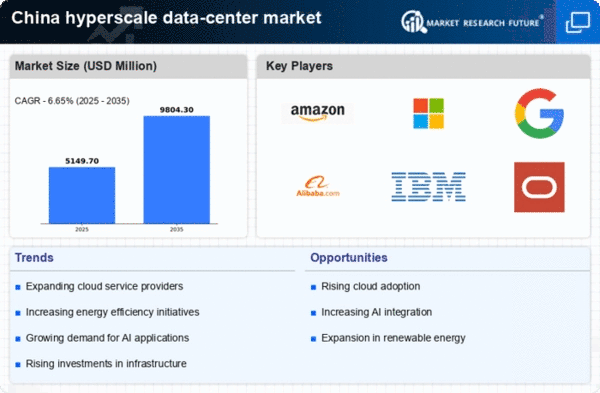
As per Market Research Future analysis, the China hyperscale data-center market was estimated at 4828.6 USD Million in 2024. The China hyperscale data-center market is projected to grow from 5149.7 USD Million in 2025 to 9804.3 USD Million by 2035, exhibiting a compound annual growth rate (CAGR) of 6.6% during the forecast period 2025 - 2035

Key Market Trends & Highlights

The China hyperscale data-center market is experiencing robust growth driven by technological advancements and sustainability efforts.

  • Sustainability initiatives are becoming a central focus for hyperscale data centers in China, reflecting a broader global trend.
  • Edge computing integration is gaining traction, particularly in urban areas, to enhance data processing capabilities.
  • AI and automation adoption is reshaping operational efficiencies, with major players investing heavily in these technologies.
  • Rapid digital transformation and increased demand for cloud services are key drivers propelling the market forward.

Market Size & Forecast

2024 Market Size 4828.6 (USD Million)
2035 Market Size 9804.3 (USD Million)
CAGR (2025 - 2035) 6.65%

Major Players

Amazon (US), Microsoft (US), Google (US), Alibaba (CN), IBM (US), Oracle (US), Equinix (US), Digital Realty (US), NTT Communications (JP)

Our Impact
Enabled $4.3B Revenue Impact for Fortune 500 and Leading Multinationals
Partnering with 2000+ Global Organizations Each Year
30K+ Citations by Top-Tier Firms in the Industry

China Hyperscale Data Center Market Trends

The hyperscale data-center market is experiencing notable growth, driven by increasing demand for cloud computing and data storage solutions. As businesses and consumers alike generate vast amounts of data, the need for efficient and scalable infrastructure becomes paramount. This market is characterized by large-scale facilities that provide high levels of computing power and storage capacity, often operated by major technology firms. In recent years, there has been a marked shift towards energy efficiency and sustainability, with operators seeking to minimize their environmental impact while maximizing performance. In addition, advancements in technology are reshaping the landscape of the hyperscale data-center market. Innovations in cooling systems, server design, and energy management are enabling operators to enhance operational efficiency. Furthermore, the rise of artificial intelligence and machine learning applications is pushing the boundaries of data processing capabilities. As the market evolves, it appears that collaboration between technology providers and data-center operators will be crucial in addressing the challenges of scalability and efficiency. The future of this market seems promising, with ongoing investments and developments likely to drive further growth and innovation.

Sustainability Initiatives

Operators in the hyperscale data-center market are increasingly prioritizing sustainability. This trend involves implementing energy-efficient technologies and renewable energy sources to reduce carbon footprints. Companies are exploring innovative cooling solutions and optimizing power usage to enhance overall efficiency.

Edge Computing Integration

The integration of edge computing is becoming a prominent trend within the hyperscale data-center market. This approach allows for data processing closer to the source, reducing latency and improving response times. As IoT devices proliferate, the demand for edge solutions is expected to rise.

AI and Automation Adoption

The adoption of artificial intelligence and automation technologies is transforming operations in the hyperscale data-center market. These advancements facilitate predictive maintenance, resource optimization, and enhanced security measures. As a result, operators can achieve greater efficiency and reliability in their services.

China Hyperscale Data Center Market Drivers

Rapid Digital Transformation

The ongoing digital transformation across various sectors in China is a primary driver for the hyperscale data-center market. As businesses increasingly adopt cloud computing, big data analytics, and IoT technologies, the demand for robust data infrastructure intensifies. In 2025, the digital economy in China is projected to reach approximately $6 trillion, indicating a substantial growth trajectory. This surge necessitates the establishment of hyperscale data centers to support the vast amounts of data generated. Furthermore, the Chinese government has been promoting digitalization initiatives, which further catalyze investments in data center infrastructure. The hyperscale data-center market is thus positioned to benefit significantly from this digital shift, as enterprises seek scalable and efficient solutions to manage their data needs.

Government Policies and Incentives

Government policies in China play a crucial role in shaping the hyperscale data-center market. The Chinese government has introduced various incentives aimed at promoting the development of data centers, including tax breaks and subsidies for energy-efficient technologies. In 2025, the government aims to enhance the digital infrastructure, with investments expected to exceed $100 billion in the next five years. These policies not only encourage domestic companies to invest in hyperscale data centers but also attract foreign investments. The regulatory framework is evolving to support the growth of this market, ensuring that data centers comply with environmental standards while promoting technological advancements. Consequently, the hyperscale data-center market is likely to experience accelerated growth due to favorable government initiatives.

Increased Demand for Cloud Services

The rising demand for cloud services in China is a significant driver for the hyperscale data-center market. As enterprises transition to cloud-based solutions, the need for expansive and efficient data storage and processing capabilities becomes paramount. In 2025, the cloud services market in China is anticipated to reach $50 billion, reflecting a compound annual growth rate (CAGR) of over 30%. This growth is fueled by the increasing reliance on remote work, digital collaboration tools, and e-commerce platforms. Hyperscale data centers are essential to accommodate this demand, providing the necessary infrastructure to support large-scale cloud operations. As businesses seek to enhance their digital capabilities, the hyperscale data-center market is poised for substantial expansion.

Emerging Technologies and Innovation

The integration of emerging technologies such as artificial intelligence (AI), machine learning, and blockchain is driving the hyperscale data-center market in China. These technologies require substantial computational power and storage capacity, which hyperscale data centers are uniquely positioned to provide. In 2025, the AI market in China is projected to surpass $30 billion, indicating a robust demand for data processing capabilities. As companies increasingly leverage these technologies for competitive advantage, the need for advanced data center solutions becomes critical. The hyperscale data-center market is likely to evolve in response to these technological advancements, fostering innovation and enhancing operational efficiencies across various industries.

Focus on Energy Efficiency and Sustainability

The hyperscale data-center market in China is increasingly influenced by the focus on energy efficiency and sustainability. As environmental concerns grow, data center operators are seeking ways to reduce their carbon footprint and energy consumption. In 2025, energy-efficient data centers are expected to account for over 40% of the market, driven by advancements in cooling technologies and renewable energy sources. The Chinese government has set ambitious targets for carbon neutrality by 2060, prompting data center operators to adopt sustainable practices. This shift not only aligns with regulatory requirements but also meets the expectations of environmentally conscious consumers. Consequently, the hyperscale data-center market is likely to see a rise in investments aimed at enhancing sustainability and energy efficiency.


Market Segment Insights

By Type: Cloud Data Centers (Largest) vs. Colocation Data Centers (Fastest-Growing)

In the China hyperscale data-center market, the segmentation reveals that Cloud Data Centers command the largest share, effectively dominating the landscape. Meanwhile, Colocation Data Centers exhibit a notable surge in interest, emerging as the fastest-growing segment, driven by increasing demand for flexible data solutions. This diversification within the segment values showcases a dynamic market responsive to varying customer needs. Growth trends indicate that the demand for Cloud Data Centers is heavily influenced by the rising adoption of cloud services across various industries, fostering scalability and efficiency. Conversely, the rapid growth of Colocation Data Centers stems from enterprises seeking cost-effective solutions and enhanced operational flexibility. The convergence of these trends points towards a robust and evolving data-center ecosystem where both segments play pivotal roles.

Colocation Data Centers (Emerging) vs. Cloud Data Centers (Dominant)

Colocation Data Centers serve as a vital infrastructure choice for organizations seeking to optimize costs and resources without compromising on performance. These facilities allow multiple clients to rent space and services, which fosters shared technology and operational efficiency. Their rapid growth in the China hyperscale data-center market is largely driven by increasing demands for hybrid cloud solutions and secure data management. In contrast, Cloud Data Centers dominate the market by offering unparalleled scalability and flexibility, catering to enterprises that require robust and efficient data solutions to drive their digital transformations. As businesses increasingly migrate to cloud environments, Cloud Data Centers are positioned to remain essential in supporting next-gen IT architectures.

By Service Type: Infrastructure as a Service (Largest) vs. Software as a Service (Fastest-Growing)

In the China hyperscale data-center market, the distribution of service types reveals Infrastructure as a Service (IaaS) as the largest segment, commanding a significant share of the market. Following closely, Platform as a Service (PaaS) holds a notable position, providing essential tools for application development. Meanwhile, Software as a Service (SaaS) is gaining traction, rapidly increasing its market presence and appealing to businesses seeking scalable software solutions. The growth trends in this segment are primarily driven by the increasing digitalization of enterprises and the shift towards cloud-based solutions. Organizations are increasingly opting for IaaS due to its flexibility and cost-effectiveness. Simultaneously, the demand for PaaS is rising as businesses strive for faster development cycles. SaaS is identified as the fastest-growing service type, accelerating due to its user-friendly model and the widespread adoption of remote work policies, prompting companies to seek agile software solutions.

Infrastructure as a Service (Dominant) vs. Software as a Service (Emerging)

Infrastructure as a Service (IaaS) stands out as the dominant service type in the China hyperscale data-center market, offering robust infrastructure solutions that support diverse workloads and applications. Organizations leverage IaaS for its scalability, allowing them to allocate resources efficiently based on their needs. This model significantly reduces the need for physical hardware investments. On the other hand, Software as a Service (SaaS) is emerging rapidly, characterized by its ease of deployment and accessibility from various devices. With the growing trend of digital transformation, SaaS provides businesses with essential software applications without the burden of management. This flexibility and the shift towards subscription-based pricing models are attracting many businesses, positioning SaaS as a critical contender in the market.

By End User: IT Services (Largest) vs. Telecommunications (Fastest-Growing)

In the China hyperscale data-center market, the end-user segment is primarily dominated by IT Services, which captures a significant share due to the rapid digital transformation across various industries. This segment thrives on the increasing demand for cloud computing solutions and data storage capabilities, allowing businesses to efficiently manage their operations. Telecommunications follows closely behind, driven by the need for robust infrastructure to support the growing mobile and internet connectivity across the nation. The growth trends in the end-user segment reveal a strong shift toward Telecommunications, characterized as the fastest-growing segment in the market. This growth is propelled by the rising demand for 5G networks and enhanced connectivity solutions, which necessitate advanced data-center capabilities. In contrast, while IT Services holds the largest market share, it continues to evolve, embracing innovative technologies to maintain its competitive edge as other segments expand rapidly in response to consumer needs.

IT Services: Dominant vs. Telecommunications: Emerging

The IT Services segment stands as the dominant force within the end-user landscape, offering comprehensive solutions that align with the needs of businesses seeking to harness the power of data. With a focus on cloud computing and data analytics, this segment caters to a broad range of industries, enabling firms to streamline operations. Conversely, Telecommunications is emerging as a critical player, fueled by the surge of 5G technology adoption. This segment is not only vital for enhancing connectivity but also for supporting the infrastructure required for smart cities and IoT applications. As demand for data transmission capabilities grows, both segments are set to remain essential, yet their characteristics underline a stark contrast in maturity and growth trajectories.

By Cooling Technology: Air-based Cooling (Largest) vs. Liquid Cooling (Fastest-Growing)

Within the cooling technology segment, Air-based Cooling currently holds the largest market share, favored for its efficiency and lower initial costs. Following closely is Liquid Cooling, which is gaining traction due to its superior thermal management capabilities and suitability for high-density deployments. Evaporative Cooling, while present, remains less significant compared to these two technologies in the overall market dynamics. The growth trends indicate a robust shift towards Liquid Cooling, driven by the increasing demands for energy efficiency and enhanced cooling performance in hyperscale data centers. These facilities are embracing advanced cooling solutions to support high-performance computing and to mitigate heat generation. As operational demands rise, the transition from traditional Air-based Cooling to more innovative Liquid and Evaporative technologies reflects the evolving landscape of cooling strategies in this market segment.

Cooling Technology: Air-based Cooling (Dominant) vs. Liquid Cooling (Emerging)

Air-based Cooling is the dominant technology in the segment, appreciated for its simplicity and cost-effectiveness in deployment. It operates primarily on ambient air circulation, making it suitable for a range of data center environments. On the other hand, Liquid Cooling is emerging rapidly due to its advanced efficiency and effectiveness in managing high thermal loads prevalent in hyperscale facilities. This method utilizes water or coolant fluids to transport heat away from hardware, enabling tighter spacing of IT equipment. Together, these technologies illustrate a competitive landscape where trade-offs between cost, efficiency, and cooling effectiveness play crucial roles in market adoption.

Get more detailed insights about China Hyperscale Data Center Market

Key Players and Competitive Insights

The hyperscale data-center market in China is characterized by intense competition and rapid growth, driven by increasing demand for cloud services and digital transformation initiatives. Major players such as Alibaba (CN), Amazon (US), and Microsoft (US) are strategically positioned to leverage their technological expertise and extensive infrastructure. Alibaba (CN) focuses on expanding its data center footprint across various regions, enhancing its capabilities to support local enterprises. Meanwhile, Amazon (US) and Microsoft (US) emphasize innovation and partnerships, aiming to integrate advanced technologies like AI and machine learning into their offerings. Collectively, these strategies foster a competitive environment that prioritizes scalability, efficiency, and customer-centric solutions.Key business tactics in this market include localizing manufacturing and optimizing supply chains to enhance operational efficiency. The competitive structure appears moderately fragmented, with several key players vying for market share. However, the influence of major companies is substantial, as they set industry standards and drive technological advancements. This dynamic creates a landscape where smaller players must innovate or collaborate to remain relevant.

In October Alibaba (CN) announced the launch of its new green data center initiative, which aims to reduce energy consumption by 30% through advanced cooling technologies and renewable energy sources. This strategic move not only aligns with global sustainability trends but also positions Alibaba (CN) as a leader in environmentally responsible data center operations. The initiative is likely to attract environmentally conscious clients and enhance the company's reputation in a competitive market.

In September Amazon (US) unveiled plans to invest $1 billion in expanding its data center capacity in China, focusing on enhancing its cloud services. This investment underscores Amazon's commitment to meeting the growing demand for cloud solutions in the region. By increasing its infrastructure, Amazon (US) aims to solidify its market position and provide more robust services to its clients, potentially outpacing competitors.

In August Microsoft (US) entered a strategic partnership with a leading Chinese telecommunications company to co-develop next-generation data center technologies. This collaboration is expected to accelerate innovation in cloud computing and enhance service delivery. By leveraging local expertise, Microsoft (US) may improve its competitive edge and better cater to the unique needs of Chinese enterprises.

As of November current trends in the hyperscale data-center market include a strong emphasis on digitalization, sustainability, and AI integration. Strategic alliances are increasingly shaping the competitive landscape, enabling companies to pool resources and expertise. Looking ahead, competitive differentiation is likely to evolve from traditional price-based competition to a focus on innovation, technological advancements, and supply chain reliability. This shift may redefine how companies position themselves in the market, emphasizing the importance of agility and responsiveness to customer needs.

Key Companies in the China Hyperscale Data Center Market include

Industry Developments

The China Hyperscale Data Center Market has seen significant developments recently, particularly with major players like Tencent, Alibaba, and Huawei expanding their infrastructure to accommodate the surging demand for cloud computing. In October 2023, GDS Services announced the opening of a new data center in Shanghai, aimed at enhancing its capacity to support increasing enterprise needs. Recent reports show that Netease has also expanded its hyperscale operations following a partnership with DigitalOcean, ensuring better service delivery in the region.

Moreover, in September 2023, Baidu disclosed plans to invest heavily in AI-driven data centers, signifying a trend toward integrating advanced technologies within hyperscale environments. 

The market is responding positively to these growth initiatives, with increased valuations noted for companies like Equinix and China Telecom. Noteworthy mergers include the acquisition of a minority stake in Kangaroo Data by China Unicom, which was finalized in August 2023, positioning both companies to leverage shared resources for enhanced market competitiveness. These developments highlight the dynamic nature of the China hyperscale data center sector, driven by rapid technological advancements and escalating data processing needs.

Future Outlook

China Hyperscale Data Center Market Future Outlook

The Hyperscale Data Center Market in China is projected to grow at a 6.65% CAGR from 2025 to 2035, driven by increasing cloud adoption, AI demands, and energy efficiency initiatives.

New opportunities lie in:

  • Investment in AI-optimized data processing solutions.
  • Development of energy-efficient cooling technologies.
  • Expansion of edge computing facilities to enhance service delivery.

By 2035, the market is expected to achieve robust growth, positioning itself as a leader in technological advancements.

Market Segmentation

China Hyperscale Data Center Market Type Outlook

  • Colocation Data Centers
  • Cloud Data Centers
  • Enterprise Data Centers
  • Managed Data Centers

China Hyperscale Data Center Market End User Outlook

  • IT Services
  • Telecommunications
  • Web Services
  • Financial Services
  • Healthcare

China Hyperscale Data Center Market Service Type Outlook

  • Infrastructure as a Service
  • Platform as a Service
  • Software as a Service

China Hyperscale Data Center Market Cooling Technology Outlook

  • Air-based Cooling
  • Liquid Cooling
  • Evaporative Cooling

Report Scope

MARKET SIZE 2024 4828.6(USD Million)
MARKET SIZE 2025 5149.7(USD Million)
MARKET SIZE 2035 9804.3(USD Million)
COMPOUND ANNUAL GROWTH RATE (CAGR) 6.65% (2025 - 2035)
REPORT COVERAGE Revenue Forecast, Competitive Landscape, Growth Factors, and Trends
BASE YEAR 2024
Market Forecast Period 2025 - 2035
Historical Data 2019 - 2024
Market Forecast Units USD Million
Key Companies Profiled Amazon (US), Microsoft (US), Google (US), Alibaba (CN), IBM (US), Oracle (US), Equinix (US), Digital Realty (US), NTT Communications (JP)
Segments Covered Type, Service Type, End User, Cooling Technology
Key Market Opportunities Adoption of advanced cooling technologies enhances efficiency in the hyperscale data-center market.
Key Market Dynamics Intensifying competition drives innovation and efficiency in the hyperscale data-center market amid evolving regulatory frameworks.
Countries Covered China
Leave a Comment

FAQs

What is the expected market size of the China Hyperscale Data Center Market in 2024?

In 2024, the China Hyperscale Data Center Market is expected to be valued at 4.14 USD Billion.

What will be the market size of the China Hyperscale Data Center Market by 2035?

By 2035, the China Hyperscale Data Center Market is projected to reach a value of 8.41 USD Billion.

What is the expected compound annual growth rate (CAGR) for the China Hyperscale Data Center Market from 2025 to 2035?

The expected CAGR for the China Hyperscale Data Center Market from 2025 to 2035 is 6.655 percent.

What are the key players in the China Hyperscale Data Center Market?

Major players in the market include GDS Services, Tencent, Alibaba, and China Telecom among others.

What is the projected market size for Colocation Data Centers in 2035?

The market size for Colocation Data Centers is expected to reach 2.6 USD Billion by 2035.

How much is the Cloud Data Centers segment valued at in 2024?

The Cloud Data Centers segment is valued at 1.2 USD Billion in the year 2024.

What will be the market size for Managed Data Centers in 2035?

In 2035, the market size for Managed Data Centers is estimated to reach 1.07 USD Billion.

What growth opportunities exist in the China Hyperscale Data Center Market?

There are significant opportunities driven by increasing demand for cloud computing and data storage solutions.

What are the challenges faced by the China Hyperscale Data Center Market?

Challenges include high operational costs and the need for robust energy management solutions.

What is the expected value of Enterprise Data Centers in 2024?

Enterprise Data Centers are expected to be valued at 1.1 USD Billion in the year 2024.

Download Free Sample

Kindly complete the form below to receive a free sample of this Report

Compare Licence

×
Features License Type
Single User Multiuser License Enterprise User
Price $4,950 $5,950 $7,250
Maximum User Access Limit 1 User Upto 10 Users Unrestricted Access Throughout the Organization
Free Customization
Direct Access to Analyst
Deliverable Format
Platform Access
Discount on Next Purchase 10% 15% 15%
Printable Versions