×
Request Free Sample ×

Kindly complete the form below to receive a free sample of this Report

* Please use a valid business email

Leading companies partner with us for data-driven Insights

clients tt-cursor
Hero Background

India Hyperscale Data Center Market

ID: MRFR/ICT/59006-HCR
200 Pages
Aarti Dhapte
February 2026

India Hyperscale Data Center Market Size, Share and Trends Analysis Report By Type (Colocation Data Centers, Cloud Data Centers, Enterprise Data Centers, Managed Data Centers), By Service Type (Infrastructure as a Service, Platform as a Service, Software as a Service), By End User (IT Services, Telecommunications, Web Services, Financial Services, Healthcare) and By Cooling Technology (Air-based Cooling, Liquid Cooling, Evaporative Cooling) - Forecast to 2035

Share:
Download PDF ×

We do not share your information with anyone. However, we may send you emails based on your report interest from time to time. You may contact us at any time to opt-out.

India Hyperscale Data Center Market Infographic
Purchase Options

India Hyperscale Data Center Market Summary

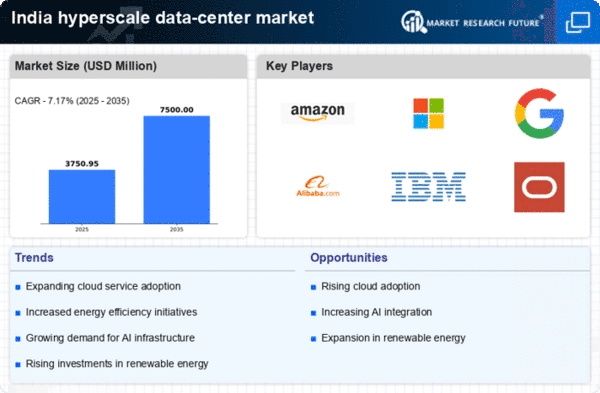
As per Market Research Future analysis, the India hyperscale data-center market was estimated at 3500.0 USD Million in 2024. The India hyperscale data-center market is projected to grow from 3750.95 USD Million in 2025 to 7500.0 USD Million by 2035, exhibiting a compound annual growth rate (CAGR) of 7.1% during the forecast period 2025 - 2035

Key Market Trends & Highlights

The India hyperscale data-center market is experiencing robust growth driven by cloud adoption and technological advancements.

  • The market is witnessing increased cloud adoption, which is reshaping data storage and processing needs.
  • Energy efficiency has become a focal point, as operators seek to reduce operational costs and environmental impact.
  • Edge computing is expanding rapidly, catering to the demand for low-latency services and localized data processing.
  • Key drivers include rising demand for data storage and government initiatives promoting digital infrastructure development.

Market Size & Forecast

2024 Market Size 3500.0 (USD Million)
2035 Market Size 7500.0 (USD Million)
CAGR (2025 - 2035) 7.17%

Major Players

Amazon (US), Microsoft (US), Google (US), Alibaba (CN), IBM (US), Oracle (US), Equinix (US), Digital Realty (US), NTT Communications (JP)

Our Impact
Enabled $4.3B Revenue Impact for Fortune 500 and Leading Multinationals
Partnering with 2000+ Global Organizations Each Year
30K+ Citations by Top-Tier Firms in the Industry

India Hyperscale Data Center Market Trends

The hyperscale data-center market is experiencing notable growth, driven by the increasing demand for cloud computing and data storage solutions. As businesses and consumers alike generate vast amounts of data, the need for efficient and scalable infrastructure becomes paramount. This market is characterized by large-scale facilities that can accommodate significant computing power and storage capacity. The rise of digital transformation initiatives across various sectors further fuels this demand, as organizations seek to enhance their operational efficiency and agility. Additionally, advancements in technology, such as artificial intelligence and machine learning, are likely to play a crucial role in shaping the future of this market. Moreover, the hyperscale data-center market is witnessing a shift towards sustainability and energy efficiency. Operators are increasingly focusing on reducing their carbon footprint and optimizing energy consumption. This trend is not only driven by regulatory pressures but also by the growing awareness among consumers regarding environmental issues. As a result, many facilities are adopting innovative cooling solutions and renewable energy sources. The interplay of these factors suggests a dynamic landscape for the hyperscale data-center market, with opportunities for growth and innovation in the coming years.

Increased Cloud Adoption

The hyperscale data-center market is seeing a surge in cloud adoption as businesses transition to digital platforms. This shift is largely influenced by the need for scalable resources and flexible solutions. Organizations are increasingly relying on cloud services to enhance their operational capabilities, which in turn drives the demand for larger data centers.

Focus on Energy Efficiency

There is a growing emphasis on energy efficiency within the hyperscale data-center market. Operators are exploring advanced cooling technologies and renewable energy sources to minimize environmental impact. This trend reflects a broader commitment to sustainability and aligns with regulatory requirements aimed at reducing carbon emissions.

Expansion of Edge Computing

The rise of edge computing is reshaping the hyperscale data-center market. As data processing needs become more localized, there is a push for data centers to be closer to end-users. This trend enhances performance and reduces latency, making it a critical consideration for future infrastructure development.

India Hyperscale Data Center Market Drivers

Rising Demand for Data Storage

The hyperscale data-center market is experiencing a notable surge in demand for data storage solutions. As businesses increasingly rely on digital platforms, the need for vast amounts of data storage has escalated. In India, the data storage capacity is projected to grow at a CAGR of approximately 30% over the next five years. This growth is driven by the proliferation of data-intensive applications, such as artificial intelligence and big data analytics. Consequently, hyperscale data centers are being developed to accommodate this demand, providing scalable and efficient storage solutions. The hyperscale data-center market is thus positioned to benefit from this trend, as organizations seek to enhance their data management capabilities.

Government Initiatives and Policies

The Indian government is actively promoting the development of the hyperscale data-center market through various initiatives and policies. Programs aimed at enhancing digital infrastructure, such as the Digital India initiative, are fostering an environment conducive to data center growth. Additionally, the government has introduced incentives for foreign investments in the technology sector, which could lead to increased funding for hyperscale data centers. The establishment of data protection regulations is also encouraging companies to invest in local data centers, thereby boosting the hyperscale data-center market. These government efforts are likely to create a robust framework for the expansion of data centers across the country.

Growth of E-commerce and Digital Services

The rapid expansion of e-commerce and digital services in India is significantly impacting the hyperscale data-center market. With online retail sales projected to reach $200 billion by 2026, the demand for robust data infrastructure is paramount. E-commerce platforms require reliable and scalable data solutions to manage vast amounts of customer data and transactions. This trend is prompting investments in hyperscale data centers, which can provide the necessary capacity and performance. As digital services continue to proliferate, the hyperscale data-center market is expected to thrive, catering to the needs of various sectors, including retail, finance, and entertainment.

Increased Investment in Cloud Infrastructure

Investment in cloud infrastructure is a key driver of the hyperscale data-center market. As organizations in India transition to cloud-based solutions, the demand for large-scale data centers is intensifying. Reports indicate that cloud spending in India is expected to exceed $10 billion by 2025, reflecting a growing reliance on cloud services. This trend is prompting hyperscale data center operators to expand their facilities to meet the rising demand for cloud storage and computing power. The hyperscale data-center market is thus positioned to capitalize on this investment wave, as businesses seek to leverage cloud technologies for enhanced operational efficiency.

Technological Advancements in Data Center Design

Innovations in data center design and technology are playing a crucial role in shaping the hyperscale data-center market. The adoption of advanced cooling techniques, energy-efficient hardware, and automation technologies is enhancing operational efficiency. For instance, the implementation of liquid cooling systems can reduce energy consumption by up to 30%, which is particularly relevant in India's hot climate. These advancements not only lower operational costs but also improve the sustainability of data centers. As companies increasingly prioritize energy efficiency, the hyperscale data-center market is likely to see a shift towards more innovative and environmentally friendly designs.


Market Segment Insights

By Type: Colocation Data Centers (Largest) vs. Cloud Data Centers (Fastest-Growing)

The India hyperscale data-center market is witnessing a varied distribution of market share across its segments. Colocation Data Centers currently hold the largest share, attributed to increasing demand from enterprises seeking cost-effective solutions for data management. This is followed by Cloud Data Centers, which are rapidly gaining traction as businesses transition to cloud-based services, thereby enhancing their operational efficiencies. In terms of growth trends, Cloud Data Centers are the fastest-growing segment, driven by a surge in digital transformation initiatives and the rise of remote work models. The increasing adoption of AI and big data analytics is further propelling the demand for cloud services. Meanwhile, Colocation Data Centers are experiencing steady growth due to their flexibility and scalability, catering to diverse enterprise needs and offering robust security features to ensure data protection.

Colocation Data Centers (Dominant) vs. Managed Data Centers (Emerging)

Colocation Data Centers are renowned for their ability to provide flexible and scalable solutions that meet the diverse needs of businesses looking for cost-efficient data management. They allow multiple clients to rent space within the same facility, offering enhanced operational efficiency and reduced capital expenditure. On the other hand, Managed Data Centers are emerging as a compelling option for enterprises looking to outsource their IT infrastructure management. These facilities often combine on-premise needs with cloud solutions, enabling organizations to focus on core business activities while ensuring robust support and maintenance. The competition between Colocation and Managed Data Centers enhances innovation in service delivery, contributing to overall market dynamism.

By Service Type: Software as a Service (Largest) vs. Infrastructure as a Service (Fastest-Growing)

In the India hyperscale data-center market, the distribution of service type segments shows Software as a Service (SaaS) occupying the largest market share. Its extensive adoption across various industries highlights its significance in facilitating efficient business processes and customer engagement. Following SaaS, Infrastructure as a Service (IaaS) secures a significant position, catering to the increasing demand for scalable and flexible IT resources. Growth trends within these segments indicate a robust shift towards digital transformation, particularly in IaaS, which is observed as the fastest-growing segment. The ongoing technological advancements, coupled with the expanding cloud computing landscape, drive this growth. Organizations are increasingly leveraging IaaS for its cost-effectiveness and flexibility, while SaaS continues to thrive due to its user-friendly nature and integration capabilities, further solidifying its dominance in the market.

Software as a Service (Dominant) vs. Infrastructure as a Service (Emerging)

Software as a Service (SaaS) stands as the dominant force in the service type segment, offering extensive solutions to meet varied customer needs. Its subscription-based model allows for ease of access and scalability, making it a preferred choice for enterprises across sectors. On the other hand, Infrastructure as a Service (IaaS) is recognized as an emerging segment, gaining traction due to its ability to provide virtualized computing resources over the internet. Companies are increasingly turning to IaaS for its flexibility and capacity to reduce IT overhead costs, as it empowers them to scale operations quickly without the necessity of extensive physical infrastructure investments. This dynamic positioning of SaaS and IaaS underscores the evolving landscape of digital services crucial to business success.

By End User: IT Services (Largest) vs. Web Services (Fastest-Growing)

The market share distribution within the India hyperscale data-center market reveals that IT Services holds a significant portion, establishing itself as the largest segment. Telecommunications follows, contributing a substantial share, while Web Services, Financial Services, and Healthcare also play crucial roles, albeit with relatively smaller portions of the overall market. The competitive landscape demonstrates that as digital transformation accelerates, IT Services maintains its dominance. Growth trends indicate that the Web Services segment is rapidly gaining traction, driven by the increasing demand for cloud-based solutions and improved internet infrastructure. The Financial Services sector is also evolving, benefiting from technology advancements and regulatory changes that support digital operations. Furthermore, the Healthcare segment is witnessing growth due to rising data needs and the push towards electronic health records, all contributing to a robust future outlook.

IT Services: Dominant vs. Financial Services: Emerging

IT Services in the India hyperscale data-center market showcases its dominant position, driven by the escalating demand for robust data management and the proliferation of IT applications. This segment thrives on providing comprehensive solutions, ensuring high availability and security for enterprise clients. On the other hand, Financial Services is an emerging segment, characterized by a growing reliance on technology for operations such as online banking, fintech solutions, and data analytics. This reliance creates a surge in demand for data-center resources, although it faces unique challenges including regulatory compliance and the need for enhanced security measures. As businesses in this sector continue to innovate, investments in hyperscale data facilities become crucial to support their growth.

By Cooling Technology: Air-based Cooling (Largest) vs. Liquid Cooling (Fastest-Growing)

The cooling technology segment in the India hyperscale data-center market is predominantly led by air-based cooling, which holds a significant portion of the total market share. Liquid cooling is positioned as the fastest-growing segment, driven by increasing heat loads and the need for improved thermal management in data centers. The adoption of air-based cooling technologies remains strong, given their cost-effectiveness and established presence in the market. As data centers continue to evolve in their requirements for performance and efficiency, liquid cooling technologies are gaining traction among operators looking to optimize their cooling efficiency. The growth in digital infrastructure and rising data generation are primary catalysts for the shift toward liquid cooling solutions. Innovative designs and technological advancements in cooling mechanisms are also propelling this segment's expansion, as operational efficiencies and sustainability become critical considerations for data center operators.

Air-based Cooling: Dominant vs. Liquid Cooling: Emerging

Air-based cooling remains the dominant technology in the cooling segment of the India hyperscale data-center market. It is favored for its simplicity, lower initial investment, and effectiveness within specific cooling load parameters. Conversely, liquid cooling is emerging rapidly due to its superior performance in managing higher heat loads and overall energy efficiency. This trend is especially evident as operators seek to maximize computing power while keeping energy costs in check. Liquid cooling systems, such as direct-to-chip cooling, are becoming increasingly popular for their ability to maintain optimal operating temperatures in high-density configurations. As data centers adopt more advanced IT equipment, the need for effective cooling solutions becomes paramount, thus driving liquid cooling's market prominence.

Get more detailed insights about India Hyperscale Data Center Market

Key Players and Competitive Insights

The hyperscale data-center market in India is characterized by intense competition and rapid growth, driven by increasing demand for cloud services, data storage, and digital transformation initiatives. Major players such as Amazon (US), Microsoft (US), and Google (US) are strategically positioned to leverage their global infrastructure and technological expertise. Amazon (US) focuses on expanding its AWS services, while Microsoft (US) emphasizes hybrid cloud solutions. Google (US) is enhancing its data analytics capabilities, which collectively shapes a competitive environment that prioritizes innovation and customer-centric solutions.Key business tactics employed by these companies include localizing operations and optimizing supply chains to enhance service delivery. The market structure appears moderately fragmented, with several players vying for market share. However, the collective influence of these key players is substantial, as they set industry standards and drive technological advancements that smaller competitors may struggle to match.

In September Amazon (US) announced the opening of a new hyperscale data center in Pune, which is expected to significantly increase its capacity to serve Indian customers. This strategic move not only enhances Amazon's operational footprint but also positions it to better compete against local and international rivals by providing lower latency and improved service reliability.

In October Microsoft (US) unveiled a partnership with a leading Indian telecommunications provider to enhance its Azure cloud services. This collaboration aims to improve connectivity and expand the reach of Azure in underserved regions, indicating Microsoft's commitment to regional expansion and customer accessibility. Such partnerships are likely to strengthen Microsoft's competitive edge in the market.

In August Google (US) launched a new initiative focused on sustainability within its data centers, committing to achieve 100% renewable energy usage by 2026. This move not only aligns with global sustainability trends but also positions Google as a leader in environmentally responsible operations, which is increasingly becoming a differentiating factor in the hyperscale data-center market.

As of November current competitive trends indicate a strong emphasis on digitalization, sustainability, and AI integration. Strategic alliances are shaping the landscape, allowing companies to pool resources and expertise. The competitive differentiation is likely to evolve from traditional price-based competition to a focus on innovation, technology, and supply chain reliability, as companies seek to meet the growing demands of a digital-first economy.

Key Companies in the India Hyperscale Data Center Market include

Industry Developments

The India Hyperscale Data Center Market has witnessed significant developments recently. Amazon Web Services and Microsoft continue to ramp up investments in data centers, with both companies announcing expansions to meet increasing regional demand for cloud services. The Indian IT Ministry declared on March 3, 2025, that AWS would invest $8.2 billion in the Maharashtra region in the upcoming years. In addition to introducing cutting-edge technology like GPU-rich nodes and AI-driven cloud services, the effort will grow its hyperscale cloud infrastructure, which will include data centers in Hyderabad and Mumbai.

By 2029–2030, it is anticipated that this expansion would greatly increase employment and the capacity of digital infrastructure.On July 19, 2025, Madhya Pradesh inks an MOU for up to 1 GW of AI-ready data center capacity in Indore.

On July 19, 2025, the Madhya Pradesh government formally partnered with Submer Technologies SL, a Spanish company, to jointly create up to 1 gigawatt of energy-efficient, AI-optimized data center infrastructure. The partnership aims to stimulate local employment, training, and green innovation while emphasizing liquid-cooling design, 45% lower energy use, and up to 90% water savings.

Future Outlook

India Hyperscale Data Center Market Future Outlook

The Hyperscale Data Center Market in India is projected to grow at a 7.17% CAGR from 2025 to 2035, driven by increasing cloud adoption, data consumption, and energy efficiency demands.

New opportunities lie in:

  • Investment in AI-driven energy management systems
  • Development of modular data-center solutions for rapid deployment
  • Partnerships with renewable energy providers for sustainable operations

By 2035, the hyperscale data-center market is expected to be robust, driven by innovation and strategic partnerships.

Market Segmentation

India Hyperscale Data Center Market Type Outlook

  • Colocation Data Centers
  • Cloud Data Centers
  • Enterprise Data Centers
  • Managed Data Centers

India Hyperscale Data Center Market End User Outlook

  • IT Services
  • Telecommunications
  • Web Services
  • Financial Services
  • Healthcare

India Hyperscale Data Center Market Service Type Outlook

  • Infrastructure as a Service
  • Platform as a Service
  • Software as a Service

India Hyperscale Data Center Market Cooling Technology Outlook

  • Air-based Cooling
  • Liquid Cooling
  • Evaporative Cooling

Report Scope

MARKET SIZE 2024 3500.0(USD Million)
MARKET SIZE 2025 3750.95(USD Million)
MARKET SIZE 2035 7500.0(USD Million)
COMPOUND ANNUAL GROWTH RATE (CAGR) 7.17% (2025 - 2035)
REPORT COVERAGE Revenue Forecast, Competitive Landscape, Growth Factors, and Trends
BASE YEAR 2024
Market Forecast Period 2025 - 2035
Historical Data 2019 - 2024
Market Forecast Units USD Million
Key Companies Profiled Amazon (US), Microsoft (US), Google (US), Alibaba (CN), IBM (US), Oracle (US), Equinix (US), Digital Realty (US), NTT Communications (JP)
Segments Covered Type, Service Type, End User, Cooling Technology
Key Market Opportunities Adoption of advanced cooling technologies enhances efficiency in the hyperscale data-center market.
Key Market Dynamics Rising demand for cloud services drives rapid expansion of hyperscale data-center infrastructure in India.
Countries Covered India
Leave a Comment

FAQs

What is the expected market size of the India Hyperscale Data Center Market in 2024?

The India Hyperscale Data Center Market is anticipated to be valued at 2.07 USD Billion in 2024.

What will be the market value of the India Hyperscale Data Center Market by 2035?

By 2035, the market is projected to reach a valuation of 4.0 USD Billion.

What is the expected CAGR for the India Hyperscale Data Center Market from 2025 to 2035?

The anticipated compound annual growth rate (CAGR) for the market is 6.174% during the period from 2025 to 2035.

Which type of hyperscale data centers is expected to have the largest market share in 2035?

In 2035, the Colocation Data Centers segment is expected to account for a significant portion of the market, valued at 1.2 USD Billion.

What is the projected market value for Cloud Data Centers by 2035?

The Cloud Data Centers segment is estimated to grow to 1.4 USD Billion by the year 2035.

Who are the key players in the India Hyperscale Data Center Market?

Major competitors in the market include Amazon Web Services, Digital Realty, Google Cloud, Microsoft, and Sify Technologies.

What challenges are anticipated in the India Hyperscale Data Center Market growth?

Challenges may include infrastructure costs, regulatory hurdles, and competition from emerging technologies.

What are the growth drivers for the India Hyperscale Data Center Market?

Growth drivers include increased cloud adoption, digital transformation initiatives, and the rising demand for data storage and processing.

What impact could global conflicts have on the India Hyperscale Data Center Market?

Global conflicts could affect supply chains, IT investment, and data exchange policies, impacting market growth.

Which segment is expected to experience the lowest growth by 2035?

The Managed Data Centers segment is projected to have the lowest market value growth, reaching 0.4 USD Billion by 2035.

Download Free Sample

Kindly complete the form below to receive a free sample of this Report

Compare Licence

×
Features License Type
Single User Multiuser License Enterprise User
Price $4,950 $5,950 $7,250
Maximum User Access Limit 1 User Upto 10 Users Unrestricted Access Throughout the Organization
Free Customization
Direct Access to Analyst
Deliverable Format
Platform Access
Discount on Next Purchase 10% 15% 15%
Printable Versions