×
Request Free Sample ×

Kindly complete the form below to receive a free sample of this Report

* Please use a valid business email

Leading companies partner with us for data-driven Insights

clients tt-cursor
Hero Background

Japan Automotive Logistics Market

ID: MRFR/PCM/54155-HCR
111 Pages
Snehal Singh
February 2026

Japan Automotive Logistics Market Research Report By Service Type (Transportation, Warehousing, Inventory Management, Freight Forwarding), By Logistics Mode (Road, Rail, Air, Sea), By Vehicle Type (Passenger Cars, Commercial Vehicles, Electric Vehicles, Hybrid Vehicles) and By Supply Chain Type (Inbound Logistics, Outbound Logistics, Third Party Logistics)- Forecast to 2035

Share:
Download PDF ×

We do not share your information with anyone. However, we may send you emails based on your report interest from time to time. You may contact us at any time to opt-out.

Japan Automotive Logistics Market Infographic
Purchase Options

Japan Automotive Logistics Market Summary

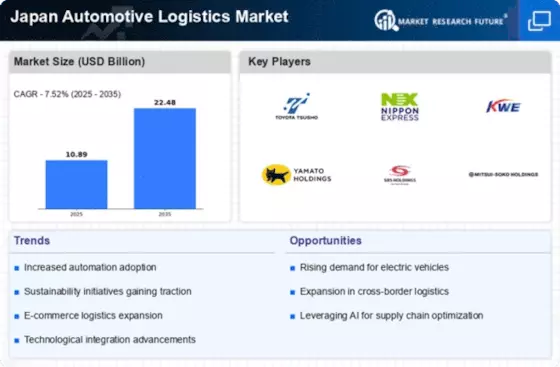
As per analysis, the Japan Automotive Logistics Market is projected to grow from USD 10.97 Billion in 2025 to USD 22.48 Billion by 2035, exhibiting a compound annual growth rate (CAGR) of 7.52% during the forecast period (2025 - 2035).

Key Market Trends & Highlights

The Japan Automotive Logistics Market is experiencing a transformative shift towards digitalization and sustainability.

  • The Transportation segment remains the largest contributor to the market, driven by increasing demand for efficient logistics solutions.
  • The Warehousing segment is currently the fastest-growing area, reflecting a shift towards optimized storage and distribution practices.
  • In the Passenger Vehicle segment, traditional vehicles dominate, while the Electric Vehicle segment is rapidly gaining traction among consumers.
  • Technological advancements in logistics and government policies supporting sustainability are key drivers propelling market growth.

Market Size & Forecast

2024 Market Size 10.13 (USD Billion)
2035 Market Size 22.48 (USD Billion)
CAGR (2025 - 2035) 7.52%

Major Players

Toyota Tsusho Corporation (JP), Nippon Express Co., Ltd. (JP), Kintetsu World Express, Inc. (JP), Yamato Holdings Co., Ltd. (JP), SBS Holdings, Inc. (JP), Mitsui-Soko Holdings Co., Ltd. (JP), Hitachi Transport System, Ltd. (JP), Seino Holdings Co., Ltd. (JP)

Our Impact
Enabled $4.3B Revenue Impact for Fortune 500 and Leading Multinationals
Partnering with 2000+ Global Organizations Each Year
30K+ Citations by Top-Tier Firms in the Industry

Japan Automotive Logistics Market Trends

The Japan Automotive Logistics Market is currently experiencing a transformative phase, driven by advancements in technology and evolving consumer preferences. The integration of digital solutions, such as automated inventory management and real-time tracking systems, appears to enhance operational efficiency and reduce costs. Furthermore, the increasing emphasis on sustainability is prompting logistics providers to adopt eco-friendly practices, which may include optimizing transportation routes and utilizing alternative fuels. This shift not only aligns with governmental policies aimed at reducing carbon emissions but also resonates with the growing consumer demand for environmentally responsible practices. In addition, the Japan Automotive Logistics Market is witnessing a trend towards increased collaboration among stakeholders. Manufacturers, suppliers, and logistics providers are likely to form strategic partnerships to streamline operations and improve supply chain resilience. This collaborative approach may facilitate better communication and coordination, ultimately leading to enhanced service delivery. As the market continues to evolve, it is essential for industry players to remain agile and responsive to changing dynamics, ensuring they can meet the demands of a competitive landscape.

Digital Transformation in Logistics

The Japan Automotive Logistics Market is increasingly embracing digital technologies to enhance efficiency. Automation and data analytics are becoming integral to operations, allowing for improved inventory management and real-time tracking. This trend suggests a shift towards more streamlined processes, potentially reducing lead times and operational costs.

Sustainability Initiatives

There is a growing focus on sustainability within the Japan Automotive Logistics Market. Companies are adopting eco-friendly practices, such as optimizing transportation routes and utilizing alternative fuels. This trend indicates a commitment to reducing environmental impact, aligning with national policies aimed at promoting greener logistics.

Collaborative Supply Chain Strategies

The trend towards collaboration among stakeholders is gaining traction in the Japan Automotive Logistics Market. Manufacturers, suppliers, and logistics providers are likely to form strategic partnerships to enhance supply chain resilience. This collaborative approach may lead to improved communication and efficiency, ultimately benefiting service delivery.

Japan Automotive Logistics Market Drivers

Global Supply Chain Integration

The Japan Automotive Logistics Market is witnessing a trend towards global supply chain integration. As automotive manufacturers expand their operations internationally, the need for efficient logistics solutions that can manage cross-border transportation becomes paramount. This integration allows for better resource allocation and cost management, as companies can leverage global suppliers and markets. Data suggests that Japan's automotive exports are projected to grow, necessitating robust logistics frameworks to support this expansion. Consequently, logistics providers are likely to enhance their capabilities to facilitate seamless international operations, which is essential for maintaining competitiveness in the global automotive landscape.

Sustainability and Green Logistics

Sustainability is becoming a critical focus within the Japan Automotive Logistics Market. Companies are increasingly adopting green logistics practices to reduce their carbon footprint and comply with environmental regulations. Initiatives such as using electric vehicles for transportation and optimizing routes to minimize fuel consumption are gaining traction. The Japanese government has set ambitious targets for reducing greenhouse gas emissions, which encourages logistics providers to innovate in sustainable practices. As a result, the logistics sector is likely to see a shift towards more environmentally friendly operations, which could enhance brand reputation and customer loyalty in the automotive market.

Growing E-commerce and Online Sales

The rise of e-commerce in Japan is significantly impacting the Automotive Logistics Market. With more consumers opting for online purchases, automotive companies are adapting their logistics strategies to accommodate this shift. The demand for efficient last-mile delivery solutions is increasing, prompting logistics providers to innovate and optimize their operations. Data indicates that the e-commerce market in Japan is expected to reach approximately 20 trillion yen by 2025, which will further drive the need for robust logistics solutions. This trend suggests that automotive logistics must evolve to meet the changing consumer preferences and ensure timely delivery of vehicles and parts.

Technological Advancements in Logistics

The Japan Automotive Logistics Market is experiencing a surge in technological advancements that enhance operational efficiency. Innovations such as automated warehousing, real-time tracking systems, and artificial intelligence are being integrated into logistics processes. For instance, the adoption of IoT devices allows for better inventory management and predictive analytics, which can reduce costs and improve service levels. According to recent data, the logistics sector in Japan is projected to grow at a CAGR of 4.5% from 2023 to 2028, driven by these technological improvements. This trend indicates a shift towards more sophisticated logistics solutions, which are essential for meeting the demands of a rapidly evolving automotive market.

Government Policies Supporting Logistics

The Japan Automotive Logistics Market benefits from supportive government policies aimed at enhancing logistics infrastructure. The Japanese government has implemented various initiatives to improve transportation networks and reduce logistics costs. For example, the Logistics Revolution Strategy aims to streamline logistics operations and promote the use of advanced technologies. Additionally, investments in infrastructure, such as the expansion of ports and highways, are expected to facilitate smoother supply chain operations. As a result, the logistics sector is likely to see increased efficiency and reduced lead times, which are crucial for the automotive industry, where timely delivery is paramount.


Market Segment Insights

By Logistics Type: Transportation (Largest) vs. Warehousing (Fastest-Growing)

In the Japan Automotive Logistics Market, the segmentation reveals that Transportation holds the largest share, attributed to the advanced infrastructure and established networks facilitating swift vehicle deliveries. Conversely, Warehousing is witnessing rapid growth, driven by increasing demand for efficient storage solutions that cater to just-in-time manufacturing practices. The shift towards e-commerce and the need for optimized inventory levels further bolster Warehousing's prominence in the logistics landscape. Additionally, Inventory Management and Distribution follow closely behind, enhancing the overall efficiency of the automotive supply chain. As manufacturers focus on reducing lead times and increasing operational efficiency, Inventory Management becomes critical. Meanwhile, Freight Forwarding plays a vital role in providing integrated logistics solutions, particularly for companies looking to expand their export capabilities amidst global supply chain complexities.

Transportation (Dominant) vs. Freight Forwarding (Emerging)

Transportation remains the dominant force in the Japan Automotive Logistics Market, characterized by a robust network of roadways, railways, and ports, enabling swift and reliable vehicle transportation. Its emphasis on cost-efficiency and timely deliveries is crucial for automakers reliant on expeditious market access. In contrast, Freight Forwarding is emerging as a pivotal segment, driven by the increasing complexities of international trade and logistical coordination. As automotive companies seek to penetrate global markets, Freight Forwarding provides critical support through comprehensive logistics solutions, including customs clearance and cross-border transportation. This growing segment is responding to heightened demand for visibility and tracking capabilities, essential for maintaining competitive advantage in a dynamic market.

By Vehicle Type: Passenger Vehicle (Largest) vs. Electric Vehicle (Fastest-Growing)

The Japan Automotive Logistics Market exhibits a diversified vehicle type segmentation. The passenger vehicle category commands a significant portion of the market, underscoring its widespread popularity across urban and suburban landscapes. Conversely, the electric vehicle segment, while smaller in share compared to passenger vehicles, is swiftly gaining traction as a result of increasing environmental consciousness and supportive governmental policies. This shift is poised to redefine logistics operations due to the unique handling requirements of electric vehicles. Over recent years, growth trends in the automotive sector have pointed toward an increased demand for both electric and hybrid vehicles, driven by a global push for sustainability. As consumers and manufacturers alike pivot towards greener alternatives, logistics providers are adapting to these trends by investing in specialized infrastructure and training. The rise of e-commerce and delivery services further fuels the need for efficient logistics solutions tailored to different vehicle types, promising a dynamic shift in the sector's landscape.

Passenger Vehicle (Dominant) vs. Electric Vehicle (Emerging)

The passenger vehicle segment remains the dominant force in the Japan Automotive Logistics Market, reflecting its established presence and consumer preference. These vehicles, encompassing cars primarily used for personal transport, necessitate efficient logistics processes related to inventory management, transportation, and aftersales services. In contrast, the electric vehicle sector is emerging rapidly, fueled by technological advancements and a growing emphasis on environmental sustainability. These vehicles require distinct logistical considerations, such as specialized charging infrastructure and understanding the complexities of battery management. As this segment expands, logistics providers are increasingly challenged to innovate and accommodate new fleet requirements, highlighting the broader trend of shifting consumer preferences towards eco-friendly transportation solutions.

By Service Type: Third Party Logistics (Largest) vs. Fourth Party Logistics (Fastest-Growing)

In the Japan Automotive Logistics Market, Third Party Logistics (3PL) captures a significant portion of market share, driven by the increasing need for efficient supply chain solutions among automotive manufacturers. This segment stands out due to its extensive network and flexibility that allows companies to focus on core competencies while entrusting logistics to specialized providers. Meanwhile, Fourth Party Logistics (4PL) is emerging swiftly, catering to a more integrated approach to logistics management, combining various services to enhance efficiency in the automotive sector. As the market evolves, growth trends reveal that the demand for Value Added Services and Supply Chain Management is also rising, stemming from the increased complexity of automotive supply chains. The need for precise Customs Brokerage services is surging as globalization expands, reflecting the critical role of logistics providers in managing compliance and regulatory requirements. Innovations in technology and strategic partnerships are expected to further propel growth across these service types in the Japan automotive market.

Third Party Logistics (Dominant) vs. Fourth Party Logistics (Emerging)

Third Party Logistics (3PL) continues to dominate the Japanese automotive logistics landscape, providing comprehensive services that include transportation, warehousing, and distribution. Its robust performance is attributed to established relationships with carriers and investments in advanced technology for tracking and inventory management. 3PL providers enable automotive manufacturers to reduce costs and improve service delivery. In contrast, Fourth Party Logistics (4PL) represents an emerging segment focused on integrated solutions, overseeing the entire supply chain process and acting as a single point of contact. As automotive supply chains become increasingly complex, 4PL is gaining traction for its ability to enhance operational efficiency and provide customized logistics solutions.

By Technology: Telematics (Largest) vs. Automation (Fastest-Growing)

In the Japan Automotive Logistics Market, the technology segment showcases a diverse range of innovations. Telematics holds the largest market share, driven by its ability to streamline operations, improve fleet management, and enhance real-time decision-making. This segment's strengths lie in tracking vehicle performance and ensuring shipment security, making it integral to logistics. Meanwhile, automation is rapidly gaining traction, fueled by the need for efficiency and cost reduction. Its applications increase operational flexibility and speed, appealing strongly to modern automotive logistics demands. Growth trends in the technology segment indicate a significant shift towards increased adoption of automation and real-time data analytics. With companies seeking to minimize costs and maximize output, automation technologies are expected to outpace others in growth rate. Furthermore, advancements in AI and IoT are paving the way for smarter logistics solutions, as firms seek predictive analytics to optimize routes and reduce delays. Overall, the convergence of these technologies is transforming the Japanese automotive logistics landscape.

Telematics: Dominant vs. Automation: Emerging

Telematics has emerged as a dominant force in the Japan Automotive Logistics Market, offering critical capabilities for monitoring and managing vehicle fleets. Its strengths lie in providing real-time data that enhances visibility, accountability, and efficiency in logistics operations. Conversely, automation is rapidly becoming an emerging player, driven by the industry's need for speed and precision. This segment leverages robotics and AI to perform repetitive tasks, significantly improving response times and throughput rates. The synergy between telematics and automation is also notable, as the integration of these technologies promises to enhance decision-making and operational efficiency in logistics, positioning both segments favorably in the evolving market landscape.

By End User: Original Equipment Manufacturers (Largest) vs. Aftermarket Suppliers (Fastest-Growing)

In the Japan Automotive Logistics Market, the end user segment displays a diverse distribution, where Original Equipment Manufacturers (OEMs) hold a significant portion of the market share due to their pivotal role in vehicle production. Other contributors, such as Aftermarket Suppliers, Fleet Operators, Logistics Service Providers, and Retailers, also play critical roles but have varying levels of market representation, with OEMs leading the pack. The dynamics among these segments indicate an evolving landscape, influenced by technology and consumer needs.

OEMs (Dominant) vs. Aftermarket Suppliers (Emerging)

Original Equipment Manufacturers (OEMs) represent the dominant force in the automotive logistics sector in Japan. They require sophisticated logistics solutions to handle large volumes of parts and components, ensuring efficient production schedules and just-in-time delivery. This dominance is complemented by their established relationships with logistics providers. In contrast, Aftermarket Suppliers are emerging as a crucial component of the market, fueled by growing consumer demand for vehicle maintenance and repairs. This segment is adapting quickly, leveraging e-commerce and improved supply chain practices to cater to a diverse range of automotive needs. Together, these segments reflect a balanced landscape where traditional manufacturing meets new-age service demands.

Get more detailed insights about Japan Automotive Logistics Market

Key Players and Competitive Insights

The Automotive Logistics Market in Japan is characterized by a competitive landscape that is both dynamic and multifaceted. Key growth drivers include the increasing demand for efficient supply chain solutions, the rise of electric vehicles (EVs), and the ongoing digital transformation within the logistics sector. Major players such as Toyota Tsusho Corporation (Japan), Nippon Express Co., Ltd. (Japan), and Kintetsu World Express, Inc. (Japan) are strategically positioned to leverage these trends. Toyota Tsusho Corporation (Japan) focuses on integrating advanced technologies into its logistics operations, while Nippon Express Co., Ltd. (Japan) emphasizes sustainability and green logistics. Kintetsu World Express, Inc. (Japan) is enhancing its global footprint through strategic partnerships, collectively shaping a competitive environment that prioritizes innovation and operational efficiency.

In terms of business tactics, companies are increasingly localizing manufacturing and optimizing supply chains to enhance responsiveness to market demands. The market structure appears moderately fragmented, with several key players exerting considerable influence. This fragmentation allows for a variety of operational strategies, enabling companies to differentiate themselves through specialized services and regional expertise.

In December 2025, Toyota Tsusho Corporation (Japan) announced a partnership with a leading tech firm to develop AI-driven logistics solutions aimed at improving delivery efficiency. This strategic move is likely to enhance their operational capabilities, allowing for real-time tracking and predictive analytics, which could significantly reduce lead times and improve customer satisfaction.

In November 2025, Nippon Express Co., Ltd. (Japan) launched a new initiative focused on carbon-neutral logistics, committing to reduce greenhouse gas emissions by 30% by 2030. This initiative not only aligns with global sustainability trends but also positions Nippon Express as a leader in environmentally responsible logistics, potentially attracting clients who prioritize sustainability in their supply chain decisions.

In October 2025, Kintetsu World Express, Inc. (Japan) expanded its operations in Southeast Asia by acquiring a local logistics firm. This acquisition is strategically important as it enhances Kintetsu's regional capabilities and allows for better service delivery in a rapidly growing market, thereby strengthening its competitive position against other logistics providers.

As of January 2026, current competitive trends in the Automotive Logistics Market are heavily influenced by digitalization, sustainability, and the integration of AI technologies. Strategic alliances are increasingly shaping the landscape, enabling companies to pool resources and expertise to tackle complex logistics challenges. Looking ahead, competitive differentiation is expected to evolve from traditional price-based competition to a focus on innovation, technology integration, and supply chain reliability. This shift underscores the importance of adaptability and forward-thinking strategies in maintaining a competitive edge in the market.

Key Companies in the Japan Automotive Logistics Market include

Industry Developments

Recent developments in the Japan Automotive Logistics Market have been marked by a focus on automation and efficiency improvements among major players like Sagawa Express, Hitachi Transport System, and Nippon Express. Companies are increasingly adopting smart logistics solutions to streamline supply chains and reduce costs. As of September 2023, Yamato Transport reported significant advancements in its delivery tracking technology, enhancing transparency throughout the logistics process. In terms of mergers and acquisitions, in April 2023, Mitsui-Soko announced an agreement to acquire a stake in a tech startup specializing in logistics optimization, signaling a trend toward digital transformation in the sector.

Meanwhile, Nissan Motor Logistics has committed to expanding its electric vehicle supply chain capabilities amid rising demand for EVs in Japan. Market valuation for automotive logistics solutions continues to grow, driven by a rising emphasis on sustainability and demand for more efficient distribution systems. Observationally, the Japan Automotive Logistics Market has undergone significant changes in the last few years, notably the push towards decarbonization initiatives that integrate logistics operations more closely with manufacturers' eco-friendly goals, especially prominent since 2021.

Future Outlook

Japan Automotive Logistics Market Future Outlook

The Japan Automotive Logistics Market is projected to grow at a 7.52% CAGR from 2025 to 2035, driven by technological advancements, increased e-commerce, and demand for efficient supply chains.

New opportunities lie in:

  • Implementation of AI-driven inventory management systems
  • Expansion of last-mile delivery networks for automotive parts
  • Development of sustainable logistics solutions using electric vehicles

By 2035, the market is expected to be robust, characterized by innovation and efficiency.

Market Segmentation

Japan Automotive Logistics Market End User Outlook

  • Original Equipment Manufacturers
  • Aftermarket Suppliers
  • Fleet Operators
  • Logistics Service Providers
  • Retailers

Japan Automotive Logistics Market Technology Outlook

  • Telematics
  • Automation
  • Blockchain
  • Artificial Intelligence
  • Internet of Things

Japan Automotive Logistics Market Service Type Outlook

  • Third Party Logistics
  • Fourth Party Logistics
  • Value Added Services
  • Supply Chain Management
  • Customs Brokerage

Japan Automotive Logistics Market Vehicle Type Outlook

  • Passenger Vehicle
  • Commercial Vehicle
  • Electric Vehicle
  • Hybrid Vehicle
  • Internal Combustion Engine

Japan Automotive Logistics Market Logistics Type Outlook

  • Transportation
  • Warehousing
  • Inventory Management
  • Distribution
  • Freight Forwarding

Report Scope

MARKET SIZE 202410.13(USD Billion)
MARKET SIZE 202510.97(USD Billion)
MARKET SIZE 203522.48(USD Billion)
COMPOUND ANNUAL GROWTH RATE (CAGR)7.52% (2024 - 2035)
REPORT COVERAGERevenue Forecast, Competitive Landscape, Growth Factors, and Trends
BASE YEAR2024
Market Forecast Period2025 - 2035
Historical Data2019 - 2024
Market Forecast UnitsUSD Billion
Key Companies ProfiledToyota Tsusho Corporation (JP), Nippon Express Co., Ltd. (JP), Kintetsu World Express, Inc. (JP), Yamato Holdings Co., Ltd. (JP), SBS Holdings, Inc. (JP), Mitsui-Soko Holdings Co., Ltd. (JP), Hitachi Transport System, Ltd. (JP), Seino Holdings Co., Ltd. (JP)
Segments CoveredLogistics Type, Vehicle Type, Service Type, Technology, End User
Key Market OpportunitiesIntegration of advanced automation and digitalization in Japan Automotive Logistics Market enhances efficiency and reduces costs.
Key Market DynamicsRising demand for electric vehicle logistics drives innovation and efficiency in Japan's automotive supply chain.
Countries CoveredJapan
Leave a Comment

FAQs

What is the current valuation of the Japan Automotive Logistics Market?

As of 2024, the market valuation was 10.13 USD Billion.

What is the projected market size for the Japan Automotive Logistics Market by 2035?

The market is projected to reach 22.48 USD Billion by 2035.

What is the expected CAGR for the Japan Automotive Logistics Market during the forecast period?

The expected CAGR for the market from 2025 to 2035 is 7.52%.

Which companies are considered key players in the Japan Automotive Logistics Market?

Key players include Toyota Tsusho Corporation, Nippon Express Co., Ltd., and Kintetsu World Express, Inc.

What are the main segments of the Japan Automotive Logistics Market?

The main segments include logistics type, vehicle type, service type, technology, and end user.

How much is the Transportation segment valued at in the Japan Automotive Logistics Market?

The Transportation segment is valued between 3.5 and 7.5 USD Billion.

What is the valuation range for the Electric Vehicle segment in the market?

The Electric Vehicle segment is valued between 1.0 and 3.0 USD Billion.

What is the projected growth for the Warehousing segment by 2035?

The Warehousing segment is expected to grow from 2.0 to 4.5 USD Billion by 2035.

How does the market size for Artificial Intelligence technology in logistics compare to other technologies?

Artificial Intelligence is projected to be valued between 2.5 and 5.0 USD Billion, indicating strong growth potential.

What is the expected valuation for Third Party Logistics by 2035?

The Third Party Logistics segment is projected to reach between 3.5 and 7.5 USD Billion by 2035.

Download Free Sample

Kindly complete the form below to receive a free sample of this Report

Compare Licence

×
Features License Type
Single User Multiuser License Enterprise User
Price $4,950 $5,950 $7,250
Maximum User Access Limit 1 User Upto 10 Users Unrestricted Access Throughout the Organization
Free Customization
Direct Access to Analyst
Deliverable Format
Platform Access
Discount on Next Purchase 10% 15% 15%
Printable Versions