×
Request Free Sample ×

Kindly complete the form below to receive a free sample of this Report

* Please use a valid business email

Leading companies partner with us for data-driven Insights

clients tt-cursor
Hero Background

Italy Automotive Logistics Market

ID: MRFR/PCM/54158-HCR
111 Pages
Snehal Singh
February 2026

Italy Automotive Logistics Market Research Report By Service Type (Transportation, Warehousing, Inventory Management, Freight Forwarding), By Logistics Mode (Road, Rail, Air, Sea), By Vehicle Type (Passenger Cars, Commercial Vehicles, Electric Vehicles, Hybrid Vehicles) and By Supply Chain Type (Inbound Logistics, Outbound Logistics, Third Party Logistics)- Forecast to 2035

Share:
Download PDF ×

We do not share your information with anyone. However, we may send you emails based on your report interest from time to time. You may contact us at any time to opt-out.

Italy Automotive Logistics Market Infographic
Purchase Options

Italy Automotive Logistics Market Summary

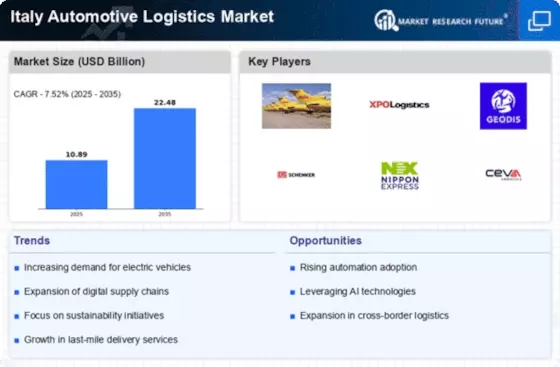
As per analysis, the Italy Automotive Logistics Market is projected to grow from USD 10.97 Billion in 2025 to USD 22.48 Billion by 2035, exhibiting a compound annual growth rate (CAGR) of 7.52% during the forecast period (2025 - 2035).

Key Market Trends & Highlights

The Italy Automotive Logistics Market is experiencing a transformative shift towards digitalization and sustainability.

  • The Transportation segment remains the largest contributor to the market, driven by robust demand for efficient logistics solutions.
  • Sustainability initiatives are gaining traction, influencing logistics practices across the industry.
  • The Electric Vehicle segment is the fastest-growing, reflecting a shift in consumer preferences towards greener alternatives.
  • Key market drivers include the growing demand for Electric Vehicles and government policies that incentivize sustainable logistics practices.

Market Size & Forecast

2024 Market Size 10.13 (USD Billion)
2035 Market Size 22.48 (USD Billion)
CAGR (2025 - 2035) 7.52%

Major Players

DHL Supply Chain (IT), Kuehne + Nagel (IT), XPO Logistics (IT), Geodis (IT), DB Schenker (IT), Nippon Express (IT), CEVA Logistics (IT), TSE Express (IT), Groupe Charles André (IT)

Our Impact
Enabled $4.3B Revenue Impact for Fortune 500 and Leading Multinationals
Partnering with 2000+ Global Organizations Each Year
30K+ Citations by Top-Tier Firms in the Industry

Italy Automotive Logistics Market Trends

The Italy Automotive Logistics Market is currently experiencing a transformative phase, driven by advancements in technology and evolving consumer preferences. The integration of digital solutions, such as real-time tracking and automated inventory management, appears to enhance operational efficiency. Furthermore, the increasing emphasis on sustainability is prompting logistics providers to adopt greener practices, which may include the use of electric vehicles and optimized routing to reduce carbon footprints. This shift not only aligns with national environmental goals but also caters to the growing demand for eco-friendly transportation options among consumers. In addition, the strategic location of Italy within Europe serves as a vital hub for automotive logistics, facilitating trade and distribution across the continent. The country's robust infrastructure, including well-developed road networks and ports, supports the seamless movement of goods. However, challenges such as fluctuating fuel prices and regulatory changes could impact the market dynamics. Overall, the Italy Automotive Logistics Market seems poised for growth, with opportunities arising from technological innovations and a focus on sustainability, which may redefine the logistics landscape in the coming years.

Digital Transformation in Logistics

The adoption of digital technologies is reshaping the Italy Automotive Logistics Market. Companies are increasingly utilizing advanced software solutions for inventory management and real-time tracking, which enhances transparency and efficiency in operations. This trend indicates a shift towards more data-driven decision-making processes, potentially leading to improved customer satisfaction.

Sustainability Initiatives

There is a growing emphasis on sustainability within the Italy Automotive Logistics Market. Logistics providers are exploring eco-friendly practices, such as utilizing electric vehicles and optimizing delivery routes to minimize environmental impact. This trend reflects a broader commitment to reducing carbon emissions and aligns with Italy's national environmental objectives.

Strategic Geographic Positioning

Italy's strategic location in Europe plays a crucial role in its automotive logistics sector. The country's extensive road and rail networks, along with its access to major ports, facilitate efficient distribution across the continent. This geographic advantage positions Italy as a key player in the automotive supply chain, enhancing its attractiveness for logistics operations.

Italy Automotive Logistics Market Drivers

Government Policies and Incentives

The Italian government has implemented various policies and incentives to promote the automotive sector, particularly in the realm of sustainability. Initiatives such as tax breaks for electric vehicle purchases and investments in charging infrastructure are expected to stimulate growth in the Italy Automotive Logistics Market. For instance, the government has allocated substantial funds to enhance logistics networks that support the distribution of low-emission vehicles. These policies not only encourage manufacturers to produce greener vehicles but also create a demand for logistics services that can efficiently manage the supply chain of these vehicles. As a result, logistics companies are likely to benefit from increased business opportunities stemming from government support.

Growing Demand for Electric Vehicles

The increasing consumer preference for electric vehicles (EVs) is reshaping the Italy Automotive Logistics Market. As Italy aims to achieve carbon neutrality by 2050, the demand for EVs is projected to rise significantly. In 2025, it is estimated that EV sales will account for over 30% of total vehicle sales in Italy. This shift necessitates a robust logistics framework to support the distribution of EVs and their components, including batteries. Consequently, logistics providers are adapting their operations to accommodate the unique requirements of EV transportation, which may involve specialized handling and storage solutions. The Italy Automotive Logistics Market is thus likely to experience growth driven by the need for efficient logistics solutions tailored to the evolving automotive landscape.

Technological Advancements in Logistics

Technological innovations are playing a pivotal role in transforming the Italy Automotive Logistics Market. The adoption of advanced technologies such as artificial intelligence, big data analytics, and the Internet of Things (IoT) is enhancing supply chain efficiency and transparency. For example, logistics companies are utilizing real-time tracking systems to monitor vehicle shipments, which improves delivery accuracy and reduces lead times. In 2025, it is projected that over 60% of logistics providers in Italy will integrate these technologies into their operations. This trend not only streamlines logistics processes but also enables companies to respond swiftly to market demands, thereby fostering growth in the Italy Automotive Logistics Market.

E-commerce Growth and Last-Mile Delivery

The rapid expansion of e-commerce in Italy is significantly influencing the logistics landscape, particularly in the automotive sector. As online vehicle sales continue to rise, logistics providers are increasingly focusing on last-mile delivery solutions to meet consumer expectations for fast and reliable service. In 2025, it is anticipated that e-commerce will account for a substantial portion of automotive sales in Italy, necessitating a reevaluation of logistics strategies. The Italy Automotive Logistics Market must adapt to these changes by developing efficient last-mile delivery networks that can handle the unique challenges of delivering vehicles directly to consumers. This shift presents both challenges and opportunities for logistics companies operating in the automotive sector.

Increased Focus on Supply Chain Resilience

The need for supply chain resilience has become a critical focus for the Italy Automotive Logistics Market. Recent disruptions in global supply chains have highlighted vulnerabilities, prompting companies to reassess their logistics strategies. In response, many logistics providers are investing in diversified supply chains and localized production to mitigate risks. This trend is particularly relevant in Italy, where the automotive sector is a key economic driver. By enhancing supply chain resilience, logistics companies can better navigate uncertainties and ensure the timely delivery of vehicles and parts. As a result, the Italy Automotive Logistics Market is likely to see increased investment in strategies that bolster supply chain robustness and flexibility.


Market Segment Insights

By Logistics Type: Transportation (Largest) vs. Warehousing (Fastest-Growing)

In the Italy Automotive Logistics Market, the 'Transportation' segment holds the largest share, driven by the extensive network of roads and railways that facilitate efficient movement of vehicles and parts across the country. The demand for transportation services is largely influenced by the growing automotive manufacturing sector, which is increasingly focused on enhancing supply chain efficiencies. Meanwhile, 'Warehousing' is emerging as the fastest-growing segment, capturing attention due to the rising e-commerce within the automotive industry, leading to greater needs for storage solutions. The recent adaptation to Just-In-Time (JIT) inventory practices has also heightened the role of warehousing in logistics.

Warehousing (Dominant) vs. Freight Forwarding (Emerging)

The 'Warehousing' segment is gaining significant traction in the Italy Automotive Logistics Market, characterized by advanced storage technologies and innovative inventory management systems, catering to both manufacturers and dealerships. Companies are increasingly investing in automated warehousing solutions to optimize space and improve logistics efficiencies. On the other hand, 'Freight Forwarding' is an emerging player with its growing importance tied to international trade and the logistics of exporting Italian automobiles. While freight forwarding involves managing the shipping of vehicles across borders, its growth is bolstered by strong global demand, requiring seamless coordination of cross-border logistics. The interplay between warehousing and freight forwarding strengthens the overall logistics infrastructure, ensuring readiness in meeting automotive market demands.

By Vehicle Type: Passenger Vehicle (Largest) vs. Electric Vehicle (Fastest-Growing)

In the Italy Automotive Logistics Market, the 'Vehicle Type' segment exhibits a diverse distribution of market share. The passenger vehicle category holds the largest share due to its prevalent demand, while commercial vehicles closely follow, supported by the logistics needs of businesses. Electric vehicles, though currently smaller in market share, are rapidly gaining traction as consumers increasingly shift toward sustainable options, driven by government's push for greener transportation solutions. Hybrid vehicles and internal combustion engines, while established, are witnessing slower growth compared to electric alternatives.

Passenger Vehicle (Dominant) vs. Electric Vehicle (Emerging)

Passenger vehicles dominate the Italy Automotive Logistics Market, characterized by a wide range of options and a strong consumer base. They are primarily utilized for personal transportation, reflecting the lifestyle of Italian consumers. Meanwhile, electric vehicles represent an emerging segment, fueled by increasing environmental awareness and government incentives. These vehicles are becoming increasingly popular among logistics providers seeking to reduce emissions and operating costs. As infrastructure for electric vehicle charging expands, the market share for electric vehicles is expected to rise exponentially, marking a significant shift in consumption patterns within the automotive logistics landscape.

By Service Type: Third Party Logistics (Largest) vs. Value Added Services (Fastest-Growing)

In the Italy Automotive Logistics Market, the service type segment exhibits diverse offerings, with Third Party Logistics (3PL) commanding a considerable share. This segment includes a myriad of services ranging from warehousing to transportation, showcasing its central role in automotive supply chains. Value Added Services, including assembly, packaging, and other enhancements, are emerging as a key driver in this market, quickly gaining traction among businesses looking to differentiate their logistics capabilities.

Third Party Logistics (Dominant) vs. Value Added Services (Emerging)

Third Party Logistics (3PL) remains the dominant force within the Italy Automotive Logistics Market, providing essential services that streamline operations and reduce costs for automotive manufacturers and distributors. On the other hand, Value Added Services are becoming increasingly relevant, driven by the need for customization and innovation. These services not only enhance the core logistics functionalities but also offer scalability and improve customer satisfaction by allowing businesses to tailor solutions to their specific needs. As companies focus on operational efficiency, the synergy between 3PL and Value Added Services creates a competitive edge, thereby encouraging continued investment in these areas.

By Technology: Telematics (Largest) vs. Automation (Fastest-Growing)

In the Italy Automotive Logistics Market, Telematics stands out as the largest segment, capturing significant market share among technological innovations. The penetration of telematics solutions among logistics providers enables enhanced fleet management, real-time tracking, and improved route optimization, showcasing its essential role. Additionally, Automation has emerged as the fastest-growing segment, driven by increasing demand for operational efficiency. The rise of automated systems in logistics processes, from warehousing to last-mile delivery, is capturing the attention of operators aiming to streamline workflows.

Technology: Telematics (Dominant) vs. Automation (Emerging)

Telematics has established itself as the dominant technology in the Italy Automotive Logistics Market, largely due to its capabilities in enhancing visibility throughout the supply chain. It empowers logistics managers with real-time insights into vehicle performance and location, facilitating quicker decision-making and operational adjustments. On the other hand, Automation is recognized as an emerging technology, rapidly gaining traction as companies look to improve productivity and reduce labor costs. This segment encompasses robotic process automation, autonomous vehicles, and advanced warehousing solutions. As logistics providers invest in these automated technologies, they aim to enhance accuracy and speed, positioning themselves competitively within the evolving market.

By End User: Original Equipment Manufacturers (Largest) vs. Fleet Operators (Fastest-Growing)

The Italy Automotive Logistics Market is characterized by a diverse end-user landscape, with Original Equipment Manufacturers (OEMs) holding a significant share due to their crucial role in the supply chain. Following closely are Fleet Operators, who are rapidly emerging in importance as mobility solutions evolve. Other segment values such as Aftermarket Suppliers, Retailers, and Distributors are integral to the supply chain, but they do not command the same level of dominance as the OEMs and Fleet Operators.

OEMs (Dominant) vs. Fleet Operators (Emerging)

Original Equipment Manufacturers (OEMs) are the dominant players in the Italy Automotive Logistics Market, driven by their need for streamlined supply chains and efficient distribution networks. They focus heavily on quality and reliability, maintaining strong relationships with logistics providers. In contrast, Fleet Operators represent the emerging force in this space, fueled by trends in shared mobility and increasing demand for logistics solutions that can adapt to fluctuating needs. Fleet Operators are increasingly leveraging technology and data analytics to optimize their operations, making them agile and responsive to market changes. This shift reveals the growing importance of Fleet Operators in the logistics ecosystem, presenting both challenges and opportunities.

Get more detailed insights about Italy Automotive Logistics Market

Key Players and Competitive Insights

The Automotive Logistics Market in Italy is characterized by a dynamic competitive landscape, driven by factors such as increasing vehicle production, the rise of e-commerce, and the growing demand for efficient supply chain solutions. Major players like DHL Supply Chain (IT), Kuehne + Nagel (IT), and XPO Logistics (IT) are strategically positioned to leverage these trends. DHL Supply Chain (IT) focuses on innovation and digital transformation, enhancing its operational efficiency through advanced technologies. Kuehne + Nagel (IT) emphasizes sustainability and green logistics, aligning its operations with environmental goals. XPO Logistics (IT) is known for its robust supply chain optimization strategies, which are critical in maintaining competitive advantage in a moderately fragmented market.

The competitive structure of the Automotive Logistics Market appears to be moderately fragmented, with several key players exerting influence over market dynamics. Localizing manufacturing and optimizing supply chains are prevalent tactics among these companies, allowing them to respond swiftly to market demands and enhance service delivery. The collective influence of these players shapes a competitive environment where innovation and operational efficiency are paramount.

In December 2025, DHL Supply Chain (IT) announced a partnership with a leading automotive manufacturer to implement a state-of-the-art logistics management system. This strategic move is likely to enhance the efficiency of the supply chain, reduce lead times, and improve overall service quality. Such collaborations may indicate a trend towards integrated logistics solutions that cater to the specific needs of automotive clients.

In November 2025, Kuehne + Nagel (IT) launched a new initiative aimed at reducing carbon emissions in its logistics operations. This initiative includes the adoption of electric vehicles and the optimization of transport routes. The strategic importance of this move lies in its alignment with global sustainability goals, potentially positioning Kuehne + Nagel (IT) as a leader in green logistics within the automotive sector.

In October 2025, XPO Logistics (IT) expanded its warehousing capabilities by acquiring a facility near a major automotive manufacturing hub. This acquisition is expected to enhance XPO's capacity to manage inventory and streamline distribution processes. The strategic significance of this expansion reflects a growing trend towards localized logistics solutions that can better serve the automotive industry.

As of January 2026, current competitive trends in the Automotive Logistics Market are increasingly defined by digitalization, sustainability, and the integration of artificial intelligence (AI) into logistics operations. Strategic alliances among key players are shaping the landscape, fostering innovation and enhancing service offerings. The shift from price-based competition to a focus on technology, reliability, and sustainable practices is likely to define future competitive differentiation, suggesting that companies must continuously innovate to maintain their market positions.

Key Companies in the Italy Automotive Logistics Market include

Industry Developments

In recent months, the Italy Automotive Logistics Market has witnessed several developments, notably focusing on technological advancements and sustainability in logistics operations. Key players like Kuehne + Nagel and DB Schenker are investing in digital solutions to enhance supply chain efficiency. In September 2023, C.H. Robinson announced enhancements in its transportation management system, promoting the integration of artificial intelligence to streamline logistics processes. Additionally, Ital Logistics and STG Logistics have been working collaboratively on sustainability initiatives, aligning with Italy's government strategy for green logistics.

In terms of mergers and acquisitions, in July 2023, Panalpina completed its acquisition of a local firm, strengthening its presence in Italy and expanding its capabilities in automotive logistics. Moreover, Groupe Charles André is reportedly looking to expand its operations in the region, building on its previous investments from 2021. The ongoing transition toward electric vehicles has intensified competition, prompting companies to articulate strategies addressing the evolving needs of the automotive sector. Overall, the current landscape of the Italy Automotive Logistics Market reflects a combination of innovation, strategic partnerships, and increased focus on environmentally sustainable practices.

Future Outlook

Italy Automotive Logistics Market Future Outlook

The Italy Automotive Logistics Market is projected to grow at a 7.52% CAGR from 2025 to 2035, driven by technological advancements, increased demand for electric vehicles, and enhanced supply chain efficiencies.

New opportunities lie in:

  • Implementation of AI-driven route optimization software for logistics efficiency.
  • Expansion of electric vehicle charging infrastructure within logistics hubs.
  • Development of automated warehousing solutions to streamline inventory management.

By 2035, the market is expected to be robust, driven by innovation and strategic investments.

Market Segmentation

Italy Automotive Logistics Market End User Outlook

  • Original Equipment Manufacturers
  • Aftermarket Suppliers
  • Fleet Operators
  • Retailers
  • Distributors

Italy Automotive Logistics Market Technology Outlook

  • Telematics
  • Automation
  • Blockchain
  • Artificial Intelligence
  • Internet of Things

Italy Automotive Logistics Market Service Type Outlook

  • Third Party Logistics
  • Fourth Party Logistics
  • Value Added Services
  • Supply Chain Management
  • Customs Brokerage

Italy Automotive Logistics Market Vehicle Type Outlook

  • Passenger Vehicle
  • Commercial Vehicle
  • Electric Vehicle
  • Hybrid Vehicle
  • Internal Combustion Engine

Italy Automotive Logistics Market Logistics Type Outlook

  • Transportation
  • Warehousing
  • Inventory Management
  • Distribution
  • Freight Forwarding

Report Scope

MARKET SIZE 202410.13(USD Billion)
MARKET SIZE 202510.97(USD Billion)
MARKET SIZE 203522.48(USD Billion)
COMPOUND ANNUAL GROWTH RATE (CAGR)7.52% (2024 - 2035)
REPORT COVERAGERevenue Forecast, Competitive Landscape, Growth Factors, and Trends
BASE YEAR2024
Market Forecast Period2025 - 2035
Historical Data2019 - 2024
Market Forecast UnitsUSD Billion
Key Companies ProfiledDHL Supply Chain (IT), Kuehne + Nagel (IT), XPO Logistics (IT), Geodis (IT), DB Schenker (IT), Nippon Express (IT), CEVA Logistics (IT), TSE Express (IT), Groupe Charles André (IT)
Segments CoveredLogistics Type, Vehicle Type, Service Type, Technology, End User
Key Market OpportunitiesIntegration of advanced automation and digitalization in Italy Automotive Logistics Market enhances efficiency and reduces costs.
Key Market DynamicsEvolving regulatory frameworks and technological advancements reshape Italy's automotive logistics landscape, enhancing efficiency and competitiveness.
Countries CoveredItaly
Leave a Comment

FAQs

What is the current valuation of the Italy Automotive Logistics Market?

As of 2024, the market valuation stood at 10.13 USD Billion.

What is the projected market size for the Italy Automotive Logistics Market by 2035?

The market is projected to reach 22.48 USD Billion by 2035.

What is the expected CAGR for the Italy Automotive Logistics Market during the forecast period?

The expected CAGR for the market from 2025 to 2035 is 7.52%.

Which logistics types are contributing to the market growth in Italy?

Key logistics types include Transportation, Warehousing, and Freight Forwarding, with valuations ranging from 1.13 to 7.5 USD Billion.

What are the primary vehicle types influencing the Italy Automotive Logistics Market?

Passenger Vehicles and Commercial Vehicles are significant, with market values between 2.0 and 7.5 USD Billion.

Who are the key players in the Italy Automotive Logistics Market?

Prominent players include DHL Supply Chain, Kuehne + Nagel, and XPO Logistics, among others.

What role does technology play in the Italy Automotive Logistics Market?

Technologies such as Artificial Intelligence and the Internet of Things are projected to enhance logistics, with valuations from 1.0 to 7.0 USD Billion.

How do end users impact the Italy Automotive Logistics Market?

End users like Original Equipment Manufacturers and Aftermarket Suppliers contribute significantly, with values ranging from 1.0 to 7.5 USD Billion.

What services are driving the logistics market in Italy?

Services such as Third Party Logistics and Value Added Services are crucial, with market values between 1.13 and 7.5 USD Billion.

What trends are expected to shape the Italy Automotive Logistics Market in the coming years?

Trends such as increased automation and the adoption of blockchain technology are likely to influence market dynamics significantly.

Download Free Sample

Kindly complete the form below to receive a free sample of this Report

Compare Licence

×
Features License Type
Single User Multiuser License Enterprise User
Price $4,950 $5,950 $7,250
Maximum User Access Limit 1 User Upto 10 Users Unrestricted Access Throughout the Organization
Free Customization
Direct Access to Analyst
Deliverable Format
Platform Access
Discount on Next Purchase 10% 15% 15%
Printable Versions