×
Request Free Sample ×

Kindly complete the form below to receive a free sample of this Report

* Please use a valid business email

Leading companies partner with us for data-driven Insights

clients tt-cursor
Hero Background

Italy Telecom Cloud Market

ID: MRFR/ICT/61567-HCR
200 Pages
Aarti Dhapte
February 2026

Italy Telecom Cloud Market Size, Share and Trends Analysis Report By Deployment Type (Private, Public, Hybrid), By Services Model (Software as a service, Platform as a service, Infrastructure as a service), and By Application (Cloud migration, Traffic management, Network, Data storage, Computing)- Forecast to 2035

Share:
Download PDF ×

We do not share your information with anyone. However, we may send you emails based on your report interest from time to time. You may contact us at any time to opt-out.

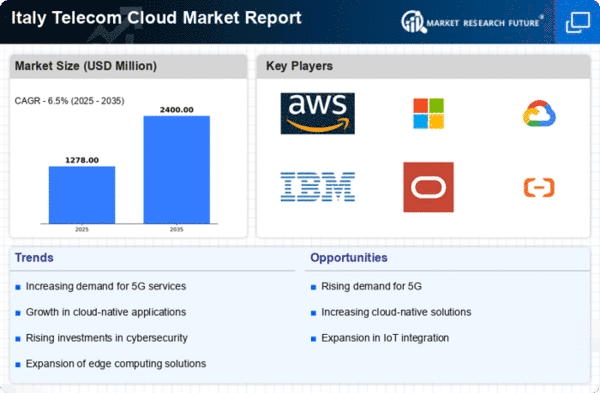
Italy Telecom Cloud Market Infographic
Purchase Options

Italy Telecom Cloud Market Summary

As per Market Research Future analysis, the Italy telecom cloud market size was estimated at 1200.0 USD Million in 2024. The Italy telecom cloud market is projected to grow from 1278.0 USD Million in 2025 to 2400.0 USD Million by 2035, exhibiting a compound annual growth rate (CAGR) of 6% during the forecast period 2025 - 2035

Key Market Trends & Highlights

The Italy telecom cloud market is experiencing a transformative shift towards hybrid solutions and enhanced security.

  • The market is witnessing increased adoption of hybrid cloud solutions, driven by the need for flexibility and scalability.
  • Enhanced security measures are becoming a focal point as businesses prioritize data protection in their cloud strategies.
  • Edge computing is emerging as a critical component, facilitating faster data processing and reduced latency for users.
  • The growing demand for digital transformation and the rise of 5G technology are key drivers propelling market growth.

Market Size & Forecast

2024 Market Size 1200.0 (USD Million)
2035 Market Size 2400.0 (USD Million)
CAGR (2025 - 2035) 6.5%

Major Players

Amazon Web Services (US), Microsoft (US), Google Cloud (US), IBM (US), Oracle (US), Alibaba Cloud (CN), NTT Communications (JP), Telefonica (ES), AT&T (US)

Our Impact
Enabled $4.3B Revenue Impact for Fortune 500 and Leading Multinationals
Partnering with 2000+ Global Organizations Each Year
30K+ Citations by Top-Tier Firms in the Industry

Italy Telecom Cloud Market Trends

The telecom cloud market in Italy is currently experiencing a transformative phase, driven by increasing demand for flexible and scalable solutions. As businesses and service providers seek to enhance operational efficiency, the adoption of cloud-based services is becoming more prevalent. This shift is largely influenced by the need for improved connectivity and the ability to manage vast amounts of data seamlessly. Moreover, the regulatory environment in Italy appears to support innovation, encouraging investments in advanced technologies that facilitate the growth of cloud services. The integration of artificial intelligence and machine learning into telecom cloud solutions is also gaining traction, suggesting a future where automation plays a crucial role in service delivery. In addition, the competitive landscape is evolving, with both established players and new entrants vying for market share. This dynamic environment fosters innovation and drives the development of tailored solutions that meet the specific needs of various sectors. The emphasis on security and compliance is becoming increasingly pronounced, as stakeholders prioritize data protection and privacy. Overall, The market is poised for substantial growth, with opportunities for collaboration and partnerships that could further enhance service offerings and customer experiences.

Increased Adoption of Hybrid Cloud Solutions

There is a noticeable trend towards hybrid cloud solutions within the telecom cloud market. This approach allows companies to leverage both public and private cloud infrastructures, providing flexibility and optimizing resource allocation. Organizations are increasingly recognizing the benefits of combining on-premises resources with cloud capabilities, which enhances their ability to respond to changing demands.

Focus on Enhanced Security Measures

Security remains a top priority for stakeholders in the telecom cloud market. As cyber threats evolve, companies are investing in advanced security protocols and compliance measures to protect sensitive data. This focus on security not only helps in safeguarding information but also builds trust with customers, which is essential for long-term success.

Emergence of Edge Computing

Edge computing is gaining momentum as a critical component of the telecom cloud market. By processing data closer to the source, this technology reduces latency and improves response times. The integration of edge computing with cloud services is likely to enhance the overall performance of applications, particularly in sectors that require real-time data processing.

Italy Telecom Cloud Market Drivers

Rise of 5G Technology

The rollout of 5G technology in Italy is poised to significantly impact the telecom cloud market. With its promise of ultra-fast connectivity and low latency, 5G enables more robust cloud services and applications. This technological advancement is expected to drive an increase in demand for cloud-based solutions, particularly in sectors such as healthcare, automotive, and smart cities. Analysts project that the telecom cloud market could witness a growth rate of around 20% as 5G adoption accelerates. The enhanced capabilities of 5G networks facilitate the deployment of edge computing solutions, further enriching the telecom cloud ecosystem. As businesses leverage 5G to enhance their operations, the telecom cloud market is likely to experience a transformative shift, creating new opportunities for service providers.

Increased Focus on Cost Efficiency

Cost efficiency remains a critical driver for the telecom cloud market in Italy. Organizations are increasingly seeking ways to reduce operational costs while maintaining service quality. The shift to cloud-based solutions allows businesses to minimize capital expenditures associated with traditional IT infrastructure. By adopting telecom cloud services, companies can benefit from a pay-as-you-go model, which aligns expenses with actual usage. This financial flexibility is particularly appealing in a competitive market where cost management is essential. Reports indicate that businesses utilizing cloud solutions can achieve cost savings of up to 30%. As more organizations recognize the financial advantages of cloud adoption, the telecom cloud market is likely to see accelerated growth, driven by the pursuit of cost-effective solutions.

Regulatory Support for Cloud Services

In Italy, regulatory frameworks are evolving to support the growth of the telecom cloud market. The government has introduced policies aimed at fostering innovation and ensuring data protection, which are crucial for cloud service providers. For instance, compliance with the General Data Protection Regulation (GDPR) has become a priority, prompting telecom companies to enhance their cloud offerings. This regulatory environment not only encourages investment in cloud infrastructure but also instills confidence among businesses considering cloud migration. As a result, the telecom cloud market is likely to expand, with an increasing number of organizations adopting cloud solutions to meet regulatory requirements while optimizing their operations. The alignment of regulatory support with market needs suggests a favorable outlook for the telecom cloud market in Italy.

Emergence of Innovative Service Models

The market in Italy is witnessing the emergence of innovative service models that cater to diverse customer needs. Service providers are increasingly offering tailored solutions, such as Software as a Service (SaaS) and Platform as a Service (PaaS), which allow businesses to customize their cloud experiences. This trend is indicative of a broader shift towards customer-centric approaches in the telecom industry. As organizations seek to enhance their operational capabilities, the availability of flexible and scalable cloud services becomes paramount. The telecom cloud market is likely to benefit from this trend, as businesses are drawn to solutions that offer agility and responsiveness. The introduction of innovative service models not only enhances customer satisfaction but also positions the telecom cloud market for sustained growth in the coming years.

Growing Demand for Digital Transformation

The market in Italy is experiencing a surge in demand driven by the ongoing digital transformation across various sectors. Businesses are increasingly seeking to enhance operational efficiency and customer engagement through cloud-based solutions. This shift is evidenced by a reported growth rate of approximately 15% in cloud adoption among enterprises in Italy. As organizations transition to digital platforms, the telecom cloud market is positioned to benefit significantly, providing essential infrastructure and services. The integration of advanced technologies such as AI and IoT into telecom cloud solutions further supports this trend, enabling companies to leverage data analytics and improve service delivery. Consequently, the telecom cloud market is likely to see sustained growth as more businesses recognize the value of digital transformation in maintaining competitive advantage.


Market Segment Insights

By Service Model: Software as a Service (Largest) vs. Infrastructure as a Service (Fastest-Growing)

In the Italy telecom cloud market, Software as a Service (SaaS) holds the largest market share among service models, as it has been widely adopted for its flexibility and cost-effectiveness. This segment caters to various industries, offering solutions that enhance productivity and streamline operations. Conversely, Infrastructure as a Service (IaaS) is recognized as the fastest-growing segment, driven by increasing demand for scalable and secure cloud solutions. Factors such as the rise of remote working, the need for data storage, and the growing trend of digital transformation are propelling IaaS growth, making it a significant player in the evolving market landscape.

Software as a Service (Dominant) vs. Infrastructure as a Service (Emerging)

Software as a Service (SaaS) is characterized by its ability to deliver applications over the internet, eliminating the need for local installation. This model allows users to access software from any device, fostering collaboration and remote work. As businesses in Italy increasingly adopt SaaS solutions, this segment has established itself as a dominant force in the market, providing a wide array of tools ranging from customer relationship management to enterprise resource planning. Meanwhile, Infrastructure as a Service (IaaS), with its increasing relevance, provides essential virtualized computing resources over the internet. Its flexibility and cost-saving benefits make it an emerging choice for startups and large enterprises alike, seeking to optimize operational efficiency and manage IT workloads effectively.

By Deployment Type: Public Cloud (Largest) vs. Hybrid Cloud (Fastest-Growing)

In the Italy telecom cloud market, the deployment type segment is primarily dominated by Public Cloud solutions, which hold a significant share of the overall market. This segment is characterized by its widespread acceptance due to its scalability and cost-effectiveness. Private Cloud, while utilized by many enterprises for enhanced security, occupies a smaller niche. Hybrid Cloud is also gaining traction, blending both private and public resources to meet diverse operational needs, thus carving out its own share of the market and enhancing overall market dynamics. Growth trends indicate that the demand for Hybrid Cloud solutions is accelerating, fueled by organizations seeking flexibility and hybrid capabilities. The rapid digital transformation within businesses is a critical driver, pushing companies to adopt models that can easily adapt to changing business requirements. Emerging technologies and increased investments in cloud infrastructure are also propelling the acceptance of Hybrid Cloud, making it an attractive option for various organizations in their cloud strategy implementations.

Public Cloud (Dominant) vs. Hybrid Cloud (Emerging)

Public Cloud solutions are dominant in the Italy telecom cloud market, being preferred for their affordability, scalability, and ease of management. Organizations favor Public Cloud for operational efficiency and reduced maintenance costs, making it a staple for startups and more extensive enterprises alike. On the other hand, Hybrid Cloud is an emerging segment that combines the strengths of both Public and Private Clouds. It enables organizations to maintain sensitive data on private servers while utilizing public services for less critical workloads, thus providing an optimal balance of flexibility, speed, and security. This segment is rapidly gaining favor as companies increasingly seek robust disaster recovery options and improved scalability, essential for navigating today's complex digital landscape.

By Component: Cloud Storage (Largest) vs. Network Functions Virtualization (Fastest-Growing)

In the Italy telecom cloud market, Cloud Storage holds the largest share among components, showcasing a robust demand for scalable storage solutions that cater to a growing number of digital services. Conversely, Network Functions Virtualization (NFV) is gaining traction, with a significant uptick in adoption as telecom providers seek to enhance service agility and reduce operational costs. The market is witnessing a diversifying shift as Cloud Management services also play a pivotal role in optimizing operations across various platforms. Growth trends indicate that Cloud Storage will continue to dominate, driven by the increasing reliance on data-driven decision-making in telecom operations. Meanwhile, NFV is recognized for its rapid growth due to its capability to streamline network processes and deliver services more efficiently. The rising demand for flexibility and cost-effective solutions further propels the expansion of these segments, highlighting a future where integrated management will be essential for competitive advantage.

Cloud Storage (Dominant) vs. Network Functions Virtualization (Emerging)

Cloud Storage remains the dominant force in the component segment, characterized by its ability to provide secure, scalable, and reliable data solutions tailored to customer needs. This component's prominence stems from the increasing volume of customer data generated within telecom environments, where effective storage is paramount. On the other hand, Network Functions Virtualization is emerging as a key player, offering innovative approaches to deploying and managing network services through software-driven solutions. This transition enhances flexibility and performance while significantly reducing hardware dependencies. Together, these components illustrate the transformation of the telecom landscape, where efficiency and adaptability are central to operational success.

By End User: Telecommunications Service Providers (Largest) vs. Small and Medium Enterprises (Fastest-Growing)

In the Italy telecom cloud market, the market share among end users reveals that Telecommunications Service Providers hold a significant portion, benefiting from established networks and customer bases. These providers leverage cloud solutions to enhance service delivery, manage infrastructure, and optimize operational efficiency. Conversely, Small and Medium Enterprises (SMEs) are experiencing rapid adoption of telecom cloud services, albeit with a smaller share of the overall market. SMEs are increasingly recognizing the value of cloud solutions for scalability and cost efficiency, leading to a robust growth scenario for this segment. The growth trends in this segment are influenced by several drivers. Telecommunication Service Providers are investing heavily in cloud infrastructure to support 5G technologies and improve customer experience. Meanwhile, SMEs are invigorating the market as they shift from traditional systems to more agile cloud-based services. This transition is primarily driven by the need for flexibility, real-time communication, and increased digital presence, making SMEs one of the most dynamic segments within the Italy telecom cloud market.

Telecommunications Service Providers (Dominant) vs. Small and Medium Enterprises (Emerging)

Telecommunications Service Providers represent the dominant force within the Italy telecom cloud market, characterized by their extensive resources and existing customer relationships. These providers are enhancing their service offerings through cloud technologies, improving operational efficiencies, and meeting the growing demand for high-speed connectivity. In contrast, Small and Medium Enterprises are emerging as a significant market player, driven by their need for innovative solutions that cater to their unique operational challenges. SMEs are increasingly adopting telecom cloud solutions to gain competitive advantages, streamline their processes, and reduce costs. This dual dynamic suggests a landscape where established providers and budding enterprises both play crucial roles, with opportunities for collaboration and innovation.

Get more detailed insights about Italy Telecom Cloud Market

Key Players and Competitive Insights

The telecom cloud market in Italy is characterized by a dynamic competitive landscape, driven by rapid technological advancements and increasing demand for digital transformation. Major players such as Amazon Web Services (US), Microsoft (US), and Google Cloud (US) are at the forefront, leveraging their extensive resources and innovative capabilities to capture market share. These companies focus on enhancing their service offerings through strategic partnerships and regional expansions, which collectively shape a competitive environment that is both robust and evolving. The emphasis on cloud-native solutions and AI integration appears to be a common thread among these key players, indicating a shift towards more sophisticated service models.In terms of business tactics, companies are increasingly localizing their operations to better serve the Italian market. This includes optimizing supply chains and establishing data centers within the region to enhance service delivery and compliance with local regulations. The market structure is moderately fragmented, with a mix of global giants and regional players, each contributing to a competitive atmosphere that fosters innovation and responsiveness to customer needs. The collective influence of these key players is significant, as they set benchmarks for service quality and technological advancement.

In October Microsoft (US) announced the launch of its new Azure data center in Milan, aimed at enhancing its cloud services for Italian enterprises. This strategic move is likely to bolster Microsoft's position in the market by providing localized services that cater to the specific needs of Italian businesses, thereby improving latency and compliance with data sovereignty regulations. Such investments reflect a broader trend of cloud providers establishing a physical presence in key markets to enhance their competitive edge.

In September Google Cloud (US) expanded its partnership with Telecom Italia (IT) to co-develop advanced cloud solutions tailored for the telecommunications sector. This collaboration is indicative of a growing trend where cloud providers align with local telecom operators to leverage their infrastructure and customer base. By integrating their services, Google Cloud aims to enhance its offerings and drive innovation in the telecom space, which could lead to improved service delivery and customer satisfaction.

In November Amazon Web Services (US) launched a new initiative focused on sustainability, committing to achieve 100% renewable energy usage in its Italian operations by 2026. This strategic focus on sustainability not only aligns with global trends but also positions AWS as a leader in responsible cloud computing. Such initiatives are increasingly important as customers prioritize environmental considerations in their purchasing decisions, suggesting that AWS is keenly aware of the shifting landscape in consumer preferences.

As of November the competitive trends in the telecom cloud market are heavily influenced by digitalization, sustainability, and the integration of AI technologies. Strategic alliances between cloud providers and local telecom operators are shaping the current landscape, fostering innovation and enhancing service delivery. Looking ahead, competitive differentiation is likely to evolve from traditional price-based competition to a focus on innovation, technological advancements, and supply chain reliability. This shift underscores the importance of agility and responsiveness in meeting the diverse needs of customers in an increasingly complex market.

Key Companies in the Italy Telecom Cloud Market include

Industry Developments

The Italy Telecom Cloud Market has seen significant developments recently, with many major players expanding their footprint. Telecom Italia has been enhancing its cloud services following strategic investments to fortify its position against competitors like Vodafone and Fastweb. In September 2023, Tiscali announced the integration of its cloud services with Oracle's solutions to improve service delivery efficiency. 

Additionally, Wind Tre has been rolling out new innovative cloud-based solutions, emphasizing security, which is becoming increasingly critical in the current digital landscape. In August 2023, Microsoft expanded its Azure cloud infrastructure in Italy, responding to rising demand for cloud services amidst the growing digitalization in the country. Furthermore, there have been discussions regarding potential collaborations and partnerships involving major companies like Google Cloud and Amazon Web Services, focused on enhancing cloud offerings tailored for the Italian market. 

The market's valuation has been positively impacted by the increasing enterprise adoption of cloud solutions, leading to a higher demand for scalable and resilient infrastructure. In the last couple of years, the overall trend has indicated a strong growth trajectory driven by these collaborations and advancements in technology across the sector.

Future Outlook

Italy Telecom Cloud Market Future Outlook

The Telecom Cloud Market in Italy is projected to grow at a 6.5% CAGR from 2025 to 2035, driven by increased demand for digital transformation and enhanced network capabilities.

New opportunities lie in:

  • Development of AI-driven network optimization tools
  • Expansion of edge computing services for low-latency applications
  • Integration of IoT solutions for smart city infrastructure

By 2035, the telecom cloud market is expected to achieve substantial growth and innovation.

Market Segmentation

Italy Telecom Cloud Market End User Outlook

  • Telecommunications Service Providers
  • Enterprise Users
  • Small and Medium Enterprises

Italy Telecom Cloud Market Component Outlook

  • Network Functions Virtualization
  • Cloud Storage
  • Cloud Management

Italy Telecom Cloud Market Service Model Outlook

  • Infrastructure as a Service
  • Platform as a Service
  • Software as a Service

Italy Telecom Cloud Market Deployment Type Outlook

  • Public Cloud
  • Private Cloud
  • Hybrid Cloud

Report Scope

MARKET SIZE 2024 1200.0(USD Million)
MARKET SIZE 2025 1278.0(USD Million)
MARKET SIZE 2035 2400.0(USD Million)
COMPOUND ANNUAL GROWTH RATE (CAGR) 6.5% (2025 - 2035)
REPORT COVERAGE Revenue Forecast, Competitive Landscape, Growth Factors, and Trends
BASE YEAR 2024
Market Forecast Period 2025 - 2035
Historical Data 2019 - 2024
Market Forecast Units USD Million
Key Companies Profiled Amazon Web Services (US), Microsoft (US), Google Cloud (US), IBM (US), Oracle (US), Alibaba Cloud (CN), NTT Communications (JP), Telefonica (ES), AT&T (US)
Segments Covered Service Model, Deployment Type, Component, End User
Key Market Opportunities Adoption of advanced 5G technologies drives growth in the telecom cloud market.
Key Market Dynamics Rising demand for flexible telecom cloud solutions drives competitive innovation and regulatory adaptation in the market.
Countries Covered Italy
Leave a Comment

FAQs

What is the expected market size of the Italy Telecom Cloud Market in 2024?

The Italy Telecom Cloud Market is expected to be valued at 578.0 million USD in 2024.

What is the projected market size by 2035 for the Italy Telecom Cloud Market?

By 2035, the Italy Telecom Cloud Market is expected to reach a valuation of 1,157.0 million USD.

What is the expected CAGR for the Italy Telecom Cloud Market from 2025 to 2035?

The expected CAGR for the Italy Telecom Cloud Market from 2025 to 2035 is 6.512%.

Which deployment type is predicted to have the highest market value by 2035?

By 2035, the Public deployment type is predicted to have the highest market value reaching 500.0 million USD.

What is the market value of the Private deployment type in 2024?

The Private deployment type is valued at 200.0 million USD in 2024.

Who are the key players in the Italy Telecom Cloud Market?

Major players in the Italy Telecom Cloud Market include Oracle, Vodafone, Google Cloud, and Telecom Italia.

What is the estimated market value of the Hybrid deployment type in 2035?

The estimated market value of the Hybrid deployment type in 2035 is 257.0 million USD.

How has the growing demand for cloud services affected the Italy Telecom Cloud Market?

The growing demand for cloud services is significantly driving the growth of the Italy Telecom Cloud Market.

What challenges does the Italy Telecom Cloud Market currently face?

The Italy Telecom Cloud Market faces challenges such as cybersecurity threats and regulatory compliance.

How do emerging technologies influence the Italy Telecom Cloud Market?

Emerging technologies, such as AI and IoT, are creating new opportunities for growth in the Italy Telecom Cloud Market.

Download Free Sample

Kindly complete the form below to receive a free sample of this Report

Compare Licence

×
Features License Type
Single User Multiuser License Enterprise User
Price $4,950 $5,950 $7,250
Maximum User Access Limit 1 User Upto 10 Users Unrestricted Access Throughout the Organization
Free Customization
Direct Access to Analyst
Deliverable Format
Platform Access
Discount on Next Purchase 10% 15% 15%
Printable Versions