×
Request Free Sample ×

Kindly complete the form below to receive a free sample of this Report

* Please use a valid business email

Leading companies partner with us for data-driven Insights

clients tt-cursor
Hero Background

Italy High Throughput Screening Market

ID: MRFR/MED/52891-HCR
200 Pages
Garvit Vyas
February 2026

Italy High Throughput Screening Market Research Report: Size, Share, Trend Analysis By Product & Service (Reagents, Assay Kits Instruments, Consumables, Accessories, Software, Services) and By Technology (Cell-Based Assays, 2D Cell Culture, 3D Cell Culture, Scaffold-Based Technologies, Scaffold-free Technologies, Hanging-drop Plates, Ultra-low Binding Plates, Other Scaffold-free Technologies) - Growth Outlook & Industry Forecast 2025 To 2035

Share:
Download PDF ×

We do not share your information with anyone. However, we may send you emails based on your report interest from time to time. You may contact us at any time to opt-out.

Italy High Throughput Screening Market Infographic
Purchase Options

Italy High Throughput Screening Market Summary

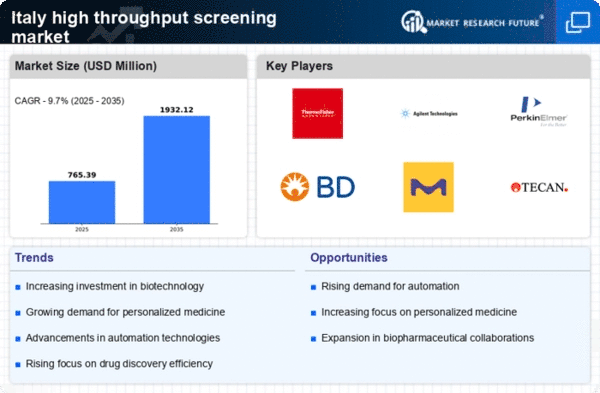
As per Market Research Future analysis, the Italy High Throughput Screening Market size was estimated at 697.71 USD Million in 2024. The High Throughput-screening market is projected to grow from 765.39 USD Million in 2025 to 1932.12 USD Million by 2035, exhibiting a compound annual growth rate (CAGR) of 9% during the forecast period 2025 - 2035

Key Market Trends & Highlights

The Italy The high throughput screening market is poised for substantial growth. This growth is driven by technological advancements and an increasing demand for personalized medicine.

  • Technological advancements are enhancing the efficiency and accuracy of high throughput screening processes.
  • The collaboration between pharmaceutical companies and research institutions is fostering innovation in drug discovery.
  • The largest segment in the market is the pharmaceutical sector, while the biotechnology sector is the fastest-growing segment.
  • Rising demand for drug discovery and government initiatives are key drivers propelling market expansion.

Market Size & Forecast

2024 Market Size 697.71 (USD Million)
2035 Market Size 1932.12 (USD Million)
CAGR (2025 - 2035) 9.7%

Major Players

Thermo Fisher Scientific (US), Agilent Technologies (US), PerkinElmer (US), Becton Dickinson (US), Merck KGaA (DE), Tecan Group (CH), Sartorius AG (DE), Corning Incorporated (US), Bio-Rad Laboratories (US)

Our Impact
Enabled $4.3B Revenue Impact for Fortune 500 and Leading Multinationals
Partnering with 2000+ Global Organizations Each Year
30K+ Citations by Top-Tier Firms in the Industry

Italy High Throughput Screening Market Trends

The Italy High Throughput Screening Market is currently experiencing notable growth. This growth is driven by advancements in technology and an increasing demand for drug discovery processes. In Italy, the integration of automation and robotics into laboratory workflows has enhanced efficiency, allowing researchers to conduct experiments at an unprecedented scale. This trend appears to be fostering innovation in various sectors, including pharmaceuticals and biotechnology, as organizations seek to streamline their research and development efforts. Furthermore, the collaboration between academic institutions and industry players is likely to accelerate the adoption of high throughput screening technologies, thereby expanding the market's reach. Moreover, the emphasis on personalized medicine is shaping the landscape of the high throughput-screening market. As healthcare providers aim to tailor treatments to individual patients, the need for rapid and accurate screening methods becomes increasingly critical. Italian companies are investing in the development of novel screening assays and platforms that can accommodate this shift towards precision medicine. This focus on customization may lead to enhanced patient outcomes and drive further investment in high throughput screening capabilities, positioning Italy as a key player in this evolving market.

Technological Advancements

The high throughput-screening market is witnessing rapid technological advancements, particularly in automation and data analysis. These innovations are enabling laboratories to process vast amounts of samples efficiently, thereby reducing time and costs associated with drug discovery.

Collaboration Between Sectors

There is a growing trend of collaboration between academic institutions and industry in the high throughput-screening market. This synergy is fostering the development of new methodologies and technologies, enhancing the overall research capabilities within Italy.

Focus on Personalized Medicine

The shift towards personalized medicine is significantly influencing the high throughput-screening market. As healthcare providers seek to tailor treatments, there is an increasing demand for screening methods that can quickly and accurately identify suitable therapies for individual patients.

Italy High Throughput Screening Market Drivers

Increased Focus on Biologics

The high throughput-screening market is witnessing a shift towards biologics, driven by the growing prevalence of chronic diseases and the demand for targeted therapies. In Italy, the biologics segment is projected to account for over 30% of the total pharmaceutical market by 2026. This trend is prompting pharmaceutical companies to invest in high throughput screening technologies that can efficiently evaluate biologic compounds. The ability to screen large libraries of biologics rapidly is essential for identifying promising candidates for further development. Consequently, the high throughput-screening market is likely to expand as companies adapt their strategies to focus on biologics, thereby enhancing their product pipelines.

Rising Demand for Drug Discovery

The high throughput-screening market in Italy is experiencing a notable increase in demand driven by the pharmaceutical industry's need for efficient drug discovery processes. As the complexity of diseases rises, the necessity for rapid screening of compounds becomes paramount. In 2025, the Italian pharmaceutical sector is projected to invest approximately €1.5 billion in research and development, with a significant portion allocated to high throughput screening technologies. This investment is likely to enhance the capabilities of laboratories, allowing for the evaluation of thousands of compounds simultaneously. Consequently, the high throughput-screening market is expected to expand as companies seek to streamline their drug development pipelines, thereby reducing time to market and associated costs.

Government Initiatives and Funding

Government support plays a crucial role in the growth of the high throughput-screening market in Italy. Various initiatives aimed at fostering innovation in biotechnology and pharmaceuticals are being implemented. For instance, the Italian government has allocated €300 million in funding for research projects that incorporate high throughput screening methodologies. This financial backing not only encourages the adoption of advanced technologies but also stimulates collaboration between academic institutions and industry players. As a result, the high throughput-screening market is likely to benefit from increased research activities and the development of novel screening platforms, ultimately enhancing the competitiveness of the Italian biotech sector.

Integration of Artificial Intelligence

The integration of artificial intelligence (AI) into the high throughput screening market is transforming the landscape of drug discovery in Italy. AI technologies are being utilized to analyze vast datasets generated from screening processes, enabling researchers to identify potential drug candidates more efficiently. In 2025, it is estimated that AI-driven solutions could reduce the time required for data analysis by up to 40%. This advancement not only accelerates the screening process but also enhances the accuracy of predictions regarding compound efficacy. As AI continues to evolve, its application in high throughput screening is expected to drive market growth, positioning Italy as a leader in innovative drug discovery methodologies.

Emergence of Startups and Innovation Hubs

The emergence of startups and innovation hubs in Italy is significantly impacting the high throughput-screening market. These entities are often at the forefront of developing novel screening technologies and methodologies. In recent years, Italy has seen a surge in biotech startups, with over 200 new companies established in the last two years alone. Many of these startups are focusing on high throughput screening solutions, which are essential for modern drug discovery. The collaborative environment fostered by innovation hubs encourages knowledge sharing and accelerates the development of cutting-edge technologies. As a result, the high throughput-screening market is poised for growth, driven by the innovative contributions of these emerging players.


Market Segment Insights

By Product & Services: Consumables (Largest) vs. Instruments (Fastest-Growing)

In the Italy high throughput-screening market, the distribution of market share among consumables, instruments, and software & services showcases consumables as the largest segment. This segment's dominance can be attributed to its essential role in various screening processes, providing a steady revenue stream for manufacturers. Meanwhile, instruments, representing a significant portion of the market, are becoming increasingly important as technological advancements drive their adoption in research and clinical settings. Growth trends within the segment highlight a robust increase in demand for instruments, positioning them as the fastest-growing category. The evolution of screening technologies, coupled with the rising need for efficient drug discovery processes, fuels this growth. Furthermore, the integration of advanced software solutions is enhancing the capabilities of these instruments, making them more appealing to researchers and pharmaceutical companies alike.

Consumables (Dominant) vs. Instruments (Emerging)

Consumables have established themselves as the dominant force in the Italy high throughput-screening market, largely due to their pivotal role in facilitating various assays and screening processes. The proliferation of reagents, plates, and other essential materials contributes significantly to laboratory operations, ensuring a consistent demand from users. On the other hand, instruments are emerging as a vital segment, benefiting from technological innovations such as automation and enhanced throughput capabilities. As researchers seek more efficient solutions to accelerate drug discovery, the growth of instruments is expected to surge, positioning them as a key player that complements the established consumables segment.

By Technology: Cell-Based Assays (Largest) vs. Lab-on-a-Chip (Fastest-Growing)

The Italy high throughput-screening market showcases a diverse array of technology segments, with Cell-Based Assays commanding the largest market share. This segment has benefited from advances in biological research and an increasing demand for more effective drug discovery methodologies. Meanwhile, Lab-on-a-Chip technology emerges as one of the fastest-growing areas, driven by the need for miniaturized, high-efficiency labs that integrate multiple laboratory functions on a single chip, catering to both academic and industrial applications. Growth trends reflect a significant shift towards automation and high-throughput capabilities across the board. Cell-Based Assays continue to leverage their established presence while undergoing innovations that enhance reliability and throughput. On the other hand, Lab-on-a-Chip technology is gaining traction due to its potential to reduce costs and time in research and clinical diagnostics. This dual trajectory highlights the dynamic nature of the Italy high throughput-screening market, where the interplay between traditional and emerging technologies sparks ongoing competitive advantages.

Technology: Cell-Based Assays (Dominant) vs. Lab-on-a-Chip (Emerging)

Cell-Based Assays represent a dominant force in the Italy high throughput-screening market, leveraging robust methodologies to provide insights into cellular functions and drug effects. Their broad applicability in various biological research fields accentuates their significance. In contrast, Lab-on-a-Chip technology is an emerging frontrunner, offering streamlined processes by integrating sample preparation, analysis, and detection into a single platform. This technology is characterized by its compactness and efficiency, allowing rapid analyses that align with the pressing demands of modern research and diagnostics. The juxtaposition of these two technologies illustrates the market's diverse offerings, each catering to distinct research needs while fostering innovation.

By Application: Drug Discovery (Largest) vs. Biochemical Screening (Fastest-Growing)

In the Italy high throughput-screening market, the application segments exhibit a varied distribution of market share. Drug Discovery is prominently the largest segment, underscoring its critical role in pharmaceutical development. Biochemical Screening follows, claiming a significant portion, while Cell & Organ-Based Screening and Others contribute comparatively less to the overall market share, highlighting the focused investment in drug-related applications. Recent growth trends within these segments indicate a robust increase in Biochemical Screening, driven by advancements in techniques and technologies that enhance screening efficiency. This segment is becoming crucial as organizations seek faster results in drug efficacy testing. Additionally, Drug Discovery continues to thrive due to the constant demand for new therapeutic agents, further propelled by collaborations between biotech firms and research institutions to innovate new drugs.

Drug Discovery (Dominant) vs. Cell & Organ-Based Screening (Emerging)

The Drug Discovery segment is a dominant force within the Italy high throughput-screening market, characterized by its extensive application in identifying viable drug candidates through systematic testing of compound libraries. This segment benefits from significant investments in research and development, as well as partnerships among pharmaceutical companies, academic institutions, and technology providers. Conversely, Cell & Organ-Based Screening is emerging as a valuable segment, focusing on utilizing live cells and organ systems for high fidelity results in drug response. This approach presents a more physiologically relevant model which is gaining traction due to the increasing need for more accurate preclinical data. Overall, while Drug Discovery remains at the forefront, the shift towards more biologically relevant screening methods positions Cell & Organ-Based Screening as a critical growth area.

By End User: Pharmaceutical Companies (Largest) vs. Research Institutes (Fastest-Growing)

In the Italy high throughput-screening market, the distribution among end users reveals that pharmaceutical and biotechnology companies hold the largest market share, capitalizing on their continuous need for efficiency in drug discovery and development processes. Conversely, research institutes and organizations are emerging prominently, leveraging increasing public and private investments in research initiatives, leading to a surge in demand for high throughput screening technologies. Growth trends show that pharmaceutical companies are primarily focused on innovative drug development, pushing the boundaries of high throughput screening to enhance their R&D productivity. Meanwhile, research institutes are positioned for rapid growth, driven by advancements in technology, collaboration with industry, and a heightened emphasis on translating research findings into practical applications. This dynamic fosters a competitive landscape that encourages investment and innovation among various end users.

Pharmaceutical Companies (Dominant) vs. Research Institutes (Emerging)

Pharmaceutical companies are the dominant end users in the Italy high throughput-screening market, characterized by sophisticated R&D processes and a robust infrastructure that supports high volumes of compound screening. Their established presence enables consistent investments in innovative technologies, enhancing drug development timelines significantly. In contrast, research institutes represent the emerging segment, driven by collaborative projects and funding opportunities that focus on translational research. These institutions leverage high throughput screening to facilitate discoveries across diverse fields, rapidly evolving as vital contributors to the scientific community. Together, these segments shape the strategic landscape, influencing market dynamics and technology adoption.

Get more detailed insights about Italy High Throughput Screening Market

Key Players and Competitive Insights

The high throughput-screening market in Italy is characterized by a dynamic competitive landscape, driven by technological advancements and increasing demand for drug discovery and development. Key players such as Thermo Fisher Scientific (US), Agilent Technologies (US), and Merck KGaA (DE) are at the forefront, leveraging innovation and strategic partnerships to enhance their market positions. These companies focus on expanding their product portfolios and improving operational efficiencies, which collectively shapes a competitive environment that is both collaborative and competitive.In terms of business tactics, companies are increasingly localizing manufacturing and optimizing supply chains to enhance responsiveness to market demands. The market structure appears moderately fragmented, with several key players exerting significant influence. This fragmentation allows for a variety of competitive strategies, as companies seek to differentiate themselves through unique offerings and tailored solutions.

In October Thermo Fisher Scientific (US) announced the launch of a new high throughput screening platform designed to streamline drug discovery processes. This strategic move is likely to enhance their competitive edge by providing researchers with advanced tools that improve efficiency and accuracy in screening assays. Such innovations are crucial in a market where speed and precision are paramount.

In September Agilent Technologies (US) expanded its collaboration with leading academic institutions in Italy to develop next-generation screening technologies. This partnership not only strengthens Agilent's position in the market but also fosters innovation through shared expertise and resources. The emphasis on collaboration suggests a trend towards leveraging academic partnerships to drive technological advancements.

In August Merck KGaA (DE) unveiled a new initiative aimed at integrating artificial intelligence into their high throughput screening processes. This initiative is indicative of a broader trend towards digital transformation within the industry, as companies seek to harness AI capabilities to enhance data analysis and decision-making processes. The integration of AI is expected to significantly improve the efficiency of screening workflows, thereby positioning Merck KGaA as a leader in technological innovation.

As of November current competitive trends indicate a strong focus on digitalization, sustainability, and AI integration. Strategic alliances are increasingly shaping the landscape, as companies recognize the value of collaboration in driving innovation. Looking ahead, competitive differentiation is likely to evolve from traditional price-based competition to a focus on technological advancements, supply chain reliability, and innovative solutions that meet the evolving needs of the market.

Key Companies in the Italy High Throughput Screening Market include

Industry Developments

The Italy High Throughput Screening Market has witnessed significant developments recently, especially with the increasing focus on drug discovery and development processes. Major companies like Evotec, Novartis, and Merck Group have been expanding their capabilities to meet the growing demand for efficient screening technologies. In term of mergers and acquisitions, in April 2023, Bayer announced the acquisition of a biotechnology firm specializing in high throughput genomic screening, which is expected to enhance its product offerings in Italy.

Samply's acquisition by Thermo Fisher Scientific in March 2023 also emphasized the strategic moves around integrated technologies for screening. The market landscape is further shaped by advancements in automation technologies and the integration of artificial intelligence, making it more viable for companies such as Siemens Healthineers and PerkinElmer to improve their research and development processes.

Over the past two years, Italy has seen a notable increase in public and private funding for biotechnology initiatives, highlighting its growing prominence in high throughput screening. As of September 2023, industry investments from firms like AbbVie and Lonza are continuing to expand the market potential, ensuring robust growth in Italy’s life sciences sector.

Future Outlook

Italy High Throughput Screening Market Future Outlook

The High Throughput Screening Market in Italy is projected to grow at a 9.7% CAGR from 2025 to 2035, driven by technological advancements and increasing demand for drug discovery.

New opportunities lie in:

  • Development of AI-driven screening platforms for enhanced data analysis.
  • Expansion of high throughput screening services in biotechnology firms.
  • Integration of miniaturized screening technologies for cost-effective research solutions.

By 2035, the market is expected to achieve substantial growth, positioning itself as a leader in innovative screening solutions.

Market Segmentation

Italy High Throughput Screening Market End User Outlook

  • Pharmaceutical and Biotechnology Companies
  • Research Institutes and Organizations
  • Contract Research Organizations

Italy High Throughput Screening Market Technology Outlook

  • Cell-Based Assays
  • Lab-on-a-Chip (LOC)
  • Ultra-High-Throughput Screening
  • Label-Free Technology
  • Others

Italy High Throughput Screening Market Application Outlook

  • Drug Discovery
  • Biochemical Screening
  • Cell & Organ-Based Screening
  • Others

Italy High Throughput Screening Market Product & Services Outlook

  • Consumables
  • Instruments
  • Software & Services

Report Scope

MARKET SIZE 2024697.71(USD Million)
MARKET SIZE 2025765.39(USD Million)
MARKET SIZE 20351932.12(USD Million)
COMPOUND ANNUAL GROWTH RATE (CAGR)9.7% (2025 - 2035)
REPORT COVERAGERevenue Forecast, Competitive Landscape, Growth Factors, and Trends
BASE YEAR2024
Market Forecast Period2025 - 2035
Historical Data2019 - 2024
Market Forecast UnitsUSD Million
Key Companies ProfiledThermo Fisher Scientific (US), Agilent Technologies (US), PerkinElmer (US), Becton Dickinson (US), Merck KGaA (DE), Tecan Group (CH), Sartorius AG (DE), Corning Incorporated (US), Bio-Rad Laboratories (US)
Segments CoveredProduct & Services, Technology, Application, End User
Key Market OpportunitiesIntegration of artificial intelligence in high throughput-screening processes enhances efficiency and data analysis capabilities.
Key Market DynamicsRising demand for innovative drug discovery methods drives growth in the high throughput-screening market.
Countries CoveredItaly
Leave a Comment

FAQs

What is the expected market size of the Italy High Throughput Screening Market in 2024?

The market is expected to be valued at 581.5 million USD in 2024.

What will be the market size of the Italy High Throughput Screening Market in 2035?

In 2035, the market is projected to reach approximately 1850.0 million USD.

What is the expected compound annual growth rate (CAGR) for the Italy High Throughput Screening Market from 2025 to 2035?

The market is expected to grow at a CAGR of 11.095% during the forecast period.

Which segment is forecasted to have the largest value in the Italy High Throughput Screening Market in 2035?

The Reagents segment is expected to be valued at 488.0 million USD in 2035.

Who are the major players in the Italy High Throughput Screening Market?

Key players include Evotec, Novartis, GE Healthcare, Sartorius, Merck Group, and others.

What is the projected market value for Assay Kits Instruments in 2035?

Assay Kits Instruments are expected to be valued at 385.0 million USD in 2035.

How much is the Consumables segment valued at in 2024?

The Consumables segment is valued at 160.5 million USD in 2024.

What is the market growth rate expected for the Accessories segment from 2025 to 2035?

The Accessories segment is expected to experience substantial growth contributing to the overall market expansion.

What is the expected value of Software in the Italy High Throughput Screening Market by 2035?

Software is projected to be valued at 224.0 million USD by 2035.

What are the key market trends driving growth in the Italy High Throughput Screening Market?

Technological advancements and increasing demand for drug discovery are significant growth drivers in the market.

Download Free Sample

Kindly complete the form below to receive a free sample of this Report

Compare Licence

×
Features License Type
Single User Multiuser License Enterprise User
Price $4,950 $5,950 $7,250
Maximum User Access Limit 1 User Upto 10 Users Unrestricted Access Throughout the Organization
Free Customization
Direct Access to Analyst
Deliverable Format
Platform Access
Discount on Next Purchase 10% 15% 15%
Printable Versions