×
Request Free Sample ×

Kindly complete the form below to receive a free sample of this Report

* Please use a valid business email

Leading companies partner with us for data-driven Insights

clients tt-cursor
Hero Background

Italy Augmented Virtual Reality Hardware Market

ID: MRFR/ICT/57327-HCR
200 Pages
Aarti Dhapte
February 2026

Italy Augmented Virtual Reality Hardware Market Size, Share and Trends Analysis Report By Hardware Type (Sensors, Processors, Controllers, Cameras, Headphones, Display Monitors, Others), By Application (Head Mounted Display, Head Up Display, Handheld Devices) and By Industry Vertical (Aerospace & Defense, Gaming & Entertainment, Education & Training, Healthcare, Automotive, Others)- Forecast to 2035

Share:
Download PDF ×

We do not share your information with anyone. However, we may send you emails based on your report interest from time to time. You may contact us at any time to opt-out.

Italy Augmented Virtual Reality Hardware Market Infographic
Purchase Options

Italy Augmented Virtual Reality Hardware Market Summary

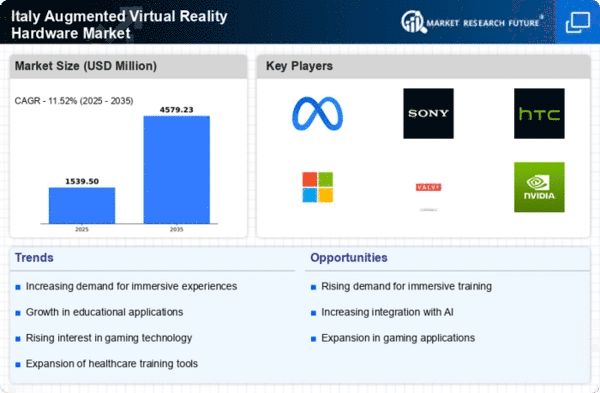
As per Market Research Future analysis, the Italy Augmented Virtual Reality Hardware Market Size was estimated at 1380.47 USD Million in 2024. The Italy augmented virtual-reality-hardware market is projected to grow from 1539.5 USD Million in 2025 to 4579.23 USD Million by 2035, exhibiting a compound annual growth rate (CAGR) of 11.5% during the forecast period 2025 - 2035

Key Market Trends & Highlights

The Italy augmented virtual-reality-hardware market is experiencing robust growth driven by technological advancements and increasing consumer adoption.

  • Rising consumer adoption is evident as more individuals integrate augmented virtual-reality into their daily lives.
  • The education sector is witnessing significant integration of augmented virtual-reality technologies, enhancing learning experiences.
  • Healthcare applications are expanding, with augmented virtual-reality being utilized for training and patient treatment.
  • Technological advancements in hardware and growing investment in startups are key drivers propelling market growth.

Market Size & Forecast

2024 Market Size 1380.47 (USD Million)
2035 Market Size 4579.23 (USD Million)
CAGR (2025 - 2035) 11.52%

Major Players

Meta Platforms (US), Sony (JP), HTC (TW), Microsoft (US), Valve Corporation (US), NVIDIA (US), Samsung Electronics (KR), Apple (US), Oculus (US)

Our Impact
Enabled $4.3B Revenue Impact for Fortune 500 and Leading Multinationals
Partnering with 2000+ Global Organizations Each Year
30K+ Citations by Top-Tier Firms in the Industry

Italy Augmented Virtual Reality Hardware Market Trends

The Augmented Virtual Reality Hardware Market in Italy is currently experiencing a notable transformation, driven by advancements in technology and increasing consumer interest. The proliferation of high-quality headsets and accessories has made immersive experiences more accessible to a broader audience. This shift is further supported by the growing integration of augmented and virtual reality in various sectors, including education, healthcare, and entertainment. As businesses recognize the potential of these technologies, investments in augmented virtual-reality-hardware are likely to rise, fostering innovation and enhancing user experiences. Moreover, the Italian market appears to be influenced by a surge in demand for interactive applications that utilize augmented virtual-reality-hardware. This trend is evident in the gaming industry, where immersive gameplay is becoming a standard expectation among consumers. Additionally, educational institutions are increasingly adopting these technologies to create engaging learning environments. The collaboration between tech companies and educational entities suggests a promising future for the augmented virtual-reality-hardware market, as it continues to evolve and adapt to the needs of various industries.

Rising Consumer Adoption

There is a noticeable increase in consumer adoption of augmented virtual-reality-hardware, particularly among younger demographics. This trend is driven by the desire for immersive experiences in gaming and entertainment, leading to a growing market presence.

Integration in Education

Educational institutions are increasingly incorporating augmented virtual-reality-hardware into their curricula. This integration enhances learning experiences, making complex subjects more accessible and engaging for students.

Healthcare Applications

The healthcare sector is exploring innovative uses for augmented virtual-reality-hardware, particularly in training and patient treatment. This trend indicates a shift towards more interactive and effective healthcare solutions.

Italy Augmented Virtual Reality Hardware Market Drivers

Growing Investment in Startups

Investment in startups focused on augmented virtual-reality-hardware is on the rise in Italy. Venture capitalists are increasingly recognizing the potential of this market, leading to a surge in funding. In 2025, it is estimated that investments in this sector could reach €200 million, reflecting a growing confidence in the technology's future. This influx of capital is likely to foster innovation and competition, resulting in a wider array of products and services. As new players enter the market, the augmented virtual-reality-hardware market is expected to diversify, catering to various consumer needs and preferences.

Technological Advancements in Hardware

The Augmented Virtual Reality Hardware Market is experiencing rapid technological advancements, particularly in Italy. Innovations in processing power, display quality, and motion tracking are enhancing user experiences. For instance, the introduction of lightweight headsets with high-resolution displays is attracting consumers. In 2025, the market is projected to grow by approximately 15%, driven by these advancements. Companies are investing heavily in research and development to create more immersive experiences, which is likely to further stimulate demand. As hardware becomes more sophisticated, it is expected that applications in gaming, training, and entertainment will expand, thereby increasing the overall market size.

Expansion of Gaming and Entertainment Sectors

The gaming and entertainment sectors in Italy are expanding, significantly impacting the augmented virtual-reality-hardware market. With a growing number of gamers and an increasing interest in immersive experiences, the demand for advanced hardware is surging. In 2025, the gaming segment alone is expected to account for over 40% of the market share. This growth is likely fueled by the introduction of new gaming titles that leverage augmented reality technology. As consumers seek more engaging and interactive experiences, the augmented virtual-reality-hardware market is poised for substantial growth, driven by the entertainment industry's evolution.

Supportive Government Policies and Initiatives

The Italian government is actively promoting the development of the augmented virtual-reality-hardware market through various policies and initiatives. By providing funding and support for research and development, the government aims to position Italy as a leader in this technology. In 2025, it is anticipated that government-backed projects could contribute to a 10% increase in market growth. These initiatives are likely to encourage collaboration between academia and industry, fostering innovation. As a result, the augmented virtual-reality-hardware market may benefit from enhanced technological capabilities and increased competitiveness on a global scale.

Increased Demand for Remote Collaboration Tools

The augmented virtual-reality-hardware market is witnessing a notable increase in demand for remote collaboration tools. As businesses in Italy seek to enhance productivity and communication, augmented reality solutions are becoming essential. In 2025, the market for remote collaboration tools is projected to grow by 20%, driven by the need for effective virtual meetings and training sessions. Companies are investing in augmented virtual-reality-hardware to facilitate seamless interactions among remote teams. This trend indicates a shift towards more integrated work environments, where augmented reality plays a crucial role in bridging geographical gaps.


Market Segment Insights

By Type: Sensors (Largest) vs. Controllers (Fastest-Growing)

In the Italy Augmented Virtual Reality Hardware Market, Sensors account for the largest market share, dominating the landscape due to their essential role in enhancing user experience through accurate motion tracking and environmental interaction. Following Sensors, Controllers also hold a significant share, contributing to the overall viability of various augmented and virtual reality applications. Other segment values like Processors and Cameras also play crucial roles but remain less dominant in terms of market presence. Looking at growth trends, Controllers are emerging as the fastest-growing segment, driven by increasing consumer demand for immersive gaming experiences and interactive applications. Innovations in technology, like haptic feedback and improved wireless functionalities, are propelling growth. This trend signifies a shift towards enhanced user engagement, making Controllers an essential component of the augmented virtual-reality-hardware market's future.

Sensors (Dominant) vs. Controllers (Emerging)

Sensors are a dominant force in the Italy augmented virtual-reality-hardware market, recognized for their critical function in capturing user movements and enabling responsive interactions within virtual environments. They utilize advanced technologies such as infrared and ultrasonic waves to provide accurate spatial awareness, essential for achieving a realistic experience. In contrast, Controllers are emerging rapidly, reflecting the growing trend in user-centric design and interaction. They are designed with intuitive interfaces and are increasingly featuring advanced functionalities, such as motion tracking and tactile feedback, which enhance the immersive experience. As the market evolves, the synergy between Sensors and Controllers is expected to drive significant advancements, making them crucial to the market's growth trajectory.

By Application: Head Mounted Display (Largest) vs. Handheld Devices (Fastest-Growing)

The market share distribution among the segment values in the Italy augmented virtual-reality-hardware market highlights Head Mounted Displays as the predominant choice, capturing significant user interest. In contrast, Handheld Devices are rapidly gaining traction, particularly among younger demographics, indicating a shift in preferences driven by advancements in technology and user accessibility. Growth trends in this segment suggest that while Head Mounted Displays remain essential for immersive experiences, Handheld Devices are emerging as key players due to their portable nature and increasing functionality. The growing interest in augmented and virtual reality experiences for gaming and education creates opportunities for innovation and expansion, making the market dynamic as manufacturers seek to meet diverse consumer demands.

Head Mounted Display (Dominant) vs. Handheld Devices (Emerging)

The Head Mounted Display segment is characterized by its immersive capabilities, appealing to gamers and professional users seeking enhanced interactive experiences. This segment enjoys a strong market presence due to ongoing advancements in display technology and ergonomic design. In contrast, Handheld Devices are emerging as flexible alternatives, providing user-friendly interfaces and portability. Their lightweight design appeals to consumers looking for convenience, especially in everyday applications like education and training. As both segments continue to evolve, the competition may encourage innovative features that blend the strengths of each, ultimately expanding consumer engagement in the Italy augmented virtual-reality-hardware market.

By Industry Vertical: Gaming & Entertainment (Largest) vs. Healthcare (Fastest-Growing)

The Italy augmented virtual-reality-hardware market displays a diverse sector distribution, with Gaming & Entertainment leading the market share. This sector is characterized by a substantial investment from leading companies aiming to provide immersive experiences. Following closely, Healthcare is emerging with a growing share fueled by innovations and the increasing adoption of VR in medical training and therapy applications. As VR technology evolves, sectors such as Healthcare are witnessing rapid expansion, driven by advancements in simulation technologies and VR applications. The increasing focus on remote education and training within the Healthcare industry contributes significantly to this growth. Furthermore, the rising popularity of VR-driven experiences in sectors like Gaming & Entertainment continues to bolster the overall market growth in Italy, illustrating a robust demand across various industries.

Gaming & Entertainment (Dominant) vs. Healthcare (Emerging)

Gaming & Entertainment stands out as the dominant segment in the Italy augmented virtual-reality-hardware market, driven by consumer demand for innovative gaming experiences and the integration of VR in entertainment platforms. Major firms invest heavily in immersive technologies to create compelling content, thereby ensuring a continuous influx of new users. Conversely, Healthcare represents an emerging segment, leveraging VR for medical training, rehabilitation, and therapy. This shift is supported by increasing investments in health technologies and the necessity for innovative training solutions. The future of these segments indicates a competitive landscape, as Gaming & Entertainment retains significant market share while Healthcare rapidly advances, promising exciting developments in virtual reality applications.

Get more detailed insights about Italy Augmented Virtual Reality Hardware Market

Key Players and Competitive Insights

The augmented virtual-reality-hardware market in Italy is characterized by a dynamic competitive landscape, driven by rapid technological advancements and increasing consumer demand for immersive experiences. Major players such as Meta Platforms (US), Sony (JP), and HTC (TW) are strategically positioned to leverage innovation and regional expansion. Meta Platforms (US) focuses on enhancing its hardware capabilities while investing in software ecosystems, thereby creating a comprehensive user experience. Sony (JP) emphasizes partnerships with game developers to enrich its content offerings, while HTC (TW) is concentrating on enterprise solutions, indicating a shift towards professional applications in addition to consumer markets.
The market structure appears moderately fragmented, with several key players vying for market share. Companies are adopting various business tactics, such as localizing manufacturing to reduce costs and optimize supply chains. This approach not only enhances operational efficiency but also allows for quicker responses to market demands. The collective influence of these major players shapes a competitive environment where innovation and strategic partnerships are paramount.
In October 2025, Meta Platforms (US) announced a collaboration with leading Italian universities to develop augmented reality applications tailored for educational purposes. This initiative underscores the company's commitment to fostering innovation through academic partnerships, potentially expanding its user base in the educational sector. Such strategic moves may enhance Meta's brand presence and drive adoption among younger demographics.
In September 2025, Sony (JP) unveiled a new line of VR headsets designed specifically for the European market, featuring advanced haptic feedback technology. This launch not only reflects Sony's dedication to enhancing user experience but also positions the company to capture a larger share of the growing gaming market in Italy. The integration of cutting-edge technology could serve as a differentiator in a competitive landscape.
In August 2025, HTC (TW) expanded its presence in Italy by establishing a new regional office aimed at bolstering its enterprise solutions division. This strategic move indicates HTC's focus on tapping into the burgeoning demand for VR applications in sectors such as healthcare and training. By localizing its operations, HTC may enhance its responsiveness to client needs and strengthen its competitive position.
As of November 2025, current trends in the augmented virtual-reality-hardware market include a pronounced emphasis on digitalization, sustainability, and AI integration. Strategic alliances are increasingly shaping the competitive landscape, as companies recognize the value of collaboration in driving innovation. Looking ahead, competitive differentiation is likely to evolve, with a shift from price-based competition to a focus on technological advancements and supply chain reliability. This transition may redefine market dynamics, compelling companies to innovate continuously to maintain their competitive edge.

Key Companies in the Italy Augmented Virtual Reality Hardware Market include

Industry Developments

The Italy Augmented Virtual Reality Hardware Market has seen several notable developments recently, particularly related to key players like Oculus, Microsoft, and Magic Leap. In October 2023, Oculus launched a new line of VR headsets tailored for educational institutions, aiming to enhance interactive learning experiences in Italian schools. Meanwhile, Microsoft's ongoing investment in VR technology is intended to strengthen its presence in the enterprise sector, aligning with Italy's growing demand for innovative solutions in business environments.

Apple is reportedly working on expanding its AR offerings in the Italian market, with expectations of new product launches in early 2024 to compete with Samsung Electronics’ advancements in consumer AR devices.

In terms of mergers and acquisitions, there have not been any recent publicized activities involving the listed companies within Italy, but the market is witnessing a gradual investment growth that is elevating company valuations. Notably, the overall market for augmented and virtual reality hardware is projected to grow dramatically, supported by Italy's digital transformation initiatives and government funding for technology development, which aims to double the country's share of the European market by 2025. Over the past two years, significant partnerships among these technology giants have also emerged to accelerate R&D and create innovative solutions.


Future Outlook

Italy Augmented Virtual Reality Hardware Market Future Outlook

The augmented virtual-reality-hardware market is projected to grow at 11.52% CAGR from 2025 to 2035, driven by technological advancements, increased consumer demand, and expanding applications across various sectors.

New opportunities lie in:

  • Development of immersive training solutions for industries like healthcare and aviation.
  • Integration of augmented reality in retail for enhanced customer experiences.
  • Creation of subscription-based models for hardware and software services.

By 2035, the market is expected to achieve substantial growth, positioning itself as a leader in innovative technology.

Market Segmentation

Italy Augmented Virtual Reality Hardware Market Type Outlook

  • Sensors
  • Processors
  • Controllers
  • Cameras
  • Headphones
  • Display Monitors
  • Others

Italy Augmented Virtual Reality Hardware Market Application Outlook

  • Head Mounted Display
  • Head Up Display
  • Handheld Devices

Italy Augmented Virtual Reality Hardware Market Industry Vertical Outlook

  • Aerospace & Defense
  • Gaming & Entertainment
  • Education & Training
  • Healthcare
  • Automotive
  • Others

Report Scope

MARKET SIZE 2024 1380.47(USD Million)
MARKET SIZE 2025 1539.5(USD Million)
MARKET SIZE 2035 4579.23(USD Million)
COMPOUND ANNUAL GROWTH RATE (CAGR) 11.52% (2025 - 2035)
REPORT COVERAGE Revenue Forecast, Competitive Landscape, Growth Factors, and Trends
BASE YEAR 2024
Market Forecast Period 2025 - 2035
Historical Data 2019 - 2024
Market Forecast Units USD Million
Key Companies Profiled Meta Platforms (US), Sony (JP), HTC (TW), Microsoft (US), Valve Corporation (US), NVIDIA (US), Samsung Electronics (KR), Apple (US), Oculus (US)
Segments Covered Type, Application, Industry Vertical
Key Market Opportunities Integration of advanced sensors and AI in augmented virtual-reality-hardware enhances user experience and market potential.
Key Market Dynamics Rising consumer demand for immersive experiences drives innovation in augmented virtual-reality-hardware technology and applications.
Countries Covered Italy
Leave a Comment

FAQs

What is the projected market size of the Italy Augmented Virtual Reality Hardware Market by 2024?

The Italy Augmented Virtual Reality Hardware Market is expected to be valued at 1.5 billion USD by 2024.

What is the expected market size by the year 2035?

By 2035, the market is projected to reach approximately 5.37 billion USD.

What is the Compound Annual Growth Rate (CAGR) for the market from 2025 to 2035?

The expected CAGR for the Italy Augmented Virtual Reality Hardware Market from 2025 to 2035 is 12.293%.

Which hardware type segment is valued the highest in 2024?

In 2024, the 'Processors' segment is expected to have the highest value, estimated at 0.4 billion USD.

What are the projected values for the Sensors segment by 2035?

The Sensors segment is anticipated to grow to 1.1 billion USD by 2035.

Which company is a key player in the Italy Augmented Virtual Reality Hardware Market?

Prominent players in the market include Oculus, Snap Inc., and Samsung Electronics.

What are the expected challenges for the Augmented Virtual Reality Hardware Market?

Challenges include technological advancements and rapid market competition affecting existing player strategies.

How is the market expected to grow for the Headphones segment between 2024 and 2035?

The Headphones segment is expected to grow significantly, rising from 0.25 billion USD in 2024 to 1.12 billion USD in 2035.

What is the expected growth rate for Cameras in the market?

The Cameras segment is anticipated to grow from 0.2 billion USD in 2024 to 0.75 billion USD by 2035.

How do global economic trends affect the Italy Augmented Virtual Reality Hardware Market?

Current global economic trends can significantly influence technology adoption rates and investment in the Augmented Virtual Reality sector.

Download Free Sample

Kindly complete the form below to receive a free sample of this Report

Compare Licence

×
Features License Type
Single User Multiuser License Enterprise User
Price $4,950 $5,950 $7,250
Maximum User Access Limit 1 User Upto 10 Users Unrestricted Access Throughout the Organization
Free Customization
Direct Access to Analyst
Deliverable Format
Platform Access
Discount on Next Purchase 10% 15% 15%
Printable Versions