×
Request Free Sample ×

Kindly complete the form below to receive a free sample of this Report

* Please use a valid business email

Leading companies partner with us for data-driven Insights

clients tt-cursor
Hero Background

India Virtual cpe Market

ID: MRFR/ICT/60730-HCR
200 Pages
Aarti Dhapte
February 2026

India Virtual CPE Market Size, Share and Trends Analysis Report By Type (Virtual Router, Virtual Firewall, Virtual Switch, Virtual Load Balancer), By Deployment Model (Public Cloud, Private Cloud, Hybrid Cloud), By End User (Telecommunications Service Providers, Enterprises, Managed Service Providers) and By Network Function (Security, Routing, Switching, Load Balancing)-Forecast to 2035

Share:
Download PDF ×

We do not share your information with anyone. However, we may send you emails based on your report interest from time to time. You may contact us at any time to opt-out.

India Virtual cpe Market Infographic
Purchase Options

India Virtual cpe Market Summary

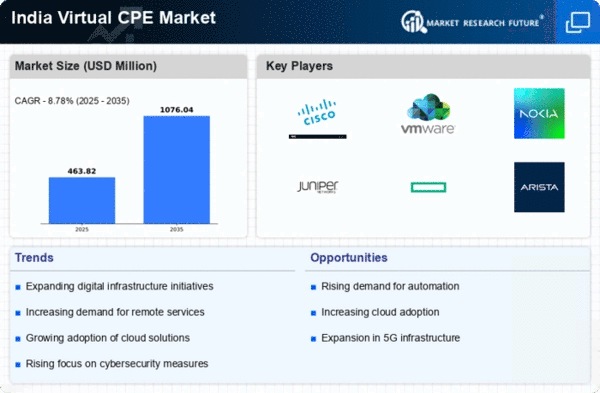
As per Market Research Future analysis, the India virtual CPE market size was estimated at 426.38 USD Million in 2024. The India virtual cpe market is projected to grow from 463.82 USD Million in 2025 to 1076.04 USD Million by 2035, exhibiting a compound annual growth rate (CAGR) of 8.7% during the forecast period 2025 - 2035

Key Market Trends & Highlights

The India virtual CPE market is experiencing robust growth driven by technological advancements and increasing demand for flexible network solutions.

  • The largest segment in the India virtual CPE market is the cloud services segment, which is witnessing increased adoption across various industries.
  • Edge computing is emerging as the fastest-growing segment, reflecting a shift towards decentralized data processing and enhanced performance.
  • The market is characterized by a heightened focus on security solutions, as organizations prioritize safeguarding their digital assets.
  • Key drivers of this market include the growing demand for network flexibility and cost efficiency, which are essential for operational savings.

Market Size & Forecast

2024 Market Size 426.38 (USD Million)
2035 Market Size 1076.04 (USD Million)
CAGR (2025 - 2035) 8.78%

Major Players

Cisco Systems (US), VMware (US), Nokia (FI), Juniper Networks (US), Hewlett Packard Enterprise (US), Arista Networks (US), Ciena Corporation (US), ZTE Corporation (CN), Huawei Technologies (CN)

Our Impact
Enabled $4.3B Revenue Impact for Fortune 500 and Leading Multinationals
Partnering with 2000+ Global Organizations Each Year
30K+ Citations by Top-Tier Firms in the Industry

India Virtual cpe Market Trends

the virtual CPE market is currently experiencing significant transformation, driven by the increasing demand for flexible and scalable network solutions. Organizations are increasingly adopting virtualized services to enhance operational efficiency and reduce costs. This shift is largely influenced by the growing trend of digitalization across various sectors, which necessitates robust and adaptable network infrastructures. As businesses seek to optimize their resources, the virtual CPE market is poised for substantial growth, with service providers offering innovative solutions tailored to meet diverse customer needs. Moreover, the rise of cloud computing and the Internet of Things (IoT) is further propelling the evolution of the virtual cpe market. Companies are leveraging these technologies to create more agile and responsive network environments. The integration of artificial intelligence and machine learning into virtual cpe solutions is also becoming increasingly prevalent, enabling enhanced performance monitoring and predictive analytics. This convergence of technologies suggests a promising future for the virtual cpe market, as it aligns with the broader trends of automation and digital transformation in the business landscape.

Increased Adoption of Cloud Services

The trend towards cloud services is significantly influencing the virtual cpe market. Organizations are increasingly migrating their operations to cloud-based platforms, which necessitates the deployment of virtualized network solutions. This shift allows for greater flexibility and scalability, enabling businesses to adapt to changing demands more efficiently.

Focus on Security Solutions

As cyber threats continue to evolve, there is a heightened emphasis on security within the virtual cpe market. Companies are prioritizing the integration of advanced security features into their virtualized solutions. This focus on security not only protects sensitive data but also builds trust with customers, which is essential for long-term success.

Emergence of Edge Computing

The rise of edge computing is reshaping the virtual cpe market landscape. By processing data closer to the source, organizations can reduce latency and improve performance. This trend is particularly relevant for industries that require real-time data processing, thereby driving demand for virtual cpe solutions that support edge computing architectures.

India Virtual cpe Market Drivers

Rise of Managed Services

The rise of managed services is significantly impacting the virtual cpe market in India. Many organizations are opting for managed service providers (MSPs) to handle their networking needs, allowing them to focus on core business activities. This trend is particularly pronounced among small and medium-sized enterprises (SMEs) that may lack the resources to manage complex networking infrastructures. As MSPs increasingly adopt virtual cpe solutions, the market is expected to witness substantial growth. The convenience and expertise offered by managed services are likely to attract more businesses to virtual cpe offerings, thereby expanding the market landscape.

Regulatory Compliance and Standards

The virtual cpe market in India is also shaped by the increasing emphasis on regulatory compliance and industry standards. As businesses navigate complex regulatory landscapes, the need for solutions that ensure compliance with data protection and privacy laws becomes paramount. The Indian government has introduced various regulations that necessitate robust security measures in network management. Consequently, providers in the virtual cpe market are focusing on developing solutions that not only meet compliance requirements but also enhance overall security posture. This focus on regulatory adherence is likely to drive innovation and investment in the market.

Growing Demand for Network Flexibility

The virtual cpe market in India is experiencing a notable surge in demand for network flexibility. Enterprises are increasingly seeking solutions that allow them to adapt their network configurations dynamically. This shift is driven by the need for agile responses to changing business requirements and the growing trend of remote work. According to recent data, approximately 60% of Indian businesses are prioritizing flexible network solutions to enhance operational efficiency. This trend indicates a significant opportunity for providers in the virtual cpe market to offer tailored solutions that meet the diverse needs of various sectors, including IT, finance, and telecommunications.

Cost Efficiency and Operational Savings

Cost efficiency remains a pivotal driver in the virtual cpe market in India. Organizations are increasingly recognizing the financial benefits of adopting virtualized solutions over traditional hardware-based systems. By leveraging virtual cpe, companies can reduce capital expenditures and operational costs significantly. Reports suggest that businesses can save up to 30% on their networking expenses by transitioning to virtual solutions. This financial incentive is compelling many Indian enterprises to explore virtual cpe options, thereby expanding the market's growth potential. The emphasis on cost savings is likely to continue influencing purchasing decisions in the coming years.

Technological Advancements in Virtualization

Technological advancements in virtualization technologies are propelling the virtual cpe market in India. Innovations such as software-defined networking (SDN) and network function virtualization (NFV) are enabling more efficient and scalable network management solutions. These advancements allow businesses to deploy and manage network services with greater agility and lower costs. As organizations seek to modernize their IT infrastructure, the adoption of these technologies is expected to increase. The continuous evolution of virtualization technologies is likely to create new opportunities for growth within the virtual cpe market, as companies strive to enhance their operational capabilities.


Market Segment Insights

By Type: Virtual Router (Largest) vs. Virtual Firewall (Fastest-Growing)

In the India virtual cpe market, the market share distribution reveals that the Virtual Router segment holds the largest share, capitalizing on its robust demand driven by enterprises seeking efficient data management and routing solutions. Conversely, the Virtual Firewall segment has emerged as the fastest-growing segment, reflecting the increasing emphasis on cybersecurity and cloud-based security measures among organizations in India. Growth trends in this segment are significantly influenced by the rapid adoption of cloud technologies and the rising complexities of network environments. Organizations are increasingly opting for virtualized solutions to streamline operations and enhance security protocols. Moreover, the shift towards remote work and digital transformations is propelling the need for advanced network management tools, positioning both Virtual Router and Virtual Firewall as critical components in the evolving IT landscape.

Virtual Router (Dominant) vs. Virtual Firewall (Emerging)

The Virtual Router segment is characterized by its capability to provide efficient data routing and network management, making it the dominant player in the market. It enables businesses to optimize their network performance while reducing hardware costs. On the other hand, the Virtual Firewall segment is emerging as a critical solution as organizations prioritize security. It offers scalable protection against evolving cyber threats and seamlessly integrates with existing cloud infrastructures. Both segments complement each other by serving distinct yet interconnected roles in the network landscape, ensuring that organizations can leverage both routing efficiency and robust security measures.

By Deployment Model: Public Cloud (Largest) vs. Hybrid Cloud (Fastest-Growing)

The deployment model segment in the India virtual cpe market showcases a diverse market share distribution. Public Cloud emerges as the largest segment, appealing to organizations seeking cost-effective and scalable solutions. In contrast, Private Cloud holds a significant portion, catering to industries requiring enhanced security and control. Hybrid Cloud has gained traction as businesses aim to combine the benefits of both public and private models, leading to a dynamic distribution landscape. Growth trends indicate a robust upward trajectory for the Hybrid Cloud segment, driven by increasing data security concerns and the need for flexible resource allocation. Organizations are progressively transitioning towards Hybrid Cloud setups to leverage the strengths of both public and private clouds. The agility of Hybrid Cloud solutions is propelling their adoption, making them a preferred choice for enterprises aiming for innovation and efficiency in a competitive market landscape.

Public Cloud (Dominant) vs. Hybrid Cloud (Emerging)

Public Cloud is currently the dominant player in the deployment model landscape, favored for its scalability and cost-effectiveness. It offers organizations a flexible infrastructure, allowing them to rapidly enhance operational efficiency without heavy capital investment. Conversely, Hybrid Cloud is emerging as a strategic solution for businesses seeking a tailored approach to data management and security. By integrating public and private cloud resources, Hybrid Cloud solutions enable firms to optimize workloads, ensuring compliance while benefiting from the expansive capabilities of the public cloud. This adaptability is becoming increasingly vital as companies respond to evolving market demands.

By End User: Telecommunications Service Providers (Largest) vs. Managed Service Providers (Fastest-Growing)

The market share distribution among the segment values reveals that Telecommunications Service Providers hold a significant portion of the India virtual cpe market, reflecting their large customer base and expansive service networks. This dominance allows them to leverage emerging technologies effectively, driving consistent revenues in this sector. In contrast, Managed Service Providers are rapidly capturing market interest, particularly as businesses shift towards outsourcing their IT services and embracing cloud solutions, making them a key player in the evolving landscape. Growth trends indicate that the sector is transforming as Enterprises increasingly opt for virtualized services for greater flexibility and scalability. The push towards digital transformation among businesses is a crucial driver, alongside the rising demand for enhanced network services and the growing adoption of IoT technologies. Consequently, this segment is poised for expansion due to the need for improved operational efficiency and the ongoing technological advancements in virtualization.

Telecommunications Service Providers (Dominant) vs. Managed Service Providers (Emerging)

Telecommunications Service Providers have established themselves as the dominant force in the India virtual cpe market. They possess robust infrastructure capabilities and offer a comprehensive range of services, including network management, connectivity solutions, and data services. This established presence allows them to capitalize effectively on market demand. On the other hand, Managed Service Providers are emerging as pivotal players by delivering tailored solutions that enable enterprises to enhance operational efficiency. Their focus on innovative cloud services and IT management allows them to cater to diverse business needs, bridging gaps left by traditional telecommunications offerings.

By Network Function: Security (Largest) vs. Load Balancing (Fastest-Growing)

In the India virtual cpe market, the segment distribution shows Security as the largest network function, holding a significant share due to rising cyber threats and increasing adoption of secure network architectures. Routing and Switching also contribute to market dynamics but remain secondary in terms of share, as organizations prioritize security measures to safeguard their infrastructures. The growth trends highlight Load Balancing as the fastest-growing segment, spurred by the surge in cloud adoption and the demand for high availability and performance in applications. With businesses migrating to cloud-based services, the need for efficient load distribution is paramount, further driving investments in advanced load balancing solutions that ensure optimal resource utilization and operational efficiency.

Security (Dominant) vs. Routing (Emerging)

Security functions continue to dominate the landscape, providing essential protection against evolving threats, and are widely integrated in network solutions. This segment's robustness is attributed to compliance requirements and the increasing sophistication of cyberattacks. On the other hand, Routing, while considered emerging in this context, plays a vital role in optimizing data flow and connectivity. Its growing relevance is fueled by the expansion of IoT devices and the need for efficient data transmission. As organizations become increasingly interconnected, both segments are poised for strategic developments, with Security firmly leading and Routing positioned to gain traction.

Get more detailed insights about India Virtual cpe Market

Key Players and Competitive Insights

The virtual cpe market in India is characterized by a dynamic competitive landscape, driven by rapid technological advancements and increasing demand for flexible network solutions. Major players such as Cisco Systems (US), VMware (US), and Nokia (FI) are strategically positioned to leverage their extensive portfolios and innovative capabilities. Cisco Systems (US) focuses on enhancing its software-defined networking solutions, while VMware (US) emphasizes its cloud infrastructure and virtualization technologies. Nokia (FI) is actively pursuing partnerships to expand its 5G offerings, which collectively shape a competitive environment that is increasingly reliant on innovation and strategic collaborations.Key business tactics within this market include localizing manufacturing and optimizing supply chains to enhance operational efficiency. The competitive structure appears moderately fragmented, with several key players vying for market share. This fragmentation allows for diverse offerings, yet the influence of major companies remains substantial, as they set benchmarks for technology and service delivery.

In September Cisco Systems (US) announced a strategic partnership with a leading Indian telecom operator to deploy its latest virtual cpe solutions, aiming to enhance network agility and reduce operational costs. This move is significant as it not only strengthens Cisco's foothold in the Indian market but also aligns with the growing trend of telecom operators seeking to modernize their infrastructure through virtualization.

In October VMware (US) launched a new initiative focused on integrating AI capabilities into its virtual cpe offerings. This initiative is pivotal as it positions VMware to capitalize on the increasing demand for intelligent network solutions, potentially enhancing customer experience and operational efficiency. The integration of AI is likely to redefine service delivery models in the virtual cpe space.

In August Nokia (FI) expanded its collaboration with local service providers to enhance its 5G virtual cpe solutions. This strategic action is crucial as it not only broadens Nokia's market reach but also reinforces its commitment to supporting the digital transformation of Indian enterprises. Such collaborations are indicative of a broader trend towards localized solutions that cater to specific market needs.

As of November current competitive trends in the virtual cpe market are heavily influenced by digitalization, sustainability, and the integration of AI technologies. Strategic alliances are increasingly shaping the landscape, enabling companies to pool resources and expertise. Looking ahead, competitive differentiation is likely to evolve from traditional price-based competition to a focus on innovation, technological advancements, and supply chain reliability, underscoring the importance of agility in a rapidly changing market.

Key Companies in the India Virtual cpe Market include

Industry Developments

In recent developments within the India Virtual Customer Premises Equipment (CPE) Market, significant growth has been observed, driven by increasing demand for cloud-based networking solutions and enhanced broadband services. With strategic partnerships already in place with Singtel, Globe Telecom, and Airtel Africa, Airtel's digital division, Xtelify, launched "Airtel Cloud," a telco-grade cloud platform with AI-driven services designed for telecom operators and companies, in August 2025. In order to improve the delivery of corporate and telecom services, Xtelify introduced a suite of cloud and AI tools in August 2025 that are aimed at digital operations.

These tools include infrastructure- and platform-as-a-service capabilities as well as AI modules for workforce and customer interaction. To strengthen regulatory requirements for CPE devices, the Telecommunication Engineering Centre (TEC), India's standardization body, required increased security testing for WiFi CPE and IP routers under the MTCTE framework in February 2023. This requirement went into force in the middle of 2023.

Future Outlook

India Virtual cpe Market Future Outlook

The Virtual CPE Market in India is poised for growth at 8.78% CAGR from 2025 to 2035, driven by increasing demand for cloud-based solutions and enhanced network security.

New opportunities lie in:

  • Development of AI-driven network management tools
  • Expansion of subscription-based service models
  • Integration of IoT solutions for enhanced connectivity

By 2035, the market is expected to achieve substantial growth, reflecting evolving technological demands.

Market Segmentation

India Virtual cpe Market Type Outlook

  • Virtual Router
  • Virtual Firewall
  • Virtual Switch
  • Virtual Load Balancer

India Virtual cpe Market End User Outlook

  • Telecommunications Service Providers
  • Enterprises
  • Managed Service Providers

India Virtual cpe Market Deployment Model Outlook

  • Public Cloud
  • Private Cloud
  • Hybrid Cloud

India Virtual cpe Market Network Function Outlook

  • Security
  • Routing
  • Switching
  • Load Balancing

Report Scope

MARKET SIZE 2024 426.38(USD Million)
MARKET SIZE 2025 463.82(USD Million)
MARKET SIZE 2035 1076.04(USD Million)
COMPOUND ANNUAL GROWTH RATE (CAGR) 8.78% (2025 - 2035)
REPORT COVERAGE Revenue Forecast, Competitive Landscape, Growth Factors, and Trends
BASE YEAR 2024
Market Forecast Period 2025 - 2035
Historical Data 2019 - 2024
Market Forecast Units USD Million
Key Companies Profiled Cisco Systems (US), VMware (US), Nokia (FI), Juniper Networks (US), Hewlett Packard Enterprise (US), Arista Networks (US), Ciena Corporation (US), ZTE Corporation (CN), Huawei Technologies (CN)
Segments Covered Type, Deployment Model, End User, Network Function
Key Market Opportunities Adoption of cloud-based solutions enhances scalability and flexibility in the virtual cpe market.
Key Market Dynamics Rising demand for flexible network solutions drives innovation in the virtual Customer Premises Equipment market.
Countries Covered India
Leave a Comment

FAQs

What is the expected market size of the India Virtual CPE Market in 2024?

The India Virtual CPE Market is expected to be valued at 440.0 million USD in 2024.

How much is the India Virtual CPE Market projected to grow by 2035?

By 2035, the India Virtual CPE Market is projected to reach a valuation of 1220.0 million USD.

What is the expected compound annual growth rate (CAGR) for the India Virtual CPE Market from 2025 to 2035?

The expected CAGR for the India Virtual CPE Market from 2025 to 2035 is 9.715%.

Which segment has the highest value in the India Virtual CPE Market in 2024?

In 2024, the Virtual Firewall segment holds the highest value at 120.0 million USD.

What are the projected values for the Virtual Router segment by 2035?

The Virtual Router segment is projected to be valued at 300.0 million USD by 2035.

Who are the major players in the India Virtual CPE Market?

Major players in the India Virtual CPE Market include Arista Networks, Hewlett Packard Enterprise, and Cisco Systems.

What is the expected market size for the Virtual Load Balancer by 2035?

The Virtual Load Balancer is expected to be valued at 330.0 million USD by 2035.

Which segment is projected to experience significant growth in the India Virtual CPE Market?

The Virtual Firewall segment is projected to experience significant growth by reaching 350.0 million USD by 2035.

What opportunities exist within the India Virtual CPE Market as it continues to grow?

Opportunities in the India Virtual CPE Market stem from increasing demand for cloud services and network virtualization.

What challenges could impact the growth of the India Virtual CPE Market?

Challenges impacting growth may include competition among key players and the rapid technological advancements in networking services.

Download Free Sample

Kindly complete the form below to receive a free sample of this Report

Compare Licence

×
Features License Type
Single User Multiuser License Enterprise User
Price $4,950 $5,950 $7,250
Maximum User Access Limit 1 User Upto 10 Users Unrestricted Access Throughout the Organization
Free Customization
Direct Access to Analyst
Deliverable Format
Platform Access
Discount on Next Purchase 10% 15% 15%
Printable Versions