×
Request Free Sample ×

Kindly complete the form below to receive a free sample of this Report

* Please use a valid business email

Leading companies partner with us for data-driven Insights

clients tt-cursor
Hero Background

Japan Virtual cpe Market

ID: MRFR/ICT/60725-HCR
200 Pages
Aarti Dhapte
February 2026

Japan Virtual CPE Market Size, Share and Trends Analysis Report By Type (Virtual Router, Virtual Firewall, Virtual Switch, Virtual Load Balancer), By Deployment Model (Public Cloud, Private Cloud, Hybrid Cloud), By End User (Telecommunications Service Providers, Enterprises, Managed Service Providers) and By Network Function (Security, Routing, Switching, Load Balancing)-Forecast to 2035

Share:
Download PDF ×

We do not share your information with anyone. However, we may send you emails based on your report interest from time to time. You may contact us at any time to opt-out.

Japan Virtual cpe Market Infographic
Purchase Options

Japan Virtual cpe Market Summary

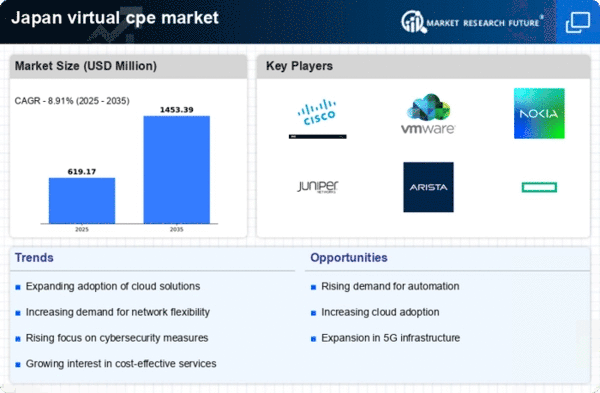
As per Market Research Future analysis, the Japan virtual cpe market size was estimated at 568.51 USD Million in 2024. The Japan virtual cpe market is projected to grow from 619.17 USD Million in 2025 to 1453.39 USD Million by 2035, exhibiting a compound annual growth rate (CAGR) of 8.9% during the forecast period 2025 - 2035

Key Market Trends & Highlights

The Japan virtual CPE market is experiencing robust growth driven by technological advancements and evolving business needs.

  • The largest segment in the Japan virtual CPE market is the cloud services segment, which is witnessing increased adoption across various industries.
  • The fastest-growing segment is the AI and automation segment, reflecting a shift towards intelligent network management solutions.
  • Enhanced security features are becoming a focal point as organizations prioritize data protection and compliance with regulatory standards.
  • Key market drivers include the rising demand for remote work solutions and government initiatives supporting digital transformation.

Market Size & Forecast

2024 Market Size 568.51 (USD Million)
2035 Market Size 1453.39 (USD Million)
CAGR (2025 - 2035) 8.91%

Major Players

Cisco Systems (US), VMware (US), Nokia (FI), Juniper Networks (US), Arista Networks (US), Hewlett Packard Enterprise (US), Mavenir (US), Ciena Corporation (US), ZTE Corporation (CN)

Our Impact
Enabled $4.3B Revenue Impact for Fortune 500 and Leading Multinationals
Partnering with 2000+ Global Organizations Each Year
30K+ Citations by Top-Tier Firms in the Industry

Japan Virtual cpe Market Trends

The virtual cpe market is currently experiencing notable growth, driven by the increasing demand for flexible and scalable network solutions. Organizations are increasingly adopting virtualized services to enhance operational efficiency and reduce costs. This shift is largely influenced by the need for improved network performance and the ability to quickly adapt to changing business requirements. As companies in Japan continue to embrace digital transformation, the virtual cpe market is poised to expand further, offering innovative solutions that cater to diverse industry needs. Moreover, advancements in technology are facilitating the development of sophisticated virtual cpe solutions. The integration of artificial intelligence and machine learning into these services is enhancing their capabilities, allowing for better resource management and predictive analytics. This trend suggests that the virtual cpe market will not only grow in size but also in complexity, as providers strive to meet the evolving demands of their clients. The focus on security and compliance is also becoming increasingly critical, as organizations seek to protect their data and maintain regulatory standards. Overall, the virtual cpe market appears to be on a promising trajectory, with various factors contributing to its ongoing evolution.

Increased Adoption of Cloud Services

The trend towards cloud-based solutions is significantly influencing the virtual cpe market. Organizations are increasingly migrating their operations to the cloud, seeking the benefits of scalability and flexibility. This shift allows businesses to optimize their network infrastructure while reducing capital expenditures. As cloud adoption continues to rise, the demand for virtual cpe solutions that seamlessly integrate with these services is likely to grow.

Focus on Enhanced Security Features

Security remains a paramount concern for organizations utilizing virtual cpe solutions. As cyber threats evolve, there is a growing emphasis on incorporating advanced security features into these services. This trend indicates that providers are prioritizing the development of robust security protocols to protect sensitive data and ensure compliance with regulatory requirements. Enhanced security measures are becoming a key differentiator in the virtual cpe market.

Integration of AI and Automation

The integration of artificial intelligence and automation technologies is transforming the virtual cpe market. These innovations enable more efficient network management and resource allocation, allowing organizations to respond swiftly to changing demands. The potential for predictive analytics and automated troubleshooting is likely to enhance operational efficiency, making virtual cpe solutions more attractive to businesses seeking to streamline their processes.

Japan Virtual cpe Market Drivers

Growing Focus on Cost Efficiency

Cost efficiency remains a critical driver for the virtual cpe market in Japan. Organizations are increasingly seeking solutions that reduce operational costs while maintaining high service quality. Virtual cpe technologies offer a compelling value proposition by minimizing the need for physical hardware and associated maintenance expenses. Market analysis indicates that businesses can achieve cost savings of up to 30% by transitioning to virtual cpe solutions. This financial incentive is particularly appealing in a competitive landscape where companies strive to optimize their budgets. Consequently, the virtual cpe market is likely to witness a robust increase in adoption as firms prioritize cost-effective solutions that align with their financial objectives.

Advancements in Network Infrastructure

The evolution of network infrastructure in Japan plays a pivotal role in shaping the virtual cpe market. With the rollout of 5G technology and enhanced broadband capabilities, the demand for advanced virtual cpe solutions is expected to rise. These advancements enable faster data transmission and improved connectivity, which are essential for modern business operations. The virtual cpe market is poised to capitalize on these developments, as organizations seek to leverage high-speed networks for their virtual solutions. Furthermore, the integration of next-generation technologies, such as edge computing, is likely to enhance the functionality of virtual cpe offerings, thereby attracting more users and driving market growth.

Rising Demand for Remote Work Solutions

The virtual cpe market in Japan experiences a notable surge in demand due to the increasing prevalence of remote work solutions. As organizations adapt to flexible work environments, the need for reliable and efficient virtual customer premises equipment becomes paramount. This shift is reflected in the market data, indicating a projected growth rate of approximately 15% annually through 2026. Companies are investing in virtual cpe technologies to ensure seamless connectivity and collaboration among remote teams. The virtual cpe market is thus positioned to benefit from this trend, as businesses seek to enhance productivity while maintaining operational efficiency. Furthermore, the integration of advanced features in virtual cpe solutions, such as enhanced bandwidth management and improved user experience, is likely to further drive adoption in this evolving work landscape.

Government Initiatives Supporting Digital Transformation

In Japan, government initiatives aimed at promoting digital transformation significantly impact the virtual cpe market. The government has launched various programs to encourage businesses to adopt digital technologies, which includes the deployment of virtual cpe solutions. These initiatives are designed to enhance the overall digital infrastructure, thereby facilitating smoother transitions to virtual environments. As a result, the virtual cpe market is likely to see increased investments, with estimates suggesting a potential market size expansion of over $1 billion by 2027. This supportive regulatory environment not only fosters innovation but also encourages collaboration between public and private sectors, ultimately driving the adoption of virtual cpe technologies across various industries.

Increased Emphasis on Compliance and Regulatory Standards

In Japan, the virtual cpe market is increasingly influenced by the need for compliance with stringent regulatory standards. Organizations are required to adhere to various data protection and privacy regulations, which necessitate the implementation of secure virtual cpe solutions. This emphasis on compliance is driving businesses to invest in technologies that not only meet regulatory requirements but also enhance their overall security posture. The virtual cpe market is thus witnessing a shift towards solutions that offer robust security features, with market projections indicating a potential growth of 20% in this segment by 2026. As companies prioritize compliance, the demand for virtual cpe solutions that align with regulatory frameworks is likely to continue to rise.


Market Segment Insights

By Type: Virtual Router (Largest) vs. Virtual Load Balancer (Fastest-Growing)

In the Japan virtual cpe market, the segment values are led by Virtual Router, displaying a significant dominance with a vast market share compared to its counterparts, followed closely by Virtual Firewall. Both Virtual Switch and Virtual Load Balancer hold substantial positions, but Virtual Load Balancer exhibits a notable trend of growth, appealing increasingly to businesses seeking enhanced cloud and network management solutions. The growth trends within this market segment are propelled by the rising demand for agile and flexible network infrastructure, which is paving the way for Virtual Load Balancers to emerge rapidly. Factors driving this growth include the increasing adoption of cloud services and the need for efficient network traffic management. As enterprises continue to migrate toward virtualized environments, the Virtual Firewall and Virtual Switch also reflect an upward trajectory, indicating robust competition and innovation within the sector.

Virtual Router (Dominant) vs. Virtual Load Balancer (Emerging)

The Virtual Router has established itself as the dominant force in the market, known for its ability to facilitate efficient routing of data across networks while providing extensive security features. Organizations rely on Virtual Routers to streamline their operations, ensuring high availability and performance. On the other hand, the Virtual Load Balancer, while emerging, has gained traction rapidly due to its capability to distribute network traffic effectively across multiple servers. This segment is characterized by its focus on enhancing user experience by minimizing latency and downtime, which is becoming increasingly crucial as businesses adopt digital transformation initiatives. The innovative features and performance enhancements in both segments highlight their importance in shaping the future network solutions landscape.

By Deployment Model: Public Cloud (Largest) vs. Private Cloud (Fastest-Growing)

The market share distribution among deployment models in the Japan virtual cpe market shows a significant preference for Public Cloud solutions, which dominate due to their scalability and cost-effectiveness. Private Cloud solutions, while smaller in overall share, are gaining traction among enterprises seeking enhanced security and control over their virtual computing environments. Hybrid Cloud also plays a critical role, providing a balanced approach to resource utilization. Growth trends indicate that the Private Cloud segment is experiencing the fastest growth as organizations increasingly prioritize data privacy and regulatory compliance. Public Cloud remains strong, driven by the demand for quick deployment and flexible resources. Hybrid Cloud's appeal lies in its adaptability, allowing businesses to blend public and private infrastructure to tailor solutions to their specific needs.

Public Cloud (Dominant) vs. Private Cloud (Emerging)

Public Cloud solutions are characterized by their cost efficiency, ease of access, and ability to scale rapidly, making them the preferred choice for many companies in the Japan virtual cpe market. They enable businesses to implement advanced functionalities without the burden of onsite infrastructure management. In contrast, Private Cloud is emerging as a strong alternative for enterprises that require stringent security measures and greater control over their data. These organizations are increasingly adopting Private Cloud to mitigate risks associated with data breaches and to meet compliance mandates, showcasing a shift towards more secure, tailored virtual environments.

By End User: Telecommunications Service Providers (Largest) vs. Managed Service Providers (Fastest-Growing)

In the Japan virtual cpe market, the share distribution among the end user segment values reveals that Telecommunications Service Providers hold the largest market share, capitalizing on their established infrastructure and existing customer base. Enterprises represent a significant portion of the market, driven by the need for digital transformation and enhanced operational efficiencies. Managed Service Providers are also gaining traction, becoming increasingly important as businesses seek reliable partners for deploying virtualized network services. Growth trends indicate a robust demand across all segments, fueled by technological advancements and the increasing adoption of cloud services. Telecommunications Service Providers are benefiting from the shift towards virtualization in network management. Meanwhile, Managed Service Providers are experiencing the fastest growth as enterprises look for flexible, outsourced solutions to meet their networking needs. This trend is supported by a growing focus on cost reduction and enhanced service delivery across diverse industries.

Telecommunications Service Providers (Dominant) vs. Enterprises (Emerging)

Telecommunications Service Providers dominate the Japan virtual cpe market, leveraging extensive network infrastructures and advanced technological assets to fulfill the communication needs of a broad client base. Their established position allows them to offer a variety of services, enhancing customer loyalty and retaining market leadership. Conversely, Enterprises are emerging as key players in the market, driven by the necessity for digital solutions that improve efficiency and scalability. As they increasingly adopt virtual cpe technology, they are becoming more reliant on these innovative networking strategies. The growing trend towards digital transformation in various sectors further supports their rising significance, making them essential contributors to the evolving landscape of the Japan virtual cpe market.

By Network Function: Security (Largest) vs. Load Balancing (Fastest-Growing)

In the Japan virtual cpe market, the distribution of market share among the network function segment values reveals that Security holds the most substantial share, reflecting its critical role in safeguarding network infrastructures. Routing and Switching follow, catering to the essential needs of data transfer and connectivity, while Load Balancing is emerging as a vital component, especially with the increasing demand for efficient resource management in virtual environments. Growth trends indicate that the demand for Security solutions is driven by heightened awareness of cybersecurity threats, prompting organizations to invest heavily. Meanwhile, Load Balancing is gaining traction as businesses seek to optimize application performance and ensure uninterrupted access to services. This dual momentum underscores the evolving landscape of network functions, where a balanced approach toward security and efficiency is becoming imperative.

Security (Dominant) vs. Load Balancing (Emerging)

Security as a dominant network function underscores its importance in the contemporary digital landscape, where cyber threats are increasingly sophisticated. Organizations prioritize this segment to mitigate risks, leading to robust investments. Conversely, Load Balancing is an emerging area, recognized for its ability to enhance system performance by distributing workloads across multiple resources. As companies migrate to cloud-based solutions and adopt digital transformation strategies, Load Balancing has become critical for maintaining application availability and performance. The synergy between these two segments is vital for providing comprehensive network solutions that not only protect but also enhance operational efficiency in the Japan virtual cpe market.

Get more detailed insights about Japan Virtual cpe Market

Key Players and Competitive Insights

The virtual cpe market in Japan is characterized by a dynamic competitive landscape, driven by rapid technological advancements and increasing demand for flexible network solutions. Major players such as Cisco Systems (US), VMware (US), and Nokia (FI) are strategically positioned to leverage their extensive portfolios and innovative capabilities. Cisco Systems (US) focuses on enhancing its software-defined networking solutions, while VMware (US) emphasizes its cloud-native technologies to facilitate digital transformation. Nokia (FI) is actively pursuing partnerships to expand its 5G offerings, which are integral to the evolution of virtual cpe solutions. Collectively, these strategies contribute to a competitive environment that is increasingly centered around innovation and customer-centric solutions.Key business tactics within the market include localizing manufacturing and optimizing supply chains to enhance responsiveness to customer needs. The competitive structure appears moderately fragmented, with several key players exerting influence over market dynamics. This fragmentation allows for a diverse range of offerings, catering to various customer segments and fostering innovation through competition.

In October Cisco Systems (US) announced a strategic partnership with a leading telecommunications provider in Japan to enhance its virtual cpe offerings. This collaboration aims to integrate advanced security features into their solutions, addressing growing concerns over network vulnerabilities. The strategic importance of this partnership lies in its potential to strengthen Cisco's market position by providing customers with robust, secure network solutions that are increasingly demanded in today's digital landscape.

In September VMware (US) launched a new initiative focused on enhancing its cloud-native capabilities, specifically targeting the Japanese market. This initiative includes the introduction of advanced analytics tools designed to optimize network performance. The strategic significance of this move is underscored by the growing trend towards data-driven decision-making, which is essential for businesses seeking to enhance operational efficiency and customer satisfaction.

In August Nokia (FI) expanded its collaboration with local service providers to accelerate the deployment of 5G-enabled virtual cpe solutions. This expansion is crucial as it aligns with the increasing demand for high-speed connectivity and supports the broader digital transformation initiatives across various sectors. By enhancing its local partnerships, Nokia is likely to solidify its presence in the market and drive innovation in service delivery.

As of November current competitive trends in the virtual cpe market are heavily influenced by digitalization, sustainability, and the integration of artificial intelligence (AI). Strategic alliances are becoming increasingly pivotal, as companies recognize the need to pool resources and expertise to remain competitive. The shift from price-based competition to a focus on innovation, technology, and supply chain reliability is evident, suggesting that future differentiation will hinge on the ability to deliver cutting-edge solutions that meet evolving customer demands.

Key Companies in the Japan Virtual cpe Market include

Industry Developments

The Japan Virtual Customer Premises Equipment (CPE) Market has seen significant developments in recent months, with a focus on advancing network virtualization and flexible service delivery. In order to facilitate quick service agility and integration with its wider digital services, Internet Initiative Japan launched its new "Omnibus" vCPE service in July 2015. It was developed on a VMware NFV platform and partnered with its proprietary high-performance routers and VPN gateway.

KDDI advanced network virtualization capabilities in March 2022 by deploying a rack-scale telco infrastructure based on Hewlett-Packard Enterprise technology to support Open-RAN-compliant operations and virtualized base station workloads throughout Japan. Along with Ericsson and other international telecom operators, KDDI joined a worldwide initiative in February 2025 by investing in and donating APIs to a new company that aims to establish standardized API frameworks that facilitate the development and expansion of virtualized network services.

Future Outlook

Japan Virtual cpe Market Future Outlook

The Virtual CPE Market in Japan is projected to grow at 8.91% CAGR from 2025 to 2035, driven by increasing demand for flexible network solutions and cost efficiency.

New opportunities lie in:

  • Development of AI-driven network management tools
  • Expansion of subscription-based service models
  • Integration of edge computing with virtual cpe solutions

By 2035, the market is expected to achieve substantial growth, reflecting evolving technological demands.

Market Segmentation

Japan Virtual cpe Market Type Outlook

  • Virtual Router
  • Virtual Firewall
  • Virtual Switch
  • Virtual Load Balancer

Japan Virtual cpe Market End User Outlook

  • Telecommunications Service Providers
  • Enterprises
  • Managed Service Providers

Japan Virtual cpe Market Deployment Model Outlook

  • Public Cloud
  • Private Cloud
  • Hybrid Cloud

Japan Virtual cpe Market Network Function Outlook

  • Security
  • Routing
  • Switching
  • Load Balancing

Report Scope

MARKET SIZE 2024 568.51(USD Million)
MARKET SIZE 2025 619.17(USD Million)
MARKET SIZE 2035 1453.39(USD Million)
COMPOUND ANNUAL GROWTH RATE (CAGR) 8.91% (2025 - 2035)
REPORT COVERAGE Revenue Forecast, Competitive Landscape, Growth Factors, and Trends
BASE YEAR 2024
Market Forecast Period 2025 - 2035
Historical Data 2019 - 2024
Market Forecast Units USD Million
Key Companies Profiled Cisco Systems (US), VMware (US), Nokia (FI), Juniper Networks (US), Arista Networks (US), Hewlett Packard Enterprise (US), Mavenir (US), Ciena Corporation (US), ZTE Corporation (CN)
Segments Covered Type, Deployment Model, End User, Network Function
Key Market Opportunities Adoption of cloud-based solutions enhances flexibility and scalability in the virtual cpe market.
Key Market Dynamics Rising demand for flexible network solutions drives innovation in the virtual Customer Premises Equipment market.
Countries Covered Japan
Leave a Comment

FAQs

What is the expected market size of the Japan Virtual CPE Market in 2024?

The Japan Virtual CPE Market is expected to be valued at 570.6 million USD in 2024.

What will be the market size of the Japan Virtual CPE Market by 2035?

By 2035, the Japan Virtual CPE Market is projected to reach a value of 1484.3 million USD.

What is the expected compound annual growth rate (CAGR) for the Japan Virtual CPE Market from 2025 to 2035?

The expected CAGR for the Japan Virtual CPE Market from 2025 to 2035 is 9.08%.

Which segment of the Japan Virtual CPE Market is expected to have the largest share in 2024?

The Virtual Switch segment is expected to have the largest share, valued at 200.7 million USD in 2024.

What is the projected market value for Virtual Router in the Japan Virtual CPE Market by 2035?

The projected market value for Virtual Router in 2035 is 315.2 million USD.

Who are the key players in the Japan Virtual CPE Market?

Some of the key players include ARRIS International, Arista Networks, Samsung Electronics, and Cisco Systems.

How much is the Virtual Firewall segment expected to be valued in 2024?

The Virtual Firewall segment is expected to be valued at 150.6 million USD in 2024.

What will be the market size of the Virtual Load Balancer segment by 2035?

The market size for the Virtual Load Balancer segment is projected to be 265.6 million USD by 2035.

What is one of the major growth drivers for the Japan Virtual CPE Market?

Increased adoption of cloud-based services is a significant growth driver for the Japan Virtual CPE Market.

How does the growth rate of the Japan Virtual CPE Market compare across different segments?

The growth rate varies among segments, with Virtual Firewall and Virtual Switch expected to see substantial increases.

Download Free Sample

Kindly complete the form below to receive a free sample of this Report

Compare Licence

×
Features License Type
Single User Multiuser License Enterprise User
Price $4,950 $5,950 $7,250
Maximum User Access Limit 1 User Upto 10 Users Unrestricted Access Throughout the Organization
Free Customization
Direct Access to Analyst
Deliverable Format
Platform Access
Discount on Next Purchase 10% 15% 15%
Printable Versions