×
Request Free Sample ×

Kindly complete the form below to receive a free sample of this Report

* Please use a valid business email

Leading companies partner with us for data-driven Insights

clients tt-cursor
Hero Background

India Radiology Information System Market

ID: MRFR/MED/54302-HCR
200 Pages
Rahul Gotadki
February 2026

India Radiology Information System Market Research Report: Size, Share, Trend Analysis By Component (Software, Services, Hardware), By Deployment Type (Cloud-Based, On-Premise), By Functionality (Radiology Reporting, Patient Management, Workflow Management, Image Management) and By End Users (Hospitals, Diagnostic Centers, Ambulatory Surgical Centers) - Growth Outlook & Industry Forecast 2025 To 2035

Share:
Download PDF ×

We do not share your information with anyone. However, we may send you emails based on your report interest from time to time. You may contact us at any time to opt-out.

India Radiology Information System Market Infographic
Purchase Options

India Radiology Information System Market Summary

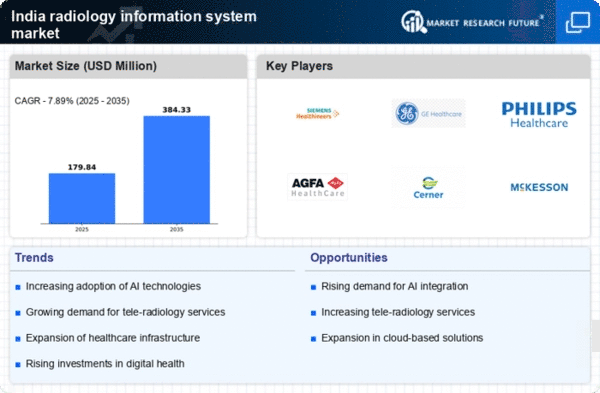
As per Market Research Future analysis, the India radiology information system market size was estimated at 166.69 USD Million in 2024. The India radiology information-system market is projected to grow from 179.84 USD Million in 2025 to 384.33 USD Million by 2035, exhibiting a compound annual growth rate (CAGR) of 7.8% during the forecast period 2025 - 2035

Key Market Trends & Highlights

The India The India radiology information system market is poised for substantial growth. This growth is driven by technological advancements and an increasing demand for diagnostic imaging.

  • Technological advancements are enhancing the efficiency and accuracy of radiology information systems.
  • The integration of telemedicine is transforming how radiology services are delivered, particularly in remote areas.
  • The largest segment in the market is the diagnostic imaging segment, while the fastest-growing segment is expected to be tele-radiology.
  • Key market drivers include the growing demand for diagnostic imaging and the rising adoption of electronic health records (EHR).

Market Size & Forecast

2024 Market Size 166.69 (USD Million)
2035 Market Size 384.33 (USD Million)
CAGR (2025 - 2035) 7.89%

Major Players

Siemens Healthineers (DE), GE Healthcare (US), Philips Healthcare (NL), Agfa HealthCare (BE), Cerner Corporation (US), McKesson Corporation (US), Allscripts Healthcare Solutions (US), Merge Healthcare (US)

Our Impact
Enabled $4.3B Revenue Impact for Fortune 500 and Leading Multinationals
Partnering with 2000+ Global Organizations Each Year
30K+ Citations by Top-Tier Firms in the Industry

India Radiology Information System Market Trends

The radiology information system market is experiencing notable growth, driven by advancements in technology and an increasing demand for efficient healthcare solutions. The integration of artificial intelligence and machine learning into radiology systems enhances diagnostic accuracy and streamlines workflows. Furthermore, the rising prevalence of chronic diseases necessitates improved imaging services, which in turn fuels the need for sophisticated radiology information systems. As healthcare providers seek to optimize patient care and operational efficiency, the adoption of these systems is likely to rise significantly. In addition, the regulatory environment in India is evolving, with government initiatives aimed at improving healthcare infrastructure. This shift may lead to increased investments in radiology information systems, as hospitals and clinics strive to comply with new standards and enhance service delivery. The emphasis on telemedicine and remote diagnostics indicates a growing market for radiology information systems that support these capabilities. Overall, the landscape of the radiology information-system market is dynamic, with various factors contributing to its expansion and transformation.

Technological Advancements

The radiology information-system market is witnessing rapid technological advancements, particularly in the integration of artificial intelligence and machine learning. These innovations are enhancing diagnostic capabilities and improving workflow efficiency, which is crucial for healthcare providers.

Regulatory Changes

Recent regulatory changes in India are influencing the radiology information-system market. The government is implementing new standards aimed at improving healthcare delivery, prompting healthcare facilities to invest in advanced radiology systems to comply with these regulations.

Telemedicine Integration

The increasing focus on telemedicine is shaping the radiology information-system market. As healthcare providers adopt remote diagnostics, there is a growing demand for systems that facilitate tele-radiology, enabling efficient patient care across distances.

India Radiology Information System Market Drivers

Focus on Patient-Centric Care

The shift towards patient-centric care in India is transforming the radiology information system market. Healthcare providers are increasingly prioritizing patient engagement and satisfaction, which necessitates the implementation of advanced radiology information systems. These systems enable better communication between patients and healthcare professionals, facilitating timely access to imaging results and enhancing the overall patient experience. As of 2025, it is estimated that patient-centric initiatives will account for approximately 30% of healthcare investments in India. This focus on patient care is likely to drive the demand for user-friendly radiology information systems that streamline processes and improve service delivery. Consequently, the radiology information-system market is expected to evolve in response to these changing patient expectations.

Growing Demand for Diagnostic Imaging

The increasing prevalence of chronic diseases in India is driving the demand for diagnostic imaging services. As healthcare providers seek to enhance patient outcomes, the radiology information-system market is experiencing significant growth. According to recent estimates, the market is projected to expand at a CAGR of approximately 12% over the next five years. This surge is attributed to the rising awareness of early disease detection and the need for accurate diagnostic tools. Furthermore, the expansion of healthcare infrastructure, particularly in rural areas, is likely to increase access to radiology services, thereby further propelling the market. The integration of advanced imaging technologies, such as MRI and CT scans, is expected to enhance diagnostic capabilities. This makes them a critical component of modern healthcare in India.

Investment in Healthcare Infrastructure

India's government and private sector are significantly investing in healthcare infrastructure, which is a crucial driver for the radiology information-system market. The National Health Mission and various state-level initiatives aim to improve healthcare access and quality across the country. This investment is expected to lead to the establishment of new hospitals and diagnostic centers, thereby increasing the demand for radiology information systems. As of 2025, the healthcare expenditure in India is projected to reach approximately $370 billion, with a substantial portion allocated to upgrading medical technology. This influx of capital is likely to facilitate the adoption of advanced radiology information systems, enhancing operational efficiency and patient care. Consequently, the radiology information-system market is poised for robust growth as healthcare facilities modernize their diagnostic capabilities.

Emergence of Artificial Intelligence in Radiology

The integration of artificial intelligence (AI) into radiology is a transformative driver for the radiology information system market. AI technologies are being utilized to enhance diagnostic accuracy, streamline workflows, and reduce the burden on radiologists. In India, the adoption of AI in radiology is gaining momentum, with several healthcare institutions exploring AI-driven solutions for image analysis and interpretation. By 2025, it is projected that AI applications in radiology could improve diagnostic efficiency by up to 40%, thereby increasing the demand for sophisticated radiology information systems that can support these technologies. This trend suggests a significant shift in how radiological services are delivered, positioning the radiology information-system market at the forefront of innovation in healthcare.

Rising Adoption of Electronic Health Records (EHR)

The shift towards electronic health records (EHR) in India is significantly influencing the radiology information-system market. As healthcare providers increasingly adopt EHR systems, the integration of radiology information systems becomes essential for seamless data exchange and improved patient management. The interoperability between EHR and radiology systems is expected to enhance workflow efficiency, reduce errors, and improve patient outcomes. By 2025, it is anticipated that over 60% of healthcare facilities in India will have implemented EHR systems, creating a substantial demand for compatible radiology information solutions. This trend indicates a growing recognition of the importance of data-driven decision-making in healthcare, positioning the radiology information-system market as a vital component of the overall healthcare ecosystem.


Market Segment Insights

By Component: Software (Largest) vs. Services (Fastest-Growing)

In the India radiology information-system market, software continues to hold the largest market share, driven by increasing automation and efficiency in imaging processes. Services are emerging rapidly, showing high demand for maintenance, support, and consulting, which caters to the evolving needs of healthcare facilities. The growth trends indicate a significant push towards software solutions that enhance image storage, sharing, and analysis capabilities. Furthermore, the service segment is expanding quickly due to partnerships and the growing need for specialized services in radiology centers, highlighting an increasing focus on customer satisfaction and tailored solutions.

Software (Dominant) vs. Services (Emerging)

Software solutions in the India radiology information-system market are characterized by their robust capabilities in managing patient data, image processing, and interoperability with other healthcare systems. This dominance reflects the crucial role software plays in improving diagnostic accuracy and workflow efficiency. Conversely, the services sector is emerging, with a sharp rise in demand for tailored support and consulting services. This includes training for radiologists and IT staff, integration assistance, and ongoing technical support. As healthcare facilities seek to leverage advanced software, the need for reliable service partnerships becomes essential, making services a key focus area for growth.

By Deployment Type: Cloud-Based (Largest) vs. On-Premise (Fastest-Growing)

In the India radiology information-system market, cloud-based solutions dominate the deployment landscape, capturing the largest share due to their scalability and accessibility. Many healthcare providers prefer cloud solutions for their cost-effectiveness and integration capabilities, which significantly enhance operational efficiency. On the other hand, on-premise systems are emerging rapidly as institutions seek to maintain data security and comply with regulatory demands. The increasing demands for customizable solutions and the growing relevance of data protection laws are driving the growth of the on-premise model, making it the fastest-growing segment in this market.

Deployment Type: Cloud-Based (Dominant) vs. On-Premise (Emerging)

Cloud-based deployment is the dominant force in the India radiology information-system market, favored for its flexibility and ease of maintenance, allowing healthcare organizations to reduce their IT overhead while enhancing service delivery. This model supports the rapid adoption of advanced analytics and telehealth services. Conversely, the on-premise deployment type is gaining momentum, characterized by its ability to offer direct control over data and custom configurations tailored to specific needs, making it appealing for facilities prioritizing security and compliance. The surge in regulatory scrutiny coupled with increased demand for specialized functionalities positions on-premise solutions as a critical emerging player in the market.

By Functionality: Radiology Reporting (Largest) vs. Patient Management (Fastest-Growing)

In the India radiology information-system market, Radiology Reporting dominates the functionality segment, capturing a substantial share. This segment benefits from the growing need for clear, efficient reporting among healthcare providers, driving its current market position. Meanwhile, Patient Management is rapidly gaining traction, identifying itself as the fastest-growing segment. Facilities are increasingly investing in systems that strengthen patient interaction and streamline administrative tasks, contributing to this upward trend. The growth trends within the functionality segment are significantly influenced by advancements in technology and the increasing focus on patient-centric services. Innovations such as AI-enhanced reporting tools and integrated management platforms are propelling efficiency. Additionally, regulatory changes and a growing emphasis on value-based care create an environment in which these functionalities can thrive. The adaptability of Patient Management solutions fosters their rapid adoption, promising a dynamic evolution in service delivery.

Radiology Reporting (Dominant) vs. Image Management (Emerging)

Radiology Reporting maintains a dominant position in the India radiology information-system market due to its critical role in ensuring accurate patient diagnosis and treatment plans. The integration of advanced technologies, such as machine learning and data analytics, enhances reporting capabilities, making them vital for healthcare professionals. In contrast, Image Management is emerging as a significant player, with healthcare facilities increasingly recognizing the necessity of efficient image storage and retrieval. The demand for solutions that facilitate seamless access to imaging data is rising, fueled by the surge in diagnostic imaging procedures. Both segments are integral to improving healthcare outcomes, yet Radiology Reporting leads with established solutions, whereas Image Management is positioned for rapid growth as healthcare environments modernize.

By End User: Hospitals (Largest) vs. Diagnostic Centers (Fastest-Growing)

In the India radiology information-system market, hospitals represent the largest share among end users, accounting for a significant portion of the total market. This domination can be attributed to the increasing number of healthcare facilities and the rising demand for advanced diagnostic solutions in hospital settings. Diagnostic centers are also contributing to the market, with a growing share as they provide specialized services and cater to a larger patient base seeking quick and efficient diagnostic procedures. The growth trends in this segment are influenced by several key factors. The expanding healthcare infrastructure, especially in urban areas, and the increasing prevalence of chronic diseases necessitate enhanced diagnostic capabilities. Additionally, technological advancements in radiology systems, such as AI integration and improved imaging technologies, are driving the adoption of radiology information systems in both diagnostic centers and hospitals, fostering a competitive landscape characterized by rapid innovation.

Hospitals (Dominant) vs. Ambulatory Surgical Centers (Emerging)

Hospitals are the dominant end users in the sector, primarily due to their comprehensive range of services and ability to invest in advanced radiology information systems that enhance operational efficiency and patient care. The substantial volume of diagnostic procedures performed in hospitals positions them as leaders in terms of market share. On the other hand, ambulatory surgical centers are emerging as notable players, driven by their focus on outpatient services and minimally invasive procedures. These centers are increasingly adopting radiology information systems to streamline their operations and improve diagnostic accuracy. The shift towards outpatient care, along with the growing preference for cost-effective healthcare solutions among patients, is driving the adoption of such technologies in ambulatory surgical centers, positioning them as an important segment in the market.

Get more detailed insights about India Radiology Information System Market

Key Players and Competitive Insights

The radiology information-system market in India is characterized by a dynamic competitive landscape, driven by technological advancements and increasing demand for efficient healthcare solutions. Major players such as Siemens Healthineers (DE), GE Healthcare (US), and Philips Healthcare (NL) are actively shaping the market through strategic initiatives focused on innovation and digital transformation. Siemens Healthineers (DE) emphasizes the integration of artificial intelligence (AI) into its imaging solutions, enhancing diagnostic accuracy and workflow efficiency. Meanwhile, GE Healthcare (US) is concentrating on expanding its cloud-based services, which facilitate remote access to radiology data, thereby improving patient care and operational efficiency. Philips Healthcare (NL) is also investing in partnerships with local healthcare providers to tailor its solutions to the specific needs of the Indian market, indicating a trend towards localized service offerings.The business tactics employed by these companies reflect a concerted effort to optimize supply chains and localize manufacturing processes. The market appears moderately fragmented, with several key players vying for dominance. This competitive structure allows for a diverse range of offerings, yet the influence of major companies remains substantial, as they set benchmarks for innovation and service quality. The collective strategies of these firms suggest a shift towards more integrated and patient-centric solutions, which could redefine operational standards across the sector.

In September Siemens Healthineers (DE) announced a partnership with a leading Indian hospital chain to implement its AI-driven imaging solutions. This collaboration aims to enhance diagnostic capabilities and streamline workflows, reflecting a strategic move towards leveraging technology to improve patient outcomes. The significance of this partnership lies in its potential to establish Siemens as a frontrunner in the Indian market, particularly in the realm of advanced imaging technologies.

In October GE Healthcare (US) launched a new cloud-based radiology platform tailored for Indian healthcare providers. This platform is designed to facilitate real-time data sharing and remote diagnostics, which could significantly enhance the efficiency of radiology departments. The strategic importance of this launch is underscored by the growing demand for telehealth solutions, positioning GE Healthcare as a key player in the digital transformation of radiology services in India.

In August Philips Healthcare (NL) expanded its operations in India by establishing a new research and development center focused on imaging technologies. This initiative aims to foster innovation and develop solutions that cater specifically to the Indian healthcare landscape. The establishment of this center indicates Philips' commitment to long-term growth in the region and highlights the importance of localized innovation in maintaining competitive advantage.

As of November the competitive trends in the radiology information-system market are increasingly defined by digitalization, sustainability, and the integration of AI technologies. Strategic alliances among key players are shaping the landscape, fostering collaboration that enhances technological capabilities and service delivery. Looking ahead, competitive differentiation is likely to evolve from traditional price-based competition to a focus on innovation, technological advancement, and supply chain reliability. This shift suggests that companies will need to prioritize not only the quality of their offerings but also their ability to adapt to the rapidly changing demands of the healthcare sector.

Key Companies in the India Radiology Information System Market include

Industry Developments

In recent months, the India Radiology Information System Market has seen significant developments. Notably, IBM Watson Health continues to expand its presence in the market, enhancing artificial intelligence capabilities to improve diagnostic accuracy. Philips Healthcare has launched advanced imaging solutions that integrate with existing healthcare management systems, reinforcing its commitment to the Indian market. 

Recent shifts in the sector also include the growing adoption of cloud-based solutions, with companies like Oracle Corporation and Cisco Systems focusing on connectivity and data management. In August 2023, Cerner Corporation announced an expansion of its operations in India, which is expected to boost local employment and service capabilities. Significant mergers and acquisitions have also been observed, with Agfa HealthCare acquiring a local startup in July 2023 to enhance its digital imaging footprint. 

Meanwhile, GE Healthcare and Siemens Healthineers are expanding their partnerships with Indian hospitals to enhance the delivery of remote healthcare services. The market has witnessed a surge in investment and innovation, driven by the increasing demand for accurate and efficient radiological processes, a trend supported by the Indian government’s push for digital health initiatives. Such developments reflect the dynamic nature of the radiology information system landscape in India.

Future Outlook

India Radiology Information System Market Future Outlook

The Radiology Information System Market is projected to grow at a 7.89% CAGR from 2025 to 2035, driven by technological advancements, increasing healthcare demands, and enhanced data management solutions.

New opportunities lie in:

  • Development of AI-driven diagnostic tools for improved accuracy and efficiency.
  • Integration of cloud-based solutions for real-time data access and collaboration.
  • Expansion of tele-radiology services to reach underserved regions and enhance patient care.

By 2035, the market is expected to achieve substantial growth, driven by innovation and strategic investments.

Market Segmentation

India Radiology Information System Market End User Outlook

  • Hospitals
  • Diagnostic Centers
  • Ambulatory Surgical Centers

India Radiology Information System Market Component Outlook

  • Software
  • Services
  • Hardware

India Radiology Information System Market Functionality Outlook

  • Radiology Reporting
  • Patient Management
  • Workflow Management
  • Image Management

India Radiology Information System Market Deployment Type Outlook

  • Cloud-Based
  • On-Premise

Report Scope

MARKET SIZE 2024 166.69(USD Million)
MARKET SIZE 2025 179.84(USD Million)
MARKET SIZE 2035 384.33(USD Million)
COMPOUND ANNUAL GROWTH RATE (CAGR) 7.89% (2025 - 2035)
REPORT COVERAGE Revenue Forecast, Competitive Landscape, Growth Factors, and Trends
BASE YEAR 2024
Market Forecast Period 2025 - 2035
Historical Data 2019 - 2024
Market Forecast Units USD Million
Key Companies Profiled Siemens Healthineers (DE), GE Healthcare (US), Philips Healthcare (NL), Agfa HealthCare (BE), Cerner Corporation (US), McKesson Corporation (US), Allscripts Healthcare Solutions (US), Merge Healthcare (US)
Segments Covered Component, Deployment Type, Functionality, End User
Key Market Opportunities Integration of artificial intelligence enhances diagnostic accuracy in the radiology information-system market.
Key Market Dynamics Technological advancements and regulatory changes drive growth in the radiology information-system market in India.
Countries Covered India
Leave a Comment

FAQs

What is the expected market size of the India Radiology Information System Market in 2024?

The India Radiology Information System Market is expected to be valued at 166.5 USD Million in 2024.

What is the projected market size for the India Radiology Information System Market by 2035?

By 2035, the market is projected to reach a value of 500.0 USD Million.

What is the expected compound annual growth rate (CAGR) of the India Radiology Information System Market from 2025 to 2035?

The India Radiology Information System Market is anticipated to grow at a CAGR of 10.513% from 2025 to 2035.

Which components contribute to the revenue of the India Radiology Information System Market?

The market is divided into three main components: software, services, and hardware.

What is the market value of software in the India Radiology Information System Market in 2024?

In 2024, the software segment is valued at 50.0 USD Million.

What is the expected growth in the services segment of the India Radiology Information System Market by 2035?

The services segment is expected to grow to 215.0 USD Million by 2035.

Which key players dominate the India Radiology Information System Market?

Major players in the market include IBM Watson Health, Philips Healthcare, Cisco Systems, and Cerner Corporation.

How much is the hardware segment projected to be worth by 2035 in the India Radiology Information System Market?

The hardware segment is projected to reach a value of 135.0 USD Million by 2035.

What are the growth drivers for the India Radiology Information System Market?

Key growth drivers include advancements in medical imaging technology and increasing demand for efficient healthcare solutions.

How has the global scenario affected the growth prospects of the India Radiology Information System Market?

The current global scenario presents both challenges and opportunities that may influence the growth of the market in upcoming years.

Download Free Sample

Kindly complete the form below to receive a free sample of this Report

Compare Licence

×
Features License Type
Single User Multiuser License Enterprise User
Price $4,950 $5,950 $7,250
Maximum User Access Limit 1 User Upto 10 Users Unrestricted Access Throughout the Organization
Free Customization
Direct Access to Analyst
Deliverable Format
Platform Access
Discount on Next Purchase 10% 15% 15%
Printable Versions