×
Request Free Sample ×

Kindly complete the form below to receive a free sample of this Report

* Please use a valid business email

Leading companies partner with us for data-driven Insights

clients tt-cursor
Hero Background

India Plasma Fractionation Market

ID: MRFR/HC/47617-HCR
200 Pages
Rahul Gotadki
February 2026

India Plasma Fractionation Market Research Report By Product Type (Immunoglobulin, Albumin, Coagulation Factors, Protease Inhibitors), By Application (Neurology, Hematology, General Medicine, Immunology), By End User (Hospitals, Ambulatory Surgical Centers, Blood Banks, Pharmaceutical Companies) and By Technology (Centrifugation, Chromatography, Precipitation, Filtration) -Forecast to 2035

Share:
Download PDF ×

We do not share your information with anyone. However, we may send you emails based on your report interest from time to time. You may contact us at any time to opt-out.

India Plasma Fractionation Market Infographic
Purchase Options

India Plasma Fractionation Market Summary

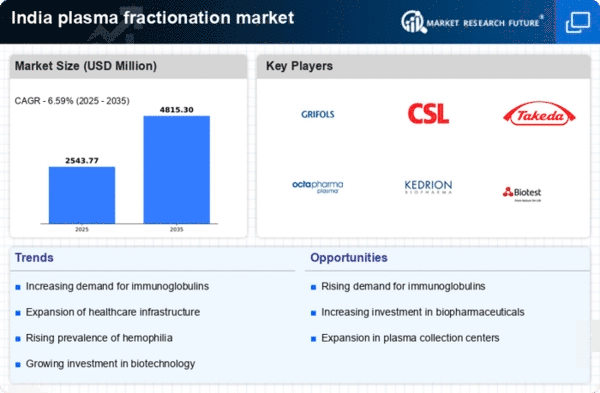
As per Market Research Future analysis, the India plasma fractionation market size was estimated at 2386.5 USD Million in 2024. The India plasma fractionation market is projected to grow from 2543.77 USD Million in 2025 to 4815.3 USD Million by 2035, exhibiting a compound annual growth rate (CAGR) of 6.5% during the forecast period 2025 - 2035

Key Market Trends & Highlights

The India plasma fractionation market is poised for substantial growth driven by technological advancements and increasing healthcare demands.

  • Technological advancements in plasma fractionation processes are enhancing efficiency and product yield.
  • The immunoglobulin segment represents the largest share of the market, reflecting a growing demand for therapeutic applications.
  • The fastest-growing segment is expected to be albumin, driven by its rising use in critical care settings.
  • Key market drivers include the rising demand for immunoglobulins and the expansion of healthcare infrastructure.

Market Size & Forecast

2024 Market Size 2386.5 (USD Million)
2035 Market Size 4815.3 (USD Million)
CAGR (2025 - 2035) 6.59%

Major Players

Grifols (ES), CSL Behring (AU), Takeda Pharmaceutical Company (JP), Octapharma (CH), Kedrion (IT), Biotest AG (DE), LFB Group (FR), Sangamo Therapeutics (US), Emergent BioSolutions (US)

Our Impact
Enabled $4.3B Revenue Impact for Fortune 500 and Leading Multinationals
Partnering with 2000+ Global Organizations Each Year
30K+ Citations by Top-Tier Firms in the Industry

India Plasma Fractionation Market Trends

The plasma fractionation market is experiencing notable growth, driven by increasing demand for immunoglobulins and clotting factors. This growth is largely attributed to the rising prevalence of chronic diseases and the expanding applications of plasma-derived products in therapeutic areas. The market landscape is characterized by advancements in technology and manufacturing processes, which enhance the efficiency and yield of plasma fractionation. Furthermore, the regulatory environment is evolving, with stricter guidelines ensuring the safety and efficacy of plasma products, thereby fostering consumer confidence. In addition, the market is witnessing a surge in investments aimed at expanding production capacities and improving infrastructure. This trend is likely to be bolstered by government initiatives promoting research and development in biopharmaceuticals. As the plasma fractionation market continues to evolve, it appears poised for sustained growth, driven by innovation and an increasing focus on patient-centric therapies. The interplay of these factors suggests a dynamic future for the market, with potential opportunities for stakeholders to capitalize on emerging trends and technologies.

Technological Advancements

Recent innovations in plasma fractionation technologies are enhancing the efficiency and yield of plasma-derived products. These advancements include improved separation techniques and automation in manufacturing processes, which are likely to reduce production costs and increase output.

Regulatory Developments

The regulatory landscape surrounding the plasma fractionation market is becoming increasingly stringent. New guidelines are being implemented to ensure the safety and efficacy of plasma-derived therapies, which may enhance consumer trust and drive market growth.

Investment in Infrastructure

There is a growing trend of investment in infrastructure aimed at expanding production capacities within the plasma fractionation market. This trend is supported by government initiatives that encourage research and development, potentially leading to increased availability of plasma-derived products.

India Plasma Fractionation Market Drivers

Rising Demand for Immunoglobulins

The plasma fractionation market in India is experiencing a notable increase in demand for immunoglobulins, which are critical for treating various immunodeficiency disorders. This surge is driven by a growing awareness of autoimmune diseases and the need for effective therapies. According to recent data, the demand for immunoglobulins is projected to grow at a CAGR of approximately 8% over the next few years. This trend is likely to propel the plasma fractionation market, as manufacturers strive to meet the rising needs of healthcare providers and patients. The increasing prevalence of chronic diseases further emphasizes the necessity for immunoglobulin therapies, thereby enhancing the market's growth potential.

Growing Awareness of Plasma Donation

Growing awareness of the importance of plasma donation is emerging as a crucial driver for the plasma fractionation market in India. Public health campaigns and educational initiatives are encouraging individuals to donate plasma, which is essential for producing life-saving therapies. This increased awareness is likely to enhance the availability of raw plasma, thereby supporting the growth of the plasma fractionation market. Recent surveys indicate that approximately 60% of the population is now aware of the benefits of plasma donation, which is a significant increase compared to previous years. As more individuals participate in donation programs, the supply chain for plasma-derived products is expected to strengthen, ultimately benefiting the market.

Expansion of Healthcare Infrastructure

The expansion of healthcare infrastructure in India is significantly impacting the plasma fractionation market. With the government's focus on improving healthcare access and quality, there has been a substantial increase in the number of hospitals and blood banks equipped to handle plasma collection and processing. This development is expected to enhance the availability of plasma-derived products, thereby driving market growth. Recent reports indicate that the healthcare sector is projected to reach a value of $372 billion by 2022, which suggests a favorable environment for the plasma fractionation market. Enhanced infrastructure not only facilitates better patient care but also encourages investment in advanced fractionation technologies.

Rising Incidence of Hematological Disorders

The rising incidence of hematological disorders in India is contributing to the growth of the plasma fractionation market. Conditions such as hemophilia, thalassemia, and other blood-related disorders require specific plasma-derived therapies for effective management. The increasing prevalence of these disorders is prompting healthcare providers to seek more plasma-derived products, thereby driving market demand. Recent statistics suggest that the incidence of hemophilia in India is approximately 1 in 10,000 males, indicating a substantial patient population that requires ongoing treatment. This trend underscores the critical role of the plasma fractionation market in providing necessary therapies and highlights the potential for future growth as awareness and diagnosis improve.

Increased Research and Development Activities

Increased research and development activities in the field of plasma fractionation are likely to propel the market in India. The focus on developing novel therapies and improving existing plasma-derived products is becoming more pronounced. Institutions and companies are investing in R&D to enhance the efficacy and safety of these products. For instance, the Indian government has allocated substantial funding for biotechnology research, which includes plasma fractionation technologies. This investment is expected to yield innovative solutions that could address unmet medical needs, thereby expanding the plasma fractionation market. The emphasis on R&D may also lead to collaborations between academic institutions and industry players, fostering a more dynamic market environment.

Market Segment Insights

By Application: Neurology (Largest) vs. Immunology (Fastest-Growing)

The application segment of the India plasma fractionation market is characterized by its diverse value distribution, with Neurology leading the charge. Neurology holds the largest market share, driven by an increasing prevalence of neurological disorders and a growing demand for plasma-derived therapies. Following closely are Hematology and General Medicine, which also contribute significantly to the market, while Immunology is rapidly gaining traction. Growth trends within this segment reveal a robust trajectory, especially in the Immunology domain, which is currently the fastest-growing application. Factors such as advances in research, innovative treatment options, and an uptick in autoimmune disease cases are propelling this growth. Additionally, increased healthcare expenditure is enhancing the market for all applications within the segment, creating opportunities for broader adoption of plasma fractionation products.

Neurology: Dominant vs. Immunology: Emerging

Neurology continues to dominate the application segment, characterized by well-established therapies for conditions such as multiple sclerosis and hemophilia. This dominance is supported by a strong pipeline of innovative treatments and robust clinical research investments. On the other hand, Immunology is emerging rapidly, driven by a rise in autoimmune diseases and increasing awareness among healthcare professionals regarding plasma therapies. This segment is characterized by its dynamic growth, with ongoing research discoveries leading to new treatment modalities. The increasing incidence of conditions requiring immunotherapy is set to bolster its market position further, making it a critical area of focus for stakeholders in the India plasma fractionation market.

By Product Type: Immunoglobulin (Largest) vs. Albumin (Fastest-Growing)

In the India plasma fractionation market, the product type segment is primarily driven by Immunoglobulin, which accounts for a significant market share. Following closely, Albumin is rapidly gaining traction due to rising awareness and applications in various therapeutic areas. Coagulation Factors and Protease Inhibitors, while essential, represent smaller portions of the total market, primarily catering to niche needs within the healthcare system. The growth trends indicate that Immunoglobulin continues to dominate the segment, benefitting from strong demand in immunotherapy. On the other hand, Albumin is recognized as the fastest-growing product type owing to its versatile use in critical care settings. Factors such as an increase in surgical procedures and the prevalence of chronic diseases are augmenting the demand for both product categories, offering favorable prospects for market expansion.

Immunoglobulin (Dominant) vs. Albumin (Emerging)

Immunoglobulin stands out as the dominant product type in the market, effectively utilized for various therapeutic purposes including immunodeficiencies and autoimmune disorders. It enjoys strong brand recognition and a well-established supply chain. Conversely, Albumin is emerging rapidly, primarily due to its vital role in maintaining oncotic pressure and as a volume expander during surgeries. The recognition of Albumin's benefits in critical care, coupled with a growing focus on healthcare quality, is fostering its impressive growth rate. Both segments showcase distinct characteristics; Immunoglobulin is characterized by higher pricing and stringent regulations, while Albumin benefits from a broader range of applications and increasing production capabilities.

By End User: Hospitals (Largest) vs. Blood Banks (Fastest-Growing)

In the India plasma fractionation market, hospitals command a significant share, serving as the primary consumers of plasma-derived products and therapies. The demand from hospitals is driven by the continuous rise in complex medical cases requiring advanced treatment options, along with increased awareness and availability of therapeutic plasma proteins. On the other hand, blood banks are emerging as the fastest-growing segment, fueled by the rising prevalence of blood-related disorders and an increasing number of donation drives. The enhancement of infrastructure and technology in blood banks contributes to their growth, allowing for better blood collection and processing, thus fostering a higher utilization rate of plasma products in treatment protocols.

Hospitals (Dominant) vs. Pharmaceutical Companies (Emerging)

Hospitals play a dominant role in the India plasma fractionation market, primarily due to their extensive infrastructure and patient base, making them key consumers of plasma therapies. The need for innovative treatments in critical care bolsters this dominance. In contrast, pharmaceutical companies are emerging players in this sector, driven by the growing demand for specialty products derived from plasma. They are increasingly focusing on research and development to expand product portfolios, which are vital for addressing unmet medical needs. This segment is supported by collaborations with hospitals to ensure effective distribution and utilization of plasma-derived products.

By Technology: Centrifugation (Largest) vs. Chromatography (Fastest-Growing)

In the India plasma fractionation market, the technology segment shows a diverse distribution among its key values. Centrifugation holds a significant portion of the market share, primarily due to its established utility and effectiveness in separating plasma components. Chromatography, while currently smaller in market share compared to centrifugation, is rapidly gaining traction as it offers advanced purification techniques that are essential for high-quality plasma-derived products. The growth trends in this segment indicate a strong shift towards more sophisticated technologies like chromatography, driven by increasing research and development activities in the healthcare sector. The demand for high-purity plasma products is fueling investments into innovative fractionation technologies. As healthcare needs evolve and the biopharmaceutical industry expands, both centrifugation and chromatography are expected to see substantial growth, but chromatography stands out as the future leader due to its efficiency and adaptability.

Technology: Centrifugation (Dominant) vs. Chromatography (Emerging)

Centrifugation remains the dominant technology in the India plasma fractionation market, known for its efficiency in separating blood components based on density differences. This method is well-established, widely adopted, and provides a robust solution for plasma separation. On the other hand, chromatography is emerging as a crucial technology, noted for its precision and capability to purify plasma proteins effectively. As the market shifts towards advanced methodologies, chromatography is being recognized for its role in enhancing product quality and safety. Both technologies face competition from methods like filtration and precipitation but continue to thrive due to their unique advantages, making them integral to the future of plasma processing.

Get more detailed insights about India Plasma Fractionation Market

Key Players and Competitive Insights

The plasma fractionation market in India is characterized by a dynamic competitive landscape, driven by increasing demand for immunoglobulins and clotting factor concentrates. Key players are actively pursuing strategies that emphasize innovation, regional expansion, and partnerships to enhance their market presence. Companies such as Grifols (Spain) and CSL Behring (Australia) are at the forefront, focusing on product development and strategic collaborations to leverage their technological capabilities. This collective approach not only fosters competition but also encourages advancements in product offerings, thereby shaping the overall market environment.In terms of business tactics, localizing manufacturing and optimizing supply chains are pivotal strategies employed by these companies. The market structure appears moderately fragmented, with several players vying for market share. However, the influence of major companies like Takeda Pharmaceutical Company (Japan) and Octapharma (Switzerland) is substantial, as they continue to set benchmarks in quality and innovation. Their operational strategies, including investments in state-of-the-art facilities, contribute to a competitive atmosphere that prioritizes efficiency and responsiveness to market needs.

In October Grifols (Spain) announced the opening of a new plasma collection center in Maharashtra, aimed at increasing its plasma supply chain capabilities. This strategic move is significant as it not only enhances Grifols' operational footprint in India but also aligns with the growing demand for plasma-derived therapies in the region. By expanding its collection network, Grifols is likely to strengthen its position in the market, ensuring a steady supply of high-quality plasma for fractionation.

In September CSL Behring (Australia) launched a new immunoglobulin product specifically designed for patients with rare autoimmune disorders. This introduction reflects the company's commitment to innovation and patient-centric solutions. By addressing niche markets, CSL Behring is poised to capture a segment of the market that is often underserved, thereby enhancing its competitive edge and reinforcing its reputation as a leader in the plasma fractionation sector.

In August Takeda Pharmaceutical Company (Japan) entered into a strategic partnership with a local biotechnology firm to enhance its research capabilities in plasma-derived therapies. This collaboration is indicative of a broader trend where established companies seek to leverage local expertise to accelerate product development. Such partnerships not only facilitate knowledge transfer but also enable faster market entry for new therapies, positioning Takeda favorably against its competitors.

As of November the competitive trends in the plasma fractionation market are increasingly defined by digitalization, sustainability, and the integration of artificial intelligence (AI) in operations. Strategic alliances are becoming more prevalent, as companies recognize the value of collaboration in navigating complex regulatory environments and enhancing R&D capabilities. Looking ahead, the competitive differentiation is likely to evolve from traditional price-based competition to a focus on innovation, technological advancements, and supply chain reliability. This shift underscores the importance of agility and responsiveness in meeting the evolving needs of healthcare providers and patients alike.

Key Companies in the India Plasma Fractionation Market include

Industry Developments

The India Plasma Fractionation Market has experienced significant developments recently, particularly as the demand for plasma-derived therapeutics expands. Companies like Serum Institute of India and Reliance Life Sciences have made strides in increasing their production capacities to meet rising healthcare requirements. In August 2023, Indian Immunologicals announced plans to enhance its plasma collection capacity and invest in new fractionation technologies.

Additionally, the market has seen an increase in collaborations aimed at research and development, with Biocon partnering with Cangene Corporation to innovate in biopharmaceuticals.In terms of mergers and acquisitions, Karnataka Antibiotics and Pharmaceuticals and Haffkine BioPharmaceutical Corporation were reported to be exploring synergies through shared technologies in January 2023. The market has demonstrated robust growth, with a valuation boost from ongoing investments and expansion efforts, fostering a competitive landscape. Over the last two years, the market has been buoyed by new regulations promoting domestic production and self-sufficiency in vital plasma products, aligning with India's health initiatives.

This ongoing evolution in the sector signals a pivotal time for growth opportunities among key players.

Future Outlook

India Plasma Fractionation Market Future Outlook

The Plasma Fractionation Market is projected to grow at a 6.59% CAGR from 2025 to 2035, driven by increasing demand for immunoglobulins and advancements in fractionation technologies.

New opportunities lie in:

  • Expansion of contract manufacturing services for biopharmaceutical companies.
  • Development of innovative plasma-derived therapies targeting rare diseases.
  • Investment in automated plasma collection and processing technologies.

By 2035, the plasma fractionation market is expected to achieve substantial growth and innovation.

Market Segmentation

India Plasma Fractionation Market End User Outlook

  • Hospitals
  • Ambulatory Surgical Centers
  • Blood Banks
  • Pharmaceutical Companies

India Plasma Fractionation Market Technology Outlook

  • Centrifugation
  • Chromatography
  • Precipitation
  • Filtration

India Plasma Fractionation Market Application Outlook

  • Neurology
  • Hematology
  • General Medicine
  • Immunology

India Plasma Fractionation Market Product Type Outlook

  • Immunoglobulin
  • Albumin
  • Coagulation Factors
  • Protease Inhibitors

Report Scope

MARKET SIZE 2024 2386.5(USD Million)
MARKET SIZE 2025 2543.77(USD Million)
MARKET SIZE 2035 4815.3(USD Million)
COMPOUND ANNUAL GROWTH RATE (CAGR) 6.59% (2025 - 2035)
REPORT COVERAGE Revenue Forecast, Competitive Landscape, Growth Factors, and Trends
BASE YEAR 2024
Market Forecast Period 2025 - 2035
Historical Data 2019 - 2024
Market Forecast Units USD Million
Key Companies Profiled Grifols (ES), CSL Behring (AU), Takeda Pharmaceutical Company (JP), Octapharma (CH), Kedrion (IT), Biotest AG (DE), LFB Group (FR), Sangamo Therapeutics (US), Emergent BioSolutions (US)
Segments Covered Application, Product Type, End User, Technology
Key Market Opportunities Advancements in plasma-derived therapies drive growth in the plasma fractionation market.
Key Market Dynamics Rising demand for immunoglobulins drives innovation and competition in the plasma fractionation market.
Countries Covered India
Leave a Comment

FAQs

What is the projected market size of the India Plasma Fractionation Market by 2035?

The India Plasma Fractionation Market is expected to be valued at 2.75 USD Billion by 2035.

What was the market size of the India Plasma Fractionation Market in 2024?

In 2024, the India Plasma Fractionation Market was valued at 1.18 USD Billion.

What is the expected compound annual growth rate (CAGR) for the India Plasma Fractionation Market between 2025 and 2035?

The expected CAGR for the India Plasma Fractionation Market from 2025 to 2035 is 7.97%.

Which product segment is expected to have the largest market share in the India Plasma Fractionation Market by 2035?

The Immunoglobulin segment is projected to hold the largest market share, valued at 1.26 USD Billion by 2035.

Who are the major players in the India Plasma Fractionation Market?

Key players in the market include Octapharma, Indian Immunologicals, Reliance Life Sciences, and Serum Institute of India.

What will be the value of the Albumin segment in the India Plasma Fractionation Market by 2035?

The Albumin segment is expected to be valued at 0.93 USD Billion by 2035.

What challenges could impact the growth of the India Plasma Fractionation Market?

Potential challenges include regulatory hurdles and competition from alternative therapies in plasma products.

How does regional demand play a role in the growth of the India Plasma Fractionation Market?

Regional demand significantly influences the market growth as various regions exhibit differing levels of healthcare infrastructure and plasma collection capabilities.

What is the expected market value for the Coagulation Factors segment by 2035?

The Coagulation Factors segment is projected to reach a value of 0.43 USD Billion by 2035.

What emerging trends are anticipated to shape the India Plasma Fractionation Market in the coming years?

Emerging trends include advancements in plasma processing technologies and an increasing focus on rare disease treatments driving demand.

Download Free Sample

Kindly complete the form below to receive a free sample of this Report

Compare Licence

×
Features License Type
Single User Multiuser License Enterprise User
Price $4,950 $5,950 $7,250
Maximum User Access Limit 1 User Upto 10 Users Unrestricted Access Throughout the Organization
Free Customization
Direct Access to Analyst
Deliverable Format
Platform Access
Discount on Next Purchase 10% 15% 15%
Printable Versions