×
Request Free Sample ×

Kindly complete the form below to receive a free sample of this Report

* Please use a valid business email

Leading companies partner with us for data-driven Insights

clients tt-cursor
Hero Background

Germany Plasma Fractionation Market

ID: MRFR/HC/47614-HCR
200 Pages
Rahul Gotadki
February 2026

Germany Plasma Fractionation Market Research Report By Product Type (Immunoglobulin, Albumin, Coagulation Factors, Protease Inhibitors), By Application (Neurology, Hematology, General Medicine, Immunology), By End User (Hospitals, Ambulatory Surgical Centers, Blood Banks, Pharmaceutical Companies) and By Technology (Centrifugation, Chromatography, Precipitation, Filtration) -Forecast to 2035

Share:
Download PDF ×

We do not share your information with anyone. However, we may send you emails based on your report interest from time to time. You may contact us at any time to opt-out.

Germany Plasma Fractionation Market Infographic
Purchase Options

Germany Plasma Fractionation Market Summary

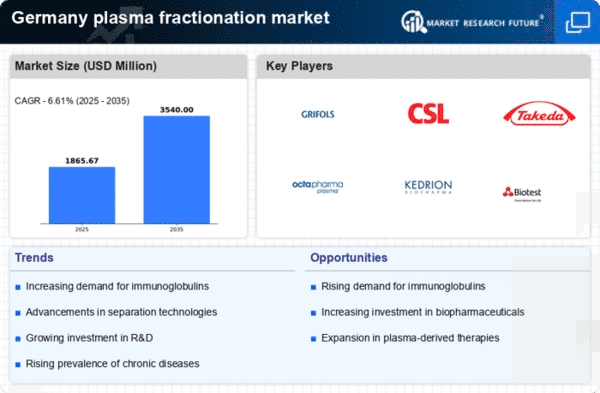
As per Market Research Future analysis, the Germany plasma fractionation market size was estimated at 1750.0 USD Million in 2024. The Germany plasma fractionation market is projected to grow from 1865.67 USD Million in 2025 to 3540.0 USD Million by 2035, exhibiting a compound annual growth rate (CAGR) of 6.6% during the forecast period 2025 - 2035

Key Market Trends & Highlights

The Germany plasma fractionation market is poised for growth driven by technological advancements and increasing demand for therapies.

  • Technological advancements in fractionation processes are enhancing the efficiency and yield of plasma-derived products.
  • The regulatory landscape is evolving, providing support for the development and approval of plasma therapies.
  • The largest segment in the market is immunoglobulins, while the fastest-growing segment is albumin due to rising therapeutic applications.
  • Key market drivers include increasing healthcare expenditure and growing awareness of plasma-derived therapies.

Market Size & Forecast

2024 Market Size 1750.0 (USD Million)
2035 Market Size 3540.0 (USD Million)
CAGR (2025 - 2035) 6.61%

Major Players

Grifols (ES), CSL Behring (AU), Takeda Pharmaceutical Company (JP), Octapharma (CH), Kedrion (IT), Biotest AG (DE), LFB Group (FR), Sangamo Therapeutics (US)

Our Impact
Enabled $4.3B Revenue Impact for Fortune 500 and Leading Multinationals
Partnering with 2000+ Global Organizations Each Year
30K+ Citations by Top-Tier Firms in the Industry

Germany Plasma Fractionation Market Trends

The plasma fractionation market is currently experiencing notable growth, driven by increasing demand for immunoglobulins and clotting factors. This demand is largely attributed to the rising prevalence of chronic diseases and the growing awareness of the therapeutic benefits of plasma-derived products. In Germany, advancements in technology and manufacturing processes are enhancing the efficiency of plasma collection and fractionation. Regulatory frameworks are also evolving, ensuring that products meet stringent safety and quality standards, which further boosts consumer confidence in these therapies. Moreover, the market is witnessing a shift towards more personalized medicine, with an emphasis on tailored therapies that cater to individual patient needs. This trend is likely to encourage innovation in product development and expand the range of applications for plasma-derived therapies. As the healthcare landscape continues to evolve, the plasma fractionation market appears poised for sustained growth, supported by both technological advancements and an increasing focus on patient-centric care. The interplay of these factors suggests a dynamic future for the sector, with potential for new entrants and expanded market opportunities.

Technological Advancements

Recent innovations in plasma fractionation technologies are enhancing the efficiency and yield of plasma-derived products. Automation and improved separation techniques are streamlining processes, which may lead to reduced production costs and increased output.

Regulatory Developments

The regulatory environment surrounding plasma fractionation is becoming more stringent, with authorities emphasizing safety and quality. This trend is likely to foster greater trust among healthcare providers and patients, potentially driving market growth.

Rising Demand for Therapies

There is a growing demand for therapies derived from plasma, particularly for treating chronic conditions. This trend is expected to continue, as healthcare providers increasingly recognize the efficacy of plasma-derived treatments in managing various diseases.

Germany Plasma Fractionation Market Drivers

Increasing Healthcare Expenditure

The rising healthcare expenditure in Germany is a pivotal driver for the plasma fractionation market. As the government and private sectors allocate more funds towards healthcare, the demand for advanced medical treatments, including those derived from plasma, is likely to increase. In 2024, healthcare spending in Germany reached approximately €450 billion, reflecting a growth of around 4% from the previous year. This trend suggests that more resources will be available for innovative therapies, thereby enhancing the market for plasma-derived products. The plasma fractionation market stands to benefit from this increased investment, as hospitals and clinics seek to incorporate cutting-edge treatments into their offerings, ultimately improving patient outcomes.

Regulatory Support for Plasma Products

The regulatory environment in Germany is becoming increasingly supportive of the plasma fractionation market. Recent initiatives by health authorities aim to streamline the approval processes for plasma-derived therapies, which may encourage more companies to invest in this sector. The plasma fractionation market is likely to benefit from these regulatory changes, as they can lead to faster market entry for new products. Additionally, the establishment of clear guidelines for safety and efficacy can enhance consumer confidence, further driving demand. This supportive regulatory framework may also attract foreign investments, contributing to the overall growth of the market.

Advancements in Fractionation Technologies

Technological advancements in plasma fractionation processes are significantly influencing the market landscape in Germany. Innovations such as improved separation techniques and automation are enhancing the efficiency and yield of plasma-derived products. For instance, the introduction of new filtration methods has been shown to increase the purity of immunoglobulins, a key product in the plasma fractionation market. As these technologies evolve, they not only reduce production costs but also improve the overall quality of plasma products. This could lead to a competitive advantage for manufacturers who adopt these advancements, potentially increasing their market share and profitability.

Rising Incidence of Hematological Disorders

The increasing incidence of hematological disorders in Germany is a critical driver for the plasma fractionation market. Conditions such as hemophilia and other blood-related disorders require ongoing treatment with plasma-derived products. According to recent statistics, the prevalence of hemophilia in Germany is estimated to be around 1 in 10,000 males, indicating a substantial patient population reliant on these therapies. The plasma fractionation market is poised to expand as healthcare providers seek to meet the needs of this growing demographic. As awareness and diagnosis of these disorders improve, the demand for effective plasma therapies is expected to rise, further propelling market growth.

Growing Awareness of Plasma-Derived Therapies

There is a notable increase in awareness regarding the benefits of plasma-derived therapies among healthcare professionals and patients in Germany. This heightened awareness is likely to drive demand for plasma fractionation products, as more individuals seek treatments for various conditions, including immune deficiencies and bleeding disorders. The plasma fractionation market is expected to see a surge in interest, particularly as educational initiatives and marketing campaigns highlight the efficacy of these therapies. Furthermore, the prevalence of chronic diseases is on the rise, which may further fuel the demand for plasma-derived therapies, thereby expanding the market's reach and potential.

Market Segment Insights

By Application: Neurology (Largest) vs. Immunology (Fastest-Growing)

In the Germany plasma fractionation market, Neurology emerges as the largest segment, benefiting from increased awareness and advancements in treatments for neurological disorders. Hematology and General Medicine also hold significant shares, though they trail behind Neurology. Immunology, on the other hand, is carving its niche with promising growth, attracting investments aimed at enhancing therapies for autoimmune diseases. The growth trends in this segment are primarily fueled by rising incidences of neurological conditions and advancements in immunotherapies. The increasing emphasis on personalized medicine and the development of novel therapeutics contribute to the dynamic landscape. As healthcare providers seek better ways to manage chronic diseases, the demand for immunological products is anticipated to rise, making it the fastest-growing segment within this market.

Neurology: Dominant vs. Immunology: Emerging

Neurology, as the dominant segment in the Germany plasma fractionation market, is characterized by its focus on high-demand treatments for conditions such as epilepsy and multiple sclerosis. The segment benefits from strong research activities and a robust pipeline of therapies, fostering its leadership position. Immunology, while emerging, is rapidly gaining traction due to the increasing need for targeted therapies for various autoimmune and chronic inflammatory conditions. The segment is marked by innovative research, expansion of treatment options, and favorable regulatory environments that encourage the development of new immunoglobulin products. As such, these segments reflect contrasting yet complementary dynamics, underscoring the shifts in therapeutic focus within the market.

By Product Type: Immunoglobulin (Largest) vs. Albumin (Fastest-Growing)

The analysis of product types in the Germany plasma fractionation market reveals that Immunoglobulin holds the largest share among the segments, largely due to its widespread application in immunotherapy and chronic disease management. Albumin follows as a notable competitor, driven by its increasing use in various therapeutic areas, like liver diseases and surgeries. Growth trends indicate a robust expansion in the Albumin segment, primarily fueled by rising demand for hypoalbuminemia treatment. The increased awareness of blood disorders and advancements in manufacturing technologies further bolster the market for both Immunoglobulin and Albumin, as healthcare institutions prioritize effective and reliable treatment options.

Immunoglobulin (Dominant) vs. Albumin (Emerging)

Immunoglobulin remains the dominant product type in the Germany plasma fractionation market, characterized by its extensive therapeutic applications and established regulatory approvals. As the largest segment, it serves critical functions in immune system support and treatment of autoimmune diseases. Conversely, Albumin is rapidly emerging as a vital product, attributed to its versatile applications in medical treatments, including burn care and trauma recovery. Its growth is enhanced by technological innovations in purification methods and expanding use in various clinical scenarios. While Immunoglobulin is well-entrenched, Albumin's emerging role aligns with ongoing trends towards more personalized medicine and targeted therapies.

By End User: Hospitals (Largest) vs. Pharmaceutical Companies (Fastest-Growing)

In the Germany plasma fractionation market, the distribution of market share among key end users is a critical aspect of understanding industry dynamics. Hospitals hold the largest share of the market, primarily due to their extensive reliance on plasma-derived products for a variety of treatments. Ambulatory surgical centers and blood banks also play crucial roles but comprise a smaller percentage of total market share. Pharmaceutical companies, while smaller in share compared to hospitals, are rapidly gaining importance due to their innovative approaches and contributions to product development. Growth trends within the end user segment are influenced by various factors, including advancements in medical technology and increasing patient demand for plasma-derived therapies. Hospitals continue to expand their capabilities, enhancing their utilization of plasma products, while pharmaceutical companies are poised for significant growth as they invest in research and development. The alignment of regulatory frameworks and an increasing focus on personalized medicine are further driving growth in this segment, particularly for pharmaceutical companies, making them a notable focal point for future market developments.

Hospitals (Dominant) vs. Pharmaceutical Companies (Emerging)

Hospitals are the dominant end user in the Germany plasma fractionation market, characterized by their broad utilization of plasma products for treating various health conditions, including immunodeficiencies and hemophilia. These facilities are equipped with advanced medical technologies that facilitate high-quality patient care and ensure the availability of critical plasma products. On the other hand, pharmaceutical companies represent an emerging segment, actively involved in the innovation and production of plasma-derived therapies. Their growth is fueled by significant investments in research and development aimed at enhancing treatment efficacy and patient outcomes. As regulatory landscapes evolve, the collaboration between hospitals and pharmaceutical companies is expected to strengthen, creating a synergistic approach to healthcare solutions that leverages the strengths of both segments.

By Technology: Centrifugation (Largest) vs. Chromatography (Fastest-Growing)

In the Germany plasma fractionation market, centrifugation holds the largest market share, driven by its established efficiency and effectiveness in separating plasma components. This method is widely adopted owing to its ability to handle large volumes and produce high-quality fractions. Chromatography, on the other hand, is quickly gaining recognition and market presence, appealing particularly in niche applications requiring higher purity levels. The growth of the chromatography segment is fueled by increasing demand for high-purity plasma products and advancements in techniques that enhance separation efficiency. Innovations in chromatographic technologies are attracting investments, positioning it as the fastest-growing method in the market. Additionally, trends toward personalized medicine and biopharmaceuticals are further driving the need for sophisticated fractionation technologies, including chromatography.

Centrifugation: Dominant vs. Chromatography: Emerging

Centrifugation is the dominant technology in the Germany plasma fractionation market, celebrated for its robustness and scalability. This method provides rapid and effective separation of plasma components, ensuring the collection of high-quality fractions that are essential for further processing. In contrast, chromatography stands as an emerging technology that focuses on the fine separation of plasma proteins and is increasingly favored in applications where purity is paramount. As biopharmaceutical developments progress, chromatography shows promise for capturing market share through enhanced techniques designed to meet evolving industry demands. Both methods play critical roles, yet they cater to different aspects of plasma processing, highlighting a diverse technological landscape.

Get more detailed insights about Germany Plasma Fractionation Market

Key Players and Competitive Insights

The plasma fractionation market in Germany exhibits a dynamic competitive landscape characterized by a blend of innovation, strategic partnerships, and regional expansion. Key players such as Grifols (ES), CSL Behring (AU), and Takeda Pharmaceutical Company (JP) are at the forefront, each employing distinct strategies to enhance their market presence. Grifols (ES) focuses on expanding its product portfolio through research and development, while CSL Behring (AU) emphasizes strategic acquisitions to bolster its capabilities in immunoglobulin therapies. Takeda Pharmaceutical Company (JP) appears to be leveraging its global footprint to enhance distribution networks, thereby increasing accessibility to its plasma-derived products. Collectively, these strategies contribute to a competitive environment that is increasingly driven by innovation and operational efficiency.In terms of business tactics, companies are increasingly localizing manufacturing to reduce supply chain vulnerabilities and enhance responsiveness to market demands. The market structure is moderately fragmented, with several players vying for market share, yet the influence of major companies remains substantial. This competitive structure allows for a diverse range of products and services, catering to various therapeutic needs while fostering a climate of continuous improvement and adaptation.

In October Grifols (ES) announced the opening of a new state-of-the-art manufacturing facility in Germany, aimed at increasing its production capacity for immunoglobulin products. This strategic move is likely to enhance Grifols' ability to meet the growing demand for plasma-derived therapies in the region, positioning the company favorably against its competitors. The investment in local manufacturing not only signifies a commitment to the German market but also reflects a broader trend towards regional production capabilities.

In September CSL Behring (AU) completed the acquisition of a smaller biotech firm specializing in rare disease therapies. This acquisition is expected to expand CSL Behring's product offerings and strengthen its position in niche markets. By integrating innovative therapies into its portfolio, CSL Behring is likely to enhance its competitive edge, particularly in areas where specialized treatments are in high demand. This strategic action underscores the importance of mergers and acquisitions as a means of accelerating growth and innovation.

In August Takeda Pharmaceutical Company (JP) launched a collaborative initiative with local healthcare providers to improve patient access to plasma-derived therapies. This partnership aims to streamline distribution channels and enhance patient education regarding treatment options. Such initiatives not only improve market penetration but also foster trust and collaboration within the healthcare ecosystem, which is increasingly vital in today’s competitive landscape.

As of November current trends in the plasma fractionation market are heavily influenced by digitalization, sustainability, and the integration of artificial intelligence (AI) in operational processes. Strategic alliances are becoming more prevalent, as companies recognize the value of collaboration in driving innovation and improving supply chain reliability. The competitive differentiation is likely to evolve from traditional price-based competition towards a focus on technological advancements and sustainable practices. This shift suggests that companies that prioritize innovation and operational excellence will be better positioned to thrive in the future.

Key Companies in the Germany Plasma Fractionation Market include

Industry Developments

In recent months, the Germany Plasma Fractionation Market has witnessed notable developments. Octapharma announced an expansion of its facilities in Germany, aiming to enhance production capacity for plasma-derived therapies, a move that underscores the growing demand for immunoglobulin products. Biotest AG has been focusing on its pipeline in the area of immunoglobulins and has recently secured funding to accelerate its Research and Development efforts. On the acquisition front, in March 2023, Grifols completed the acquisition of certain assets from a leading plasma collection center operator in Germany, strengthening its market position and expanding its operational capabilities.

Takeda Pharmaceutical has also been expanding its plasma collection network in the region to support its existing products and enhance supply reliability. The market has been positively influenced by the increasing prevalence of chronic diseases and rising awareness regarding the benefits of plasma therapies. Over the last two years, the market has shown a valuation growth of around 15%, primarily driven by innovation and increased patient needs, resulting in a strengthened competitive landscape among key players like CSL Behring and Baxter International.

These dynamics highlight the robust nature of the Germany Plasma Fractionation Market, reflecting its importance within the broader healthcare landscape.

Future Outlook

Germany Plasma Fractionation Market Future Outlook

The Plasma Fractionation Market is projected to grow at 6.61% CAGR from 2025 to 2035, driven by increasing demand for immunoglobulins and advancements in fractionation technologies.

New opportunities lie in:

  • Expansion of contract manufacturing services for biopharmaceutical companies.
  • Development of innovative plasma-derived therapies targeting rare diseases.
  • Investment in automated plasma collection and processing technologies.

By 2035, the plasma fractionation market is expected to achieve robust growth and enhanced competitive positioning.

Market Segmentation

Germany Plasma Fractionation Market End User Outlook

  • Hospitals
  • Ambulatory Surgical Centers
  • Blood Banks
  • Pharmaceutical Companies

Germany Plasma Fractionation Market Technology Outlook

  • Centrifugation
  • Chromatography
  • Precipitation
  • Filtration

Germany Plasma Fractionation Market Application Outlook

  • Neurology
  • Hematology
  • General Medicine
  • Immunology

Germany Plasma Fractionation Market Product Type Outlook

  • Immunoglobulin
  • Albumin
  • Coagulation Factors
  • Protease Inhibitors

Report Scope

MARKET SIZE 2024 1750.0(USD Million)
MARKET SIZE 2025 1865.67(USD Million)
MARKET SIZE 2035 3540.0(USD Million)
COMPOUND ANNUAL GROWTH RATE (CAGR) 6.61% (2025 - 2035)
REPORT COVERAGE Revenue Forecast, Competitive Landscape, Growth Factors, and Trends
BASE YEAR 2024
Market Forecast Period 2025 - 2035
Historical Data 2019 - 2024
Market Forecast Units USD Million
Key Companies Profiled Grifols (ES), CSL Behring (AU), Takeda Pharmaceutical Company (JP), Octapharma (CH), Kedrion (IT), Biotest AG (DE), LFB Group (FR), Sangamo Therapeutics (US)
Segments Covered Application, Product Type, End User, Technology
Key Market Opportunities Advancements in plasma-derived therapies drive growth in the plasma fractionation market.
Key Market Dynamics Rising demand for immunoglobulins drives innovation and competition in the plasma fractionation market.
Countries Covered Germany
Leave a Comment

FAQs

What is the expected market size of the Germany Plasma Fractionation Market in 2024?

The Germany Plasma Fractionation Market is expected to be valued at 1.18 USD Billion in 2024.

What is the estimated market size for the Germany Plasma Fractionation Market by 2035?

By 2035, the Germany Plasma Fractionation Market is projected to reach a value of 2.5 USD Billion.

What is the expected CAGR for the Germany Plasma Fractionation Market from 2025 to 2035?

The projected CAGR for the Germany Plasma Fractionation Market from 2025 to 2035 is 7.039%.

How is the market for Immunoglobulin segment expected to grow by 2035?

The Immunoglobulin segment is expected to be valued at 1.05 USD Billion by 2035, up from 0.48 USD Billion in 2024.

What will be the market value of Albumin in 2035?

The Albumin segment is projected to grow to 0.68 USD Billion by 2035, from 0.3 USD Billion in 2024.

Who are the key players in the Germany Plasma Fractionation Market?

Major players in the market include Octapharma, Biotest AG, Grifols, Takeda Pharmaceutical, and Baxter International.

What growth rate can be anticipated for the Coagulation Factors segment by 2035?

The Coagulation Factors segment is expected to reach a market value of 0.55 USD Billion by 2035, up from 0.25 USD Billion in 2024.

What are the predicted market conditions for the Protease Inhibitors segment in 2035?

By 2035, the Protease Inhibitors segment is expected to increase to 0.22 USD Billion, a rise from 0.15 USD Billion in 2024.

What factors are expected to drive the growth of the Germany Plasma Fractionation Market?

Key growth drivers include increasing demand for immunoglobulin products and advancements in plasma collection technologies.

How might the current global environment affect the Germany Plasma Fractionation Market?

The current global scenario could pose challenges such as supply chain disruptions impacting product availability in the market.

Download Free Sample

Kindly complete the form below to receive a free sample of this Report

Compare Licence

×
Features License Type
Single User Multiuser License Enterprise User
Price $4,950 $5,950 $7,250
Maximum User Access Limit 1 User Upto 10 Users Unrestricted Access Throughout the Organization
Free Customization
Direct Access to Analyst
Deliverable Format
Platform Access
Discount on Next Purchase 10% 15% 15%
Printable Versions