×
Request Free Sample ×

Kindly complete the form below to receive a free sample of this Report

* Please use a valid business email

Leading companies partner with us for data-driven Insights

clients tt-cursor
Hero Background

UK Plasma Fractionation Market

ID: MRFR/HC/47612-HCR
200 Pages
Rahul Gotadki
February 2026

UK Plasma Fractionation Market Research Report: Size, Share, Trend Analysis By Product Type (Immunoglobulin, Albumin, Coagulation Factors, Protease Inhibitors), By Applications (Neurology, Hematology, General Medicine, Immunology), By End Users (Hospitals, Ambulatory Surgical Centers, Blood Banks, Pharmaceutical Companies) and By Technology (Centrifugation, Chromatography, Precipitation, Filtration) - Growth Outlook & Industry Forecast 2025 To 2035

Share:
Download PDF ×

We do not share your information with anyone. However, we may send you emails based on your report interest from time to time. You may contact us at any time to opt-out.

UK Plasma Fractionation Market Infographic
Purchase Options

UK Plasma Fractionation Market Summary

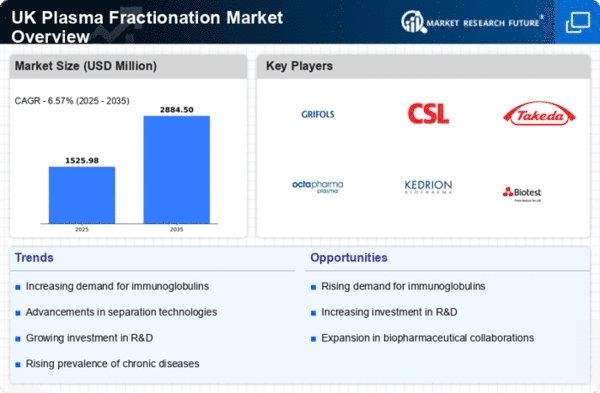
As per Market Research Future analysis, the UK plasma fractionation market size was estimated at 1431.9 USD Million in 2024.. The UK plasma fractionation market is projected to grow from 1525.98 USD Million in 2025 to 2884.5 USD Million by 2035, exhibiting a compound annual growth rate (CAGR) of 6.5% during the forecast period 2025 - 2035

Key Market Trends & Highlights

The UK plasma fractionation market is poised for growth driven by technological advancements and increasing demand for therapies.

  • Technological advancements are enhancing the efficiency of plasma fractionation processes.
  • The largest segment in the UK market is immunoglobulins, while the fastest-growing segment is albumin.
  • Regulatory support is fostering a favorable environment for market expansion and innovation.
  • Key market drivers include the increasing prevalence of chronic diseases and rising awareness of plasma-derived therapies.

Market Size & Forecast

2024 Market Size 1431.9 (USD Million)
2035 Market Size 2884.5 (USD Million)
CAGR (2025 - 2035) 6.57%

Major Players

Grifols (ES), CSL Behring (AU), Takeda Pharmaceutical Company (JP), Octapharma (CH), Kedrion (IT), Biotest AG (DE), LFB Group (FR), Sangamo Therapeutics (US), Emergent BioSolutions (US)

Our Impact
Enabled $4.3B Revenue Impact for Fortune 500 and Leading Multinationals
Partnering with 2000+ Global Organizations Each Year
30K+ Citations by Top-Tier Firms in the Industry

UK Plasma Fractionation Market Trends

The plasma fractionation market is currently experiencing notable growth, driven by increasing demand for immunoglobulins and clotting factors. This growth is largely attributed to the rising prevalence of chronic diseases and the expanding applications of plasma-derived products in therapeutic areas. Regulatory frameworks in the UK are evolving to support innovation while ensuring safety and efficacy, which may further enhance market dynamics. Additionally, advancements in technology are facilitating more efficient fractionation processes, potentially leading to higher yields and reduced costs. Moreover, the focus on patient-centric healthcare is influencing the plasma fractionation market. Stakeholders are increasingly prioritizing the development of personalized therapies, which may lead to a greater emphasis on the customization of plasma-derived products. The collaboration between public and private sectors appears to be strengthening, fostering research and development initiatives that could yield novel therapies. As the market continues to evolve, it is essential for industry participants to remain agile and responsive to changing healthcare needs and regulatory landscapes.

Technological Advancements

Recent innovations in fractionation techniques are enhancing the efficiency and yield of plasma-derived products. These advancements may lead to cost reductions and improved product quality, thereby attracting more investment into the sector.

Regulatory Support

The evolving regulatory environment in the UK is likely to facilitate the growth of the plasma fractionation market. Streamlined approval processes and supportive policies may encourage the development and commercialization of new therapies.

Rising Demand for Therapies

There is an increasing need for plasma-derived therapies, particularly in treating chronic conditions. This growing demand may drive expansion within the plasma fractionation market, prompting companies to enhance their production capabilities.

UK Plasma Fractionation Market Drivers

Supportive Regulatory Framework

A supportive regulatory framework is essential for the growth of the plasma fractionation market. The UK regulatory authorities have established guidelines that facilitate the approval and monitoring of plasma-derived products, ensuring their safety and efficacy. This regulatory environment encourages innovation and investment in the sector, as companies are more likely to pursue the development of new therapies when they have clear pathways for approval. Additionally, the UK’s commitment to maintaining high standards in blood safety and quality further enhances the credibility of the plasma fractionation market. As regulations evolve to accommodate new technologies and therapies, the market is expected to benefit from increased confidence among stakeholders.

Increasing Prevalence of Chronic Diseases

The rising incidence of chronic diseases in the UK is a crucial driver for the plasma fractionation market. Conditions such as hemophilia, immune deficiencies, and other blood-related disorders necessitate the use of plasma-derived therapies. According to recent data, the prevalence of hemophilia in the UK is estimated at 1 in 5,000 males, indicating a significant patient population reliant on plasma products. This growing demand for effective treatment options is likely to propel the plasma fractionation market forward, as healthcare providers seek innovative solutions to manage these conditions. Furthermore, the increasing awareness of the benefits of plasma therapies among healthcare professionals and patients may further stimulate market growth, as more individuals seek out these life-saving treatments.

Advancements in Plasma Collection Techniques

Innovations in plasma collection techniques are transforming the plasma fractionation market. Enhanced methods, such as automated plasmapheresis, are improving the efficiency and safety of plasma collection. These advancements not only increase the yield of plasma but also reduce the time required for collection, making it more accessible for donors. In the UK, the introduction of these technologies has the potential to increase the number of plasma donations, which is critical given the rising demand for plasma-derived therapies. As the market adapts to these technological improvements, it is expected that the overall capacity for plasma fractionation will expand, thereby supporting the growth of the industry.

Rising Awareness of Plasma-Derived Therapies

The growing awareness of the benefits of plasma-derived therapies among healthcare professionals and patients is driving the plasma fractionation market. Educational campaigns and outreach programs are effectively informing stakeholders about the therapeutic potential of immunoglobulins, clotting factors, and albumin. As a result, more patients are being diagnosed and treated with these therapies, leading to increased demand. In the UK, the market for immunoglobulin therapy alone is expected to grow at a CAGR of 8% over the next five years. This heightened awareness is likely to encourage healthcare providers to incorporate plasma-derived therapies into treatment protocols, thereby bolstering the plasma fractionation market.

Growing Investment in Biopharmaceutical Research

The surge in investment in biopharmaceutical research is a significant driver for the plasma fractionation market. The UK government and private sector are increasingly funding research initiatives aimed at developing new therapies derived from plasma. This investment is expected to enhance the capabilities of plasma fractionation facilities, leading to the production of novel therapies that address unmet medical needs. In 2025, the UK biopharmaceutical sector is projected to reach a market value of £50 billion, with a substantial portion allocated to plasma-derived products. This trend indicates a robust pipeline of innovative therapies, which could further stimulate demand within the plasma fractionation market.


Market Segment Insights

By Application: Hematology (Largest) vs. Neurology (Fastest-Growing)

In the UK plasma fractionation market, Hematology holds the largest share, reflecting its critical role in treating blood disorders and offering comprehensive therapeutic options. This segment benefits from extensive utilization in healthcare settings, addressing a range of conditions such as hemophilia and immune deficiencies. Neurology, while smaller in share, is rapidly gaining traction with innovative therapies aimed at neurodegenerative diseases, paving the way for potential market expansion. Growth in these segments is propelled by increasing awareness and advancements in medical technology. The rising incidence of hematological disorders underscores the demand for plasma-derived treatments, fostering a strong Hematology segment. Neurology, on the other hand, is characterized by a surge in research initiatives and partnerships, aiming to enhance treatment modalities, thus establishing it as the fastest-growing area within the market.

Hematology (Dominant) vs. Neurology (Emerging)

Hematology dominates the UK plasma fractionation market due to its established therapeutic applications, including clotting factor therapies that support patients with chronic blood disorders. This dominance is underpinned by strong clinical backing and a well-developed infrastructure for treatment delivery. Neurology is an emerging segment, focusing on innovative approaches for conditions like Alzheimer's and multiple sclerosis. As research into neuroprotective therapies escalates, this segment is projected to witness substantial growth, supported by increased funding and heightened interest from biotech firms. The integration of advanced technologies further positions Neurology as a promising avenue for future development.

By Product Type: Immunoglobulin (Largest) vs. Albumin (Fastest-Growing)

The UK plasma fractionation market segments include Immunoglobulin, Albumin, Coagulation Factors, and Protease Inhibitors, with Immunoglobulin commanding the largest market share. This segment is recognized for its essential role in treating various immune deficiencies and autoimmune diseases, resulting in a robust demand landscape. In contrast, Albumin is increasingly gaining traction, characterized by its wide range of therapeutic applications, including fluid management and nutritional support, thereby positioning itself as a significant growth driver within the market. Growth trends in the UK plasma fractionation market reflect an increasing demand for Immunoglobulin due to the rise in chronic diseases and the aging population. Albumin's growth is attributed to ongoing advancements in production processes and the heightened awareness of its therapeutic benefits. Additionally, Coagulation Factors and Protease Inhibitors are also seeing shifts in demand, albeit at a slower pace, with their applications primarily in specialized medical scenarios, reinforcing the dominance of Immunoglobulin and the emerging presence of Albumin within this segment.

Immunoglobulin (Dominant) vs. Albumin (Emerging)

Immunoglobulin represents a dominant segment in the UK plasma fractionation market, recognized for its critical therapeutic use in treating immune disorders. This segment benefits from extensive clinical validation and established protocols, positioning it favorably among healthcare providers. On the other hand, Albumin is emerging as a vital component in various medical treatments, particularly in critical care and surgeries, due to its ability to maintain oncotic pressure and regulate blood volume. Its versatility and growing recognition in clinical settings highlight its potential for rapid growth, marking it as a key player capable of significantly influencing market dynamics in the near future.

By End User: Hospitals (Largest) vs. Pharmaceutical Companies (Fastest-Growing)

The end user segment of the UK plasma fractionation market is primarily dominated by hospitals, which hold the largest share due to their extensive requirements for various plasma-derived products. These facilities utilize plasma for transfusions, immunoglobulin therapies, and other specialized treatments, leading to significant demand and market presence. On the other hand, blood banks and ambulatory surgical centers also contribute to the market, but their shares are comparatively smaller, reflecting patients' varied healthcare needs across settings. Growth trends in this segment are driven by an increasing prevalence of chronic diseases and advancements in medical technology that enhance the efficiency of plasma therapies. The pharmaceutical companies are emerging as a fast-growing segment due to innovations in product development and their role in research and development of new therapies. This combined momentum means that while hospitals remain the dominant players, pharmaceutical companies are quickly gaining ground, indicating a dynamic landscape in the plasma fractionation sector.

Hospitals: Dominant vs. Pharmaceutical Companies: Emerging

Hospitals are the dominant end user in the UK plasma fractionation market, leveraging their extensive infrastructure to administer and manage plasma therapies effectively. Their larger budgets allow for the acquisition of advanced plasma products and technologies, making them critical players in this sector. Conversely, pharmaceutical companies are emerging quickly as significant contributors to the market. Driven by innovation and research, they focus on developing new plasma therapies that address unmet medical needs, thereby enhancing operational efficiencies. This shift indicates a growing trend where pharmaceutical companies are not only supplementing traditional uses of plasma but are also creating new markets for plasma-derived products. Together, these segments illustrate a comprehensive healthcare ecosystem prioritizing quality and access to plasma therapies.

By Technology: Centrifugation (Largest) vs. Chromatography (Fastest-Growing)

In the UK plasma fractionation market, centrifugation holds the largest market share among the various technology segments, reflecting its established presence and reliability in separating plasma components effectively. Chromatography follows, gaining traction due to its specificity and efficiency in isolating desired biomolecules, making it significant in the market landscape. Other techniques like precipitation and filtration are also present but do not command the same level of market share as these two dominant technologies. Growth trends indicate a rising demand for innovative technologies within the plasma fractionation market. Centrifugation remains prevalent owing to its efficiency and cost-effectiveness, while chromatography is experiencing rapid growth due to advancements in technology that enhance its capabilities. Factors driving this growth include increasing research and development in biologics, regulatory advancements, and a higher prevalence of chronic diseases that require advanced therapeutic solutions, creating a broader market for both technologies.
Technology: Centrifugation (Dominant) vs. Chromatography (Emerging)

Centrifugation is a dominant force in the UK's plasma fractionation market, characterized by its long-standing reliability and efficiency in separating plasma components. It provides higher throughput and lower operational costs, making it favorable for large-scale production. On the other hand, chromatography, while emerging, is rapidly becoming a preferred choice among biopharmaceutical developers due to its precision in isolating specific proteins and antibodies. This method is becoming more integrated with automated systems, enhancing its appeal. Both technologies complement each other in terms of process efficacy, ensuring quality and compliance in producing therapeutics, thus holding significant positions in the market.

Get more detailed insights about UK Plasma Fractionation Market

Key Players and Competitive Insights

The plasma fractionation market exhibits a dynamic competitive landscape characterized by innovation, strategic partnerships, and regional expansion. Key players such as Grifols (ES), CSL Behring (AU), and Takeda Pharmaceutical Company (JP) are at the forefront, each employing distinct strategies to enhance their market presence. Grifols (ES) focuses on expanding its product portfolio through research and development, while CSL Behring (AU) emphasizes strategic acquisitions to bolster its capabilities in immunoglobulin therapies. Takeda Pharmaceutical Company (JP) is actively pursuing digital transformation initiatives to streamline operations and improve patient access to therapies. Collectively, these strategies contribute to a competitive environment that is increasingly driven by technological advancements and patient-centric approaches.In terms of business tactics, companies are localizing manufacturing to reduce supply chain vulnerabilities and enhance responsiveness to market demands. The market structure appears moderately fragmented, with several players vying for market share, yet a few dominant firms maintain significant influence. This competitive structure allows for a diverse range of products and services, catering to various therapeutic needs while fostering innovation through competition.

In October Grifols (ES) announced a strategic partnership with a leading biotechnology firm to co-develop next-generation therapies for rare diseases. This collaboration is poised to enhance Grifols' research capabilities and accelerate the development of innovative treatments, thereby reinforcing its position in the market. The strategic importance of this partnership lies in its potential to expand Grifols' therapeutic offerings and improve patient outcomes, aligning with the growing demand for specialized treatments.

In September CSL Behring (AU) completed the acquisition of a regional plasma collection center, significantly increasing its capacity for sourcing high-quality plasma. This move is strategically vital as it not only enhances CSL Behring's supply chain resilience but also positions the company to meet the rising global demand for plasma-derived therapies. The acquisition reflects a broader trend of vertical integration within the industry, aimed at securing reliable sources of raw materials.

In August Takeda Pharmaceutical Company (JP) launched a new digital platform designed to facilitate patient engagement and streamline the distribution of its plasma-derived products. This initiative underscores Takeda's commitment to leveraging technology to enhance patient access and improve service delivery. The strategic importance of this digital transformation lies in its potential to create a more efficient supply chain and foster stronger relationships with healthcare providers.

As of November current trends in the plasma fractionation market are increasingly defined by digitalization, sustainability, and the integration of artificial intelligence. Strategic alliances are becoming more prevalent, as companies recognize the value of collaboration in driving innovation and enhancing operational efficiency. Looking ahead, competitive differentiation is likely to evolve from traditional price-based competition to a focus on innovation, technological advancements, and supply chain reliability. This shift suggests that companies will need to invest in research and development, as well as in sustainable practices, to maintain a competitive edge in the evolving landscape.

Key Companies in the UK Plasma Fractionation Market include

Industry Developments

The UK Plasma Fractionation Market has seen significant developments recently, particularly with the growing investments and expansions by major companies such as Octapharma, Grifols, and CSL Behring. In September 2023, Octapharma announced plans to expand its production capabilities in the UK, aligning with the increased demand for immunoglobulin therapy. Concurrently, Grifols revealed investments aimed at enhancing its research and development facilities within the region.

In terms of mergers and acquisitions, Takeda Pharmaceutical confirmed its acquisition of a specialized plasma therapy company in August 2023 to bolster its portfolio, while Baxter International has been actively pursuing partnerships to optimize its plasma supply chain.

Recent growth estimates show a vibrant market valuation, with significant opportunities driven by the increasing prevalence of chronic diseases. Moreover, the UK health authorities have recognized the importance of plasma-derived therapies, reinforcing regulatory frameworks to support market expansion. Over the past few years, the market has been marked by technological advancements and rising awareness about the benefits of plasma-derived products, with a notable increase in blood donation campaigns initiated by organizations like NHS Blood and Transplant to secure a steady plasma supply.


Future Outlook

UK Plasma Fractionation Market Future Outlook

The Plasma Fractionation Market is projected to grow at a 6.57% CAGR from 2025 to 2035, driven by increasing demand for immunoglobulins and advancements in fractionation technologies.

New opportunities lie in:

  • Expansion of contract manufacturing services for biopharmaceutical companies.
  • Development of innovative plasma-derived therapies targeting rare diseases.
  • Investment in automated plasma collection and processing technologies.

By 2035, the plasma fractionation market is expected to achieve substantial growth and innovation.

Market Segmentation

UK Plasma Fractionation Market End User Outlook

  • Hospitals
  • Ambulatory Surgical Centers
  • Blood Banks
  • Pharmaceutical Companies

UK Plasma Fractionation Market Technology Outlook

  • Centrifugation
  • Chromatography
  • Precipitation
  • Filtration

UK Plasma Fractionation Market Application Outlook

  • Neurology
  • Hematology
  • General Medicine
  • Immunology

UK Plasma Fractionation Market Product Type Outlook

  • Immunoglobulin
  • Albumin
  • Coagulation Factors
  • Protease Inhibitors

Report Scope

MARKET SIZE 20241431.9(USD Million)
MARKET SIZE 20251525.98(USD Million)
MARKET SIZE 20352884.5(USD Million)
COMPOUND ANNUAL GROWTH RATE (CAGR)6.57% (2025 - 2035)
REPORT COVERAGERevenue Forecast, Competitive Landscape, Growth Factors, and Trends
BASE YEAR2024
Market Forecast Period2025 - 2035
Historical Data2019 - 2024
Market Forecast UnitsUSD Million
Key Companies ProfiledGrifols (ES), CSL Behring (AU), Takeda Pharmaceutical Company (JP), Octapharma (CH), Kedrion (IT), Biotest AG (DE), LFB Group (FR), Sangamo Therapeutics (US), Emergent BioSolutions (US)
Segments CoveredApplication, Product Type, End User, Technology
Key Market OpportunitiesAdvancements in plasma-derived therapies drive growth in the plasma fractionation market.
Key Market DynamicsRising demand for immunoglobulins drives innovation and competition in the plasma fractionation market.
Countries CoveredUK
Leave a Comment

FAQs

What is the expected market size of the UK Plasma Fractionation Market in 2024?

The UK Plasma Fractionation Market is expected to be valued at 1.06 USD Billion in 2024.

What is the projected market size of the UK Plasma Fractionation Market by 2035?

The UK Plasma Fractionation Market is projected to reach a value of 1.6 USD Billion by 2035.

What is the expected CAGR for the UK Plasma Fractionation Market from 2025 to 2035?

The market is expected to grow at a CAGR of 3.772 percent from 2025 to 2035.

Which product type holds the largest market share in the UK Plasma Fractionation Market?

Immunoglobulin is expected to hold the largest market share within the UK Plasma Fractionation Market.

What is the market value of Immunoglobulin in 2024?

The market value of Immunoglobulin is expected to be 0.45 USD Billion in 2024.

Which are the key players in the UK Plasma Fractionation Market?

Major players include Octapharma, Grifols, Takeda Pharmaceutical, and CSL Behring among others.

What is the expected market value for Albumin in 2035?

The expected market value for Albumin in 2035 is projected to be 0.4 USD Billion.

What growth opportunities exist in the UK Plasma Fractionation Market?

Key growth opportunities arise from increasing demand for immunoglobulins and albumin products.

How much is the Coagulation Factors market valued at in 2024?

The Coagulation Factors market is valued at 0.2 USD Billion in 2024.

What is the expected market size for Protease Inhibitors in 2035?

The market size for Protease Inhibitors is expected to reach 0.25 USD Billion by 2035.

Download Free Sample

Kindly complete the form below to receive a free sample of this Report

Compare Licence

×
Features License Type
Single User Multiuser License Enterprise User
Price $4,950 $5,950 $7,250
Maximum User Access Limit 1 User Upto 10 Users Unrestricted Access Throughout the Organization
Free Customization
Direct Access to Analyst
Deliverable Format
Platform Access
Discount on Next Purchase 10% 15% 15%
Printable Versions