×
Request Free Sample ×

Kindly complete the form below to receive a free sample of this Report

* Please use a valid business email

Leading companies partner with us for data-driven Insights

clients tt-cursor
Hero Background

India Percutaneous Coronary Intervention Market

ID: MRFR/HC/43701-HCR
200 Pages
Rahul Gotadki
February 2026

India Percutaneous Coronary Intervention Market Research Report By Product Type (Coronary Stents, Ballon Catheters, Coronary Guidewires, Guiding Catheters, Guiding Sheaths, Diagnostic Catheters, Crossing Catheters, Inflation Device, Guidance System, Peripheral Thrombectomy System, Embolic Protection System, Accessories), By Vascular Access (Radial, Femoral) and By End User (Hospitals Clinics, Ambulatory Surgical Centers, Others) - Growth & Industry Forecast 2025 To 2035

Share:
Download PDF ×

We do not share your information with anyone. However, we may send you emails based on your report interest from time to time. You may contact us at any time to opt-out.

India Percutaneous Coronary Intervention Market Infographic
Purchase Options

India Percutaneous Coronary Intervention Market Summary

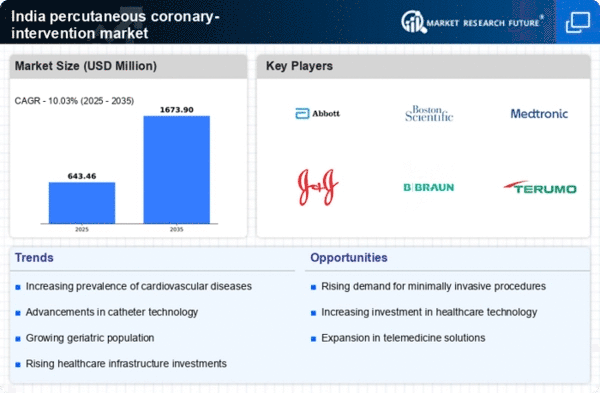
As per Market Research Future analysis, the India Percutaneous Coronary Intervention Market size was estimated at 584.8 USD Million in 2024. The Percutaneous Coronary-intervention market is projected to grow from 643.46 USD Million in 2025 to 1673.9 USD Million by 2035, exhibiting a compound annual growth rate (CAGR) of 10.0% during the forecast period 2025 - 2035

Key Market Trends & Highlights

The India percutaneous coronary-intervention market is poised for growth driven by technological advancements and increasing health awareness.

  • Technological advancements are enhancing the efficacy and safety of percutaneous coronary interventions.
  • The largest segment in the market is the balloon angioplasty segment, while the fastest-growing segment is the drug-eluting stents segment.
  • Rising awareness of cardiovascular health is contributing to an increase in patient consultations and procedures.
  • Key market drivers include the increasing incidence of cardiovascular diseases and advancements in medical technology.

Market Size & Forecast

2024 Market Size 584.8 (USD Million)
2035 Market Size 1673.9 (USD Million)
CAGR (2025 - 2035) 10.03%

Major Players

Abbott Laboratories (US), Boston Scientific Corporation (US), Medtronic plc (IE), Johnson & Johnson (US), B. Braun Melsungen AG (DE), Terumo Corporation (JP), Cardinal Health, Inc. (US), Siemens Healthineers AG (DE)

Our Impact
Enabled $4.3B Revenue Impact for Fortune 500 and Leading Multinationals
Partnering with 2000+ Global Organizations Each Year
30K+ Citations by Top-Tier Firms in the Industry

India Percutaneous Coronary Intervention Market Trends

The India Percutaneous Coronary Intervention Market is currently experiencing notable growth. This growth is driven by an increasing prevalence of cardiovascular diseases in India. This rise in health issues is prompting a greater demand for advanced medical procedures, particularly those that are less invasive. The market appears to be influenced by technological advancements, which enhance the efficacy and safety of interventions. Furthermore, the growing awareness among the population regarding heart health is likely contributing to the rising number of procedures performed. As healthcare infrastructure continues to improve, access to these interventions is expected to expand, potentially leading to a more significant market presence. In addition, the percutaneous coronary-intervention market is witnessing a shift towards personalized medicine. This trend suggests that treatments are becoming more tailored to individual patient needs, which may improve outcomes. The integration of digital health technologies, such as telemedicine and remote monitoring, is emerging as a key factor in this market. These innovations could facilitate better patient management and follow-up care. These innovations could facilitate better patient management and follow-up care, thereby enhancing the overall effectiveness of interventions. As the landscape evolves, stakeholders in the healthcare sector must remain vigilant to adapt to these changes and capitalize on emerging opportunities.

Technological Advancements

The percutaneous coronary-intervention market is benefiting from rapid technological innovations. New devices and techniques are being developed, which enhance the precision and safety of procedures. These advancements may lead to improved patient outcomes and reduced recovery times.

Rising Awareness of Cardiovascular Health

There is a growing awareness among the Indian population regarding cardiovascular health. Educational campaigns and health initiatives are likely contributing to an increase in the number of individuals seeking preventive care and intervention, thereby expanding the market.

Shift Towards Personalized Medicine

The trend towards personalized medicine is becoming more pronounced within the percutaneous coronary-intervention market. Tailoring treatments to individual patient profiles may enhance the effectiveness of interventions and improve overall patient satisfaction.

India Percutaneous Coronary Intervention Market Drivers

Growing Geriatric Population

The increasing geriatric population in India is a crucial driver for the percutaneous coronary-intervention market. As individuals age, the risk of developing cardiovascular diseases escalates, necessitating effective treatment options. By 2030, it is estimated that the elderly population in India will exceed 300 million, creating a substantial demand for healthcare services, including percutaneous coronary interventions. This demographic shift is prompting healthcare providers to enhance their capabilities in managing age-related health issues. Consequently, the percutaneous coronary-intervention market is likely to expand as more elderly patients seek timely interventions to address their cardiovascular conditions. Additionally, the focus on geriatric care is expected to lead to increased investments in healthcare infrastructure, further supporting market growth.

Advancements in Medical Technology

Technological advancements in medical devices and techniques are propelling the percutaneous coronary-intervention market forward. Innovations such as drug-eluting stents, bioresorbable stents, and advanced imaging techniques have improved the efficacy and safety of these procedures. In India, the adoption of these technologies is becoming more widespread, as healthcare providers seek to enhance patient outcomes. The market for coronary stents alone is projected to reach approximately $1.5 billion by 2026, reflecting the growing reliance on advanced interventions. Furthermore, the integration of telemedicine and remote monitoring technologies is likely to facilitate better patient management post-procedure, thereby increasing the attractiveness of percutaneous coronary interventions. This trend suggests a robust future for the market as technology continues to evolve.

Rising Health Insurance Penetration

The increasing penetration of health insurance in India is positively impacting the percutaneous coronary-intervention market. As more individuals gain access to health insurance coverage, the financial burden of medical procedures, including percutaneous coronary interventions, is alleviated. This trend is particularly relevant in urban areas, where health insurance adoption is on the rise. Reports indicate that health insurance coverage in India has grown to approximately 40% of the population, which is likely to increase further. With improved financial accessibility, patients are more inclined to seek necessary interventions for cardiovascular diseases. This shift not only enhances patient outcomes but also stimulates growth in the percutaneous coronary-intervention market, as healthcare providers respond to the rising demand for these essential services.

Government Initiatives and Healthcare Policies

Government initiatives aimed at enhancing healthcare infrastructure and accessibility are significantly influencing the percutaneous coronary-intervention market. The Indian government has launched various schemes to improve healthcare delivery, including the Ayushman Bharat scheme, which aims to provide health insurance to millions of citizens. Such policies are likely to increase the number of patients seeking treatment for cardiovascular diseases, thereby driving demand for percutaneous coronary interventions. Additionally, investments in healthcare facilities and training for medical professionals are expected to improve the quality of care. As a result, the percutaneous coronary-intervention market is poised for growth, with more hospitals equipped to perform these procedures and a larger patient base able to afford them.

Increasing Incidence of Cardiovascular Diseases

The rising incidence of cardiovascular diseases in India is a primary driver for the percutaneous coronary-intervention market. According to recent health reports, cardiovascular diseases account for approximately 28% of all deaths in the country. This alarming statistic highlights the urgent need for effective treatment options, including percutaneous coronary interventions. As the population ages and lifestyle-related health issues become more prevalent, the demand for these minimally invasive procedures is expected to grow. Hospitals and healthcare providers are increasingly adopting advanced technologies to address this growing health crisis, thereby expanding the percutaneous coronary-intervention market. Furthermore, the Indian government's initiatives to improve healthcare access and affordability may further bolster the market, as more patients seek timely interventions to manage their cardiovascular health.


Market Segment Insights

By Product Type: Coronary Stents (Largest) vs. Balloon Catheters (Fastest-Growing)

The India percutaneous coronary-intervention market is characterized by a diverse array of product types, with coronary stents holding the largest share among the various segment values. Followed by balloon catheters which are seeing a rapid rise in adoption. Other notable products include coronary guidewires and guiding catheters, each contributing to significant, although smaller, portions of the overall market share. In recent years, the market has witnessed a surge in the demand for innovative and minimally invasive solutions, which is primarily driving the growth of balloon catheters as they become key tools in coronary interventions. Additionally, advancements in technology and an increase in cardiovascular diseases have propelled the growth of stents, while guiding systems and thrombectomy systems are emerging with robust potential in the evolving market landscape.

Coronary Stents (Dominant) vs. Balloon Catheters (Emerging)

Coronary stents remain the dominant force in the India percutaneous coronary-intervention market due to their essential role in maintaining arterial patency, thereby preventing re-stenosis. This segment benefits from established manufacturing practices and widespread clinical acceptance. In contrast, balloon catheters are emerging as vital tools in treating coronary artery diseases, providing effective options for lesion dilation. The growing trend towards less invasive procedures has bolstered their use, as they offer advantages in terms of recovery time and patient comfort. Both segment values reflect a shift towards precision and efficiency in interventional cardiology, appealing to a broad range of healthcare providers and directly impacting patient outcomes.

By Vascular Access: Radial (Largest) vs. Femoral (Fastest-Growing)

In the India percutaneous coronary-intervention market, the vascular access segment is primarily dominated by the radial approach, which accounts for the largest share due to its numerous clinical advantages and improved patient outcomes. Radial access is preferred by many healthcare professionals as it provides lower complication rates and faster recovery times compared to traditional methods. Conversely, the femoral access method, while historically used more often, is seeing a shift in popularity as it is increasingly recognized for specific clinical scenarios. Growth trends indicate a rising preference for radial access, driven by advancements in technology and a greater focus on patient-centric care. The femoral approach, however, is not far behind, as procedural innovations and training initiatives are enhancing its application in complex cases. As both methods evolve, they contribute to a dynamic competitive landscape characterized by continuous improvement and efficiency gains in vascular access techniques.

Vascular Access: Radial (Dominant) vs. Femoral (Emerging)

The radial access method is widely regarded as the dominant approach within the vascular access segment, particularly in the India percutaneous coronary-intervention market. Its advantages include reduced risk of vascular complications and quicker post-procedural recovery, which resonate well with patients and healthcare providers alike. On the other hand, femoral access, while traditionally favored, is emerging as a viable alternative in specific complex situations due to technological advances and enhanced procedural success rates. As both access techniques undergo refinement through training and innovation, they cater to varying patient needs and procedural requirements. The interplay between these two methodologies is shaping a competitive landscape that focuses on optimizing patient outcomes and procedural efficacy.

By End User: Hospitals & Clinics (Largest) vs. Ambulatory Surgical Centers (Fastest-Growing)

In the India percutaneous coronary-intervention market, Hospitals & Clinics dominate the end-user segment, accounting for a significant market share. This sector benefits from a robust infrastructure, having established networks and access to advanced technology, which enhances patient care and treatment outcomes. In contrast, Ambulatory Surgical Centers represent a rapidly growing sector, appealing to patients due to their focused and efficient care for outpatient procedures. The growth trends in this segment are largely driven by the increasing prevalence of cardiovascular diseases, which necessitate timely interventions. Additionally, the rising awareness among patients regarding treatment options available at Ambulatory Surgical Centers is facilitating this shift. The demand for cost-effective solutions and the convenience of outpatient care further amplify growth, contributing to the evolution of the India percutaneous coronary-intervention market.

Hospitals & Clinics (Dominant) vs. Ambulatory Surgical Centers (Emerging)

Hospitals & Clinics remain the dominant segment in the India percutaneous coronary-intervention market due to their comprehensive care capabilities, well-established facilities, and access to a wide range of medical technologies. These institutions are equipped to handle complex cases and support a multidisciplinary approach to patient care. Conversely, Ambulatory Surgical Centers are emerging as a crucial alternative, offering specialized outpatient services with lower operational costs. This segment attracts patients looking for quicker recovery times and minimal hospital stays. The efficiency and convenience offered by Ambulatory Surgical Centers position them favorably in an increasingly patient-centered healthcare environment.

Get more detailed insights about India Percutaneous Coronary Intervention Market

Key Players and Competitive Insights

The percutaneous coronary-intervention market in India is characterized by a dynamic competitive landscape, driven by increasing cardiovascular disease prevalence and advancements in medical technology. Major players such as Abbott Laboratories (US), Boston Scientific Corporation (US), and Medtronic plc (IE) are at the forefront, each adopting distinct strategies to enhance their market presence. Abbott Laboratories (US) focuses on innovation, particularly in drug-eluting stents, while Boston Scientific Corporation (US) emphasizes strategic partnerships to expand its product offerings. Medtronic plc (IE) is investing heavily in digital health solutions, indicating a shift towards integrated care models. Collectively, these strategies contribute to a competitive environment that is increasingly focused on technological advancement and patient-centric solutions.Key business tactics within this market include localizing manufacturing and optimizing supply chains to reduce costs and improve service delivery. The competitive structure appears moderately fragmented, with several key players holding substantial market shares. This fragmentation allows for a diverse range of products and services, fostering innovation while also creating challenges in terms of market penetration and brand loyalty.

In October Abbott Laboratories (US) announced the launch of its next-generation drug-eluting stent, which incorporates advanced polymer technology aimed at improving patient outcomes. This strategic move is significant as it not only reinforces Abbott's commitment to innovation but also positions the company to capture a larger share of the growing market for minimally invasive cardiac procedures. The introduction of this product is likely to enhance Abbott's competitive edge in a rapidly evolving landscape.

In September Boston Scientific Corporation (US) entered into a partnership with a leading Indian healthcare provider to enhance access to its cardiovascular products across rural areas. This collaboration is crucial as it addresses the accessibility challenges faced by patients in underserved regions, thereby expanding Boston Scientific's market reach and reinforcing its commitment to improving healthcare outcomes in India. Such partnerships may also serve to strengthen brand loyalty among healthcare professionals and patients alike.

In August Medtronic plc (IE) unveiled a new digital platform designed to streamline patient management and enhance data analytics capabilities for healthcare providers. This initiative reflects a broader trend towards digitalization in healthcare, suggesting that Medtronic is positioning itself as a leader in integrating technology with traditional medical practices. The platform's potential to improve patient monitoring and outcomes could significantly influence Medtronic's market positioning in the coming years.

As of November current competitive trends in the percutaneous coronary-intervention market are increasingly defined by digitalization, sustainability, and the integration of artificial intelligence (AI). Strategic alliances are becoming more prevalent, as companies recognize the need to collaborate to enhance innovation and expand their technological capabilities. Looking ahead, competitive differentiation is likely to evolve from traditional price-based competition to a focus on innovation, technology integration, and supply chain reliability. This shift underscores the importance of not only developing cutting-edge products but also ensuring that they are delivered efficiently and effectively to meet the growing demands of the healthcare market.

Key Companies in the India Percutaneous Coronary Intervention Market include

Industry Developments

Recent developments in the India Percutaneous Coronary Intervention Market (PCI) market highlight significant advancements and market dynamics. Terumo Corporation has launched innovative PCI devices aimed at enhancing procedural efficiency and patient outcomes, responding to India's rising cardiovascular disease prevalence.Notably, in October 2023, Johnson Johnson announced a strategic initiative to expand its cardiac care portfolio through collaborations with local hospitals, improving patient access to cutting-edge PCI technologies.

Meanwhile, Boston Scientific and Abbott Laboratories are significantly investing in research and development, contributing to the dynamic nature of the PCI landscape in India. The market has seen a valuation increase driven by these developments, particularly as hospital infrastructure and healthcare expenditure in India have improved.Furthermore, B.Braun Melsungen AG established a partnership with local medical institutions to enhance training and adoption of PCI technologies. Market growth is also fueled by rising disposable income and increased health awareness among the populace.

In a noteworthy event in June 2022, Cook Medical expanded its local manufacturing capabilities in India, signifying confidence in the nation's PCI market potential and serving the growing demand for cardiac interventions.

Future Outlook

India Percutaneous Coronary Intervention Market Future Outlook

The Percutaneous Coronary Intervention Market in India is projected to grow at 10.03% CAGR from 2025 to 2035, driven by technological advancements, increasing prevalence of cardiovascular diseases, and rising healthcare expenditure.

New opportunities lie in:

  • Development of advanced biodegradable stents for improved patient outcomes.
  • Expansion of telehealth services for remote patient monitoring and follow-up.
  • Investment in AI-driven analytics for personalized treatment plans and operational efficiency.

By 2035, the market is expected to achieve substantial growth, reflecting enhanced healthcare capabilities and patient access.

Market Segmentation

India Percutaneous Coronary Intervention Market End User Outlook

  • Hospitals & Clinics
  • Ambulatory Surgical Centers
  • Others

India Percutaneous Coronary Intervention Market Product Type Outlook

  • Coronary Stents
  • Balloon Catheters
  • Coronary Guidewires
  • Guiding Catheters
  • Guiding Sheaths
  • Diagnostic Catheters
  • Crossing Catheters
  • Inflation Device
  • Guidance System
  • Peripheral Thrombectomy System
  • Embolic Protection System
  • Accessories

India Percutaneous Coronary Intervention Market Vascular Access Outlook

  • Radial
  • Femoral

Report Scope

MARKET SIZE 2024 584.8(USD Million)
MARKET SIZE 2025 643.46(USD Million)
MARKET SIZE 2035 1673.9(USD Million)
COMPOUND ANNUAL GROWTH RATE (CAGR) 10.03% (2025 - 2035)
REPORT COVERAGE Revenue Forecast, Competitive Landscape, Growth Factors, and Trends
BASE YEAR 2024
Market Forecast Period 2025 - 2035
Historical Data 2019 - 2024
Market Forecast Units USD Million
Key Companies Profiled Abbott Laboratories (US), Boston Scientific Corporation (US), Medtronic plc (IE), Johnson & Johnson (US), B. Braun Melsungen AG (DE), Terumo Corporation (JP), Cardinal Health, Inc. (US), Siemens Healthineers AG (DE)
Segments Covered Product Type, Vascular Access, End User
Key Market Opportunities Integration of advanced imaging technologies enhances procedural accuracy in the percutaneous coronary-intervention market.
Key Market Dynamics Technological advancements and regulatory changes drive growth in the percutaneous coronary-intervention market in India.
Countries Covered India
Leave a Comment

FAQs

What is the expected market size of the India Percutaneous Coronary Intervention Market in 2024?

The India Percutaneous Coronary Intervention Market is expected to be valued at 731.25 million USD in 2024.

What is the projected market size of the India Percutaneous Coronary Intervention Market by 2035?

By 2035, the market is projected to reach a value of 2906.5 million USD.

What is the expected CAGR for the India Percutaneous Coronary Intervention Market during the forecast period of 2025 to 2035?

The market is expected to grow at a CAGR of 13.366% from 2025 to 2035.

Which product segment holds significant market value within the India Percutaneous Coronary Intervention Market in 2024?

The Coronary Stents segment is expected to hold a significant market value of 300.0 million USD in 2024.

What is the market value for Balloon Catheters in the India Percutaneous Coronary Intervention Market in 2035?

The market value for Balloon Catheters is expected to reach 600.0 million USD by 2035.

Who are the key players in the India Percutaneous Coronary Intervention Market?

Key players in the market include Terumo Corporation, Johnson and Johnson, Device Technologies, and Medtronic among others.

What is the estimated market value for Guiding Catheters in the upcoming years?

The market value for Guiding Catheters is expected to be 120.0 million USD in 2024 and grow to 460.0 million USD by 2035.

What challenges and opportunities exist in the India Percutaneous Coronary Intervention Market?

The market presents opportunities for innovative technologies while facing challenges related to regulatory hurdles and competition.

What factors are driving the growth of the India Percutaneous Coronary Intervention Market?

Key growth drivers include increasing prevalence of cardiovascular diseases and advancements in medical technology.

What is the market value for Guiding Sheaths in 2024 and 2035?

The market value for Guiding Sheaths is projected to be 81.25 million USD in 2024 and reach 366.5 million USD by 2035.

Download Free Sample

Kindly complete the form below to receive a free sample of this Report

Compare Licence

×
Features License Type
Single User Multiuser License Enterprise User
Price $4,950 $5,950 $7,250
Maximum User Access Limit 1 User Upto 10 Users Unrestricted Access Throughout the Organization
Free Customization
Direct Access to Analyst
Deliverable Format
Platform Access
Discount on Next Purchase 10% 15% 15%
Printable Versions