×
Request Free Sample ×

Kindly complete the form below to receive a free sample of this Report

* Please use a valid business email

Leading companies partner with us for data-driven Insights

clients tt-cursor
Hero Background

Germany Percutaneous Coronary Intervention Market

ID: MRFR/HC/43694-HCR
200 Pages
Rahul Gotadki
February 2026

Germany Percutaneous Coronary Intervention Market Research Report By Product Type (Coronary Stents, Ballon Catheters, Coronary Guidewires, Guiding Catheters, Guiding Sheaths, Diagnostic Catheters, Crossing Catheters, Inflation Device, Guidance System, Peripheral Thrombectomy System, Embolic Protection System, Accessories), By Vascular Access (Radial, Femoral) and By End User (Hospitals Clinics, Ambulatory Surgical Centers, Others) - Growth & Industry Forecast 2025 To 2035

Share:
Download PDF ×

We do not share your information with anyone. However, we may send you emails based on your report interest from time to time. You may contact us at any time to opt-out.

Germany Percutaneous Coronary Intervention Market Infographic
Purchase Options

Germany Percutaneous Coronary Intervention Market Summary

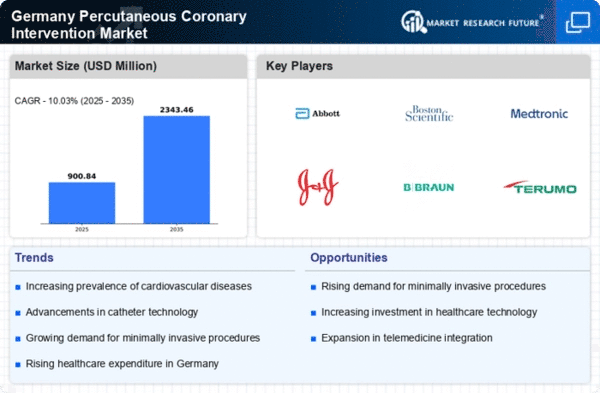
As per Market Research Future analysis, the Germany Percutaneous Coronary Intervention Market size was estimated at 818.72 USD Million in 2024. The Percutaneous Coronary-intervention market is projected to grow from 900.84 USD Million in 2025 to 2343.46 USD Million by 2035, exhibiting a compound annual growth rate (CAGR) of 10.0% during the forecast period 2025 - 2035

Key Market Trends & Highlights

The Germany percutaneous coronary-intervention market is poised for growth driven by technological advancements and increasing healthcare demands.

  • Technological advancements are enhancing the efficacy and safety of percutaneous coronary interventions in Germany.
  • The prevalence of cardiovascular diseases continues to rise, contributing to a growing patient population requiring intervention.
  • Germany is witnessing a significant increase in healthcare expenditure, which supports the expansion of the percutaneous coronary-intervention market.
  • Key market drivers include the rising aging population and advancements in medical technology, which are likely to propel market growth.

Market Size & Forecast

2024 Market Size 818.72 (USD Million)
2035 Market Size 2343.46 (USD Million)
CAGR (2025 - 2035) 10.03%

Major Players

Abbott Laboratories (US), Boston Scientific Corporation (US), Medtronic plc (IE), Johnson & Johnson (US), B. Braun Melsungen AG (DE), Terumo Corporation (JP), Cardinal Health, Inc. (US), Siemens Healthineers AG (DE)

Our Impact
Enabled $4.3B Revenue Impact for Fortune 500 and Leading Multinationals
Partnering with 2000+ Global Organizations Each Year
30K+ Citations by Top-Tier Firms in the Industry

Germany Percutaneous Coronary Intervention Market Trends

The Germany Percutaneous Coronary Intervention Market in Germany is currently experiencing notable advancements. This growth is driven by a combination of technological innovations and an increasing prevalence of cardiovascular diseases. The integration of cutting-edge devices and techniques has enhanced procedural outcomes, leading to improved patient safety and recovery times. Furthermore, the growing awareness of heart health among the population appears to be contributing to a rise in demand for these interventions. As healthcare providers continue to adopt minimally invasive procedures, the market is likely to expand, reflecting a shift towards more efficient treatment options. In addition, regulatory support and funding initiatives from the government may further bolster the percutaneous coronary-intervention market. The emphasis on enhancing healthcare infrastructure and access to advanced medical technologies suggests a favorable environment for growth. Moreover, collaborations between medical device manufacturers and healthcare institutions could facilitate the development of innovative solutions tailored to the needs of patients. Overall, the landscape of the percutaneous coronary-intervention market in Germany seems poised for continued evolution, with a focus on improving patient outcomes and expanding access to care.

Technological Advancements

The percutaneous coronary-intervention market is witnessing rapid technological advancements, particularly in the development of new devices and techniques. Innovations such as drug-eluting stents and bioresorbable scaffolds are enhancing the effectiveness of procedures, leading to better patient outcomes. These advancements are likely to attract more healthcare providers to adopt percutaneous interventions as a preferred treatment option.

Increasing Prevalence of Cardiovascular Diseases

The rising incidence of cardiovascular diseases in Germany is significantly influencing the percutaneous coronary-intervention market. As more individuals are diagnosed with conditions requiring intervention, the demand for these procedures is expected to grow. This trend underscores the importance of timely and effective treatment options to manage heart health.

Regulatory Support and Funding Initiatives

Government initiatives aimed at improving healthcare access and funding for advanced medical technologies are positively impacting the percutaneous coronary-intervention market. Regulatory bodies are likely to streamline approval processes for new devices, facilitating quicker market entry. This support may encourage innovation and enhance the overall quality of care in cardiovascular interventions.

Germany Percutaneous Coronary Intervention Market Drivers

Rising Aging Population

The shift towards an older population in Germany is a crucial driver for the percutaneous coronary-intervention market. As individuals age, the incidence of cardiovascular diseases tends to increase, leading to a higher demand for interventional procedures. In 2025, it is estimated that over 20% of the German population will be aged 65 and above, which correlates with a growing prevalence of conditions requiring percutaneous interventions. This trend suggests that healthcare providers will need to adapt their services to accommodate the needs of this demographic, potentially increasing the market size significantly. Furthermore, the aging population is likely to drive innovations in treatment options, as patients seek less invasive procedures with quicker recovery times. Thus, the rising aging population is expected to play a pivotal role in shaping the future of the percutaneous coronary-intervention market.

Growing Patient Awareness

Patient awareness regarding cardiovascular health is on the rise in Germany, significantly influencing the percutaneous coronary-intervention market. Educational campaigns and public health initiatives have contributed to a better understanding of heart disease risk factors and the importance of early intervention. As patients become more informed, they are more likely to seek medical advice and treatment options, including percutaneous interventions. This trend is likely to increase the number of procedures performed, as individuals recognize the benefits of timely treatment. Furthermore, the emphasis on preventive care may lead to earlier diagnoses, which can enhance the effectiveness of interventions. The growing patient awareness is expected to drive demand for percutaneous coronary interventions, ultimately contributing to market expansion.

Increased Healthcare Expenditure

Germany's commitment to healthcare funding is a significant driver for the percutaneous coronary-intervention market. The country allocates a substantial portion of its GDP to healthcare, with expenditures reaching around 11.7% in 2025. This financial support facilitates access to advanced medical technologies and treatments, including percutaneous interventions. As healthcare budgets expand, hospitals and clinics are more likely to invest in state-of-the-art equipment and training for healthcare professionals, thereby enhancing the quality of care. Additionally, increased funding for cardiovascular health initiatives may lead to greater awareness and screening, resulting in earlier detection and treatment of heart diseases. Consequently, the rise in healthcare expenditure is expected to positively impact the percutaneous coronary-intervention market, fostering an environment conducive to growth and innovation.

Advancements in Medical Technology

Technological innovations are transforming the landscape of the percutaneous coronary-intervention market in Germany. The introduction of advanced imaging techniques, such as intravascular ultrasound and optical coherence tomography, enhances procedural accuracy and patient outcomes. Moreover, the development of new stent designs and drug-eluting technologies has improved the efficacy of interventions, reducing the risk of restenosis. In 2025, the market for coronary stents alone is projected to reach approximately €1.5 billion, reflecting the growing reliance on these technologies. These advancements not only improve patient safety but also expand the range of treatable conditions, thereby increasing the overall demand for percutaneous interventions. As technology continues to evolve, it is likely that the percutaneous coronary-intervention market will experience sustained growth driven by these innovations.

Regulatory Environment and Support

The regulatory framework in Germany plays a vital role in shaping the percutaneous coronary-intervention market. The country's stringent yet supportive regulations ensure that medical devices and procedures meet high safety and efficacy standards. In 2025, the European Union's Medical Device Regulation is expected to further streamline the approval process for innovative technologies, potentially accelerating their entry into the market. Additionally, government initiatives aimed at promoting cardiovascular health and funding for research and development are likely to bolster the market. This supportive regulatory environment encourages manufacturers to invest in new technologies and expand their product offerings, thereby enhancing competition and driving market growth. As a result, the regulatory landscape is a key driver of the percutaneous coronary-intervention market.


Market Segment Insights

By Product Type: Coronary Stents (Largest) vs. Balloon Catheters (Fastest-Growing)

In the Germany percutaneous coronary-intervention market, the product type segment showcases significant diversity, with Coronary Stents holding the largest market share. Other notable values include Balloon Catheters, which are gaining traction rapidly among healthcare providers due to advancements in technology and efficacy. Additional segments such as Guiding Catheters and Diagnostic Catheters contribute to the competitive landscape but lag in terms of overall market share. Growth trends in this segment are largely driven by increasing incidences of coronary artery diseases and advancements in minimally invasive techniques. The shift towards outpatient procedures and the development of innovative devices are also propelling the market forward. The rising preference for faster recovery times and improved patient outcomes fuels the demand for effective intervention products.

Coronary Stents (Dominant) vs. Balloon Catheters (Emerging)

Coronary Stents play a critical role in the Germany percutaneous coronary-intervention market, dominating through their extensive use in treating blocked arteries. They offer durability, ease of deployment, and efficacy in maintaining arterial patency, making them preferred by interventional cardiologists. Meanwhile, Balloon Catheters represent an emerging segment, gaining popularity due to their role in angioplasty procedures and the development of advanced balloon technologies that enhance their functionality. Both segments are integral to the treatment of coronary artery diseases; however, Coronary Stents are more established, while Balloon Catheters show promising growth potential driven by technological innovations.

By Vascular Access: Radial (Largest) vs. Femoral (Fastest-Growing)

In the Germany percutaneous coronary-intervention market, the market share distribution is significantly tilted towards the radial access method, which has established itself as the largest segment due to its favorable outcomes and lower complication rates. The femoral access method, while traditionally prominent, is witnessing a decline in preference as more practitioners adopt the radial approach, which offers enhanced patient comfort and quicker recovery times. The growth trends in this segment are largely driven by advancements in medical technology and increasing awareness among healthcare providers regarding the safety and efficiency of radial access. Additionally, the rising number of percutaneous coronary interventions in Germany is bolstered by an aging population and a surge in cardiovascular diseases, positioning the femoral access as an emerging segment in response to specific clinical needs, particularly in complex cases that require a more robust approach.

Vascular Access: Radial (Dominant) vs. Femoral (Emerging)

The radial access method is recognized as the dominant approach in the Germany percutaneous coronary-intervention market due to its advantageous characteristics such as reduced risk of bleeding and shorter recovery times compared to the femoral method. Radial access has revolutionized procedures, allowing for greater patient satisfaction and has become the preferred choice among many interventional cardiologists. On the other hand, femoral access, although historically the standard, is emerging as a viable option for certain complex cases where access to the coronary arteries needs a more established route. This trend reflects a dual strategy where both methods serve essential roles, with radial access leading in routine procedures and femoral access adapting to specific clinical circumstances.

By End User: Hospitals & Clinics (Largest) vs. Ambulatory Surgical Centers (Fastest-Growing)

The market share distribution among the end user segment reflects a diverse range of preferences within the Germany percutaneous coronary-intervention market. Hospitals and clinics command the largest share, showcasing their central role in delivering cardiology services and interventions. In contrast, ambulatory surgical centers are capturing significant attention, benefiting from the trend towards outpatient care and quicker recovery times, thus gaining a smaller yet substantial foothold in the market. Growth trends within this segment are being driven by an increasing patient population requiring cardiac interventions and a shift towards more cost-effective treatment options. The expansion of ambulatory surgical centers represents a noteworthy change, emphasizing convenience and efficiency in patient care delivery. Factors such as technological advancements in minimally invasive procedures further propel the growth of these centers, making them an attractive alternative to traditional hospital settings.
Hospitals & Clinics (Dominant) vs. Ambulatory Surgical Centers (Emerging)

Hospitals and clinics remain the dominant players in the end user segment, supported by their extensive resources, established infrastructure, and comprehensive care capabilities. These facilities are often preferred for complex procedures and have well-trained medical teams and advanced technologies at their disposal. In contrast, ambulatory surgical centers are emerging as a viable alternative, appealing to patients seeking less invasive procedures with reduced hospital stays. These centers typically have lower overhead costs, which translates into cheaper procedures for patients. Their growth narrative is bolstered by a trend towards outpatient services, with an increasing number of providers investing in these facilities to meet the growing demand for both convenience and quality care.

Get more detailed insights about Germany Percutaneous Coronary Intervention Market

Key Players and Competitive Insights

The percutaneous coronary-intervention market in Germany is characterized by a dynamic competitive landscape, driven by technological advancements and an increasing prevalence of cardiovascular diseases. Key players such as Abbott Laboratories (US), Boston Scientific Corporation (US), and Medtronic plc (IE) are at the forefront, each adopting distinct strategies to enhance their market presence. Abbott Laboratories (US) focuses on innovation, particularly in drug-eluting stents, while Boston Scientific Corporation (US) emphasizes strategic partnerships to expand its product portfolio. Medtronic plc (IE) is actively pursuing regional expansion, particularly in underserved areas, thereby enhancing its competitive positioning.The market structure appears moderately fragmented, with several players vying for market share. Key business tactics include localizing manufacturing to reduce costs and optimize supply chains, which is crucial in maintaining competitive pricing. The collective influence of these major companies shapes the market dynamics, as they continuously adapt to evolving healthcare needs and regulatory environments.

In October Abbott Laboratories (US) announced the launch of a next-generation drug-eluting stent designed to improve patient outcomes in coronary artery disease. This strategic move is significant as it reinforces Abbott's commitment to innovation and positions the company to capture a larger share of the market by addressing the growing demand for advanced treatment options.

In September Boston Scientific Corporation (US) entered into a partnership with a leading telehealth provider to integrate remote monitoring capabilities into its coronary intervention devices. This collaboration is indicative of the company's strategy to leverage digital health technologies, potentially enhancing patient engagement and improving clinical outcomes, which could lead to increased adoption of their products.

In August Medtronic plc (IE) expanded its manufacturing capabilities in Germany, investing €50 million in a new facility dedicated to producing advanced coronary intervention devices. This expansion not only signifies Medtronic's commitment to the German market but also reflects a broader trend of companies localizing production to enhance supply chain reliability and responsiveness to market demands.

As of November current trends in the percutaneous coronary-intervention market include a strong emphasis on digitalization, sustainability, and the integration of artificial intelligence (AI) in device development. Strategic alliances are increasingly shaping the competitive landscape, allowing companies to pool resources and expertise. Looking ahead, competitive differentiation is likely to evolve from traditional price-based competition to a focus on innovation, technological advancements, and the reliability of supply chains, as companies strive to meet the complex needs of healthcare providers and patients.

Key Companies in the Germany Percutaneous Coronary Intervention Market include

Industry Developments

Recent developments in the Germany Percutaneous Coronary Intervention Market (PCI) market have focused on technological advancements and strategic mergers. In September 2023, Abbott Laboratories launched a new stent technology in Germany, enhancing the efficacy of PCI procedures.Meanwhile, in a notable strategic move, Stryker Corporation acquired the cardiovascular device division of a local firm in July 2023, aiming to strengthen its foothold in the European market. Concurrently, Terumo Corporation has ramped up its operations in Germany, focusing on innovative delivery systems for PCI, which are expected to increase procedural efficiency.

Growth rates in this sector have been significant, with an annual increase of approximately 5% due to rising cardiovascular disease prevalence and an aging population. Recent studies from reputable German medical institutions have highlighted the effectiveness of new PCI techniques and devices developed by companies like Philips Healthcare and Boston Scientific.In the last few years, Medtronic saw a surge in market valuation after launching a line of next-generation balloons for PCI procedures in Germany, marking August 2022 as a pivotal month for the industry.

Regulatory support from the German Federal Ministry of Health continues to enhance the market landscape, encouraging innovation and patient accessibility.

Future Outlook

Germany Percutaneous Coronary Intervention Market Future Outlook

The Percutaneous Coronary Intervention Market is projected to grow at a 10.03% CAGR from 2025 to 2035, driven by technological advancements, increasing prevalence of cardiovascular diseases, and rising healthcare expenditure.

New opportunities lie in:

  • Development of advanced biodegradable stents for improved patient outcomes.
  • Integration of AI-driven analytics for personalized treatment plans.
  • Expansion of telehealth services for remote patient monitoring and follow-up.

By 2035, the market is expected to achieve substantial growth, reflecting enhanced treatment options and increased accessibility.

Market Segmentation

Germany Percutaneous Coronary Intervention Market End User Outlook

  • Hospitals & Clinics
  • Ambulatory Surgical Centers
  • Others

Germany Percutaneous Coronary Intervention Market Product Type Outlook

  • Coronary Stents
  • Balloon Catheters
  • Coronary Guidewires
  • Guiding Catheters
  • Guiding Sheaths
  • Diagnostic Catheters
  • Crossing Catheters
  • Inflation Device
  • Guidance System
  • Peripheral Thrombectomy System
  • Embolic Protection System
  • Accessories

Germany Percutaneous Coronary Intervention Market Vascular Access Outlook

  • Radial
  • Femoral

Report Scope

MARKET SIZE 2024 818.72(USD Million)
MARKET SIZE 2025 900.84(USD Million)
MARKET SIZE 2035 2343.46(USD Million)
COMPOUND ANNUAL GROWTH RATE (CAGR) 10.03% (2025 - 2035)
REPORT COVERAGE Revenue Forecast, Competitive Landscape, Growth Factors, and Trends
BASE YEAR 2024
Market Forecast Period 2025 - 2035
Historical Data 2019 - 2024
Market Forecast Units USD Million
Key Companies Profiled Abbott Laboratories (US), Boston Scientific Corporation (US), Medtronic plc (IE), Johnson & Johnson (US), B. Braun Melsungen AG (DE), Terumo Corporation (JP), Cardinal Health, Inc. (US), Siemens Healthineers AG (DE)
Segments Covered Product Type, Vascular Access, End User
Key Market Opportunities Integration of advanced imaging technologies enhances procedural accuracy in the percutaneous coronary-intervention market.
Key Market Dynamics Technological advancements and regulatory changes drive growth in the percutaneous coronary-intervention market.
Countries Covered Germany
Leave a Comment

FAQs

What is the expected market size of the Germany Percutaneous Coronary Intervention Market in 2024?

The expected market size of the Germany Percutaneous Coronary Intervention Market in 2024 is valued at 585.0 million USD.

What will be the projected market size of the Germany Percutaneous Coronary Intervention Market in 2035?

The projected market size of the Germany Percutaneous Coronary Intervention Market in 2035 is estimated to be 1750.0 million USD.

What is the expected CAGR for the Germany Percutaneous Coronary Intervention Market from 2025 to 2035?

The expected CAGR for the Germany Percutaneous Coronary Intervention Market from 2025 to 2035 is 10.474%.

Which product type holds the highest market value in the Germany Percutaneous Coronary Intervention Market in 2024?

In 2024, the product type with the highest market value in the Germany Percutaneous Coronary Intervention Market is Coronary Stents at 200.0 million USD.

What is the market value for Balloon Catheters in the Germany Percutaneous Coronary Intervention Market in 2035?

The market value for Balloon Catheters in the Germany Percutaneous Coronary Intervention Market in 2035 is projected to be 450.0 million USD.

Who are the key players in the Germany Percutaneous Coronary Intervention Market?

Key players in the Germany Percutaneous Coronary Intervention Market include Terumo Corporation, Johnson and Johnson, Philips Healthcare, and Boston Scientific.

What challenges and opportunities are present in the Germany Percutaneous Coronary Intervention Market?

Challenges in the market include regulatory hurdles, while opportunities are driven by innovation and technological advancements in medical devices.

What is the projected market value for Guiding Catheters in the Germany Percutaneous Coronary Intervention Market by 2035?

The projected market value for Guiding Catheters in the Germany Percutaneous Coronary Intervention Market by 2035 is 225.0 million USD.

How does the Germany Percutaneous Coronary Intervention Market growth compare to other regions?

The Germany Percutaneous Coronary Intervention Market is expected to exhibit robust growth, which is competitive when compared to other key regional markets.

What growth drivers are influencing the Germany Percutaneous Coronary Intervention Market?

Growth drivers include the increasing prevalence of coronary artery diseases and advancements in minimally invasive surgical techniques.

Download Free Sample

Kindly complete the form below to receive a free sample of this Report

Compare Licence

×
Features License Type
Single User Multiuser License Enterprise User
Price $4,950 $5,950 $7,250
Maximum User Access Limit 1 User Upto 10 Users Unrestricted Access Throughout the Organization
Free Customization
Direct Access to Analyst
Deliverable Format
Platform Access
Discount on Next Purchase 10% 15% 15%
Printable Versions